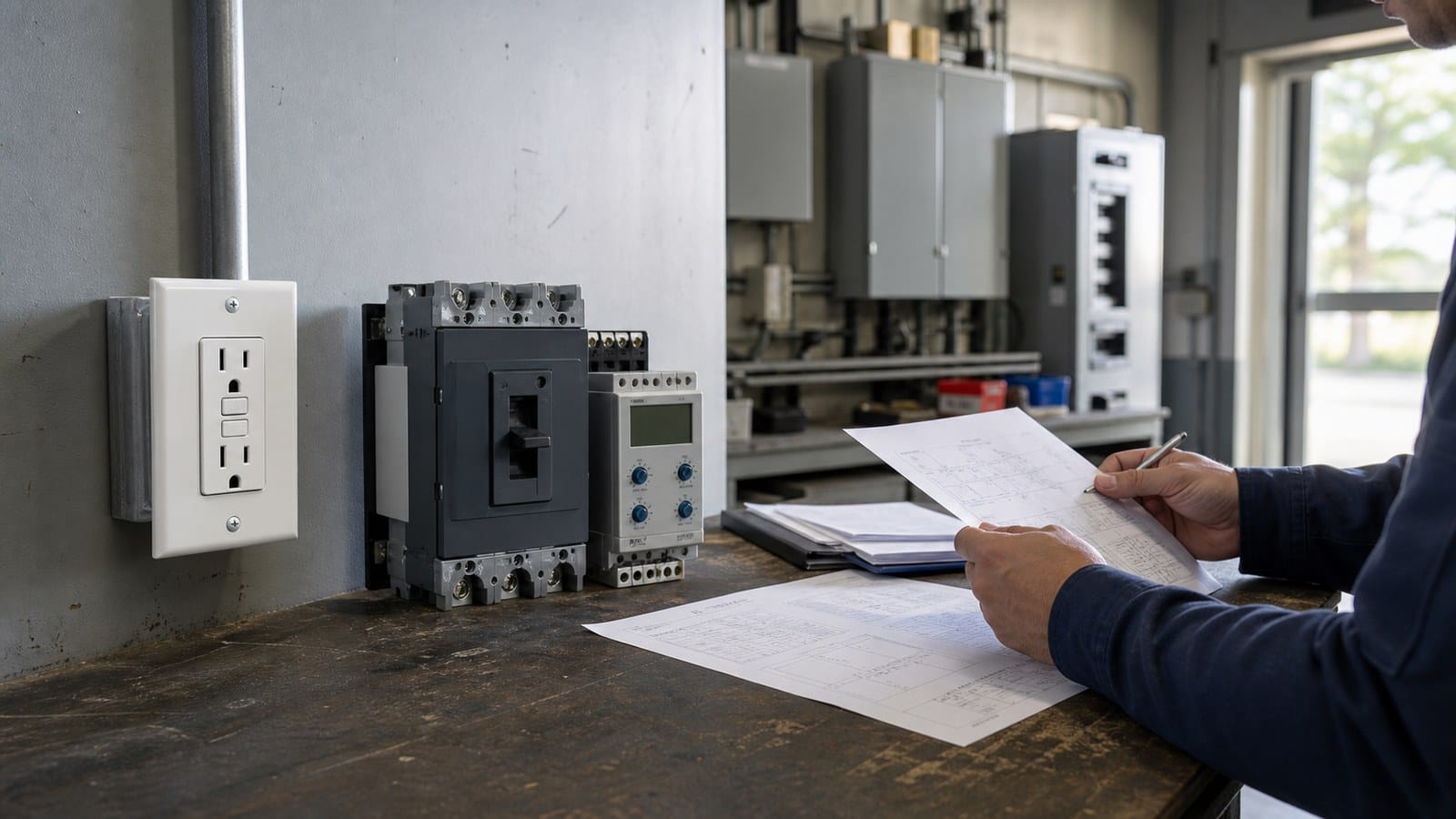
A plug-in garbage disposal connected to a receptacle in a dwelling-unit kitchen generally needs GFCI protection under the 2023 NEC because that edition expanded the kitchen rule to all qualifying receptacles in the location, not only countertop outlets. Under older adopted editions, the answer may depend on sink distance, receptacle location, wiring method, and local amendments. A hardwired disposal requires a separate code review because a receptacle-location rule and an outlet rule are not always the same.
If you are replacing a disposal in an existing house, do not decide from an online yes/no answer alone. Identify the adopted code edition, whether the unit is cord-and-plug connected or hardwired, where the disconnect is located, what else shares the circuit, and whether the work is a simple replacement or part of a permitted kitchen remodel.
The practical safety answer is still straightforward: a food-waste disposer operates under a sink, near plumbing and possible leaks. When GFCI protection is required, do not bypass it because the motor trips. Diagnose the appliance, cord, receptacle, wiring, moisture, and protective device.
Quick answer by installation type
| Installation | Likely GFCI question | What controls the final answer |
|---|---|---|
| Plug-in disposal under a dwelling kitchen sink | The receptacle is in a kitchen; 2023 NEC broadly covers kitchen receptacles | Adopted NEC edition, local amendments, receptacle and circuit ratings |
| Plug-in disposal under an older code | Sink-distance or countertop/location rules may determine coverage | Code edition in force, measured location, renovation scope |
| Hardwired disposal | There may be no receptacle for the kitchen-receptacle rule to cover | Appliance/outlet rules, adopted edition, local amendments, manufacturer instructions |
| Disposal in a commercial kitchen | Non-dwelling kitchen rules can be broader and use different limits | Occupancy, voltage, phase, current, exact equipment connection |
| Existing disposal replacement | Existing-work treatment varies by jurisdiction | Permit scope, local enforcement policy, new circuit work |
The NFPA’s code-development material records that the 2023 NEC expanded dwelling-unit kitchen coverage to all qualifying receptacles. That is the reason older advice focused on the six-foot sink rule or countertop outlets can be incomplete for a current design.
What changed in the 2023 NEC kitchen rule
Earlier NEC editions commonly led installers to ask whether a receptacle served a countertop or sat within the specified distance of a sink. Those questions still matter in some adopted codes and other locations, but the 2023 dwelling-unit kitchen language is broader: the kitchen itself is a listed GFCI location for qualifying receptacles.
For a typical cord-connected disposal, the under-sink receptacle is still in the kitchen even though it is behind a cabinet door and does not serve the countertop. A dedicated circuit does not automatically create an exemption.
This does not mean every city adopted the 2023 NEC on the day it was published. States and municipalities adopt model codes on different schedules and may amend them. An installation can therefore be legal under one jurisdiction’s current code and require an upgrade in another.
Use this three-step check:
- Find the electrical-code edition adopted at the project address.
- Read the local amendments and permit requirements.
- Confirm the interpretation with the AHJ or project electrician before buying or wiring the device.
Faith’s kitchen GFCI selection guide provides a broader room-level overview.
Plug-in versus hardwired disposals
The connection method matters because electrical codes distinguish a receptacle from an outlet. A receptacle is the contact device that accepts a plug. An outlet is the point on the wiring system where current is taken to supply equipment, including some hardwired connections.
Cord-and-plug connected disposal
A typical plug-in unit uses a grounded flexible cord and a receptacle inside the sink-base cabinet. The receptacle may be controlled by a wall switch, an air switch, or another listed switching method. Under the 2023 dwelling kitchen rule, that kitchen receptacle is generally within the GFCI location requirement when it meets the rule’s voltage and circuit limits.
Use only the cord set and connection method permitted by the disposal instructions. For example, Whirlpool describes a 120-volt, 13-amp, three-wire grounded garbage-disposal power cord and tells users to disconnect power before installation work. The exact disposer manual remains the controlling product instruction.
Hardwired disposal
A hardwired unit does not use a receptacle. The 2023 kitchen-receptacle expansion therefore cannot be quoted by itself to prove the hardwired outlet’s treatment. Review the appliance rules, the kitchen-location rules that apply to outlets, disconnect requirements, manufacturer instructions, and local amendments.
Some jurisdictions or project specifications require GFCI protection beyond the minimum model-code language. Others may treat a like-for-like existing replacement differently from a new branch circuit. Document the decision instead of assuming that “hardwired” means “exempt.”
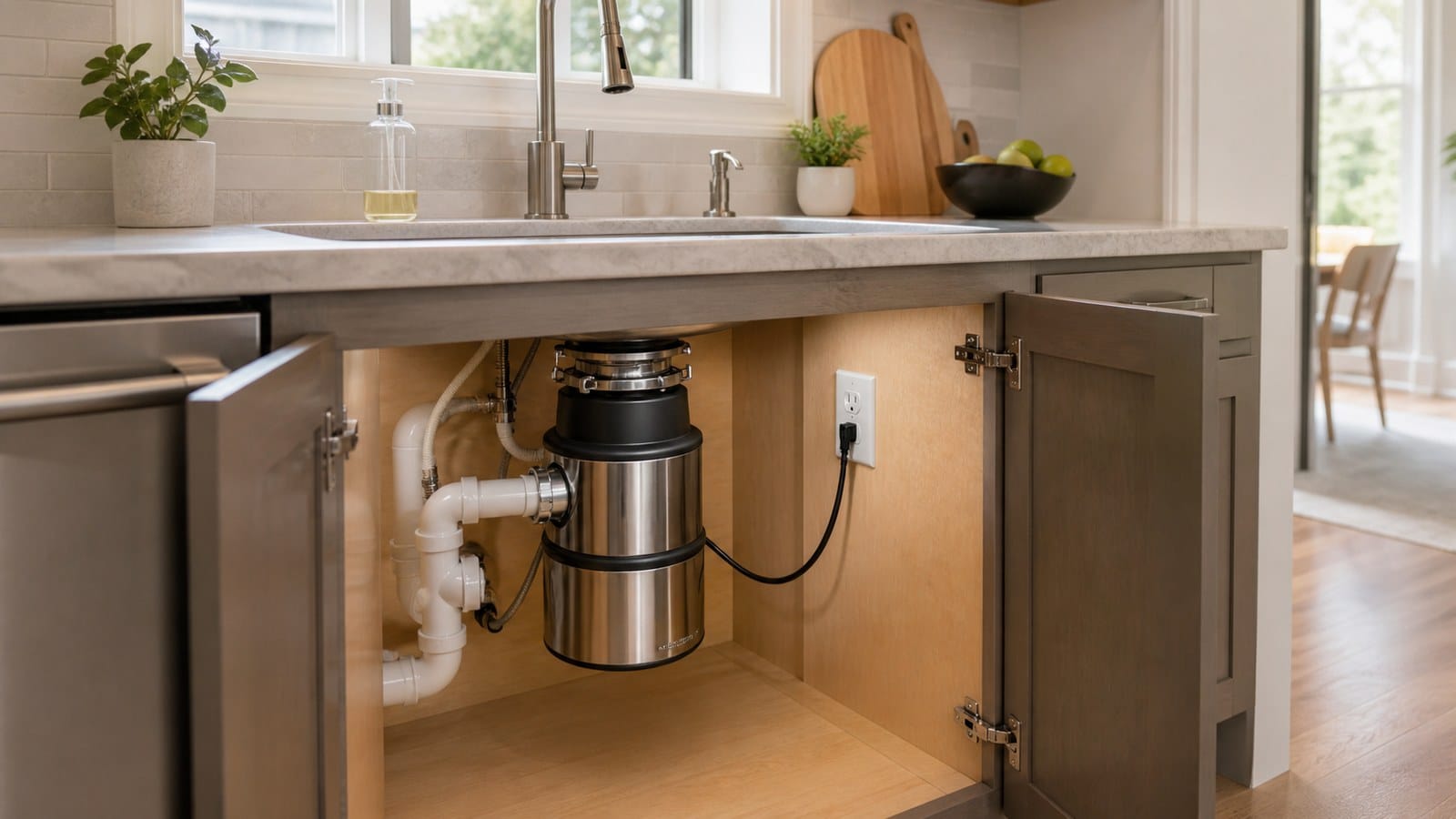
Where should the GFCI device be located?
The protective function can be provided by a GFCI receptacle, a GFCI circuit breaker, or another listed arrangement permitted for the circuit. The best choice depends on access, protection scope, cabinet conditions, and maintenance.
GFCI receptacle in the sink cabinet
Advantages:
- the device is near the disposal;
- a tripped condition is easier to connect to the appliance;
- testing does not require a trip to the panel; and
- the receptacle can protect downstream outlets when designed and labeled correctly.
Limitations:
- the device must remain readily accessible after plumbing, bins, filters, and cabinet organizers are installed;
- a leak can wet the device or enclosure;
- a large plug or cover can block TEST/RESET buttons; and
- cramped wiring can increase installation errors.
GFCI circuit breaker
Advantages:
- the protective device stays out of the damp sink cabinet;
- it can protect a hardwired load or the complete branch circuit; and
- combination AFCI/GFCI protection may be available in one listed breaker for compatible panels.
Limitations:
- the trip and reset point is remote;
- occupants may not know which breaker controls the disposal;
- shared loads can make diagnosis harder; and
- the exact breaker must be listed for the panel.
Faith’s GFCI receptacle vs. GFCI breaker guide explains these tradeoffs in more detail.
Does the disposal need a dedicated circuit?
Do not infer circuit requirements from motor horsepower alone. Follow the disposal nameplate, installation instructions, adopted code, and local practice. Some kitchens use a dedicated branch circuit; others may have a permitted arrangement that shares a circuit with a dishwasher or another load.
Before changing the circuit, record:
- disposal voltage, full-load current, and manufacturer circuit instructions;
- branch-circuit ampere rating and conductor size;
- every other load on the circuit;
- whether a split or multiwire branch circuit is present;
- AFCI and GFCI requirements under the adopted edition; and
- the switch, disconnect, and receptacle ratings.
A 20-amp circuit does not justify installing a 20-amp receptacle configuration automatically. Receptacle ratings and permitted configurations must match the branch circuit and listing rules.
Why a garbage disposal trips a GFCI
A GFCI does not trip because the motor simply uses “too many amps.” Overload and short-circuit protection are primarily breaker functions. A GFCI responds to current imbalance: some current is returning by a path other than the intended neutral.
Common disposal-related causes include:
| Symptom or condition | Possible cause | Safe next step |
|---|---|---|
| Trips immediately when switched on | Cord damage, internal insulation fault, neutral-ground contact, wiring error | Stop using the unit and have the appliance/circuit tested |
| Trips after a leak or cabinet cleaning | Moisture at receptacle, plug, switch, cord, or disposer wiring compartment | De-energize, stop the water source, and allow qualified inspection |
| Hums, stalls, then trips breaker or GFCI | Mechanical jam may be stressing the motor; electrical leakage may also exist | Disconnect power and follow the manufacturer’s jam-clearing instructions |
| Trips only with dishwasher running | Shared circuit, cumulative leakage, mispaired neutral, or appliance fault | Map the circuit and test each appliance separately |
| GFCI will not reset with disposal unplugged | No line power, reversed LINE/LOAD, open neutral, downstream fault, or failed GFCI | Diagnose the receptacle and circuit; do not force RESET |
| Old GFCI trips unpredictably | Device degradation is possible, but a real fault must be ruled out | Test both device and load before replacement |
Whirlpool’s jam-clearing guidance tells users to disconnect power and never put a hand inside the disposer chamber. A mechanical jam and a ground fault are different problems, but a stalled motor can be the event that exposes an existing insulation or moisture problem.
Safe troubleshooting sequence
If the GFCI trips, do not hold RESET while operating the wall switch. Work through the fault in a controlled order.
- Turn the disposal switch off. Keep hands and tools out of the chamber.
- Disconnect power. Unplug the unit if the plug is safely accessible, or switch off the correct breaker.
- Check for water. Look for active plumbing leaks, wet cords, damp receptacle covers, or water tracks. Do not energize wet equipment.
- Inspect the cord and plug. Look for cuts, crushed insulation, heat discoloration, loose blades, or damaged strain relief.
- Clear a verified mechanical jam only by the manufacturer’s method. Use the specified wrench or tools; never reach into the chamber.
- Test the GFCI with the disposal disconnected. Use the device’s TEST and RESET controls. If it will not reset, the problem may be upstream, downstream, or inside the GFCI.
- Reconnect only after the circuit and appliance are dry and visibly sound. If the GFCI trips again, stop.
- Call a qualified person. Appliance leakage, neutral-ground contact, hidden moisture, and circuit wiring require suitable instruments and safe access.
For general device diagnosis, use Faith’s GFCI won’t reset guide and GFCI keeps tripping guide.

What not to do
- Do not replace the GFCI with an ordinary receptacle to stop trips.
- Do not connect neutral and ground together downstream of the service equipment.
- Do not use a three-to-two-prong adapter or remove the cord’s grounding pin.
- Do not keep resetting a wet device.
- Do not assume a new disposal is fault-free.
- Do not replace a 15A device with a 20A configuration without checking the circuit.
- Do not bury the reset point behind permanent plumbing or fixed cabinet equipment.
- Do not perform live measurements inside a wet sink cabinet unless you are qualified and equipped to do so.
The CPSC GFCI fact sheet explains that GFCIs are intended to reduce severe or fatal shock risk. Removing required protection trades an inconvenience for a potentially serious hazard.
How to specify an under-sink GFCI receptacle
For a builder, distributor, OEM buyer, or private-label program, define the device beyond color and amperage.
Electrical and listing information
- voltage and receptacle configuration;
- feed-through rating and terminal range;
- listed Class A GFCI certification for the exact model;
- self-test or auto-monitoring behavior and end-of-life response;
- LINE and LOAD terminal identification;
- applicable tamper-resistant requirement;
- compatible wire type and torque instructions; and
- indicator-light meaning in the approved instructions.
Cabinet application details
- accessible mounting position;
- protection from plumbing leaks and cleaning water;
- box depth and conductor fill;
- plug clearance with the cabinet door closed;
- labels identifying the disposal circuit; and
- coordination with the switch, dishwasher, leak sensor, and water filter.
Faith Electric has manufactured wiring devices since 1996. Importers and private-label buyers should verify the exact listing relationship, models, markings, artwork, and change-control process. Use Faith’s private-label GFCI checklist before approving a branded sample.
Inspection checklist after installation
- The GFCI device and disposal plug remain accessible.
- The receptacle box is secure and not directly below a likely leak point.
- The cord has strain relief and does not touch sharp plumbing hardware.
- TEST opens the circuit and RESET restores it.
- The wall or air switch controls the intended appliance.
- The circuit directory identifies the disposal accurately.
- Any downstream protection is documented and labeled.
- No neutral-to-ground connection was added downstream.
- The installer recorded the adopted code edition and permit inspection.
- The owner received the disposal and GFCI test instructions.
FAQ
Does a garbage disposal need GFCI under the 2023 NEC?
A cord-connected disposal receptacle in a dwelling-unit kitchen is generally covered because the 2023 NEC expanded the kitchen location to all qualifying receptacles. Local adoption and amendments still control.
Does the six-foot sink rule decide the answer?
Not by itself under the 2023 dwelling kitchen rule. It can still matter under older adopted editions or in locations governed by a separate sink-proximity rule.
Does a hardwired garbage disposal need GFCI?
Possibly, but the receptacle rule alone does not answer it because a hardwired connection is not a receptacle. Review the adopted appliance/outlet rules, local amendments, and manufacturer instructions.
Can a garbage disposal share a GFCI with a dishwasher?
Only when the branch-circuit design, load, conductors, protective devices, and appliance instructions permit it. Shared circuits can complicate troubleshooting and may be restricted locally.
Why does the disposal trip the GFCI but not the breaker?
The devices respond to different conditions. A small leakage current can trip a GFCI while remaining far below the breaker’s overcurrent threshold.
Can a GFCI breaker protect the disposal instead of a GFCI receptacle?
Yes in many designs, provided the breaker is listed for the panel and the complete installation meets code, access, circuit, and manufacturer requirements.
Should I replace the GFCI if it is the only thing that trips?
Not automatically. Disconnect the disposal and test the device and circuit. Replacing the GFCI without checking the load can leave the real leakage fault in service.
Final answer
For a typical plug-in garbage disposal in a dwelling kitchen, plan on GFCI protection under the 2023 NEC and verify what your jurisdiction has adopted. For an older-code installation or a hardwired disposal, document the exact connection and applicable local rule instead of relying on a blanket exemption.
If the disposal trips a GFCI, keep the protection in place. Disconnect the load, check for leaks and visible cord damage, clear mechanical jams only by the manufacturer’s procedure, and have repeated trips diagnosed. A correctly selected and accessible GFCI is part of the kitchen circuit design—not an optional accessory to remove when a motor develops a problem.
This article provides general U.S. electrical product and code-planning information. It is not a substitute for the locally adopted NEC, local amendments, appliance instructions, permits, or inspection by the authority having jurisdiction. Electrical work and fault testing should be performed by qualified persons.