
A customer reports that a GFCI will not reset. If the importer can identify only the catalog number, the investigation may begin with every unit of that model in stock. If the unit, carton and shipment point to a controlled production lot, the team can ask a much narrower question: which materials, line, date, tests, rework records and customers are connected to that lot?
That is the value of batch traceability. It does not prove that a product is safe or certified, and it does not prevent defects by itself. It creates a reliable path from a market unit back to manufacturing records—and from an affected production lot forward to inventory and customers.
How this draft was prepared: AI-assisted research was used to organize the official GS1, UL Solutions, OSHA and ISO materials cited below. This draft does not claim access to a Faith Electric factory, customer order, production batch, certification file, or quality record. A verified author or technical reviewer must be assigned before publication.

Illustrative editorial image. It does not depict a real Faith Electric production line, shipment, certificate, or customer project.
Model, batch and serial identification are different
The first design decision is the level of identification needed.
| Identification level | What it distinguishes | Typical use |
|---|---|---|
| Product class or model | All units of a defined product configuration | Catalog, ordering, certification and product-family reporting |
| Batch or lot | A group produced or handled under defined conditions | Production release, test records, containment and complaint investigation |
| Serial number | One individual unit | Unit-level service, warranty or high-resolution investigation |
GS1’s Global Traceability Standard makes the same basic distinction: a trade item identifier can define the product class; combining it with a batch or lot identifies a production group; adding serialized identification distinguishes an individual instance. Not every GFCI program needs unit-level serialization, but every importer should decide deliberately what resolution is required for the product, channel, warranty and risk.
A useful lot is more than a string printed on a box. It must connect to records. If code L2407A appears on a unit but no one can explain the date, line, shift, bill of materials, tests or shipment mapping behind it, the code adds little investigative value.
Define the traceability chain before the first order
For an imported or private-label GFCI, traceability should connect six stages:
- approved product configuration;
- incoming materials and critical components;
- assembly conditions and production lot;
- inspection, testing, nonconformance and release;
- unit pack, master carton, pallet and shipment;
- receiving, inventory, customer distribution, complaint and corrective action.
The chain does not need one giant database. It can use controlled ERP records, manufacturing records, inspection reports and shipping files, provided that the identifiers link reliably and authorized users can retrieve them within an agreed response time.
Make the requirement part of the request for quotation and quality agreement. Retrofitting traceability after a complaint usually produces incomplete spreadsheets, photographs of cartons and assumptions about which production run was shipped.
The minimum record set buyers should request
The exact records depend on the product, certification program, customer contract and applicable law. The following set is a practical starting point for supplier qualification and purchase-order terms.
| Record group | Minimum information to connect | Buyer verification question |
|---|---|---|
| Approved configuration | Manufacturer model, buyer SKU, revision, ratings, color, TR/WR or other attributes | Does the lot match the approved specification, sample and artwork? |
| Certification identity | Certification body, file/listing identity, covered model and approved marking | Can the shipped identity be matched to a current certification record? |
| Bill of materials and changes | Controlled BOM revision, approved deviations and effective lot | Which configuration was actually built, and were changes authorized? |
| Critical incoming materials | Supplier identity, internal material code, supplier lot and receiving status | Which finished lots used the affected component lot? |
| Production history | Site, line, date/time window, shift or work order and quantity | Where and when was the batch produced? |
| Test and inspection records | Test plan revision, equipment ID, result summary, sample size where applicable and release decision | What was checked, with which controlled method, and who released the lot? |
| Measurement equipment | Equipment identity and calibration/verification status | Was the equipment within its required status when the lot was tested? |
| Nonconformance and rework | Defect, segregated quantity, disposition, rework instruction and retest | Were rejected units controlled and retested before release? |
| Packaging and labels | Unit/carton artwork revision, lot-code rule, carton quantity and packing date | Can the market package be tied to the correct product lot? |
| Shipment mapping | Purchase order, invoice, carton/pallet identifiers, quantity, ship date and destination | Which inventory locations or customers received the lot? |
| Complaint and corrective action | Returned-unit identity, symptoms, containment, investigation and closure | Can a complaint be linked back and a confirmed scope be traced forward? |
Do not ask only for a “QC report.” That phrase can mean a one-page pass stamp, a laboratory report for a different model, a pre-shipment sample check, or complete lot records. Name the record, required fields, identifier links, format, language, retention owner and retrieval time.
Build a lot code that survives handling
A lot code should be unique within the agreed retention period and remain readable through distribution. The coding rule may incorporate a production date, line, shift or sequence, but buyers do not need to expose every internal detail on the consumer-facing package. The supplier can maintain a controlled decoding table.
At minimum, decide where the lot appears:
- device or durable unit marking, where the design and certification controls permit it;
- individual retail or contractor-pack label;
- master carton;
- pallet or logistics label;
- packing list, inspection report and electronic shipment record.
The identifiers at different packaging levels do not need to be identical, but the relationship must be recorded. One master carton may contain one lot, or mixed lots may be permitted under controlled rules. If mixed lots are allowed, the carton-level record must show which quantities belong to each lot.
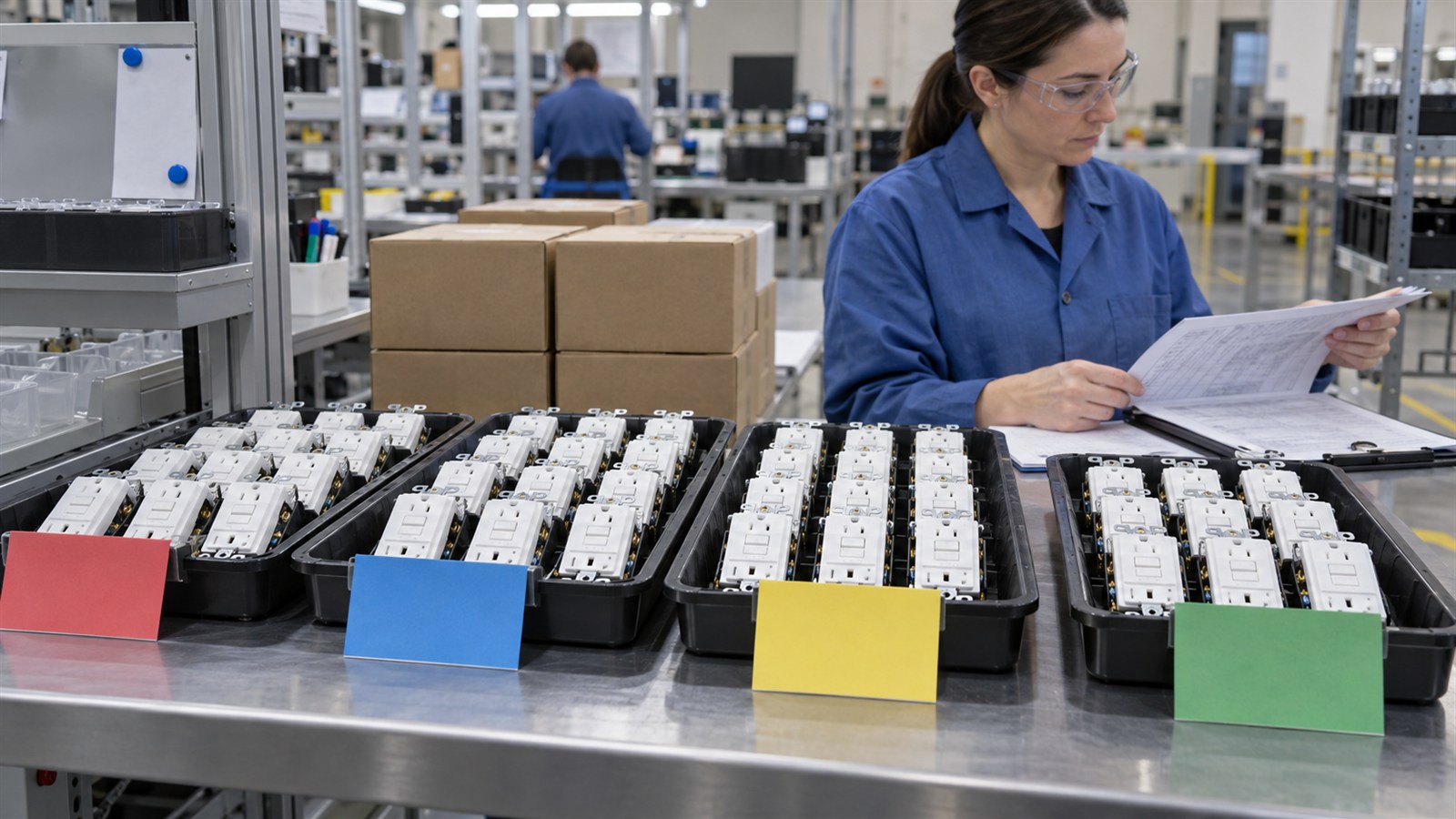
Lot segregation should be visible in the records and material flow; this scene is illustrative, not evidence of a specific factory process.
Avoid putting a lot code only on disposable outer packaging if complaints are likely to arrive as loose devices. Also avoid a printed code that rubs off during ordinary handling. Marking method and location should be reviewed with the product’s certification and artwork controls before use.
Connect traceability to certification without confusing the two
Traceability supports certification control, but it is not a certification mark or laboratory listing.
UL Solutions describes Follow-Up Services as ongoing onsite inspections intended to verify that current production of certified products remains consistent with the construction originally evaluated. The certification body controls that program. A buyer’s lot records, incoming checks and shipment-release documents are separate commercial and quality controls.
Use both layers correctly:
- verify the exact model and certification identity in the current database;
- confirm that markings and permitted construction match the controlled approval;
- maintain lot records that show what was manufactured and shipped;
- do not describe an internal QC report as an NRTL certificate;
- do not assume an ISO 9001 quality-management certificate means every individual product is certified or defect-free.
ISO 9001 provides a quality-management framework, while product certification addresses the defined product and certification scheme. Supplier qualification should recognize both without treating them as substitutes.
Link components to finished-goods lots
The most useful backward trace asks: “Which component lots went into this finished lot?” The most useful forward trace asks: “Which finished lots used this component lot, and where did they ship?”
Not every screw or package insert needs the same control. Work with engineering, quality and the supplier to identify materials and components where a change or defect could affect protection, electrical connection, mechanical performance, markings or market compliance.
The record should include:
- the approved internal material code and revision;
- the actual component supplier or approved source identity;
- supplier batch or internal receiving lot;
- incoming acceptance status;
- quantity issued and returned;
- production work orders that consumed the lot;
- authorized substitution or deviation records.
If a component is supplied from more than one approved source, the finished-goods record should not erase that distinction. Otherwise, a supplier-level component issue may force unnecessary containment of every unit.
Make test records searchable by lot
A pass/fail stamp is difficult to investigate. Lot-linked records should identify the controlled test or inspection plan, result summary, equipment, operator or authorized release, date, sample size where sampling is permitted, and any retest after rework.
Separate three concepts:
- checks applied to every unit;
- sampling inspections applied to a defined lot;
- qualification or type testing performed on representative designs.
They answer different questions. A historic type-test report does not show that the current shipment passed production controls. A pre-shipment sampling report does not prove every unit received a particular test. Buyers should ask the supplier to state the frequency and acceptance rule rather than infer it from a list of test names.
For GFCI functional behavior, the production record should use controlled criteria tied to the applicable model and process. Do not publish proprietary limits, certification test details or universal pass criteria unless they are verified and authorized for release.
Use GS1 identifiers where the channel benefits
GS1 standards can connect a product identifier with batch/lot, serial and logistics information in barcodes and electronic records. This can reduce manual entry between supplier, importer, warehouse and customer.
The business should decide:
- which trade item identifier represents the sellable configuration;
- whether a batch/lot must be encoded in a barcode;
- whether unit serialization adds enough value;
- how carton and pallet identifiers connect to contained trade items;
- which data must also remain human-readable;
- whether retail, marketplace or trading partners impose label rules.

Barcode scanning can reduce transcription errors, but the underlying identifier and record links still need to be validated.
Do not claim that GS1 coding is universally mandatory for GFCIs. It is a standards-based option that may be required by a trading partner or selected for operational control. The label design must also respect certification-mark controls and customer artwork approvals.
Verify traceability during receiving inspection
Receiving inspection should test the record chain, not only count cartons.
Select cartons from different pallet positions and confirm:
- purchase order and buyer SKU;
- manufacturer model and rating;
- unit, pack and carton lot identifiers;
- consistency between physical codes and shipment records;
- packaging and instruction revisions;
- certification mark and model identity against the approved artwork;
- quantities by lot;
- damage, moisture or relabeling;
- availability of the promised lot-release records.
Record exceptions before stock is mixed across warehouses or customer orders. If the received lot code does not appear on the supplier’s inspection report, ask for a written reconciliation and hold release until the scope is clear.
The product specification itself should also be controlled. The companion draft, How to Read a GFCI Specification Sheet, explains how to match ratings, terminals, features, certification records and samples before ordering. Add its internal link only after that companion page is published and the final permalink has been verified.
Run a mock trace before a real complaint
A traceability system can look complete on paper and still fail when the records are requested. During supplier qualification and periodically afterward, choose one finished lot and run both directions.
Backward trace: From one device or carton, retrieve the approved product revision, component lots, production work order, test results, nonconformances, rework and release.
Forward trace: From one component or finished-goods lot, identify remaining factory stock, goods in transit, importer warehouses, distributor inventory and customer shipments.
Measure completeness and response time. Note any point where staff rely on memory, an uncontrolled translation, a renamed spreadsheet or a person who is unavailable. Correct those gaps before volume grows.
Use traceability to scope complaints and corrective actions
When a complaint arrives, preserve the available identity before the unit is discarded or separated from its packaging. Request photographs of front and rear markings, lot code, box label, installation context and observed behavior. Follow safe de-energization and qualified-service procedures; do not tell an unqualified user to open or modify the device.
The investigation should separate:
- reported symptom;
- verified failure mode;
- installation or application factors;
- product configuration and lot;
- related production or material exceptions;
- other complaints from the same or adjacent lots;
- containment decision;
- root-cause evidence;
- corrective and preventive actions;
- effectiveness check.
Traceability narrows the search, but a convenient lot boundary should not override evidence. If the same issue crosses lots, suppliers or revisions, expand the scope. If only one returned unit is available, describe the conclusion with appropriate uncertainty.
Control changes as part of traceability
A trace record should show which revision was effective for each lot. Require prior notification and approval for changes that can affect the controlled product, including components, materials, tooling, terminal design, housing, PCB, firmware if applicable, factory site, production line, test method, markings, instructions or packaging.
The change record should identify:
- reason for change;
- old and new revisions;
- risk and validation review;
- certification-body action where required;
- affected first production lot;
- old-material disposition;
- updated artwork or instructions;
- buyer approval before shipment.
Without an effective-lot field, the buyer may know that a change occurred but not which inventory contains it.
Set a retention and retrieval agreement
There is no responsible one-size-fits-all retention period for every GFCI program. Contract terms, certification requirements, applicable law, warranty exposure, customer policies and product life all matter.
Define:
- which party owns each record;
- format and language;
- access permissions and confidentiality;
- required retention period;
- backup and migration controls;
- response time for routine and urgent requests;
- what happens if the supplier, importer or system changes;
- how records are preserved during a complaint, stop-ship, recall review or dispute.
Do not accept a retention promise that is shorter than the commercial or regulatory need simply because the supplier’s current software defaults to a shorter archive.
Put these requirements into the RFQ
Send the supplier a traceability appendix that asks for:
- a sample finished-goods lot code and decoding rule;
- photographs showing code locations on unit, pack and carton;
- a redacted example of the lot traveler or production record;
- component-to-finished-lot linkage for agreed critical items;
- test, inspection, nonconformance, rework and release fields;
- carton/pallet-to-lot and shipment mapping;
- change-notification and effective-lot control;
- record-retention and retrieval commitments;
- a mock backward and forward trace;
- named contacts for urgent containment.
Combine that appendix with the broader 12-point GFCI manufacturer vetting checklist and the private-label GFCI approval checklist. The supplier audit asks whether the system exists; the traceability appendix defines what the buyer expects for the ordered product.
Frequently asked questions
Does every GFCI need a unique serial number?
Not necessarily. Batch or lot identification may provide adequate resolution for many distribution programs. Decide from risk, channel, service model, contract and applicable requirements rather than assuming serialization is always required.
Is a date code the same as a lot code?
Only if it connects unambiguously to the controlled production and shipment records. A date alone may include several lines, shifts, component lots or product revisions.
Is a pre-shipment inspection report enough for traceability?
No. It can be one linked record, but full traceability also needs the product revision, production lot, applicable materials, test and release history, packaging identifiers and shipment destinations.
Does ISO 9001 certification prove the batch is compliant?
No. ISO 9001 addresses a quality-management system. The exact product, certification scope, production records and shipment still need product-specific verification.
What if the supplier will not share confidential production records?
Agree on redacted examples, required data fields, audit access, urgent-response rules and a formal statement of linkage. Commercial confidentiality can shape access, but it should not leave the importer unable to identify affected inventory.
Request a traceable quotation
Before ordering, define the model, certification identity, approved revisions, lot resolution, record set, code locations, retrieval time and change-control rules. Ask the supplier to demonstrate one backward and one forward trace using redacted records.
Contact Faith Electric to discuss GFCI specifications, sample approval and batch-record requirements for an OEM or distribution inquiry. Buyers should verify the final certification, quality and traceability arrangements for their own market and contract.
Sources
- GS1 — Global Traceability Standard
- GS1 — Barcodes
- UL Solutions — Product Sourcing and Certifications Database (Product iQ)
- UL Solutions — Follow-Up Services
- UL Solutions — Marking and Labeling Systems FAQs
- OSHA — Nationally Recognized Testing Laboratory Program FAQs
- ISO — ISO 9001 Quality Management Systems
Procurement and quality note: This article provides a general record-control framework. It is not a certification decision, recall plan, legal opinion or substitute for applicable regulations, contracts, certification requirements and qualified quality or engineering review.