
By Faith — Technical review pending.
A GFCI shipment arrives with the right carton count and no obvious transport damage. The warehouse wants to put it away; sales already has orders waiting. Before stock becomes available, someone needs to establish that the received product matches the approved purchase.
GFCI incoming inspection should verify shipment identity, product and document consistency, physical condition and the agreed inspection results. Where functional evaluation is required, it belongs in a controlled setup operated by qualified personnel. A receiving checklist cannot replace product certification or demonstrate that every unit is defect-free.
This guide is for importers and electrical distributors receiving finished GFCI receptacles. It covers the release decision at the buyer’s warehouse, rather than an installation inspection or the manufacturer’s component inspection process.

AI-generated editorial illustration of a generic receiving check. It is not evidence of a Faith Electric shipment, employee or inspection.
Set the inspection basis before the shipment arrives
Receiving cannot decide whether a difference is acceptable if the order says only “white GFCI outlet.” Give the inspection team a controlled reference package that identifies the exact model and approved version.
Include the purchase order, model mapping, specification and drawing revisions, approved sample reference, installation instructions, label artwork, packing requirements and agreed inspection plan. Add the applicable certification reference and any approved change notice affecting the shipment.
Separate three questions in the plan. Did the buyer receive the ordered SKU? Does the sampled product meet the defined inspection criteria? Is the evidence sufficient for the designated approver to release the lot? An invoice match answers only part of the first question.
Identify who owns each check. Warehouse staff may record quantities and transit condition, while quality or technical staff review product discrepancies. Give one role authority to record the final release; the person rushing to fill an order should not have to improvise that authority.
Keep unverified stock unavailable for allocation
Assign a receiving reference and retain the shipment’s lot identities before cartons are mixed with existing inventory. Use both physical identification and an inventory-system status to prevent accidental picking while inspection is open.
Document carton counts, pallet condition, visible damage, seals where applicable and transport exceptions. Photograph a discrepancy before unpacking destroys the evidence. A damaged carton does not automatically establish that every device inside failed, but the condition needs assessment under the agreed criteria.
If one delivery contains different product revisions or production lots, preserve those distinctions. Splitting inspection lots may be appropriate where the products or histories differ; the quality owner should decide rather than treat the entire truckload as one homogeneous lot.
Use a receiving checklist tied to objective records
The table below is a suggested framework. Convert each item into a defined requirement for the exact order; it is not a mandatory certification checklist.
| Check | Compare against | Record or escalation |
|---|---|---|
| Model and suffix | Purchase order and approved model mapping | Photograph identity markings and resolve mismatches |
| Product ratings and features | Approved specification and applicable certification information | Hold unexplained differences in voltage, current, terminal method or claimed features |
| Markings | Approved artwork and certification body’s applicable guidance | Record missing, changed or questionable marks for qualified review |
| Instructions and included labels | Controlled instruction revision and pack contents | Identify missing sheets, wrong versions or inconsistent directions |
| Physical condition | Agreed workmanship and dimensional criteria | Record cracks, loose parts, damage and out-of-tolerance measurements |
| Pack quantity and accessories | Packing specification | Count shortages and identify affected cartons |
| Lot identity | Shipment and production release records supplied for the order | Preserve the connection between sampled units and the received lot |
| Evaluation results | Agreed inspection plan and exact model instructions | Record method, equipment, results and disposition |
Record what was observed before assigning a cause. “Housing crack beside mounting strap” is useful evidence; “poor plastic material” is an unverified explanation unless an investigation establishes it.
Verify certification identity without recreating certification
OSHA explains that NRTLs authorize manufacturers to apply their certification marks after product certification under the program. A mark on a carton is therefore something to verify, not a substitute for matching the received device to the relevant record. See OSHA’s NRTL program overview.
Compare the received model, certification reference and company identity with the certification body’s current information. If a private-label model differs from the manufacturer’s original model, use the approved mapping and appropriate brand authorization rather than guess from the appearance.
Ask for clarification when a search does not produce an exact match. An absent search result alone does not prove counterfeit goods; incomplete search terms or restricted information may be involved. Keep the affected goods on hold until the discrepancy is resolved through an appropriate verification route.
Certification verification and installation acceptance are different. This receiving check does not decide whether the device belongs on a particular circuit or meets a project’s locally adopted code. Use the private-label GFCI checklist for brand-document alignment and the supplier-vetting guide for the earlier qualification stage.
Choose sampling deliberately
NIST describes acceptance sampling as a means of deciding the disposition of a lot using a random sample. Its main purpose is lot acceptance, rather than estimating the lot’s quality. See NIST’s explanation of acceptance sampling.
Have the quality owner define the lot, sampling method, sample size, defect classifications and acceptance rules before inspection starts. Where a recognized sampling standard is used, identify its edition and the plan selected. Do not choose a familiar AQL number without considering the characteristics and consequences involved.
Select units in a way that represents the defined lot, rather than opening only the easiest carton. Record the source cartons and lot codes for sampled units. If construction revisions are mixed, resolve how each group will be evaluated before combining results.
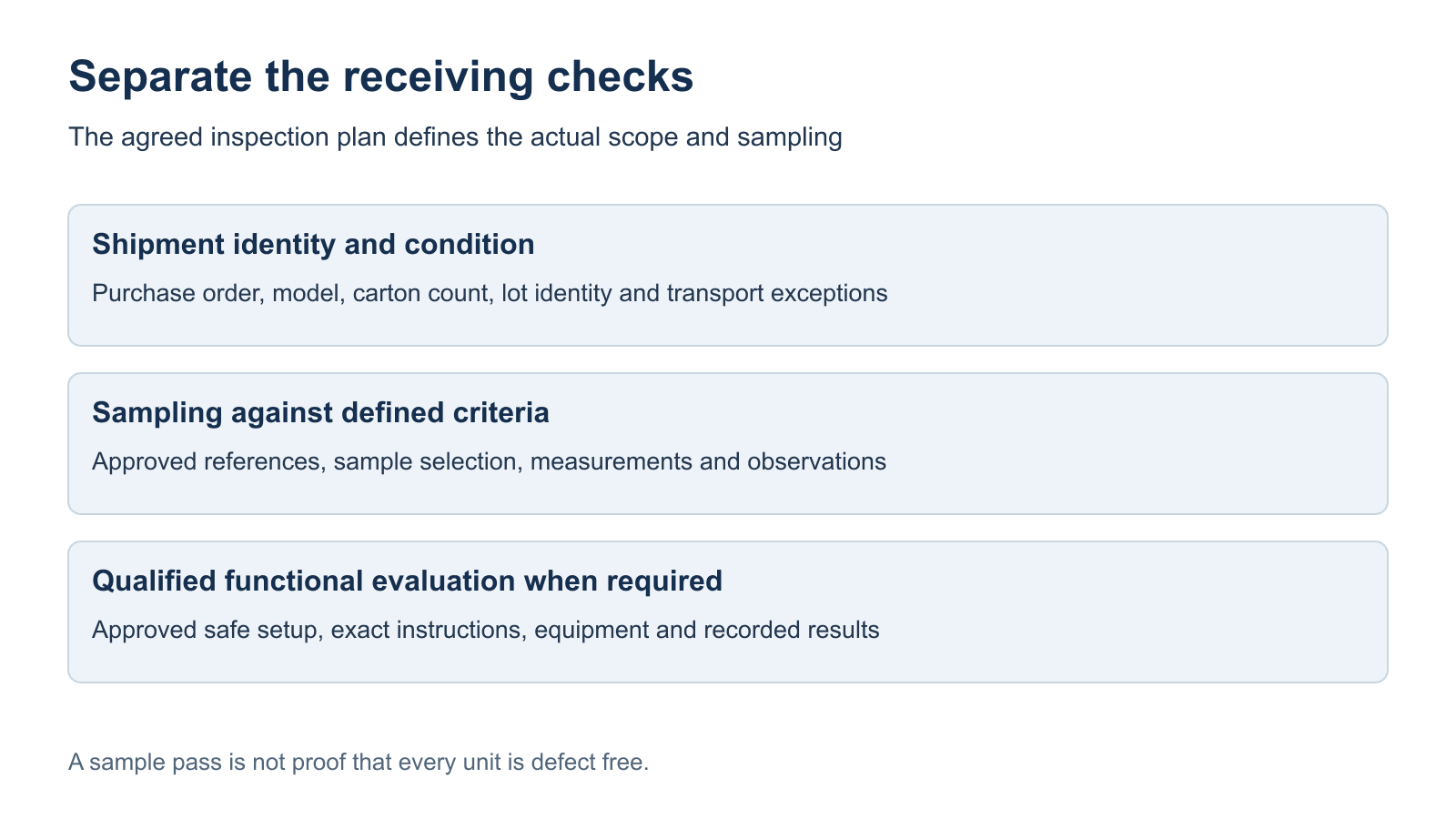
Suggested division of inspection work. The inspection plan determines the actual scope and sampling rules.
A zero-acceptance rule for specified defects is not proof that the lot contains zero defects. Sample size and selection still matter. Nor should a serious safety finding be balanced against a small number of cosmetic defects merely because one arithmetic acceptance limit appears to permit it. Escalation requirements should be defined separately from routine workmanship acceptance.
Keep electrical evaluation in a qualified test setup
A shipping sample may not reset when it is unpowered. That observation alone cannot establish a defect. Some GFCIs have model-specific initial conditions and reset behavior; use the exact instructions to define expected operation.
Do not wire loose receptacles on the receiving counter or ask unqualified staff to make energized connections. If powered evaluation is part of the inspection plan, use a documented procedure, suitable guarded fixture, appropriate equipment and qualified personnel. Evaluate the setup itself before interpreting a device failure.
Record the instruction revision and conditions used. Where the plan calls for observing TEST and RESET operation, confirm the relevant output behavior rather than record a button click or indicator light alone. Leviton’s GFCI testing guidance illustrates checking that a connected load loses and regains power during a test sequence. It is an example for the products it describes, not a universal procedure for other manufacturers.
Do not turn that user check into a claim that trip-current accuracy, trip time, self-test fault response or durability has been validated. Those assessments need an appropriate method and competence. Likewise, a plug-in tester’s indication is limited to what that instrument is designed to assess.
If an apparent failure occurs, preserve the sample and record the fixture, supply conditions, equipment identification, method revision and observed behavior. Have a qualified reviewer distinguish a setup problem from a device problem. Never bypass a protective feature merely to make the unit reset.
For terminology used in wiring documents, see the separate GFCI LINE versus LOAD guide. Receiving staff should not use a general blog article as authorization to perform electrical testing.
Create an inspection record that supports the release decision
A useful receiving record contains more than a pass stamp. Capture the inspection reference, supplier, purchase order, delivery date, model, lot identities and received quantity. Identify the controlled documents and sampling plan used, then record sampled quantities and source cartons.
For each check, record the requirement and actual observation. Attach photographs with sample identifiers. If dimensions are measured, retain the readings and instrument identification rather than only “dimensions OK.” For evaluations requiring calibrated equipment, record its status as required by the approved procedure.
Close the record with the approver, date and disposition. State any restricted quantity, excluded lot or condition. Keep the evidence with the inventory decision so another employee can understand why the goods were released or held.
Resolve discrepancies before making stock sellable
Use explicit dispositions, such as release, hold pending investigation, reject or release under a narrowly defined concession. Avoid a vague “conditional pass” that does not tell the warehouse whether it can ship.
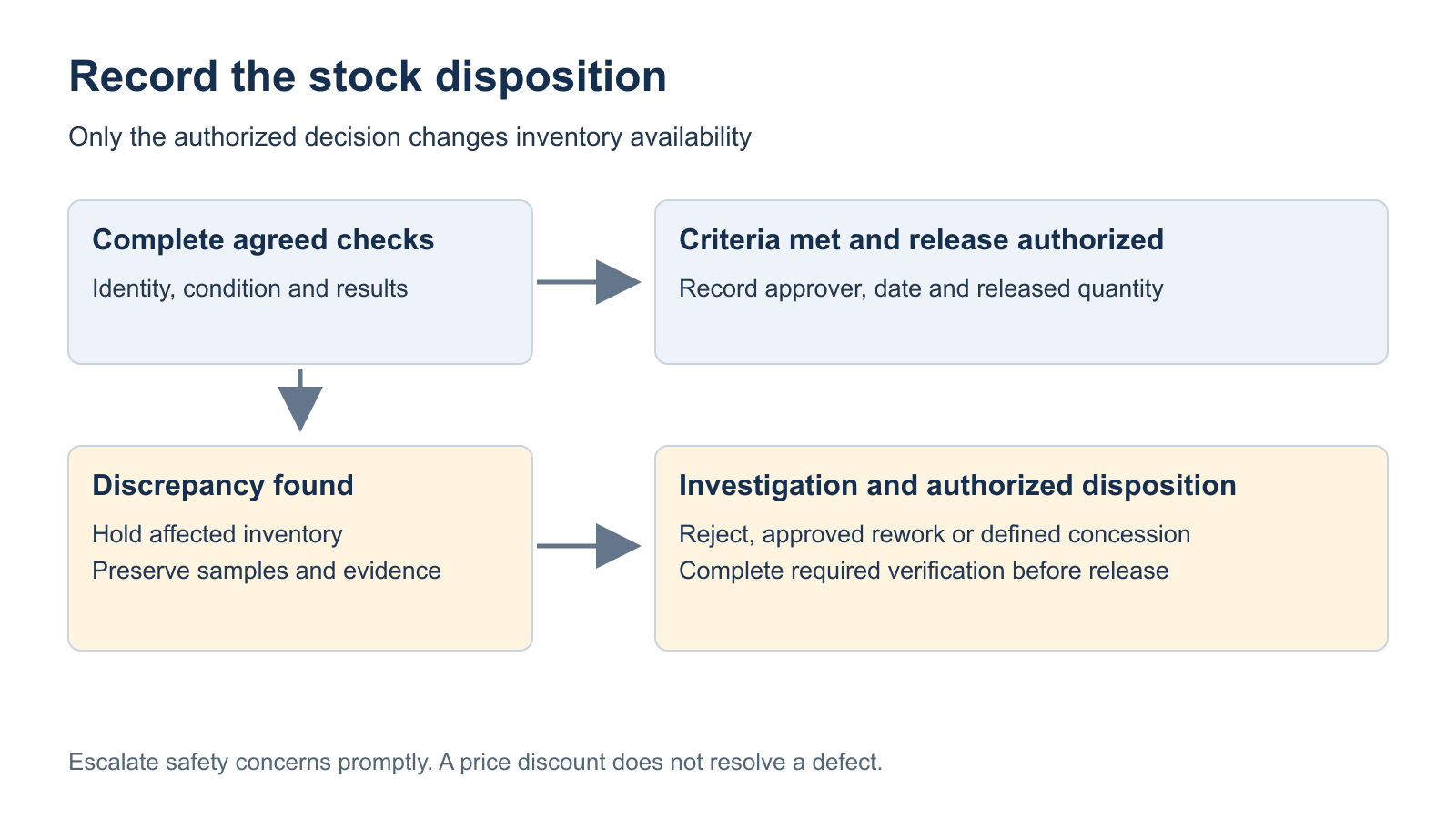
Suggested disposition workflow. A commercial concession cannot override applicable safety or certification requirements.
For a model or instruction mismatch, identify the affected quantity and request the correct controlled records. Do not assume that substituting paperwork fixes a product difference. For damage or a functional concern, preserve representative samples and request an investigation supported by evidence.
If rework is proposed, define who is authorized to perform it, the procedure, affected inventory and verification needed afterward. Replacement of a label, repacking and modification of a device have different implications. A discount does not resolve a technical nonconformity.
In a hypothetical mixed-shipment case, two instruction revisions are found across one delivery. Receiving holds the relevant stock and records carton-to-revision mapping. The technical owner determines whether both instructions apply to the actual constructions; the supplier identifies affected lots. Only the documented disposition tells the warehouse which quantities can move. This is an example, not a report of an actual shipment.
Escalate potential product hazards promptly
A suspected protective-function failure may require action beyond the supplier’s complaint process. For consumer products within CPSC jurisdiction, reporting duties can apply to manufacturers, importers, distributors and retailers. CPSC states that a company must report within 24 hours of obtaining reportable information and that injury need not already have occurred. See CPSC’s duty-to-report guidance.
Escalate promptly to the responsible compliance or legal personnel. Do not wait for a credit note or a completed root-cause report before considering the applicable reporting obligation. The details of reportability and any permitted investigation period depend on the facts and governing rules; this receiving guide is not legal advice.
Keep potentially affected inventory controlled while the responsible team determines scope and next steps. Preserve evidence and distribution records. An ordinary inspection rejection is not automatically a recall, but an inspection workflow should have a clear route for safety escalation.
Questions from warehouse and purchasing teams
Is a pre shipment inspection report enough
It is useful evidence, but it does not establish the condition or identity of what actually arrived. Confirm the report’s lot and shipment connection, then complete the receiving checks agreed for the order.
How many GFCIs should be sampled
There is no universal number for every order. Define the lot and inspected characteristics, then have a competent quality owner select the plan and decision rules. Do not substitute an arbitrary percentage.
Can receiving pass goods because one unit powers a lamp
No. That observation does not resolve model identity, certification questions, lot variation or the full agreed evaluation. Release should reflect all applicable checks and the authorized disposition.
Should every discrepancy cause rejection of the whole delivery
Not necessarily. First identify the affected lots and quantities. The authorized quality or technical reviewer determines scope and disposition; safety-related findings need their defined escalation route.
Agree on the receiving package when placing the order
Ask the supplier which model-specific instructions, approved artwork, lot references and shipment inspection records will accompany the delivery. Clarify how changes and discrepancies will be handled before the warehouse has stock waiting for release.
Use the Faith Electric GFCI outlet category to identify products for discussion. Send the intended SKU list and receiving requirements through Faith Electric’s contact page, and request confirmation for the exact models being quoted. This article does not claim that a shipment or test program has already passed review.
Sources and preparation note
Sources checked on October 8, 2026. This is the research check date, not a claimed source publication date.
- OSHA NRTL program overview supports the certification-mark explanation.
- NIST acceptance sampling overview supports the limits of lot acceptance sampling.
- Leviton GFCI testing guidance illustrates a manufacturer-specific user check, not a production acceptance procedure.
- CPSC duty-to-report guidance supports the reporting discussion for consumer products within its jurisdiction.
AI assisted the research and drafting. The checklist, record fields and mixed-shipment example are editorial recommendations, not certification instructions or an actual inspection report. Faith is the requested brand byline. Technical review is pending; this draft is not approved for publication. Electrical testing requires qualified personnel, the exact product instructions and an approved safe procedure.