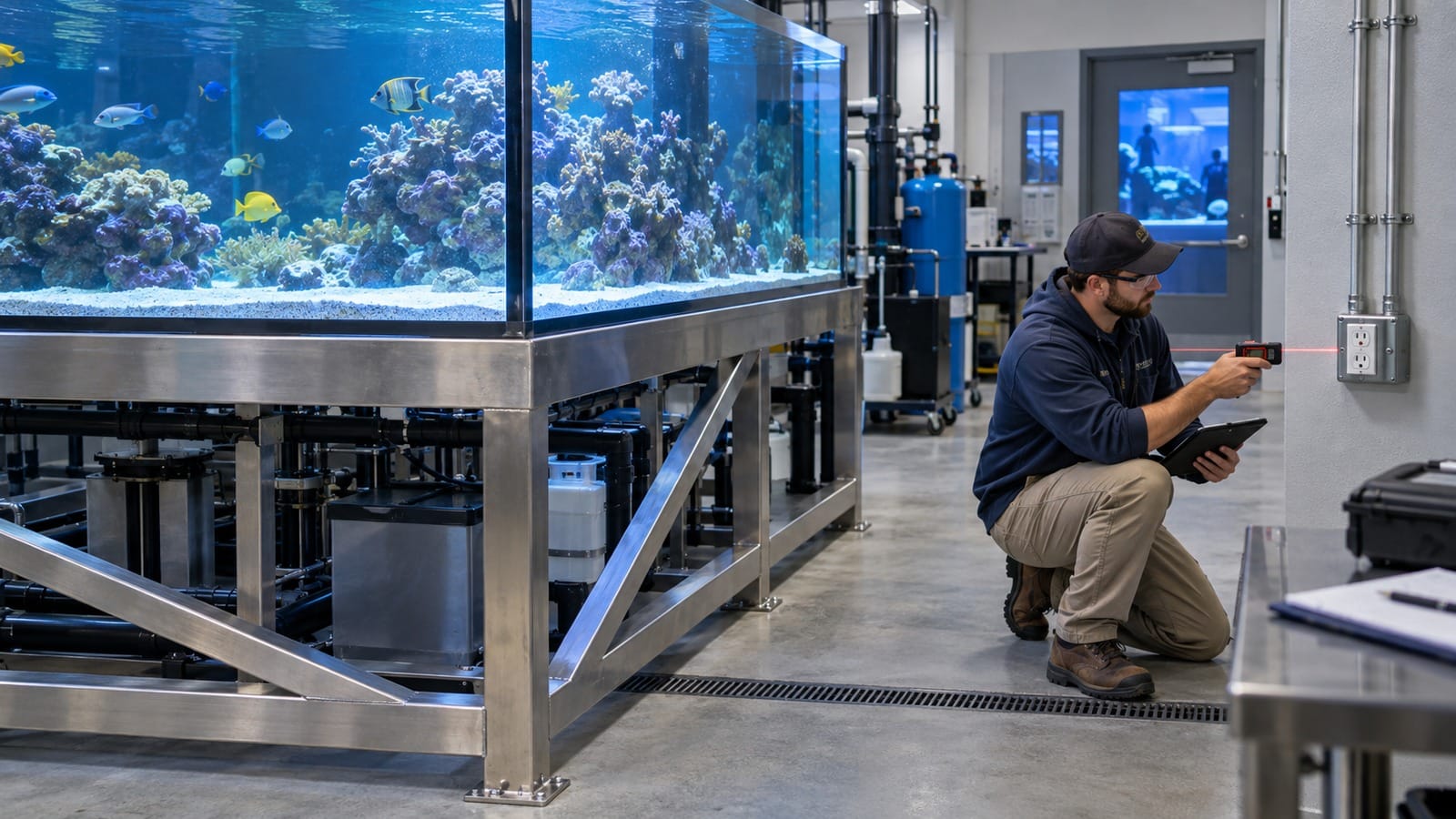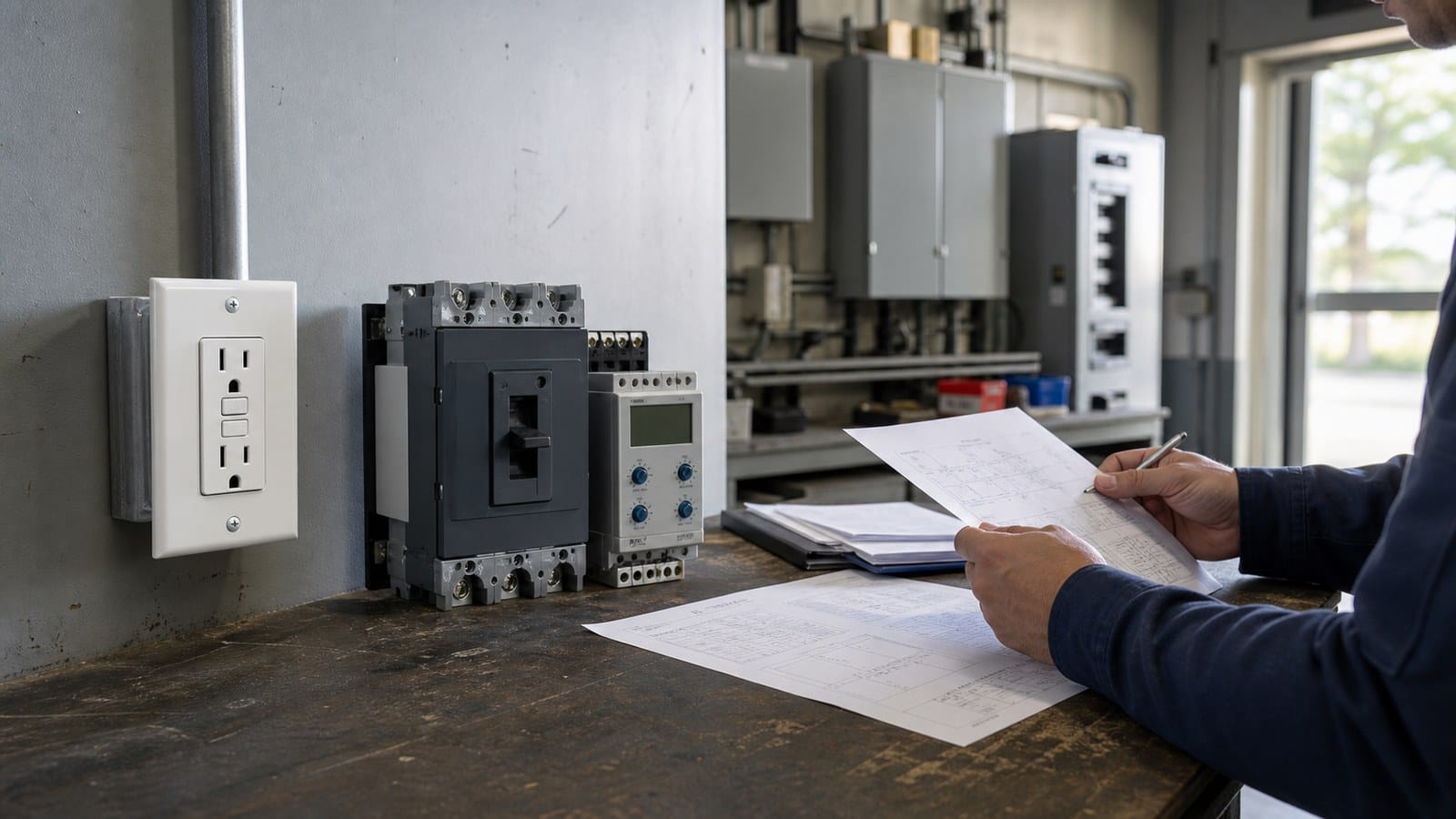
For other-than-dwelling occupancies using the 2023 National Electrical Code, qualifying receptacles within 6 feet of an aquarium, bait well or similar open aquatic vessel can require GFCI protection under NEC 210.8(B)(13). The distance is not measured only from the nearest glass wall. The referenced language measures from the top inside edge or rim, or from conductive support framing.
That detail matters in aquarium stores, seafood markets, restaurants, museums, laboratories, classrooms, aquaculture rooms and marina bait facilities. Pumps, lights, heaters, filters and maintenance tools often create several cord connections around water and grounded metal. The correct plan begins with the adopted code edition, an accurate tank layout and a complete receptacle schedule—not with a last-minute decision to add one GFCI outlet.
How this article was prepared: Faith Electric’s editorial team used AI-assisted drafting to organize the cited NFPA, CPSC and OSHA materials, then checked the key code statements against those sources. No site survey, licensed design review, product certification decision or AHJ approval is claimed.
The 2023 NEC rule in plain language
Section 210.8(B) covers GFCI protection in occupancies other than dwelling units. In the 2023 edition, item (13) identifies aquariums, bait wells and similar open aquatic vessels or containers—such as tanks or bowls—when receptacles are installed within 1.8 m (6 ft) of the top inside edge or rim or the conductive support framing.
The 210.8(B) stem also sets electrical scope. It addresses 125-volt through 250-volt receptacles supplied by specified single-phase and three-phase branch circuits within stated voltage-to-ground and ampere limits. Do not rely on the old shortcut that only a 120-volt, 15- or 20-amp duplex receptacle can be affected.
Use this decision sequence:
- Confirm that the occupancy is other than a dwelling unit.
- Identify every open aquatic vessel or similar container and its conductive support framing.
- Draw the six-foot measurement zone using the method in the adopted text.
- Inventory every receptacle in that zone, including receptacles above, below or behind equipment.
- Compare voltage, phase and circuit ampere rating with the scope and exceptions in the adopted rule.
- Review additional wet/damp-location, equipment, enclosure and manufacturer requirements.
This provision is not a blanket statement that every home aquarium has an aquarium-specific NEC requirement. The cited item is in the other-than-dwelling subsection. In a dwelling, GFCI protection may still be required because the receptacle is in a kitchen, basement, garage, laundry area, near a sink or in another covered location. Local rules and equipment instructions can also add requirements.
How to measure the six-foot zone
The common mistake is measuring from the nearest side panel at floor level. The 2023 wording points to the top inside edge or rim and also includes conductive support framing. On a large display tank, the closest qualifying point may be a metal frame, platform or stand rather than the water surface seen by visitors.
The electrical drawings should show a plan-view measurement from the relevant tank boundary to every receptacle. Where a vessel has an irregular shape, open sump, connected trough or conductive framework, the design team should identify the controlling point instead of assuming a simple rectangle. Ask the AHJ how the measurement is applied when the installation is unusual.
| Installation detail | Why it changes the review | Required drawing or record |
|---|---|---|
| Glass tank on a nonconductive cabinet | The rim may be the main measurement reference | Tank footprint, rim location and receptacle coordinates |
| Stainless-steel tank or conductive rack | Conductive support framing is part of the stated measurement language | Frame extent, bonding details and closest receptacles |
| Retail tank wall with receptacles behind access panels | A hidden receptacle can still be within the zone | Service-side elevation and access method |
| Open sump or filtration basin below the display | It may be a separate open aquatic vessel or container | Sump dimensions, rim and nearby receptacles |
| Portable maintenance receptacle or cord reel | Its connection point and intended use need separate review | Source receptacle, cord equipment listing and operating procedure |
Do not use cord length as the measurement. A ten-foot appliance cord does not move a receptacle outside the code-defined zone, and a short cord does not remove a nearby receptacle from review.
Map the full water-and-power system
An aquarium is more than the visible tank. Commercial systems may include pumps, UV sterilizers, protein skimmers, heaters, chillers, aerators, controllers, lighting, automatic feeders, sensors, drains, dosing equipment and a remote filtration sump. Some loads are cord-and-plug connected; others are hardwired. Some run continuously and others are used only during maintenance.
Create one equipment schedule that records:
- tank, sump, trough or bait-well identifier;
- location of the top rim and any conductive support framing;
- equipment name, model, voltage, current and connection method;
- receptacle configuration and exact branch circuit;
- GFCI protection method and reset/test location;
- environmental classification, box and cover;
- bonding or grounding instructions from the equipment manufacturer;
- emergency shutdown and life-support consequences of a trip.
This schedule prevents two dangerous assumptions: that every aquarium load is supplied by the receptacle visible next to the tank, and that a protected receptacle automatically protects all downstream outlets. Trace the circuit and verify the protection boundary.
Receptacle rule versus hardwired equipment
NEC 210.8(B)(13) is written around receptacles in the stated location. A hardwired pump or lighting system does not become a receptacle because it draws power near a tank. Hardwired equipment must be evaluated under the other provisions that apply to the outlet, equipment, wiring method, wet or damp location, listing and manufacturer instructions.
Likewise, a receptacle GFCI protects its face and only those downstream outlets correctly connected to its LOAD terminals. It does not protect wiring or equipment connected upstream. A GFCI circuit breaker can protect the branch circuit from the panel, but it must match the exact panel family, poles, voltage and circuit arrangement.
Faith’s GFCI receptacle versus GFCI circuit breaker comparison explains the practical differences. For a tank system, the selection should also account for life-support continuity, alarm response and who can reach the reset point.
Design for a trip without hiding the hazard
Aquarium systems can be sensitive to loss of circulation, oxygenation or temperature control. That operational consequence does not justify removing required personnel protection. Instead, design the system so a single fault does not create an uncontrolled loss.
Possible engineering and operations measures include separate branch circuits where permitted, divided life-support loads, alarmed controllers, supervised backup equipment and a written response plan. The details must come from a qualified designer and the equipment manufacturer. Avoid connecting all critical pumps, aerators and temperature-control equipment to one unidentified upstream GFCI simply because it reduces device count.
When a trip occurs:
- treat the water and nearby conductive surfaces as potentially hazardous;
- follow the facility’s safe shutdown and emergency life-support procedure;
- disconnect or isolate loads only as qualified personnel are permitted to do;
- inspect cords, plugs, equipment housings, junctions and receptacles for water or damage;
- identify the fault before resetting repeatedly;
- document the affected circuit, equipment and corrective action.
Calling a trip “nuisance” before testing can hide insulation failure, salt creep, condensation, a cracked heater, a failing pump seal or damaged cord. Do not bypass the GFCI, remove the equipment grounding conductor or replace personnel protection with equipment-only ground-fault protection.
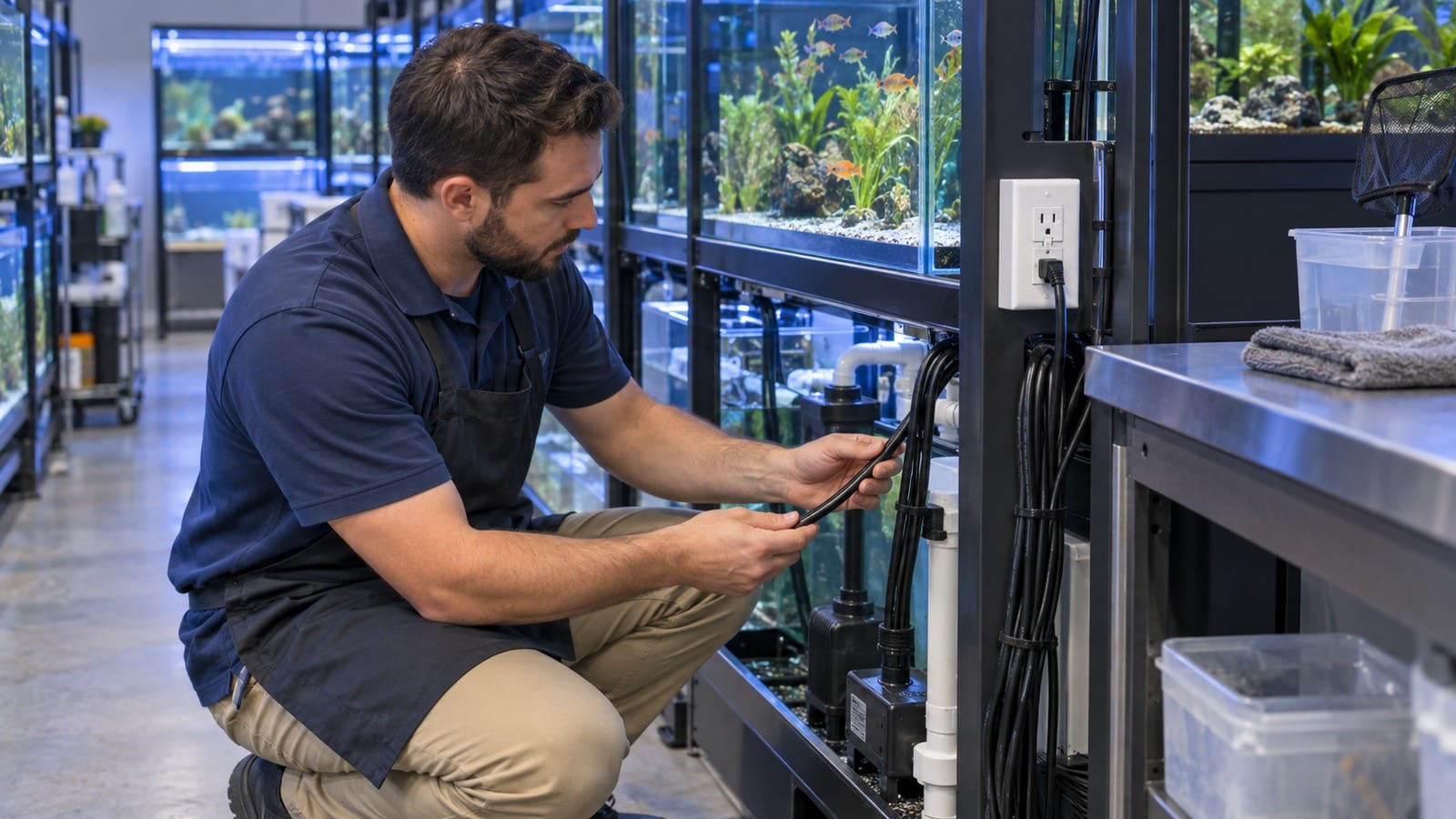
Illustrative application scene: power is controlled and cords, plugs, receptacles and equipment are checked as one system.
Saltwater, condensation and splash require more than GFCI
GFCI protection addresses ground-fault shock risk. It does not make a receptacle, wall box or plug connection resistant to salt, spray, condensation or hose cleaning. Saltwater residue can be conductive and corrosive. Drip loops can reduce water travel along a cord, but they are not a substitute for the correct device, enclosure, cover, mounting location or maintenance program.
Classify the environment. A visitor-side receptacle in a dry gallery, a service-side connection under a tank, a seafood-market washdown area and an outdoor bait station may require different boxes, covers, materials and wiring methods. If the receptacle is in a location requiring weather resistance, specify WR construction separately. If it is exposed to physical damage, add guards or relocate it without sacrificing required accessibility.
Review:
- splash and hose direction;
- condensation paths and ventilation;
- salt and chemical exposure;
- box orientation, drainage and gasket condition;
- cord entries, drip loops and strain relief;
- accessibility for testing and replacement;
- corrosion inspection and cleaning methods;
- suitability of every plug, connector and cover while connected.
Faith’s outdoor GFCI requirements guide explains why GFCI protection, weather-resistant construction and a suitable cover solve different parts of the problem.
Selecting the protective device
The right GFCI is identified by more than “15A” or “20A.” Match the product to the branch circuit, receptacle configuration, box, environment, intended feed-through load and operations plan.
| Selection point | Buyer question | Evidence |
|---|---|---|
| Electrical rating | Does voltage, current and receptacle configuration match the circuit and connected plug? | Drawing, panel schedule, product data and nameplate |
| Protection boundary | Which face and downstream receptacles are protected? | Wiring diagram and commissioning test record |
| Certification | Is the exact catalog number certified by an OSHA-recognized NRTL for the applicable standard? | Current certification directory record |
| Environment | Are WR, corrosion-resistant components, suitable box and cover required? | Location classification and equipment schedule |
| Self-test behavior | How does the model indicate failure or end of life, and does it deny power when protection is unavailable? | Manufacturer instructions |
| Access | Can staff safely reach TEST/RESET without moving the tank or entering a wet service cavity? | Elevation drawing and maintenance review |
OSHA explains that its NRTL program recognizes organizations to test and certify products within defined scopes and that each NRTL uses its own registered certification mark. A mark is meaningful only when it applies to the exact product and standard. Verify the certification record; do not accept “UL/ETL compliant” as a substitute for a current listing or certification when the project requires one.
For common ratings, Faith’s 15-amp versus 20-amp GFCI guide explains why a 20-amp face cannot be used to upgrade a 15-amp circuit.
Procurement checklist for tanks and bait wells
Before releasing devices or panels, confirm the following:
- project address, occupancy and adopted electrical code edition;
- tank, bowl, trough, sump and bait-well dimensions;
- conductive support-frame boundaries and bonding design;
- six-foot measurement on plan and elevation drawings;
- every receptacle in the zone, including hidden service receptacles;
- branch-circuit voltage, phase, rating and panel compatibility;
- cord-and-plug versus hardwired connection for every load;
- exact GFCI type, catalog number, NRTL record and instructions;
- downstream protection map and required labels;
- environmental rating, box, cover, gasket and corrosion materials;
- TEST/RESET access and staff responsibility;
- commissioning, alarm, backup and trip-response records.

Illustrative application scene: tank geometry, circuit data, certification and operational continuity are reviewed together.
Commissioning and maintenance
At commissioning, operate the TEST function according to the manufacturer’s instructions and confirm the exact receptacles and equipment that lose power. Verify correct polarity, grounding, labels and downstream protection using appropriate qualified-person procedures. Record the protective-device model, circuit, test date and reset location.
CPSC recommends testing GFCIs after installation, at least monthly, after a power failure and according to manufacturer instructions. In an aquarium facility, add visual checks for corrosion, salt deposits, cracked cords, loose plugs, damaged covers, moisture and blocked access. Self-test electronics do not eliminate the manual test or inspection required for the exact product.
Coordinate electrical testing with animal-care or process staff so critical life-support equipment has an approved continuity plan. That plan must not defeat the protective device. If a GFCI does not trip during its prescribed test, will not reset, shows a fault/end-of-life indication, is hot, damaged or corroded, remove the affected circuit or device from service according to the facility procedure and arrange qualified correction.
Frequently asked questions
Do all fish tanks need a GFCI outlet?
The cited aquarium-specific rule is in the 2023 NEC subsection for other-than-dwelling units and applies to qualifying receptacles within the defined zone. A home aquarium may still be covered by other location rules or local requirements. Check the adopted code and the installation.
Is the six-foot distance measured from the water surface?
Use the exact adopted text. The referenced 2023 language measures from the top inside edge or rim or from conductive support framing. Do not substitute a floor-level glass-wall measurement.
Does one GFCI protect every tank on a rack?
Only if the circuit is intentionally designed that way and all relevant downstream outlets are correctly connected to the protective device. Confirm the protection boundary by documentation and commissioning tests. Also evaluate whether one trip would disable too many critical loads.
Is a drip loop enough protection?
No. A drip loop is one cord-management measure. It does not replace required GFCI protection, suitable enclosures and covers, grounding, environmental ratings or inspection.
Can a GFCI trip harm fish or research specimens?
Loss of life-support power can be serious, but bypassing required protection is not the answer. A qualified team should design redundancy, alarms, backup and response procedures that preserve personnel protection.
Sources and references
- National Fire Protection Association, NFPA 70 code-development record for Section 210.8(B), including the 2023-cycle language for aquariums, bait wells and similar open aquatic vessels, accessed September 23, 2026: https://docinfofiles.nfpa.org/files/AboutTheCodes/70/70_A2022_NEC_P02_SD_PCStatements.pdf
- National Fire Protection Association, NFPA 70, National Electrical Code, use the edition adopted for the project, accessed September 23, 2026: https://www.nfpa.org/codes-and-standards/nfpa-70-standard-development/70
- U.S. Consumer Product Safety Commission, GFCI Fact Sheet, accessed September 23, 2026: https://www.cpsc.gov/safety-education/safety-guides/electronics-and-electrical-home/gfci-fact-sheet
- U.S. Consumer Product Safety Commission, Test GFCIs after installation, monthly, after a power failure and according to instructions, accessed September 23, 2026: https://www.cpsc.gov/Newsroom/News-Releases/2011/Change-Smoke-and-Carbon-Monoxide-Alarm-Batteries-When-Changing-Clocks-This-WeekendCPSC-Also-Recommends-Consumers-Test-Their-Homes-Electrical-Safety-Equipment
- U.S. Occupational Safety and Health Administration, Nationally Recognized Testing Laboratory Program, accessed September 23, 2026: https://www.osha.gov/nationally-recognized-testing-laboratory-program
Safety and code disclaimer: General information only; not electrical design, animal-care guidance, installation instructions, a certification decision or a code ruling. Use the official code edition adopted by the jurisdiction, local amendments, project specifications and listed-product instructions. Qualified personnel and the AHJ must make final design, installation, inspection and acceptance decisions.