The 2023 National Electrical Code added a clear GFCI location for other-than-dwelling occupancies: buffet serving areas with permanent provisions for food serving, beverage serving or cooking. For a qualifying receptacle, the decision is no longer limited to whether it is close to a sink or inside a room labeled “kitchen.” The serving area itself can trigger the review under NEC 210.8(B)(4).
That change matters in hotels, restaurants, cafeterias, schools, healthcare dining areas, conference centers and workplaces with permanent breakfast or beverage service. It does not mean every temporary catering table automatically becomes a code-defined buffet serving area. The adopted NEC edition, the permanent features actually installed, local amendments, project documents and the authority having jurisdiction (AHJ) control the result.
How this article was prepared: Faith Electric’s editorial team used AI-assisted drafting to organize the cited NFPA, CPSC and OSHA materials, then checked the key code statements against those sources. No field inspection, licensed design review, product certification decision or AHJ approval is claimed.
What NEC 210.8(B)(4) covers
The NFPA code-development record for the 2023 NEC places “buffet serving areas with permanent provisions for food serving, beverage serving, or cooking” in the list of other-than-dwelling locations that require GFCI protection for qualifying receptacles. In that edition, the 210.8(B) stem addresses 125-volt through 250-volt receptacles supplied by specified single-phase and three-phase branch circuits within stated voltage-to-ground and ampere limits.
The practical lesson is to start with four questions:
- Is the occupancy other than a dwelling unit?
- Is the space a buffet serving area with permanent provisions for one of the listed activities?
- Does the receptacle fall within the voltage, phase and ampere scope of the adopted rule?
- Does an exception, local amendment or project-specific requirement change the result?
Do not reduce that review to “within six feet of a sink.” Sink proximity is a separate trigger in 210.8(B). A buffet serving area may need GFCI-protected receptacles even when there is no sink beside the serving line.
| Area or equipment | Why it needs review | What to document |
|---|---|---|
| Hotel breakfast counter with built-in warmers and beverage dispensers | Permanent food and beverage service is part of the installed use | Floor plan, receptacle schedule, equipment connection type and branch-circuit data |
| Restaurant buffet line with heat lamps and hot-food wells | The area is purpose-built for serving and may include several receptacle types | Every receptacle, connected load, reset location and equipment instructions |
| Office coffee station with fixed cabinets and permanent beverage equipment | It may also fall under the food/beverage-preparation language in 210.8(B)(3) | Actual installed provisions, not only the room name |
| Temporary folding tables used for one event | Temporary use alone may not establish permanent provisions | Event power plan, venue rules and AHJ interpretation |
| Hardwired serving equipment | A receptacle-location rule cannot be assumed to govern a connection with no receptacle | Separate outlet, appliance, listing and manufacturer-instruction review |
This table is a planning aid, not a code ruling. The exact adopted text and project conditions must be checked before construction or procurement.
“Permanent provisions” is the key classification question
The NEC language does not turn on whether food happens to be placed on a table today. It focuses on the area and the permanent provisions built for serving, beverage service or cooking. Fixed counters, millwork, electrical rough-in, plumbing, installed warming equipment, permanently located dispensers, sneeze guards, menu systems or similar features can help show the intended use.
Labels on a drawing can be incomplete. A room called “lounge” may contain a permanent hotel breakfast bar. A space called “break room” may include a beverage-preparation counter and sink. Conversely, a ballroom may host a temporary catered meal without becoming a permanently equipped buffet area. The electrical designer should classify the space from the actual design, not from marketing language alone.
Document the decision on the plans. If the serving layout changes after rough-in, repeat the receptacle review before equipment is ordered. Late millwork or equipment substitutions can move a cord connection, add receptacles or change the load without anyone updating the protection plan.
Buffet area, kitchen and sink rules can overlap
A food-service project may trigger more than one part of 210.8(B). A buffet line can be adjacent to a commercial kitchen, include a beverage-preparation counter, or place receptacles near a sink. The goal is not to choose one label and ignore the rest. Map every applicable location and equipment rule.
Common overlaps include:
- Kitchens: the room may already qualify under the commercial-kitchen item.
- Areas with sinks and permanent food or beverage preparation: coffee bars and service counters can fit this description.
- Sink proximity: qualifying receptacles or specified cord-and-plug-connected fixed or stationary appliances near a sink may require a separate six-foot review.
- Indoor damp or wet locations: washdown practices or exposure may create additional environmental requirements.
- Outdoor serving areas: GFCI protection, weather-resistant receptacles, suitable boxes and covers are separate selection layers.
Faith’s commercial-building GFCI guide provides the wider location checklist. For kitchens specifically, use the adopted code and the actual kitchen and appliance layout rather than treating the buffet rule as a substitute.
Which receptacles should be included in the schedule?
Begin with a complete receptacle inventory inside the classified serving area. Include wall, floor, counter, furniture-system and equipment-integrated receptacles when they are part of the premises wiring review. Record voltage, phase, branch-circuit rating, receptacle configuration and expected load.
Do not assume that only familiar 120-volt, 15- and 20-amp duplex devices matter. The 2023 210.8(B) stem reaches a broader range of qualifying receptacles. A larger receptacle supplying food-service equipment may still fall within the specified circuit limits. The electrician must evaluate the actual voltage to ground, phase and ampere rating against the adopted text.
Also separate a receptacle from an outlet in NEC terminology. A receptacle accepts an attachment plug. An outlet is the broader point where current is taken to supply equipment. Section 210.8(B)(4) is written around receptacles in the location. Hardwired equipment may still have other GFCI, appliance, manufacturer or local requirements, but those must be established separately rather than assumed from the buffet-receptacle rule.
Receptacle GFCI or circuit-breaker GFCI?
Either approach can be appropriate when the selected equipment is listed, correctly rated, compatible with the circuit and permitted by the adopted code. The main operational difference is where staff test, reset and troubleshoot the protection.
| Selection factor | Receptacle-type GFCI | GFCI circuit breaker |
|---|---|---|
| Reset location | At the serving area or an accessible upstream device | At the electrical panel |
| Protection scope | Device plus correctly wired load-side receptacles | Entire branch circuit |
| User access | Convenient if visible and not blocked by equipment | May be limited by locked or remote electrical rooms |
| Installation constraint | Box depth, conductor fill, LINE/LOAD wiring and environmental exposure | Exact panel family, poles, voltage and breaker compatibility |
| Troubleshooting impact | Can isolate a smaller part of the serving line | A trip may interrupt several loads on one circuit |
For a hospitality operation, reset access is a service-continuity decision. A GFCI hidden behind a built-in refrigerator or warming cabinet can be code-compliant only if all accessibility requirements are met, yet still be a poor maintenance choice. A panel-based device can centralize maintenance but may require authorized staff for every reset.
Faith’s GFCI receptacle versus GFCI circuit breaker guide covers these tradeoffs in more detail.
Plan leakage and trips without defeating protection
Commercial buffet lines may connect several heating elements, refrigeration units, pumps, electronic controls and filters. Normal equipment leakage can accumulate, while damaged cords, moisture, cleaning chemicals and overheated connections can create actual faults. A trip must be treated as a fault signal, not as permission to remove GFCI protection.
When a trip occurs, de-energize as required, disconnect loads according to the facility procedure, inspect for moisture or damage, and reconnect only verified equipment. Record the circuit, devices connected, cleaning activity, trip time and corrective action. If one appliance repeats the trip, remove it from service for qualified evaluation. If the circuit trips with equipment disconnected, inspect the branch wiring and protective device.
Do not solve repeated trips by substituting a non-GFCI receptacle, lifting the equipment grounding conductor or installing a protection device with a different purpose. Class A GFCI protection is personnel protection. Equipment ground-fault protection or an ordinary overcurrent breaker is not an interchangeable substitute.

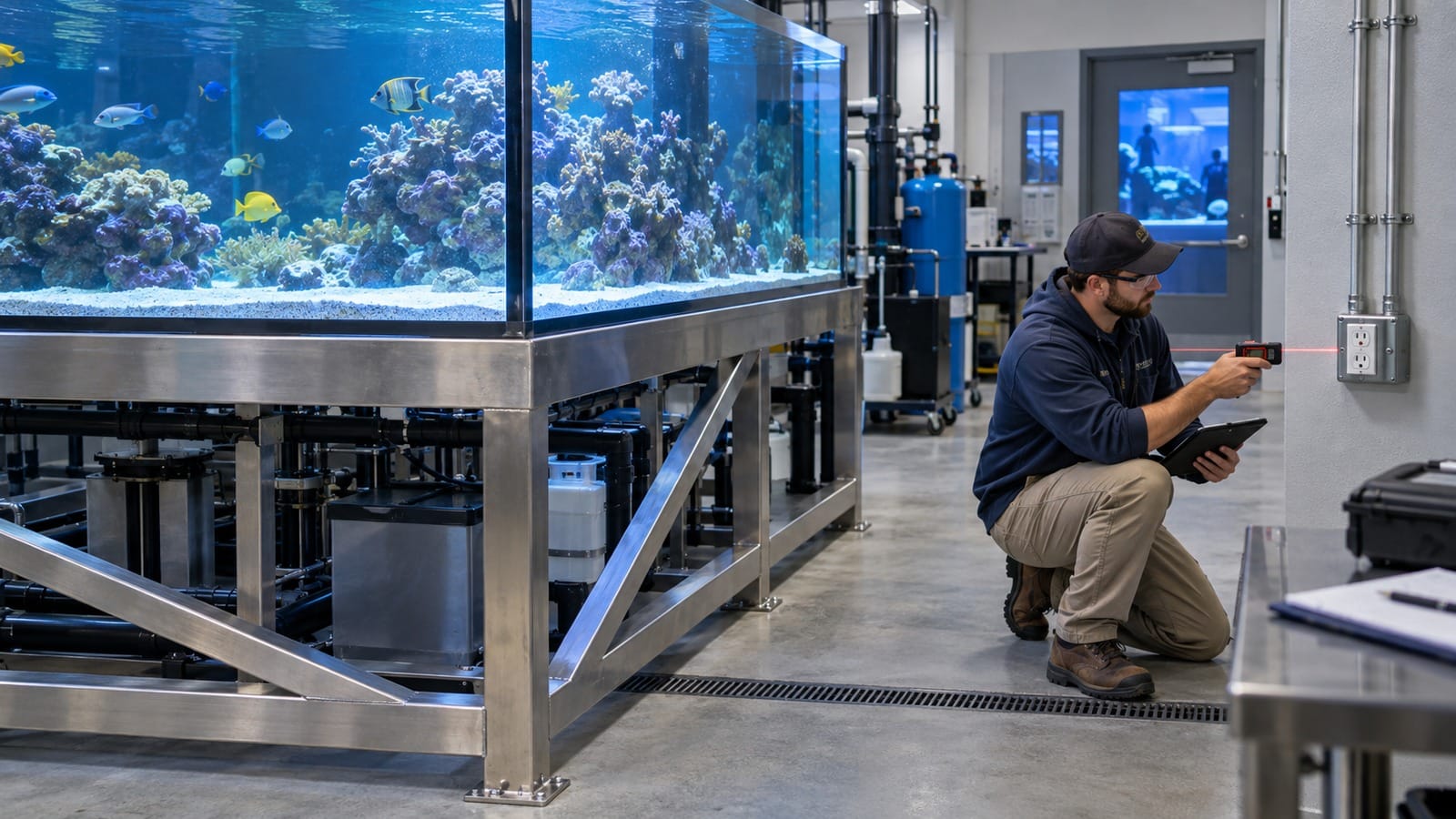
Illustrative application scene: testing and reset access are kept clear of appliances, stored supplies and cleaning water.
Cleaning and environmental exposure change the product specification
Food-service areas are cleaned frequently. Splash, condensation, steam, grease and chemical residue can reach receptacles and cord connections even when the room is not classified as a wet location. GFCI protection does not make a receptacle waterproof and does not replace a suitable enclosure, cover, gasket or cleaning procedure.
The designer should identify how the area will be cleaned. A dry-wiped hotel breakfast counter is different from a washdown zone. If a receptacle is outdoors or in a location requiring weather resistance, specify the correct WR marking and cover arrangement separately. If tamper-resistant construction is required by the adopted code, occupancy or project specification, add the TR requirement rather than assuming every GFCI includes it.
For each exposed device, confirm:
- environmental classification and expected cleaning method;
- box, cover, gasket and wall-plate compatibility;
- cord routing and strain relief;
- resistance to impact from carts and movable equipment;
- access for inspection, TEST/RESET operation and replacement;
- manufacturer restrictions for mounting orientation and temperature.
Procurement checklist for a multi-site rollout
“Commercial buffet GFCI” is not a complete purchase description. A hotel or restaurant program should issue a location and circuit schedule that identifies:
- adopted NEC edition and local amendment set for each site;
- buffet, beverage, preparation, kitchen, sink, wet and outdoor area classifications;
- every receptacle configuration, voltage, phase and branch-circuit rating;
- connected equipment, plug type, load and manufacturer instructions;
- receptacle-type or breaker-type protection and the exact protection boundary;
- NRTL certification mark, exact catalog number and applicable standard for the product category;
- TR, WR, corrosion resistance, color and wall-plate requirements;
- panel compatibility for every proposed GFCI breaker;
- test/reset access, labeling and downstream-protected-receptacle identification;
- commissioning test, turnover record, spare-parts plan and maintenance owner.
OSHA explains that an NRTL certification mark shows that a recognized laboratory tested and certified the product to standards within its scope. For workplace procurement, verify the exact model and certification record rather than relying on a logo copied into a sales sheet.

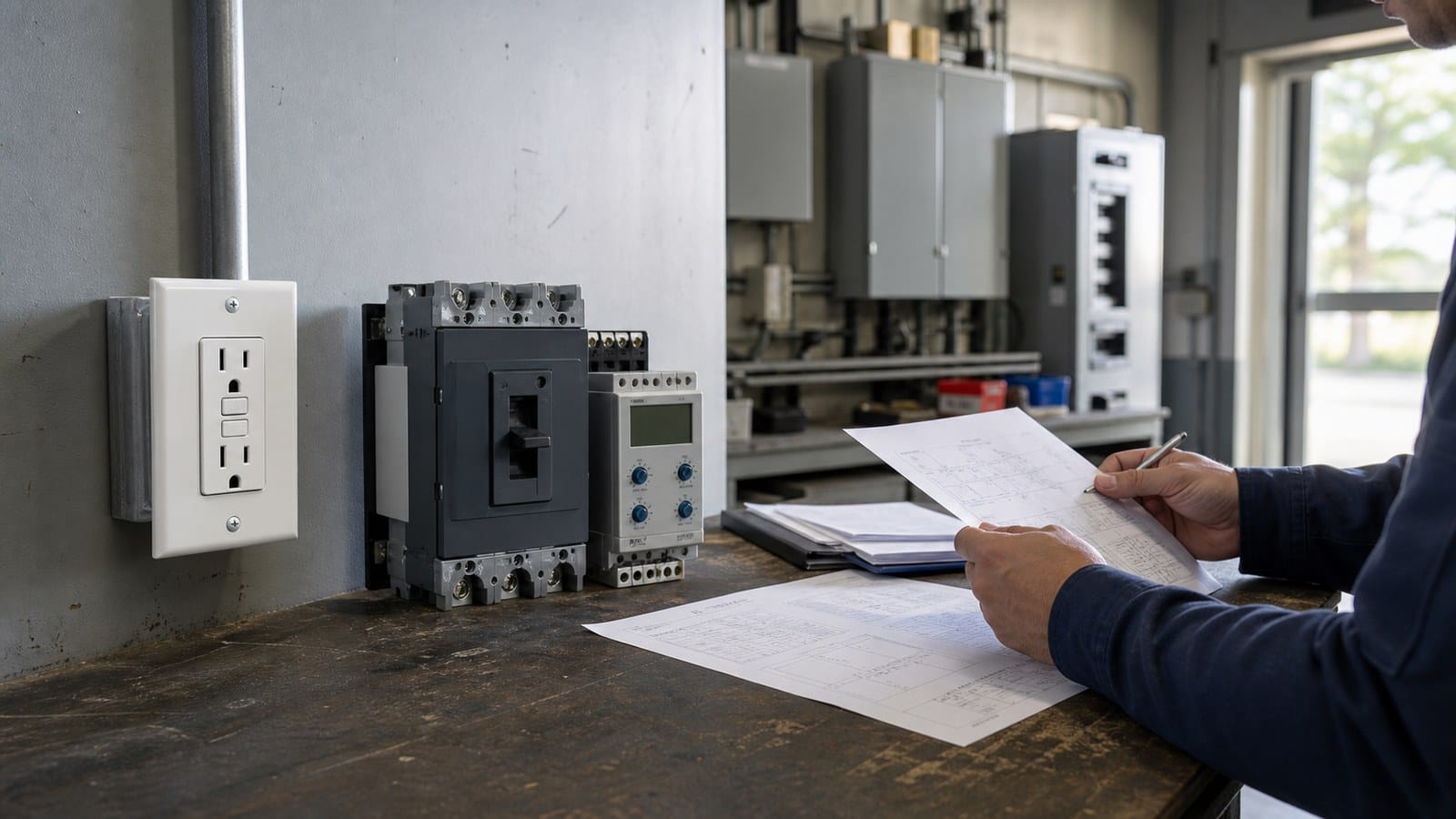
Illustrative application scene: equipment schedules, catalog numbers and protection boundaries are reviewed before release.
Commissioning and routine testing
Before turnover, test each protective device according to its manufacturer instructions and verify which receptacles lose power. Label downstream protected receptacles as required, confirm that staff can reach the reset point, and record the circuit and protective-device model. A plug-in tester can be a useful field aid, but it does not replace the built-in TEST function, manufacturer procedure or qualified electrical testing.
CPSC advises testing GFCIs after installation, at least monthly, after a power failure and according to the manufacturer’s instructions. A facility procedure should assign that task, retain results and state what happens when a device fails to test or reset. Automatic self-testing does not eliminate the manual checks specified for the exact product.
Frequently asked questions
Does a buffet receptacle need to be within six feet of a sink?
Not for the buffet-location trigger itself. Under the referenced 2023 language, a qualifying receptacle in a buffet serving area with permanent provisions can require GFCI protection because of the location. The sink rule is a separate analysis that may also apply.
Does the rule apply to a temporary catering table?
The wording refers to buffet serving areas with permanent provisions. A temporary event setup may be governed by other electrical, venue and temporary-power requirements, but it should not be automatically classified from the presence of food alone. Have the designer or AHJ review the actual installation.
Are hardwired warming cabinets covered by 210.8(B)(4)?
The item is written around receptacles. Hardwired equipment requires a separate review of other NEC provisions, the equipment listing, manufacturer instructions, local amendments and project specifications.
Can one upstream GFCI protect several buffet receptacles?
Yes, when the device is listed and correctly wired for feed-through protection, the branch circuit is suitable, and the arrangement is permitted. The protected outlets must be identified and the reset location must remain accessible under the applicable rules.
Sources and references
- National Fire Protection Association, NFPA 70 code-development record for Section 210.8(B), including the 2023-cycle language for buffet serving areas, accessed September 23, 2026: https://docinfofiles.nfpa.org/files/AboutTheCodes/70/70_A2022_NEC_P02_SD_PCStatements.pdf
- National Fire Protection Association, NFPA 70, National Electrical Code, use the edition adopted for the project, accessed September 23, 2026: https://www.nfpa.org/codes-and-standards/nfpa-70-standard-development/70
- U.S. Consumer Product Safety Commission, Test the GFCI after installation, monthly, after a power failure and according to instructions, accessed September 23, 2026: https://www.cpsc.gov/Newsroom/News-Releases/2011/Change-Smoke-and-Carbon-Monoxide-Alarm-Batteries-When-Changing-Clocks-This-WeekendCPSC-Also-Recommends-Consumers-Test-Their-Homes-Electrical-Safety-Equipment
- U.S. Occupational Safety and Health Administration, Nationally Recognized Testing Laboratory Program, accessed September 23, 2026: https://www.osha.gov/nationally-recognized-testing-laboratory-program
Safety and code disclaimer: General information only; not electrical design, installation instructions, a certification decision or a code ruling. Use the official code edition adopted by the jurisdiction, local amendments, project specifications and listed-product instructions. Qualified personnel and the AHJ must make final design, installation, inspection and acceptance decisions.