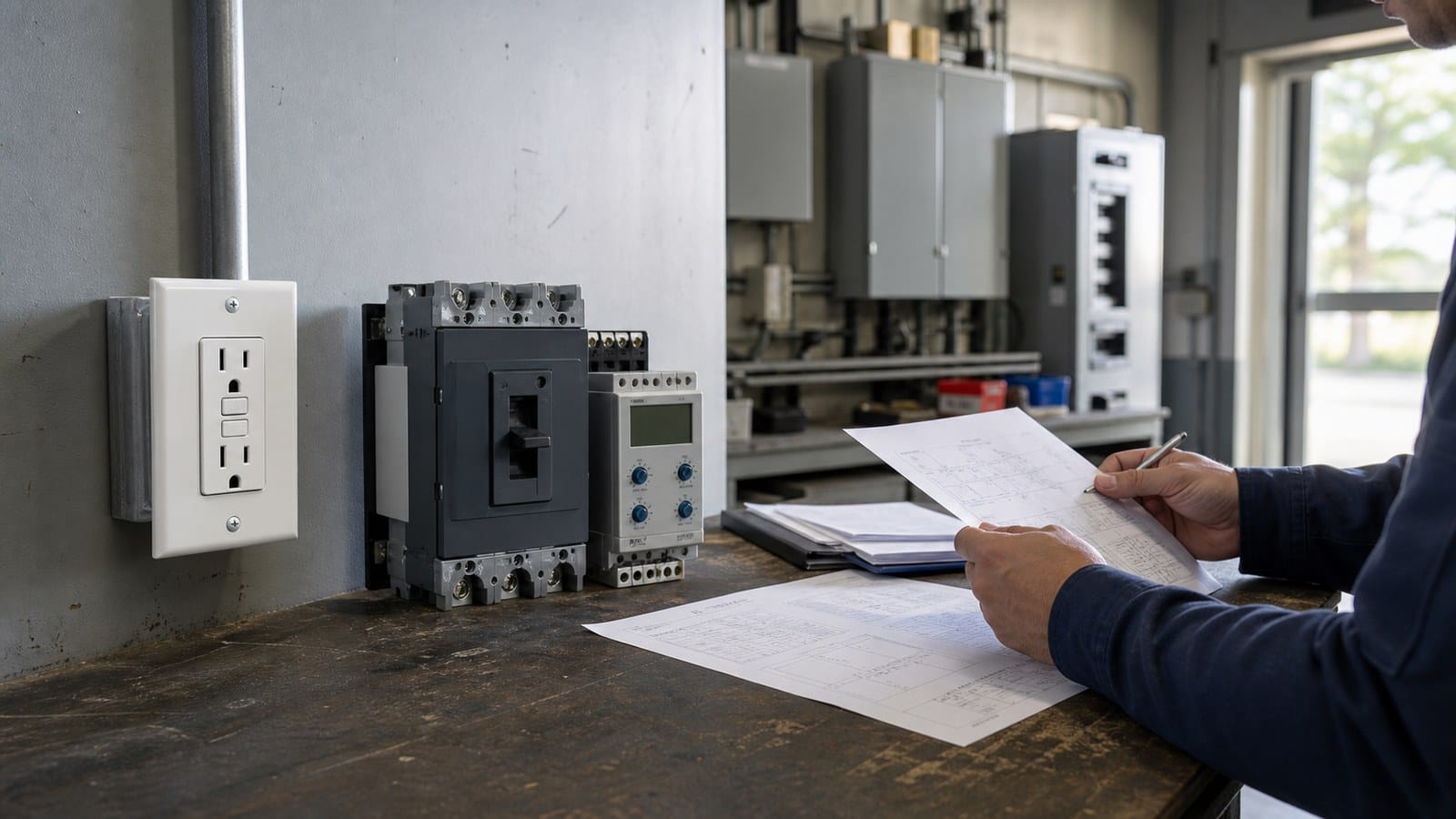
Choosing the right GFCI outlet for a kitchen is not just about replacing a wall device with one that has TEST and RESET buttons.
A kitchen GFCI outlet needs to match the kitchen zone, circuit rating, appliance load, installation method, and local electrical code. If the rating is wrong, the result may be nuisance tripping, failed inspection, poor reset access, or a safety problem that should have been avoided during product selection.
For homeowners, this affects daily use. For electricians, contractors, distributors, and project buyers, it affects installation efficiency, callbacks, compliance confidence, and long-term product reliability.

Why Kitchen GFCI Outlets Need More Than a Basic Replacement
A GFCI outlet, or Ground Fault Circuit Interrupter receptacle, is designed to detect current leakage between the hot and neutral conductors. When the imbalance reaches a dangerous level, the device cuts power quickly to reduce electric shock risk.
That matters in kitchens because the environment is different from a bedroom or hallway.
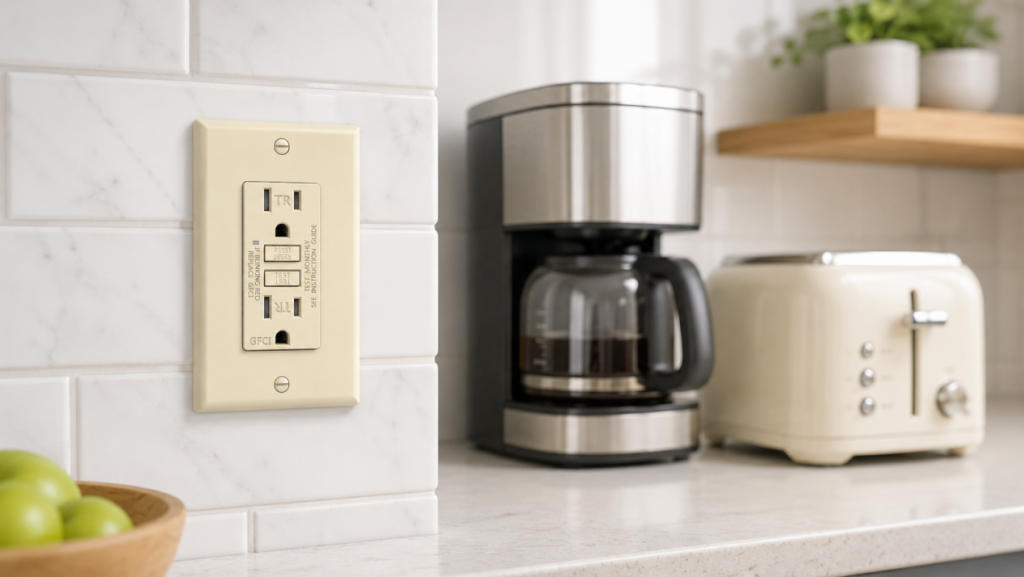
Kitchen outlets often serve coffee makers, toasters, air fryers, blenders, rice cookers, countertop ovens, and microwave-related work zones. Many of these devices draw high current for long periods. At the same time, water, steam, metal appliance bodies, wet hands, and grounded surfaces are part of normal kitchen use.
A basic outlet may only provide power. A kitchen GFCI outlet must provide protection in a space where water and high-load appliances often meet.
Kitchen outlets face water, heat, and high appliance loads
A typical coffee maker may draw around 800–1,500 watts. A toaster or air fryer can easily reach 1,200–1,800 watts. If several devices are used on the same small-appliance circuit, the load adds up quickly.
That does not mean the GFCI outlet is responsible for carrying every possible appliance combination without tripping. It means the outlet, branch circuit, wiring, and breaker must be selected as a system.
A mismatched device is not a small detail.
GFCI protection is about fast power cutoff
GFCI protection is not the same as overload protection. A circuit breaker protects wiring from excessive current. A GFCI protects people from ground-fault shock hazards.
That distinction matters. If a kitchen GFCI keeps tripping, the cause may be ground leakage, moisture, a faulty appliance, incorrect wiring, or downstream load issues. Replacing the outlet with a higher amperage model does not automatically solve the problem.
The first rule is simple: choose the outlet according to the circuit and location, not by guesswork.
Where GFCI Outlets Are Commonly Needed in a Kitchen
Kitchen GFCI selection starts with location. Code requirements can vary depending on the NEC version adopted locally, local amendments, and the authority having jurisdiction. A licensed electrician should always verify the final requirement.
Still, several kitchen zones commonly need careful GFCI planning.
Countertop work surfaces
Kitchen countertop receptacles are one of the most common GFCI protection areas. This is where users plug in small appliances, often near water, food prep zones, and metal surfaces.
For countertop areas, the outlet choice should consider:
- Appliance load
- Circuit amperage
- Frequency of use
- Reset accessibility
- Tamper-resistant design
- Wall plate and backsplash compatibility
This is also where 20A small-appliance branch circuits are common in many kitchen designs. But that does not mean every countertop replacement should automatically use a 20A GFCI outlet. The circuit must support it.
Sink-adjacent areas
Any receptacle near a sink deserves special attention. Water splashes, damp hands, and grounded surfaces increase shock risk.
The exact distance requirements should be checked against local code. Do not rely only on a general online rule. In many projects, the safest approach is to treat sink-adjacent receptacles as high-priority GFCI protection points and confirm the final layout before cabinets, backsplash, or countertops are finished.
For manufacturers, suppliers, and contractors, this also means the product should be easy to identify, test, reset, and install correctly.
Islands, peninsulas, and wall counter spaces
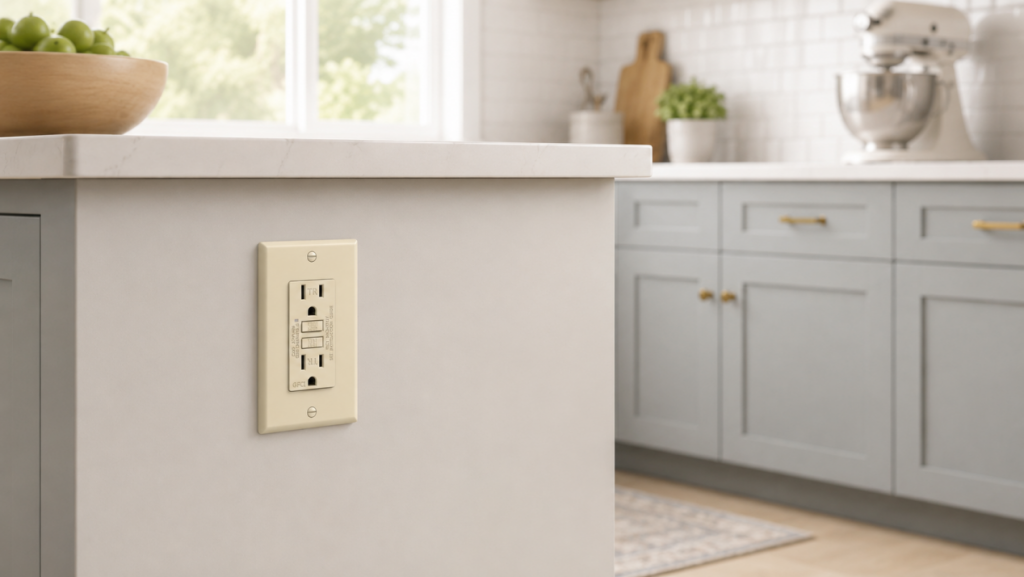
Modern kitchens often include islands and peninsulas. These zones are not just design features; they are real work surfaces. People use mixers, laptops, chargers, food processors, and warming appliances there.
Outlet placement should be planned early. Once stone countertops, cabinetry, and finished panels are installed, changing receptacle locations becomes expensive.
A good kitchen GFCI plan considers both code compliance and daily use. Minimum compliance does not always create a convenient kitchen.
Dedicated appliance locations
Refrigerators, dishwashers, garbage disposals, built-in microwaves, and similar appliances should be evaluated separately. The right protection method depends on the appliance instructions, circuit design, receptacle location, and local code.
Do not assume all fixed appliances need the same type of GFCI outlet. Some projects may use GFCI protection at the breaker level. Others may require a receptacle solution. The final choice should follow the electrical design and local inspection requirement.
15A vs 20A GFCI Outlet: Choose by Circuit, Not by Guesswork
The 15A vs 20A question is one of the most common issues when choosing a kitchen GFCI outlet.
A 15A GFCI outlet is designed for a 15-amp circuit. A 20A GFCI outlet is designed for a 20-amp circuit and usually has a T-shaped neutral slot. The visible difference is small, but the electrical meaning is not.
| Item | 15A GFCI Outlet | 20A GFCI Outlet |
| Common circuit match | 15A branch circuit | 20A branch circuit |
| Typical use | General residential areas, some replacement situations | Kitchen small-appliance circuits, higher-load areas, project installations |
| Slot design | Standard straight slots | T-slot neutral design |
| Selection rule | Match 15A-rated wiring and breaker | Use only when circuit, breaker, and wiring support 20A |
| Main risk if misused | Underrated for heavy load if circuit design is wrong | Should not be installed on a 15A circuit |
When a 15A GFCI outlet may be suitable
A 15A GFCI outlet may be suitable when the existing branch circuit is rated for 15 amps and the application matches that circuit design.
This is common in some older homes, certain replacement projects, or locations where the load is limited. The key is not whether the kitchen has many appliances overall. The key is what that specific circuit is designed to handle.
If the breaker, wiring, and circuit design are 15A, installing a 20A receptacle is not a proper upgrade.
When a 20A GFCI outlet makes sense
A 20A GFCI outlet makes sense when the kitchen circuit is designed for 20 amps. Many kitchen countertop small-appliance circuits fall into this category, especially in new construction, renovation projects, and contractor-led installations.
This is where a 20A self-test, tamper-resistant GFCI receptacle can be a practical choice.
But the full system matters:
- Breaker rating
- Wire gauge
- Circuit layout
- Appliance load
- Local code
- Installation method
A 20A GFCI outlet is not “better” by itself. It is correct only when the circuit is correct.
Never treat 20A as a universal upgrade
Frequent tripping is often misunderstood. Some users assume that replacing a 15A GFCI with a 20A model will solve the problem.
That can be the wrong move.
Tripping may come from appliance leakage, water intrusion, overloaded circuits, downstream wiring problems, shared neutral issues, or incorrect LINE/LOAD connections. A higher-rated receptacle does not fix those problems.
If a kitchen GFCI keeps tripping, diagnose the cause before changing the product specification.
Key Features to Look for in a Kitchen GFCI Outlet
After the location and amperage are clear, product features become the next filter. For kitchen use, the most relevant features are not decorative extras. They affect protection, installation, inspection, and maintenance.
| Feature | Why It Matters in Kitchen Use |
| UL or ETL certification | Supports U.S. market compliance and project acceptance |
| Self-test function | Helps monitor whether GFCI protection remains functional |
| Tamper-resistant design | Reduces risk of foreign-object insertion in residential spaces |
| LED indicator | Helps users and electricians identify trip, reset, or end-of-life status |
| Installation-friendly terminals | Improves wiring speed and reduces installation errors |
| Wall plate compatibility | Helps maintain a clean kitchen design |
UL or ETL certification
For the U.S. market, a kitchen GFCI outlet should have recognized certification such as UL Listed or ETL Listed status.
For a homeowner, certification means the product has been evaluated against relevant safety standards. For a contractor or distributor, it is even more direct: certification affects project approval, sales channel acceptance, and customer trust.
For B2B buyers, certification should not be treated as a logo on packaging. Ask for clear product documentation, model coverage, and certification consistency across 15A and 20A versions.
Self-test function
A self-test GFCI outlet automatically checks whether the ground-fault protection function is still working. This is especially useful in kitchens because the outlet may be used daily, but manual testing is often forgotten.
Self-test does not remove the need for regular manual testing according to the product instructions. It does, however, add another layer of monitoring.
For rental properties, multi-family housing, renovation projects, and contractor installations, self-test GFCI receptacles are usually the better long-term choice.
Tamper-resistant design
A tamper-resistant GFCI outlet, often marked as TR, includes internal shutters that help block foreign objects from being inserted into the slots.
For residential kitchens, apartments, schools, rental homes, and family spaces, TR design is not just a selling point. It is a practical safety feature.
If the project is intended for the U.S. residential market, TR GFCI outlets should be high on the selection list.
LED indicator, reset status, and installation-friendly terminals
A kitchen GFCI outlet should be easy to inspect and troubleshoot. LED status indicators help users understand whether the device is powered, tripped, miswired, or at end-of-life depending on the product design.
For electricians, terminal design also matters. Clear LINE and LOAD markings, secure wiring terminals, and reasonable device depth can reduce installation time.
This is where low-cost products often show their weakness. A GFCI outlet that saves a little on unit price but creates wiring difficulty or callbacks is not cheaper at the project level.
Style, color, and wall plate compatibility
Kitchen outlets are visible. They sit on backsplash walls, islands, peninsulas, side panels, and appliance zones. Color, shape, and wall plate compatibility affect the final look.
This does not mean safety should be sacrificed for appearance. It means the product line should support both.
For larger kitchen projects, it is useful to source GFCI outlets, standard receptacles, USB outlets, switches, and wall plates from a consistent product family. The result looks cleaner and is easier for contractors to manage.
GFCI Outlet vs GFCI Breaker: Which Setup Fits Your Kitchen?
A GFCI outlet provides ground-fault protection at the receptacle. A GFCI breaker provides ground-fault protection from the electrical panel for the circuit.
Both can be valid. The better choice depends on project design.
| Option | Best Fit | Main Advantage | Main Limitation |
| GFCI outlet | Local replacement, countertop outlet, visible reset access | Easy to reset at point of use | TEST/RESET buttons visible on backsplash |
| GFCI breaker | New construction, full renovation, whole-circuit protection | Cleaner outlet appearance, centralized protection | Reset requires access to panel |
| Downstream GFCI protection | Multiple receptacles on one protected run | Cost-effective when wired correctly | LINE/LOAD errors can cause protection problems |
When a GFCI outlet is the practical choice
A GFCI outlet is practical when the goal is to protect a specific kitchen receptacle or downstream outlets on the same run. It is common in replacement work, countertop receptacle upgrades, and smaller renovations.
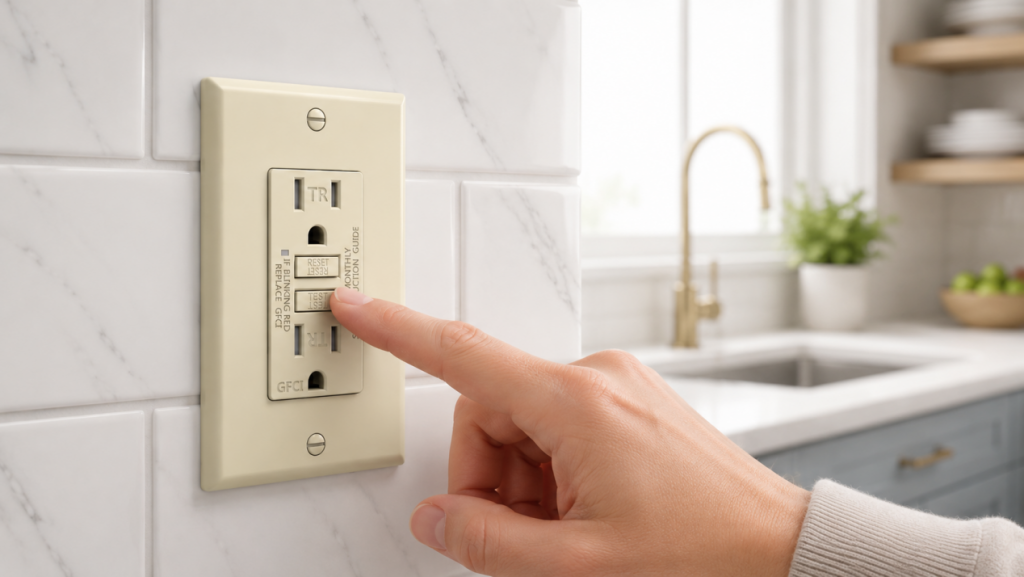
The reset button is right where the user needs it. If a countertop appliance trips the GFCI, the user does not need to walk to the electrical panel.
That convenience matters in daily kitchen use.
When a GFCI breaker may be better
A GFCI breaker may be better in new kitchens, full remodels, or projects where the designer wants a cleaner backsplash without visible TEST and RESET buttons on every protected point.
It can also simplify whole-circuit protection. But it is not always the cheaper or easier solution. Panel compatibility, breaker cost, circuit layout, and reset access all need to be considered.
For contractors, the best answer is usually project-specific.
Downstream protection must be wired correctly
One GFCI outlet can protect downstream receptacles when the LINE and LOAD terminals are wired correctly. This can reduce the number of GFCI devices needed on one circuit.
But wrong wiring creates real problems. It may leave downstream outlets unprotected, cause confusing trip behavior, or make troubleshooting harder.
Kitchen GFCI installation should be tested after wiring. Do not assume protection is working just because the device powers on.
Common Mistakes to Avoid When Choosing Kitchen GFCI Outlets
Many kitchen GFCI problems start before installation. The wrong specification, poor product quality, or weak understanding of the circuit can create problems that appear later as tripping, callbacks, or inspection issues.
Choosing by price only
A GFCI outlet is a safety device. Buying only by lowest unit price is risky, especially for contractors, wholesalers, and distributors.
Poor-quality devices may have inconsistent trip performance, weak terminals, unclear markings, short product life, or certification issues. The cost shows up later through returns, complaints, and installation labor.
For B2B projects, the better question is not “Which GFCI is cheapest?” It is “Which GFCI can stay consistent across batches, pass project requirements, and reduce service problems?”
Ignoring local code and circuit conditions
Online guidance can help with product selection, but it cannot replace local code review. Kitchen requirements depend on the adopted NEC version, local amendments, inspection practices, and the actual circuit.
Before selecting a GFCI outlet, confirm:
- Branch circuit rating
- Breaker rating
- Wire size
- Outlet location
- Appliance load
- Local inspection requirement
This is especially important in remodels and older homes.
Assuming every kitchen outlet needs the same product
Not every kitchen location has the same requirement. A countertop work surface, a sink-adjacent outlet, an island receptacle, a refrigerator location, and a charging zone may call for different planning.
The product family can be consistent, but the selection logic should not be lazy.
Misunderstanding frequent GFCI tripping
A tripping kitchen GFCI is not always a bad outlet.
Possible causes include overloaded small-appliance circuits, moisture, damaged appliances, old wiring, incorrect LINE/LOAD connections, downstream faults, or shared neutral problems. Replacing the receptacle without diagnosing the cause may only hide the issue for a short time.
Treat nuisance tripping as a system problem first, not a product complaint.
Quick Selection Checklist for Kitchen GFCI Outlets
Use the following checklist as a practical starting point before purchasing or specifying kitchen GFCI outlets.
| Project Situation | What to Check | Practical Direction |
| New kitchen construction or full renovation | Layout, countertop zones, island/peninsula needs, circuit design, local code | Decide early between GFCI outlets and GFCI breaker protection |
| Replacing old countertop receptacles | Existing circuit rating, wall box depth, LINE/LOAD wiring, old device condition | Use matching 15A or 20A self-test TR GFCI outlets |
| Older homes without grounding | Grounding conductor, replacement rules, labeling requirements | GFCI may be used in certain replacement situations with proper labeling |
| Frequent tripping issue | Appliance faults, moisture, circuit load, wiring errors | Diagnose before changing outlet rating |
| Contractor or bulk purchase | UL/ETL documents, model range, packaging, color options, batch consistency | Choose a supplier with stable certified product lines |
For most kitchen projects, a good selection process follows the same order: location first, circuit second, product features third, supplier reliability last. Skipping that order is where mistakes happen.
Why Choose Faith Electric for Kitchen GFCI Outlet Solutions
Faith Electric is a professional electrical manufacturer in China with 28 years of experience serving the U.S. market. We provide UL/ETL certified in-wall electrical solutions, including GFCI outlets, AFCI safety receptacles, USB outlets, standard receptacles, switches, and wall plates.
For contractors, distributors, wholesalers, and project buyers, kitchen GFCI outlet selection is not only about one receptacle model. It is about product consistency, certification support, installation-friendly design, packaging options, and long-term supply.
Faith Electric supports customers who need reliable wiring devices for residential, renovation, and project-based electrical applications. If you are sourcing GFCI outlets or building a complete in-wall electrical product line for the U.S. market, our team can help you review specifications and product options.
FAQ About Choosing GFCI Outlets for Kitchens
What type of GFCI outlet is best for a kitchen?
The best GFCI outlet for a kitchen should match the circuit amperage, carry recognized certification such as UL or ETL, include self-test protection, use tamper-resistant design, and fit the actual kitchen location.
For countertop areas, 20A GFCI outlets are common when the circuit is designed for 20A. For replacement work, always verify the existing circuit first.
Should I use a 15A or 20A GFCI outlet in my kitchen?
Choose based on the branch circuit rating. A 15A circuit needs a compatible 15A device. A 20A GFCI outlet should only be used when the breaker, wire, and circuit design support 20 amps.
Do not install a 20A receptacle on a 15A circuit just because the kitchen has high-power appliances.
Do all kitchen countertop outlets need GFCI protection?
Kitchen countertop receptacles are commonly subject to GFCI protection requirements in U.S. residential installations. The final requirement depends on the locally adopted electrical code and inspection authority.
Check the local code and have a licensed electrician confirm the installation plan.
Can one GFCI outlet protect other kitchen outlets downstream?
Yes, one GFCI outlet can protect downstream receptacles when connected correctly through the LOAD terminals. The installation must be tested after wiring.
Incorrect LINE/LOAD wiring can leave outlets unprotected or cause troubleshooting problems.
Is a self-test GFCI outlet worth it for a kitchen?
Yes. Kitchens are high-use areas, and self-test GFCI outlets help monitor whether the protection function remains operational.
Manual testing should still follow the product instructions, but self-test protection is a better choice for long-term residential and project use.
Final Thoughts: Choose Kitchen GFCI Outlets by Safety, Circuit, Code, and Reliability
The right kitchen GFCI outlet is the one that fits the location, circuit rating, appliance load, code requirement, and long-term use case. A 20A model is not automatically better. A low-cost model is not automatically cheaper. A visible GFCI outlet is not always better than breaker-level protection.
Make the choice as part of the whole kitchen electrical system.
Faith Electric provides UL/ETL certified GFCI outlets and complete in-wall electrical solutions for customers serving the U.S. market. Contact us to discuss your kitchen GFCI outlet specifications, bulk purchasing needs, or complete wiring device product line.