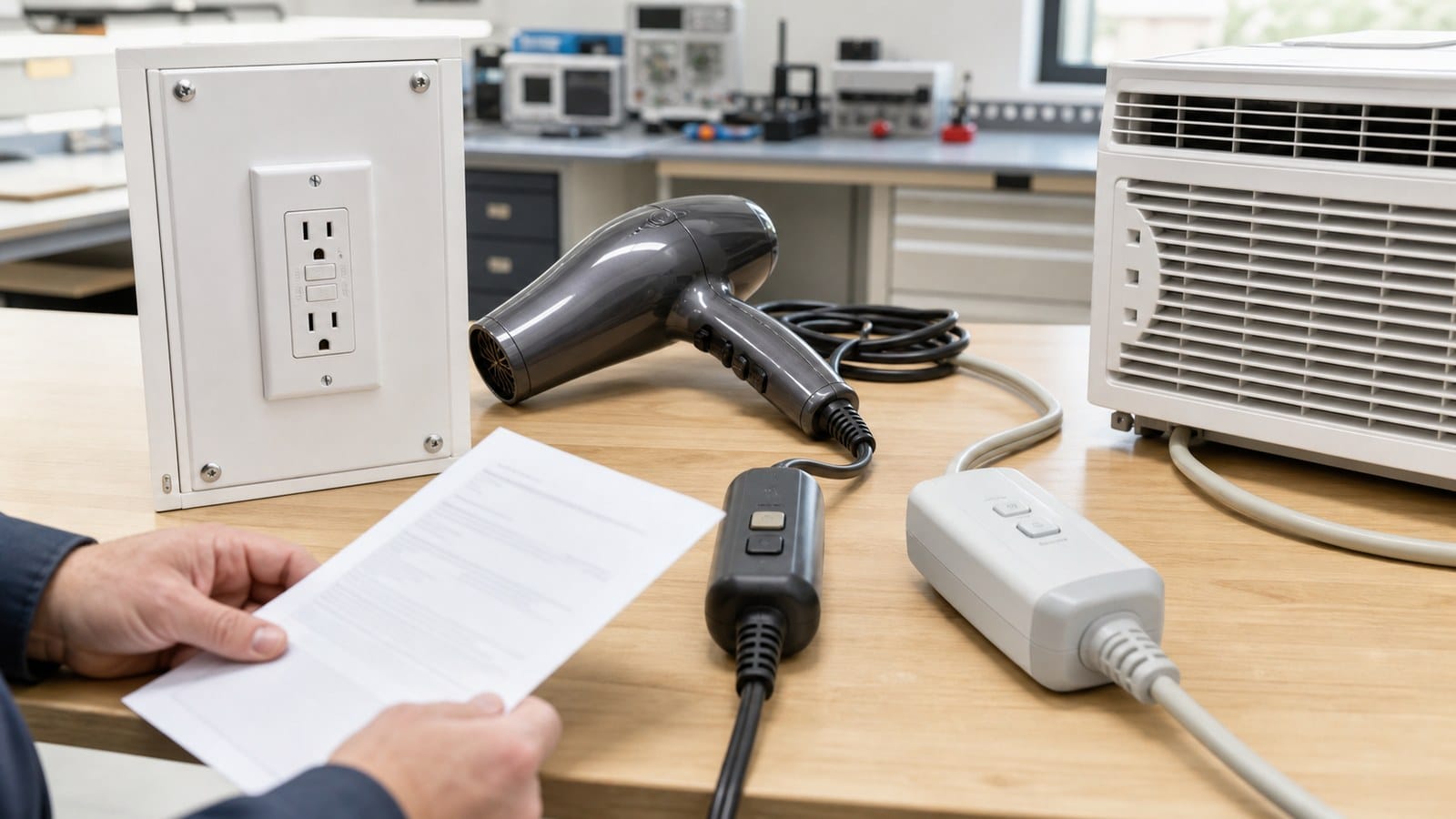
Construction-site GFCI protection is not a one-device decision. Under OSHA 29 CFR 1926.404(b)(1), an employer must use ground-fault circuit interrupters or an assured equipment grounding conductor program for specified construction-site receptacles. The practical starting point is the power path: identify the source, decide whether the receptacle is temporary or part of permanent wiring, record who will use it, and verify every protective device and cord in that path.
That distinction matters because a GFCI does not replace the equipment grounding conductor, overcurrent protection, correct conductor sizing, weather protection or routine inspection. A portable generator also does not create an automatic exemption. The narrow generator condition in the federal rule depends on the generator rating, winding configuration and isolation described in the regulation—not simply on the words “portable” or “jobsite.”
How this article was prepared: Faith Electric’s editorial team used AI-assisted drafting to organize the cited OSHA, CPSC, UL Solutions and NFPA materials, then checked the regulatory statements against those sources. No field testing, manufacturer approval, licensed-electrician review or authority-having-jurisdiction approval is claimed.
Start with the rule that actually governs the job
Federal OSHA’s construction regulation at 29 CFR 1926.404(b)(1) addresses receptacle outlets used by employees on construction sites. It requires an employer to use either GFCI protection or an assured equipment grounding conductor program as specified in the rule. The GFCI provision covers 120-volt, single-phase, 15- and 20-ampere receptacle outlets that are not part of the permanent wiring and are in use by employees.
This federal floor is only one layer. A project can also be governed by a state-plan OSHA program, contract specifications, the electrical code edition adopted by the jurisdiction, temporary-power rules in NFPA 70, the listing and instructions for the distribution equipment, and site-specific safety procedures. Treat those documents as an approval stack. If two requirements differ, the responsible contractor and authority having jurisdiction must resolve the applicable rule before energization.
One field table for the first decision
| Jobsite condition | Immediate action | Evidence to retain |
|---|---|---|
| Temporary 120 V, single-phase, 15 or 20 A receptacle used by employees | Provide approved GFCI protection unless the employer is operating a compliant assured equipment grounding conductor program under the applicable rule | Device identification, daily/required inspection record and test procedure |
| Permanent-building receptacle temporarily used during construction | Do not assume the temporary-receptacle wording settles the issue; check the adopted NEC, OSHA conditions, contract and site plan | Panel/circuit identification and adopted-code decision |
| Portable generator feeding tools | Verify the generator output arrangement, grounding/bonding instructions and whether the narrow OSHA generator condition applies | Exact generator model, manual, nameplate data and connection diagram |
| Wet or damp work area | Use equipment listed or identified for the environment, keep connections protected and inspect before use | Environmental rating, enclosure/cover details and inspection log |
| Trip during tool operation | Stop, isolate the load and inspect the complete source-to-tool path; never defeat the GFCI | Trip report, affected equipment and corrective action |
The table is a screening aid, not permission to energize. A qualified person should make the final site determination.
GFCI option versus an assured equipment grounding conductor program
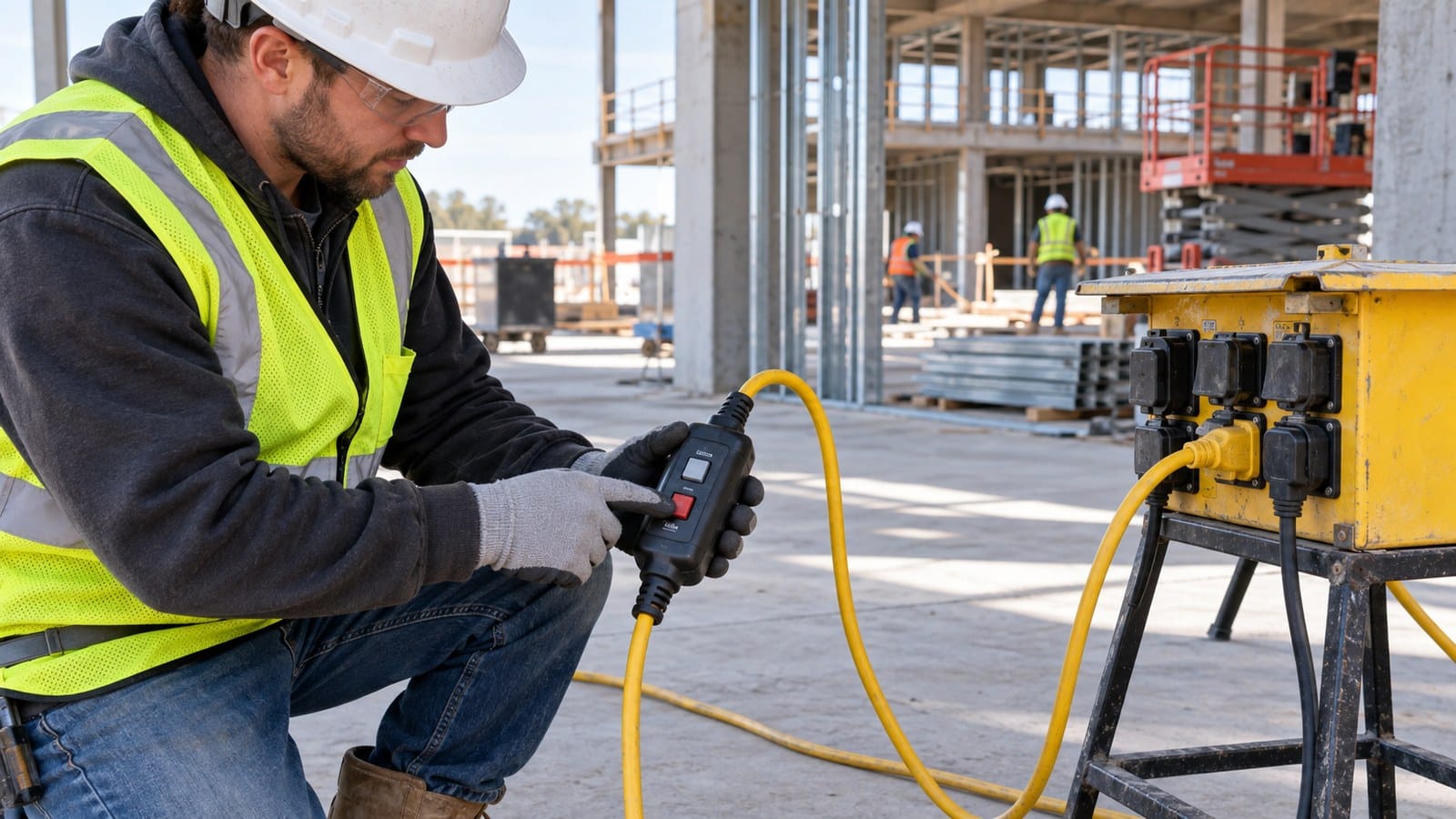
The GFCI route is usually straightforward to see in the field: protection may be provided at a temporary-power panel, a listed portable distribution unit, a receptacle, or a listed cord-connected device. What matters is that the selected arrangement protects the intended outlet and remains compatible with the source and downstream equipment.
An assured equipment grounding conductor program (AEGCP) is not a verbal promise that extension cords are grounded. OSHA 1926.404(b)(1)(iii) calls for a written program kept at the jobsite, implementation by one or more competent persons, visual inspections, prescribed continuity and wiring tests, and records of the required tests. The program covers cord sets, receptacles not part of permanent wiring, and cord-and-plug-connected equipment required to be grounded.
For procurement, the choice changes the paperwork. A GFCI-based plan needs the protective device’s exact model, listing information, ratings, instructions, test/reset access and the circuits it protects. An AEGCP needs a site procedure, assigned competent persons, suitable test equipment, test intervals, identification of inspected items and retained records. Buying “grounded cords” alone does not establish an AEGCP.
Permanent wiring and temporary power are not interchangeable labels
A receptacle mounted in a building does not become temporary wiring merely because a construction crew plugs into it. Conversely, a professionally built spider box remains temporary distribution when it is deployed for construction. Classification follows the installation and use, not how finished the equipment looks.
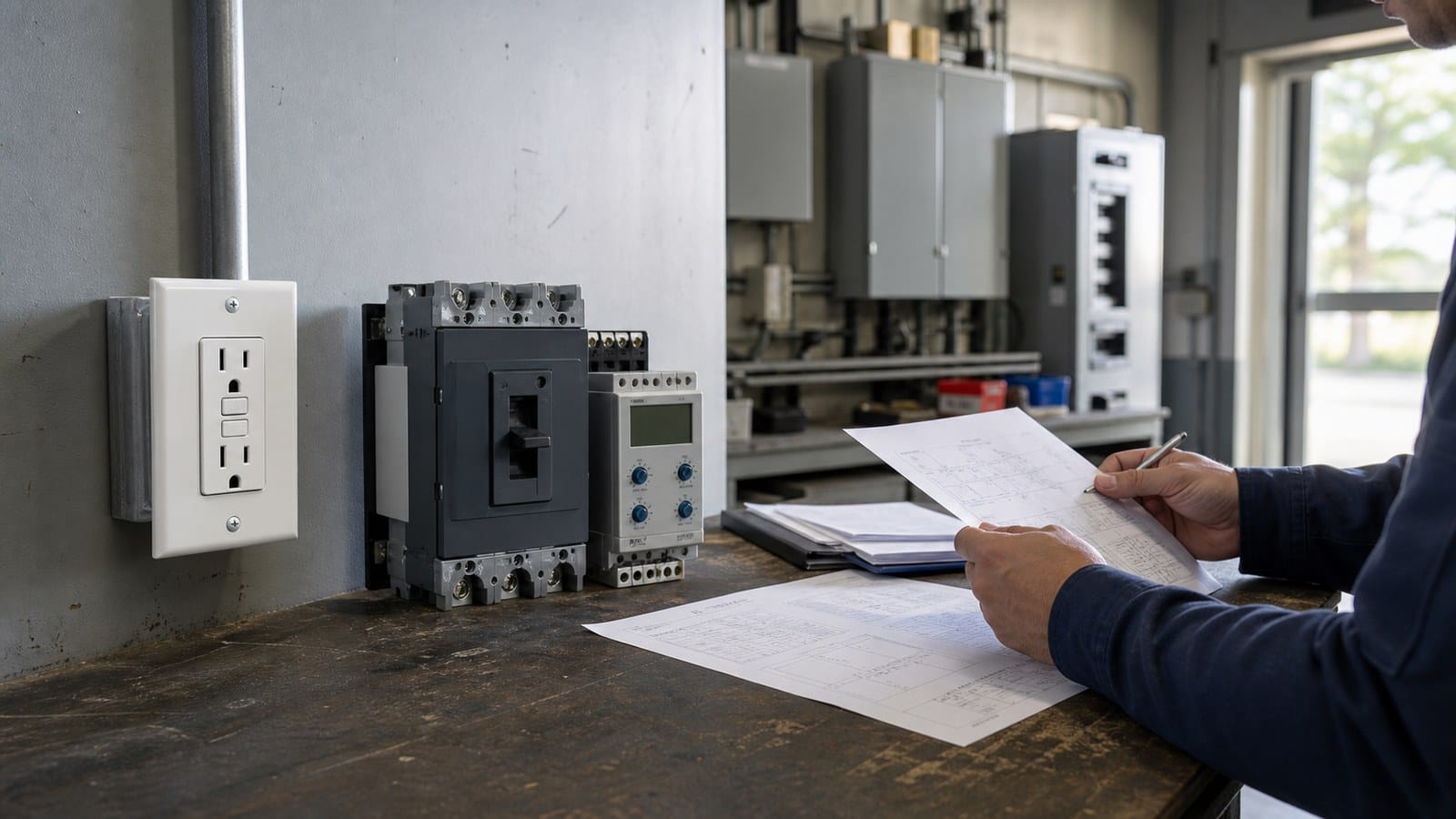
Before connecting tools, trace the circuit to its source. Mark the panel, breaker, feeder, distribution box and downstream outlets. If a branch circuit that will remain as permanent wiring is used during construction, document how personnel protection is being provided under the adopted rules. This prevents the common handoff problem in which the temporary-power team assumes the permanent electrical contractor supplied protection, while the permanent contractor assumes the outlet is still under the temporary plan.
For related product-level choices, Faith’s guide to GFCI receptacles versus GFCI circuit breakers explains how device location affects reset access and downstream protection.
Portable generators: verify the exact exception, not the category name
OSHA 1926.404(b)(1)(ii) contains a limited condition for certain small portable or vehicle-mounted generators. The provision refers to a generator rated not more than 5 kW, with circuit conductors insulated from the generator frame and all other grounded surfaces, and to receptacles supplied by a two-wire, single-phase system. A machine does not qualify merely because it is under 5 kW; the wiring configuration and isolation conditions also matter.
OSHA’s grounding provisions for portable and vehicle-mounted generators add another separate analysis. Depending on how the generator supplies cord-and-plug equipment or a structure, the frame may be permitted to serve as the grounding electrode only when all stated conditions are met. Follow the exact generator manual and site design. Do not improvise neutral-to-frame bonds, grounding electrodes or transfer connections.
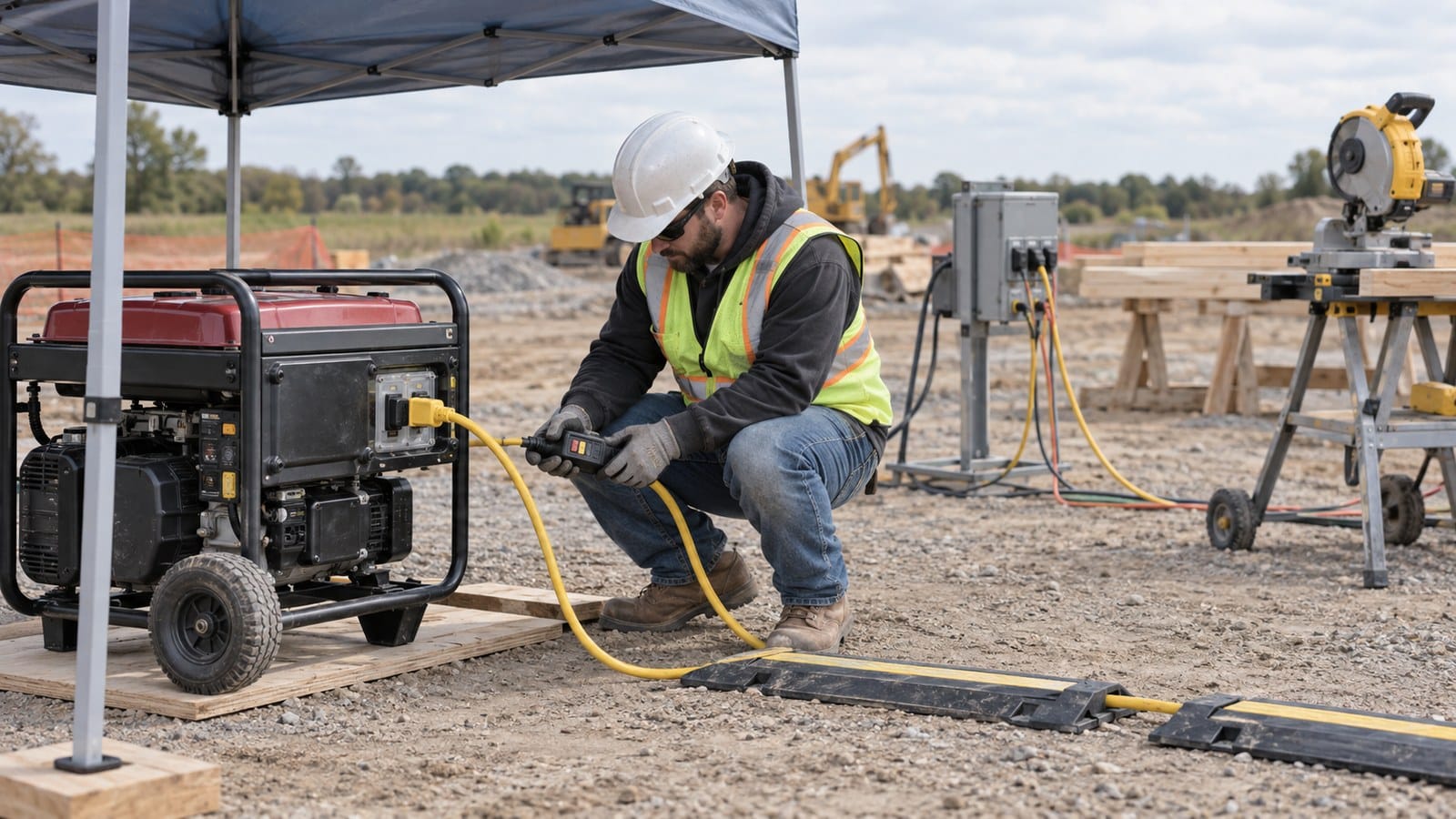
Illustrative application scene: the output arrangement and grounding method must be verified from the exact generator documentation.
The generator conversation must also include carbon monoxide. CPSC’s May 27, 2026 safety notice says portable generators should be operated outdoors, at least 20 feet from homes and buildings, with exhaust directed away from openings. On a construction site, use the same conservative separation from occupied trailers, temporary offices, shafts, air intakes and partially enclosed work areas. Electrical protection does nothing to control exhaust exposure.
Wet and damp conditions need more than a GFCI
A GFCI reduces shock risk by opening the circuit when it detects an imbalance, but it does not make an unsuitable plug, connector or distribution box weatherproof. OSHA’s portable-generator safety sheet advises using GFCIs—especially in wet or damp locations—and using electrical equipment identified for those conditions. Cords and connections should be kept out of standing water and protected from traffic, sharp edges and physical damage.
Do not wrap a damaged connector in plastic and call it weatherproof. Check the enclosure and cover rating, cord jacket, strain relief, connector closure, cable-entry orientation and drainage. If the manufacturer requires the cover to be closed while a cord is connected, confirm that the installed cover can actually do so.
Faith’s outdoor GFCI requirements guide covers weather-resistant receptacles and covers in permanent outdoor installations. Construction sites add temporary wiring, repeated handling and daily damage exposure, so the inspection routine must be tighter.
A field inspection that follows the actual power path
Begin before the first tool is plugged in. A useful sequence is short enough to repeat and specific enough to audit:
- Identify the source. Record utility power, temporary service, generator or inverter, including voltage, phase, grounding arrangement and source model where applicable.
- Trace the protected path. Identify the breaker, feeder, distribution unit, receptacle, portable GFCI, extension cord and tool. Confirm which device provides personnel protection.
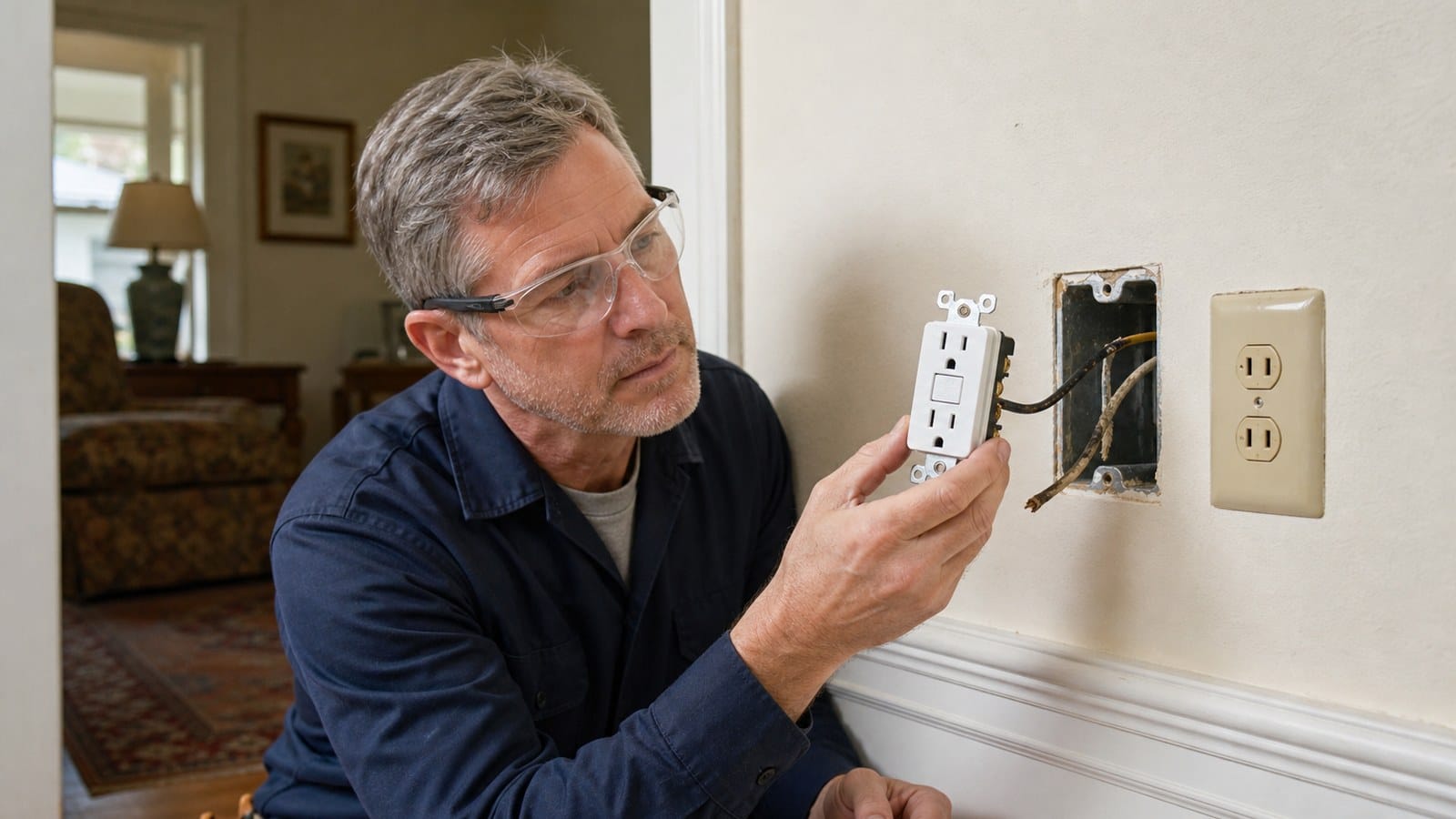
- Inspect condition. Look for broken covers, missing ground pins, crushed cord jackets, loose strain reliefs, moisture, heat damage, improvised adapters and exposed conductors.
- Verify suitability. Match voltage, current, interrupting rating, enclosure/environmental rating, plug configuration and listing to the application.
- Perform the prescribed test. Use the device manufacturer’s test procedure and the employer’s site program. A plug-in tester has limitations and does not replace the built-in test or a qualified electrical test.
- Control the result. If a device will not test, reset or hold under the verified no-load condition, remove it from service. Tag the affected circuit and record what was corrected.

Illustrative application scene: environmental suitability and physical condition are checked before energization.
What a trip means on a busy jobsite
Repeated resetting is not troubleshooting. Unplug the connected loads, inspect for damage or moisture, and restore the circuit only according to the device and site procedure. Reconnect one verified load at a time. If one tool causes the trip, quarantine that tool for evaluation. If the GFCI trips with the loads removed, the fault may be in the cord, distribution equipment, wiring or protective device.
Long cord runs, filters and several electronic tools can contribute leakage, but “nuisance trip” should never be the first diagnosis. Record the source, weather, equipment connected, sequence of events and corrective action. That record helps distinguish a damaged tool from a recurring distribution problem and prevents the next shift from repeating unsafe resets.
Never bypass the protective device, lift an equipment grounding conductor, use a three-to-two-prong adapter, or substitute a higher pickup device where personnel protection is required. If continuity, polarity or leakage testing is needed, assign it to a qualified person with appropriate instruments.
Procurement fields that prevent field improvisation
For a temporary-power package, treat the source, protection, distribution equipment and documentation as one approval set. A purchase description should include:
- source type, voltage, phase, frequency and available fault current;
- required personnel-protection method and every circuit it covers;
- exact listed product category, certification record and catalog number;
- receptacle configurations and current ratings;
- enclosure and environmental ratings, including covers used while connected;
- upstream overcurrent protection and interrupting rating;
- cord type, conductor size, length, plug/connector configuration and usage rating;
- test/reset location, indication and manufacturer test procedure;
- grounding and neutral arrangement, including generator instructions;
- inspection, tagging and record fields required by the site program.
This specification is more useful than “provide jobsite GFCI.” It gives the distributor, safety manager and electrical contractor the same data set to review. If a proposed substitution changes the breaker family, cord length, distribution-box rating or generator configuration, repeat the compatibility check instead of approving it by appearance.
Two questions that prevent common mistakes
Can a portable GFCI replace a GFCI breaker?
It can provide personnel protection only when the complete portable arrangement is listed and suitable for the source, circuit and environment, and when the applicable workplace and electrical rules permit that location in the protection path. It does not automatically correct an ungrounded, damaged or incorrectly wired distribution system.
Is pressing TEST once at delivery enough?
No. Follow the product instructions and the employer’s written program. Jobsite equipment is moved, dropped, exposed to moisture and reconfigured. Inspections and tests must follow the applicable OSHA program, manufacturer instructions and site procedure, with defective items removed from service.
Sources and references
- U.S. Occupational Safety and Health Administration, 29 CFR 1926.404(b)(1), Ground-fault protection, and 1926.404(f)(3), portable and vehicle-mounted generators, accessed September 10, 2026: https://www.osha.gov/laws-regs/regulations/standardnumber/1926/1926.404
- OSHA, Grounding Requirements for Portable Generators, Publication OSHA 3286, accessed September 10, 2026: https://www.osha.gov/sites/default/files/publications/OSHA3286.pdf
- U.S. Consumer Product Safety Commission, CPSC Warns of Generator, Carbon Monoxide and Fire Hazards Ahead of Hurricane Season, May 27, 2026, accessed September 10, 2026: https://www.cpsc.gov/Newsroom/News-Releases/2026/CPSC-Warns-of-Generator-Carbon-Monoxide-and-Fire-Hazards-Ahead-of-Hurricane-Season
- UL Solutions, Electrical Safety for Code Authorities, Design Professionals and Installers, accessed September 10, 2026: https://code-authorities.ul.com/about/buildingsafetyprograms/electrical-safety-code-authorities-design-professionals-and-installers/
- National Fire Protection Association, NFPA 70, National Electrical Code, Article 590 (use the edition adopted for the project), accessed September 10, 2026: https://www.nfpa.org/codes-and-standards/nfpa-70-standard-development/70
Safety and code disclaimer: General information only; not electrical design, installation instructions, an OSHA compliance decision or a code ruling. Follow applicable OSHA rules, locally adopted codes and amendments, listed-product instructions, the site safety plan and AHJ requirements. Qualified personnel must design, install, inspect, test and maintain temporary electrical systems.