
By Faith — Technical review pending.
A supplier offers an alternate housing material to avoid a production delay. The dimensions stay the same, the carton keeps the same model number and the next shipment is scheduled for Friday. Can purchasing approve the substitution?
Not on those facts alone. The buyer needs to know exactly what changed, whether the revised construction remains covered by the product certification, what evidence supports the change and which production lots will contain it. A commercial approval cannot answer all of those questions.
GFCI supplier change control is the process that connects a proposed modification to the approved product, the relevant certification review and a documented production transition. This guide covers finished GFCI receptacles purchased for OEM, private-label and distribution programs. It does not provide a circuit design or a universal test specification.

AI-generated editorial illustration. It depicts a generic sample review, not a Faith Electric inspection, facility or certification decision.
Keep buyer approval separate from certification authorization
UL Solutions explains that its Follow-Up Services inspections check continuing conformity with the original certification requirements, including consistency of materials and components with the applicable procedure. A changed part therefore needs more than a supplier’s statement that it performs the same job. See UL Solutions Follow-Up Services.
Use two separate review tracks. The buyer reviews the purchase specification, channel requirements and agreed quality controls. The manufacturer or certification holder handles the certification body’s applicable change process. Ask for written evidence of the outcome relevant to the exact construction and manufacturing location before releasing changed goods.
OSHA describes an NRTL certification mark as evidence of certification to appropriate product safety standards under its program. The mark is not a buyer’s authorization to substitute components. OSHA’s NRTL program overview explains the certification relationship.
Do not assume that every change requires identical testing or a new file number. The certification body determines the review needed within its program. A receiving inspector or purchasing manager should not make that determination from a photograph.
Establish what the supplier is allowed to build
Before asking for advance change notices, establish a baseline that both parties can identify. Otherwise, a notice saying “no change to approved specifications” may refer to a different revision than the buyer holds.
Record the exact model and suffixes, electrical ratings, construction revision, drawing revision, terminal method, installation instructions and approved label artwork. Add the applicable certification reference and authorized manufacturing location. Where proprietary records cannot be shared, agree on a controlled reference or redacted summary that still identifies the approved version.
Keep an approved sample with its approval date and document references. It helps resolve visible differences, but cannot prove hidden material grades, electronic design or certification coverage. A product photograph alone is a weak baseline.
Include packaging and channel documents. A carton label, instruction sheet or product-page claim can become inaccurate even when the device itself has not changed. For brand and artwork considerations, use the separate private-label GFCI buyer checklist.
Define the changes that trigger a notice
The following matrix is a suggested purchasing control. It is not a list of mandatory tests or a substitute for the certification file.
| Proposed change | Question the buyer should resolve | Evidence to request |
|---|---|---|
| Housing material or color formulation | Does the exact grade or formulation differ from the baseline? | Old and new material references, supplier rationale and relevant compliance review |
| Contact, clamp, screw or terminal structure | Could conductor accommodation or installation instructions change? | Revised drawings, installation comparison and qualified evaluation |
| PCB, sensing part or electronic component | Could protection, self-test or failure response change? | Controlled construction comparison and certification disposition |
| Mold, tool or manufacturing process | Could fit, assembly or a safety-related feature change? | Identification of affected features and process validation plan |
| Assembly or marking location | Is the location authorized for the changed product and marking activity? | Location details and applicable certification authorization |
| Product label, instructions or package claims | Do model identity, ratings and user directions still agree? | Marked-up artwork and controlled document revisions |
| Test fixture, software or acceptance limit | Will the method detect the same required failures? | Method comparison, validation and release authorization |
Terms such as “equivalent,” “cosmetic” and “temporary” should not exempt a change automatically. A color change may involve a formulation change. A tool repair may alter a dimension. Ask what physically changes before assigning the review level.
For an already approved alternate, have the supplier identify the authorization that covers it and the lots in which it will be used. A preapproved alternate still needs a traceable implementation record if the purchase agreement requires one.
Require a usable product change notice
A product change notice should let an unfamiliar reviewer understand the proposal without reconstructing a series of emails. Give it a unique reference and require these fields:
- Affected models, customer SKUs and current approved revisions.
- A side-by-side description of the old and new construction, documents or process.
- The reason for the change and the consequence of declining it.
- Proposed production date, first affected lot and expected first shipment.
- Existing stock, work in progress and open orders affected by the transition.
- Validation evidence and the status of the applicable certification review.
- Sample availability and any change to installation, packaging or channel claims.
- Supplier approval, buyer decision and conditions that remain open.
Agree on a notice period in the purchasing contract. There is no universal number of days that makes every GFCI change safe. A component substitution may need more review than a shipping-carton layout change. Build the schedule around the actual review work and contractual obligations.
Avoid approval by silence. State what happens if the buyer has not responded, and identify who can authorize a deviation. A request arriving before the agreed deadline is not itself permission to implement it.
Review the proposal in the right order
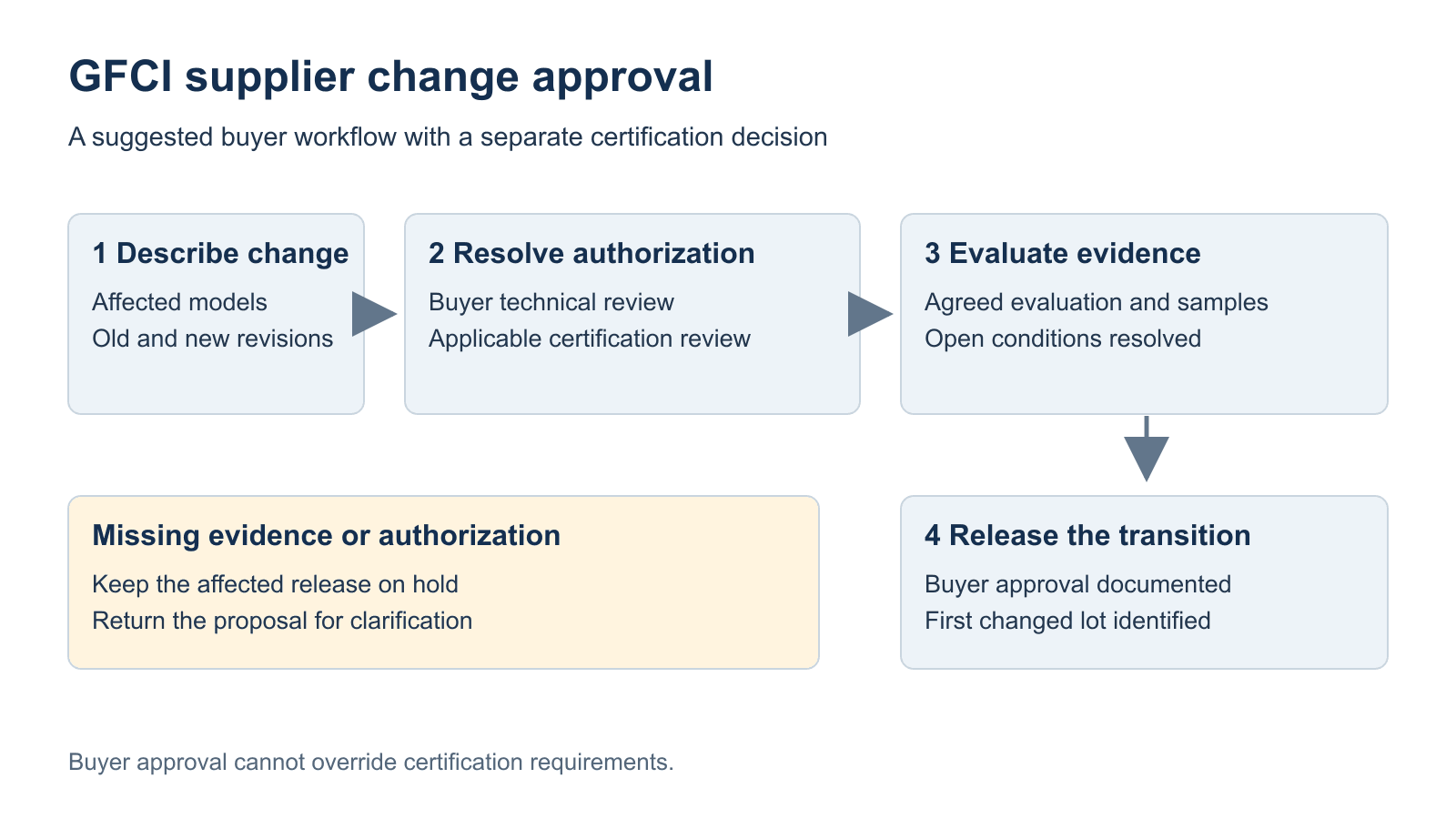
Suggested buyer workflow. Certification authorization and buyer approval remain separate decisions.
Start by checking completeness. If the notice does not name affected models or explain the difference, return it for clarification before arranging sample testing.
Next, have the responsible technical and quality reviewers assess the proposal against the controlled baseline. Ask which functions or dimensions could be affected and which documents require revision. The purpose is to define an evaluation that addresses the actual change, rather than request a generic “full test report.”
The certification holder should then resolve the applicable certification requirements. UL’s guide to submitting revisions describes how controlled product descriptions and procedure revisions are identified. Use a specific revised reference or applicable written disposition, not an unrelated certificate for the product family.
Review samples and evaluation results against the agreed plan. A simple power-on observation does not establish protection performance, durability or material compliance. Specialized assessments belong with qualified personnel and appropriate equipment. Do not invent trip thresholds, test voltages or pass limits for a receiving team to use.
Finally, approve the transition plan and update the buyer’s records before shipment release. Record whether approval is unconditional, limited to a pilot quantity or dependent on further evidence. “Sample accepted” should not be used as shorthand for all of these decisions.
Plan the last old lot and the first new lot
Even an acceptable change can create a receiving problem if old and new versions arrive under one unidentified stock code. The transition plan should explain how the warehouse will distinguish them.
Identify the last old-construction lot and first new-construction lot. Record quantities of finished goods and work in progress, and decide which open purchase orders can receive each version. Specify whether mixing versions in a carton or shipment is allowed and how mixed shipments will be documented.
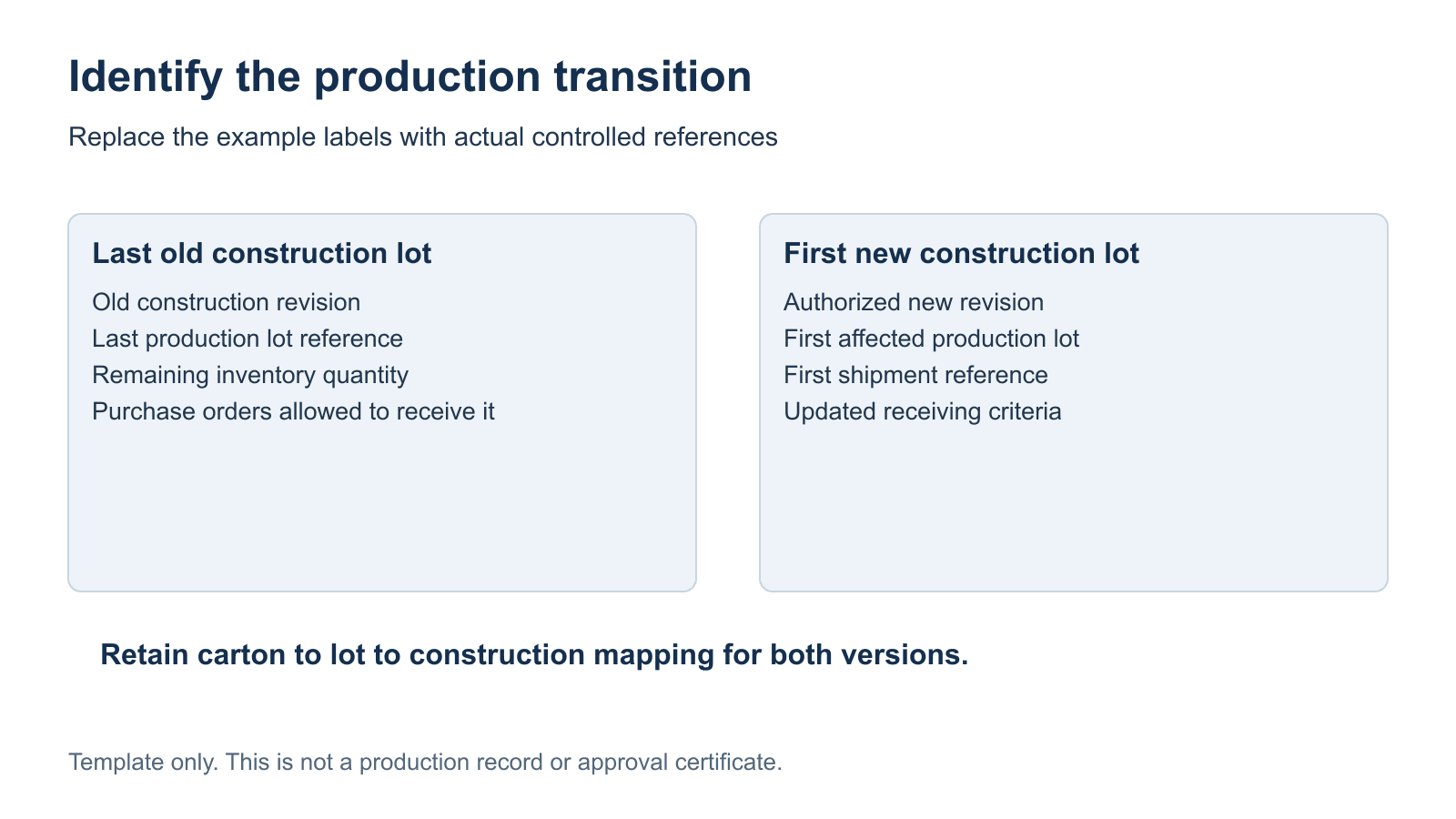
A transition record should identify actual lot references and shipment allocation. The diagram is a template, not production evidence.
Give receiving the revised comparison criteria before the goods arrive. Replace obsolete inspection references, retain the old version for historical orders and prevent an unapproved revision from becoming the default merely because it is the newest file in a shared folder.
If the supplier intends to use both approved constructions, make that explicit. The buyer may need separate inventory identifiers or lot-level records even when the public model number remains unchanged. Do not relabel old inventory as the new revision without an authorized, documented basis.
Handle urgent substitutions without losing the record
An emergency does not make the technical questions disappear. Ask the supplier to propose a defined temporary deviation with affected models, quantity, dates, construction difference and required authorization.
A temporary buyer concession should specify its limits and expiry. It should not authorize departure from certification requirements or applicable law. If the supplier cannot establish that the changed goods can be manufactured and marked under the relevant program, hold the affected release and resolve that uncertainty.
Consider commercial alternatives separately: use remaining approved stock, split the delivery, move the promised date or evaluate another qualified source. Record the choice and who made it. These are procurement options, not technical approval shortcuts.
Work through a proposed terminal change
Consider this hypothetical case: a supplier proposes a different terminal clamp because the original component is unavailable. The face, color and model marking remain unchanged.
The buyer first requests the old and new clamp references, drawings, conductor accommodation and instruction differences. Technical reviewers define what needs evaluation, while the certification holder establishes whether the alternate is covered or requires further authorization. Purchasing checks delivery consequences without approving construction independently.
If the proposal is accepted, the release record identifies the relevant evaluation, applicable certification disposition, revised instructions and first affected lot. Receiving gets photographs or drawings of the visible differences and the updated criteria. If the alternate cannot be distinguished externally, the supplier provides a lot-to-construction mapping instead.
This example does not establish that a particular terminal is interchangeable. It shows the information needed to make a controlled decision.
Put the expectation into the purchasing agreement
The following wording is a starting point for technical and contract review, not legal advice:
The supplier shall notify the buyer before implementing changes affecting the agreed product construction, materials, components, tooling features, manufacturing location, test method, markings, instructions or packaging. The notice shall identify affected models and revisions, describe the difference, provide relevant evaluation and certification disposition, and define the first affected production lot. Changed goods shall not be released to the buyer until the approvals required by the purchase agreement and applicable certification program are documented. Any approved temporary deviation shall state its quantity, duration and traceability requirements.
Define the reviewer roles and retention requirements separately. The supplier’s certification holder, the buyer’s technical approver and purchasing contact may be different people. For broader supplier selection, see how to vet a China GFCI manufacturer.
Questions buyers commonly ask
Does the same model number prove that nothing changed
No. A model number may remain the same across controlled revisions. Request the applicable construction revision and lot mapping when the purchasing program needs that distinction.
Can an approved sample replace the change notice
No. A sample can support comparison, but does not explain implementation dates, hidden construction differences or the certification outcome. Keep the notice and approval records with it.
Does every change need a new certification file number
Do not assume so. Ask the certification holder to document the applicable program’s disposition. The important question is whether the exact changed construction is authorized, not whether the number visibly changed.
What if the supplier considers the details confidential
Agree on redacted comparisons, controlled part references or qualified third-party review. Confidentiality arrangements should still allow the buyer to identify the difference, approval basis and affected lots.
Prepare the next OEM discussion
Before requesting a revised quotation, assemble the approved model list, document revisions, proposed change and required delivery date. Ask which technical records can be supplied for review and how the transition would be identified in shipments.
Browse the Faith Electric GFCI outlet category for the initial product discussion, then contact Faith Electric with those requirements. Verify certification coverage and available documentation for the exact proposed model; this article does not assert that a particular change or process is already approved.
Sources and preparation note
Sources checked on October 8, 2026. Dates below indicate this research check, not the publication date of the source.
- UL Solutions Follow-Up Services supports the distinction between the certified construction and continuing production conformity.
- UL Solutions guide to submitting revisions explains controlled descriptions and revision identifiers.
- OSHA NRTL program overview explains certification marks under the NRTL program.
AI assisted the research and drafting. The purchasing templates and hypothetical terminal example are editorial recommendations, not excerpts from a certification procedure or evidence of an actual supplier audit. Faith is the requested brand byline. Technical review is pending; this draft is not approved for publication. Product certification, installation suitability and local code acceptance require separate verification.