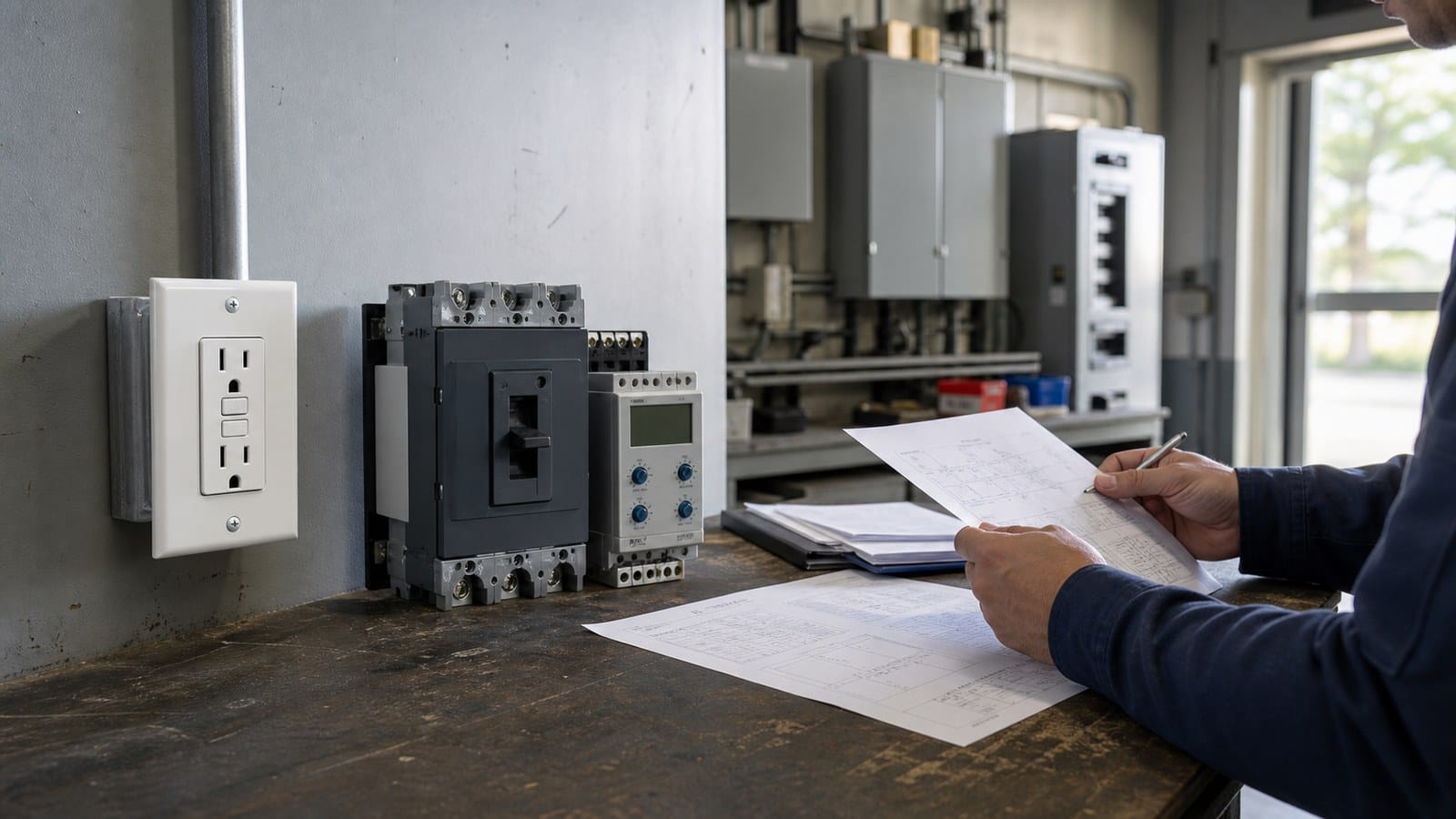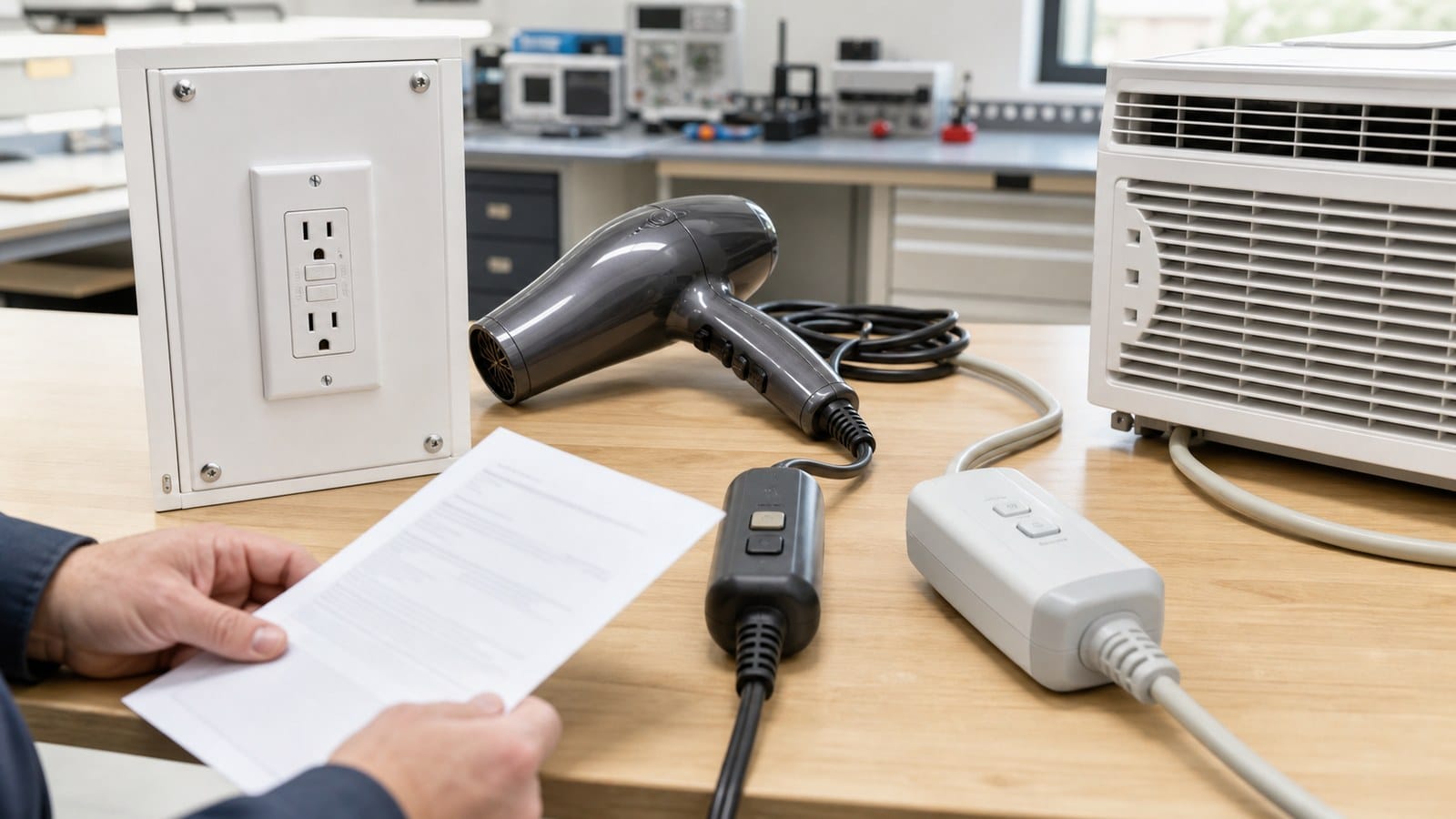
A 30 mA or adjustable ground-fault device should not be specified as a “stronger GFCI.” Class A GFCIs and equipment ground-fault protective devices serve different safety functions and are evaluated under different product categories. Start the submittal review with the required protective purpose, then verify the marked pickup, clearing method, ratings, certification record, and instructions.
How this article was prepared: Faith Electric’s editorial team used AI-assisted drafting to organize cited public sources, then checked the cited UL Solutions and U.S. Department of Energy materials. No laboratory testing, manufacturer approval, licensed-electrician review or authority-having-jurisdiction approval is claimed.
The distinction in one table
| Selection point | Class A GFCI | EGFPD / equipment ground-fault protection |
|---|---|---|
| Primary purpose | Personnel protection | Equipment protection |
| Typical operating level | Trips in the Class A range; UL material describes 4–6 mA operation | Operates above the Class A personnel-protection range at the pickup value marked for the evaluated product |
| Common product basis | UL 943 for GFCIs | UL 1053 or another category appropriate to the equipment-protection function |
| Typical form | Receptacle, circuit breaker or portable device | Breaker, relay, sensor-and-trip assembly or integrated equipment-protection device |
| Can it replace required GFCI protection? | It is the required function when the applicable rule calls for a listed Class A GFCI | No; equipment protection is not personnel protection |
| Buyer’s first check | Listing category, voltage/current rating, poles and installation instructions | Pickup setting/range, clearing device, system grounding, coordination and listed category |
The table is a screening tool, not a design rule. Some products combine functions, and some applications use special-purpose ground-fault circuit interrupters. Confirm the exact marking and certification record rather than inferring the function from appearance.
What “Class A” means in a purchasing specification
Class A identifies a personnel-protection function, not an enclosure grade or a marketing tier. The U.S. Department of Energy electrical-safety handbook describes Class A GFCI operation in the 4–6 mA range and distinguishes it from higher-threshold equipment protection. UL’s ground-fault device guidance likewise separates GFCIs from equipment ground-fault protective devices.
A procurement line that says only “ground-fault breaker” is incomplete. At minimum, state:
- required protective function: listed Class A GFCI for personnel, where applicable;
- circuit voltage, current, phase and number of poles;
- interrupting rating and panel compatibility for a breaker;
- receptacle configuration and feed-through requirements for a device;
- environmental and enclosure requirements;
- listing agency, product category and exact catalog number;
- required markings, test/reset arrangement and instructions.
Do not convert the phrase “5 mA sensitivity” into a substitute for a listing requirement. A component’s set point alone does not prove that the complete device was evaluated as a GFCI, will clear the circuit correctly or carries the markings required for the installation.
What an EGFPD actually does
An equipment ground-fault protective device disconnects a circuit when leakage exceeds its marked pickup level. EGFPDs operate above the Class A personnel-protection range at the pickup value marked for the evaluated product. Confirm the exact category, standard, pickup setting and installation conditions in the certification record and instructions. UL category information also states that equipment-protection devices are not intended to replace a GFCI where personnel protection is required.
Applications commonly associated with this category include fixed electric de-icing and snow-melting equipment and fixed electric heating for pipelines or vessels. Those systems can have normal leakage that makes a Class A threshold impractical, while still needing protection against deteriorating insulation or a developing ground fault. The adopted NEC edition, equipment listing and engineered design determine the actual device and setting.
An EGFPD may contain its own disconnecting means, or the protection scheme may use sensing and relaying equipment with a separate circuit breaker or contactor. That difference matters. Buyers should ask what actually opens the circuit, whether the clearing device is included, and whether the combination is listed or documented for the intended use.
EGFPD, GFPE and service ground-fault protection are related—but not identical
“GFPE” is often used as a functional description. “EGFPD” can identify a specific equipment category. Service equipment may use ground-fault sensing and relaying with much higher pickup values and time-delay coordination. These systems address fire and equipment damage; they are not Class A personnel protection.
This is why a one-column schedule labeled “GFP” creates ambiguity. A safer schedule separates:
- personnel-protection requirement;
- equipment-protection requirement;
- pickup or trip range;
- clearing device;
- applicable standard or listing category;
- location and equipment served.
If the same circuit needs both personnel and equipment protection, the design must coordinate both functions. Do not assume that adding two devices in series is automatically acceptable. Leakage, test routines, selectivity, neutral sensing and manufacturer restrictions can produce unwanted trips or failed coordination.
A realistic application comparison
Bathroom or kitchen receptacle
Where the adopted code requires Class A GFCI protection for personnel, use a listed solution suitable for the branch circuit. A 30 mA equipment-protection breaker is not a substitute. The device should be readily accessible for testing and resetting, and any downstream protection must be documented.
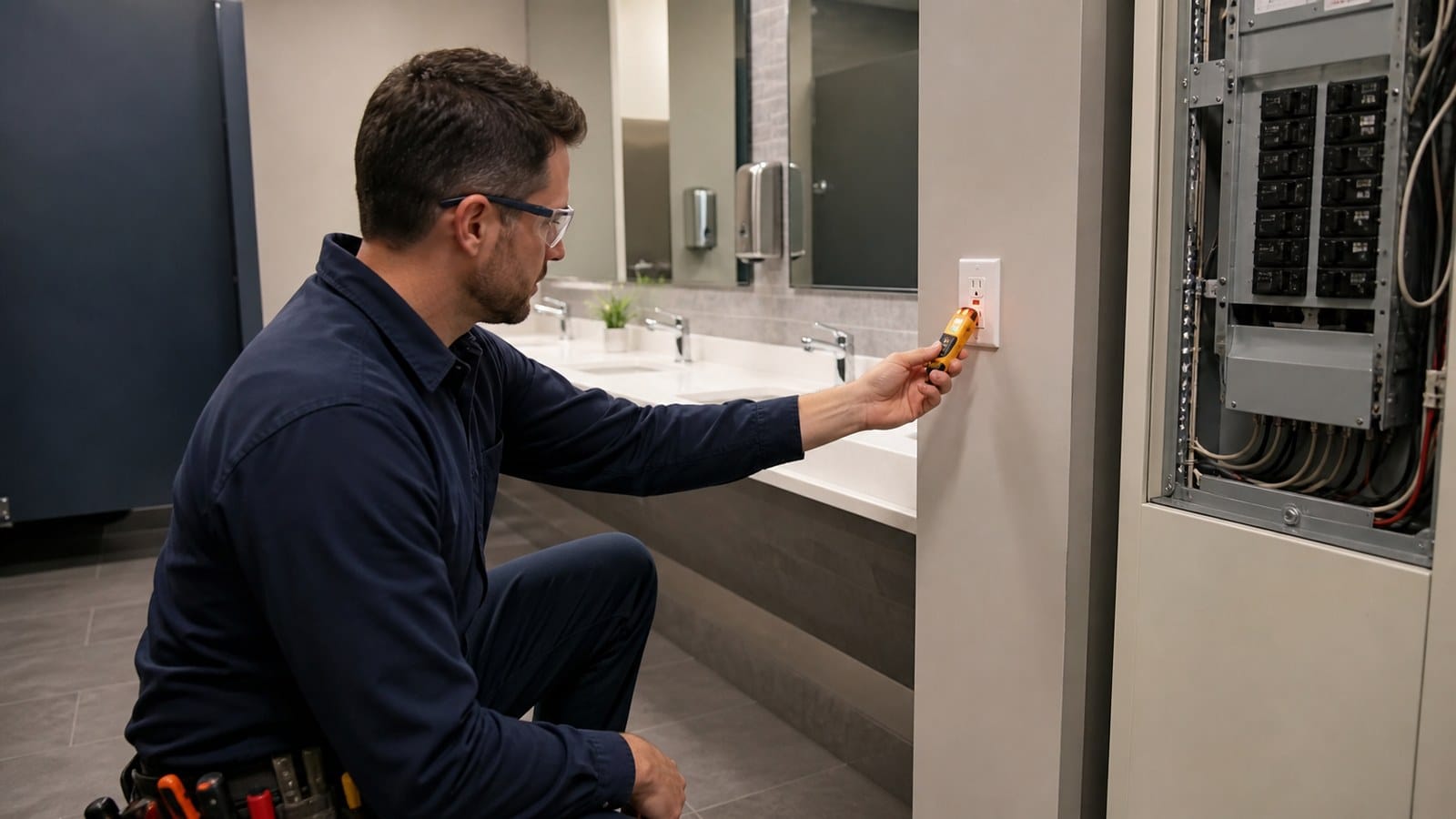
Illustrative application scene: Class A personnel protection is tested at an accessible receptacle. It is not represented as a Faith Electric customer project.
Fixed snow-melting system

Illustrative application scene: equipment-protection settings and clearing components are reviewed for a fixed heating system.
The equipment instructions and adopted code may call for ground-fault protection of equipment at a threshold above the Class A range. Here, selecting a standard receptacle GFCI simply because it is familiar can cause operational problems and may not meet the equipment-protection design.
Industrial feeder or service
Large systems may use ground-fault relays, sensors and breakers coordinated with downstream protective devices. A TEST button does not turn that assembly into a personnel-protection GFCI. The engineer’s study, breaker settings and commissioning records are part of the approval package.
Seven approval fields buyers should require
1. Protective purpose
Write “personnel protection” or “equipment protection.” Do not accept “ground-fault protection” without the object being protected.
2. Product standard and category
Verify the certification record in the listing agency’s database. For GFCIs, confirm the relevant GFCI category and UL 943 basis. For equipment protection, confirm the category and standard that match the product’s actual construction and use.
3. Pickup or trip characteristics
Record the marked value or range and whether it is fixed or adjustable. For adjustable protection, also document the approved setting and who is authorized to change it.
4. Fault-clearing method
Identify whether interruption is integral or depends on a separate breaker, contactor or shunt-trip mechanism. List every component required for the evaluated assembly.
5. Electrical ratings
Check voltage to ground, system voltage, phase, poles, frequency, continuous current and interrupting rating. A correct milliampere value on the wrong system is still the wrong device.
6. Grounding and neutral arrangement
Confirm whether the device monitors the neutral, whether all circuit conductors pass through the sensor, and whether the system grounding method matches the instructions. Multiwire and shared-neutral circuits need specific attention.
7. Test, maintenance and reset access
The owner needs a practical way to test and restore the protection. Record the test interval from the manufacturer, the reset location, expected indication and procedure after a trip.
For purchasing, treat the protective function, trip level, ratings, clearing device, certification record, markings and installation instructions as one approval set.
How to review a proposed substitution
A substitution should be checked against the approved protective function, not against the enclosure shape or the milliampere number alone. Ask the supplier to place the original and proposed catalog numbers on one comparison sheet. The sheet should identify the listing category, standard, fixed or adjustable pickup, clearing device, voltage-to-ground limit, poles, neutral treatment, interrupting rating, enclosure and required accessories. Any blank field is an unresolved engineering question, not an acceptable assumption.
Then compare the certification record with the nameplate and instructions delivered for the exact model. Confirm that optional sensors, shunt-trip units, breakers or contactors named in the record are included in the submitted assembly. If the setting is adjustable, the submittal should state the approved value, who may change it and how the setting is secured after commissioning. A broad product-family brochure is not enough when different suffixes carry different protection functions.
Finally, check maintainability. The test control, status indication and reset or disconnecting means must be reachable under the project’s operating conditions. Record what the owner should see after a self-test or trip and which document governs restoration. A protection scheme that cannot be tested without opening energized equipment, or that depends on an unidentified upstream device, needs design clarification before purchase.
Common specification errors
“30 mA GFCI” used without qualification
In U.S. product language, this phrase can mislead reviewers into thinking the device provides Class A personnel protection. State the listed category and intended function instead.
Selecting by TEST button
Test controls appear on multiple types of protective equipment. They demonstrate a test function, not equivalence among product categories.
Copying a European RCD description into a U.S. schedule
RCD terminology and trip ratings do not automatically map to U.S. GFCI categories. Use the certification, installation instructions and code terminology applicable to the U.S. project.
Ignoring normal leakage
Filters, drives, heaters and long conductors can contribute leakage. That may affect device selection and coordination, but it does not authorize replacing required personnel protection with a higher threshold. Resolve the equipment and circuit design with the manufacturer, engineer and AHJ.
Treating a component certificate as an end-product approval
A recognized component or sensing module may require additional evaluation inside the completed assembly. Match the certificate holder, model, conditions of acceptability and final product construction.
Preorder document checklist
- Single-line diagram and load schedule
- Adopted code edition and cited sections
- Written statement of personnel versus equipment protection
- Exact manufacturer and catalog number
- Listing certificate or database record
- Trip/pickup value and time characteristic
- Voltage, current, phase, poles and interrupting rating
- Required sensor, relay, breaker or contactor components
- Panel or enclosure compatibility
- Installation and test instructions
- Labels and panel-schedule wording
- Commissioning and maintenance record fields
If a supplier cannot connect the model number to a public certification record and a complete instruction set, hold the approval. A similar enclosure or matching current rating is not enough.
Sources and references
- UL Solutions, Understanding Ground Fault and Leakage Current Protection, accessed August 27, 2026: https://code-authorities.ul.com/wp-content/uploads/2014/04/ul_GroundFaultProtectiveDevices.pdf
- UL Solutions, Guide Information for Electrical Equipment—Equipment Ground-Fault Protective Devices, accessed August 27, 2026: https://code-authorities.ul.com/wp-content/uploads/2014/09/UL-White-Book.pdf
- U.S. Department of Energy, Electrical Safety Handbook, ground-fault circuit interrupter discussion, accessed August 27, 2026: https://www.energy.gov/sites/default/files/2026-05/DOE-HDBK-1092-98.pdf
- UL Solutions, Product iQ, certification-record database overview, accessed August 27, 2026: https://www.ul.com/software/product-sourcing-and-certifications-database
Safety and code disclaimer: This article provides general purchasing and product-selection information. It is not an electrical design, installation instruction or code ruling. Use the code edition adopted by the project jurisdiction, the complete listed-product instructions and the AHJ’s requirements. Qualified personnel should design, install, test and maintain ground-fault protection.