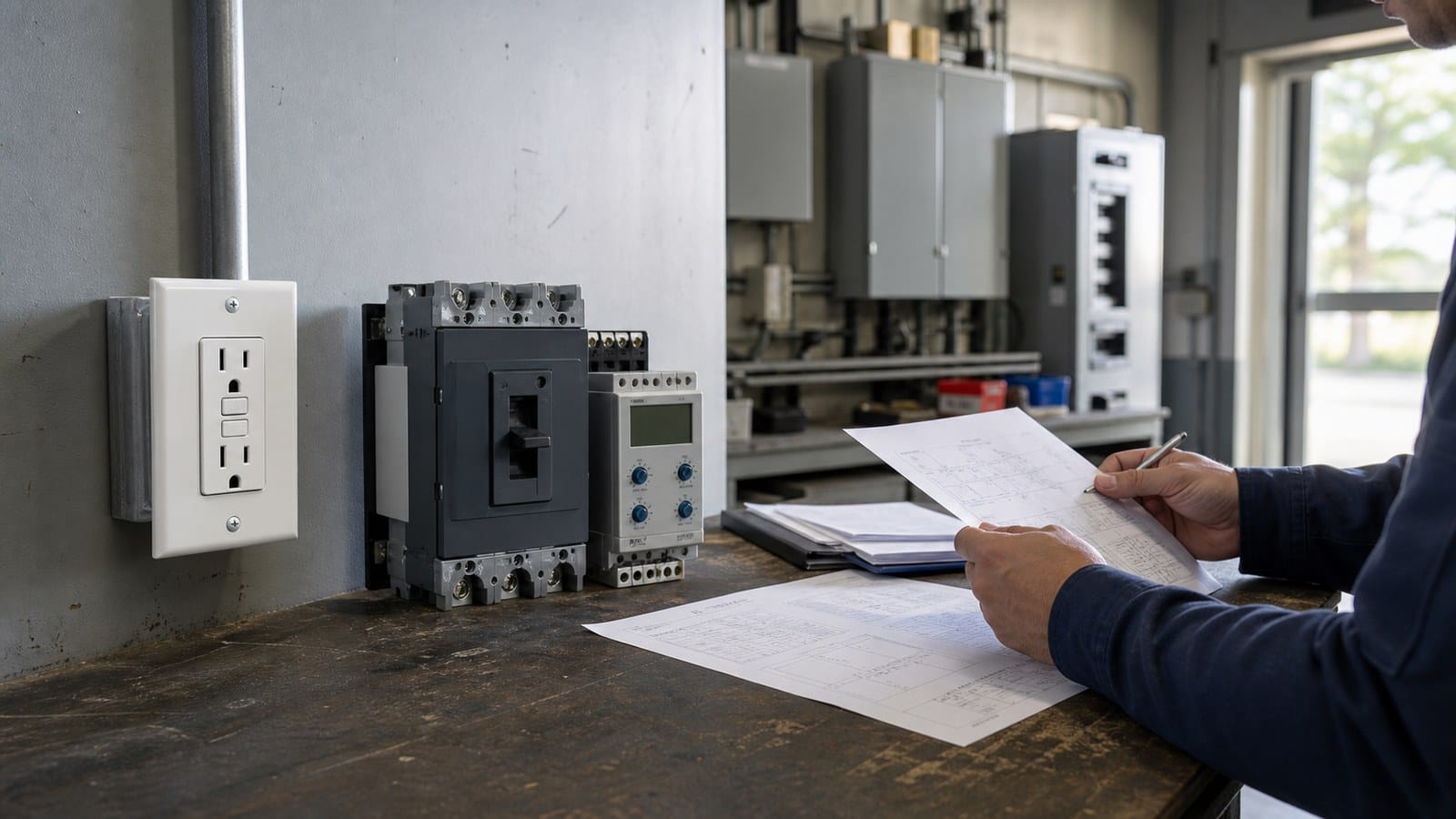
GFCI receptacle and GFCI circuit breaker both deliver ground-fault circuit interrupter protection. They cut power when they detect current leaking to ground, typically in the 4-6 mA range, to prevent shocks. The real decision comes down to where you install the protection and how many outlets one device needs to cover.
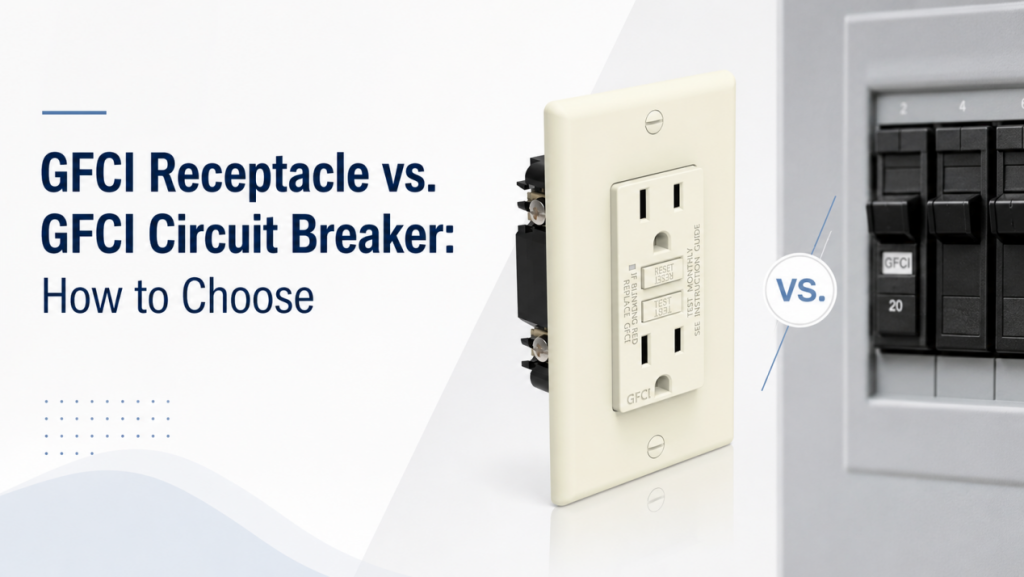
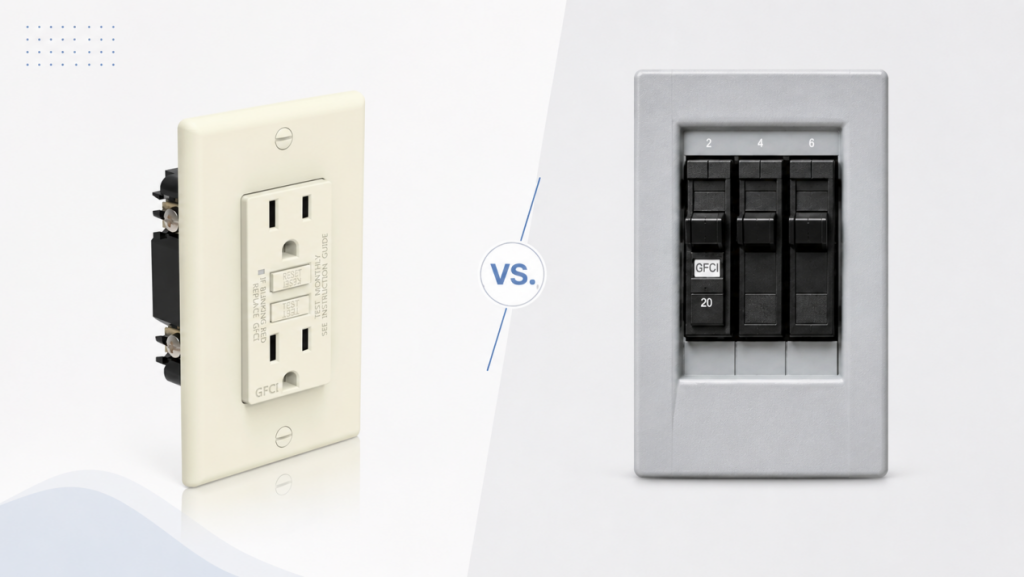
A GFCI receptacle (also called GFCI outlet) sits in the wall box and protects at the point of use. A GFCI circuit breaker installs in the electrical panel and guards the entire branch circuit from the source.
Choose a GFCI receptacle for targeted protection at one or two locations. Choose a GFCI circuit breaker when multiple outlets share the same circuit and need uniform coverage.
How GFCI Protection Works
A GFCI, or Ground Fault Circuit Interrupter, monitors the current flowing out through the hot conductor and returning through the neutral conductor. If the device detects an imbalance that suggests current may be leaking through an unintended path, it trips quickly and cuts power.
That unintended path could involve water, damaged insulation, a metal housing, wet equipment, or a person touching energized parts.
The safety principle is similar whether the protection is built into a receptacle or a circuit breaker. The difference is the protection point.
A GFCI receptacle works at the outlet box.
A GFCI breaker works at the panel.
That single difference changes installation cost, reset location, troubleshooting method, product selection, and project design.
GFCI Receptacle vs. GFCI Circuit Breaker: Key Differences
The main differences are easy to understand when placed side by side.
| Comparison Factor | GFCI Receptacle | GFCI Circuit Breaker |
| Installation location | Outlet box | Electrical panel |
| Protection range | Own outlet, plus downstream outlets if wired correctly | Entire branch circuit |
| Reset location | At the receptacle | At the panel |
| Typical cost logic | Lower per device | Higher per unit, but covers more of the circuit |
| Best use case | Local protection, replacement, retrofit | Whole-circuit protection, new wiring, multi-outlet circuits |
| User visibility | TEST / RESET buttons on the outlet | TEST button on the breaker |
| Troubleshooting | Easier to identify local trips | Better for centralized maintenance |
| Compatibility concern | Box depth, wiring, LINE / LOAD connection | Panel brand, breaker type, circuit rating |
| Buyer focus | 15A / 20A, TR, WR, self-test, UL / ETL listing | Panel compatibility, code requirement, UL 489 listing |
Location and Coverage
A GFCI receptacle is installed where the user plugs in equipment. This is why it is common in bathrooms, kitchens, garages, laundry areas, basements, and outdoor locations.
It can protect only itself, or it can protect other outlets downstream. That depends on how the LINE and LOAD terminals are wired.
A GFCI circuit breaker sits in the electrical panel and monitors the entire circuit. If the branch circuit feeds five receptacles in a garage, one GFCI breaker can protect all five.
This is the cleanest way to understand the difference:
A GFCI receptacle protects from the outlet point forward. A GFCI breaker protects from the panel forward.
Reset and Troubleshooting
A GFCI receptacle has TEST and RESET buttons on the face. When it trips, the user can usually reset it right at the outlet.
That is convenient when the receptacle is visible and accessible.
But not every outlet is easy to reach. If a GFCI receptacle is behind a refrigerator, washing machine, vending machine, garage cabinet, or commercial appliance, local reset becomes less convenient.
A GFCI breaker resets at the panel. For a facility manager, electrician, or maintenance team, this may be easier because protection is centralized. For a homeowner or tenant, it may be less convenient if the panel is in a basement, locked electrical room, or service area.
Reset location should match the user group. A residential kitchen and a managed commercial space do not have the same maintenance logic.
Cost and Project Budget
A GFCI receptacle usually has a lower device cost than a GFCI circuit breaker. For a single outlet replacement, this matters.
For example, if a contractor is replacing one standard receptacle near a laundry sink, installing one GFCI receptacle is usually more direct than replacing the breaker.
But project cost is not only product price.
If a branch circuit feeds six outdoor receptacles, installing one GFCI breaker may be cleaner than installing multiple GFCI receptacles. It may also reduce confusion about which device controls which outlet.
For contractors and distributors, the real cost includes:
- Device price
- Installation labor
- Troubleshooting time
- Replacement convenience
- Inventory planning
- Inspection and certification requirements
A lower-cost device is not always the lower-cost solution.
Installation and Compatibility
A GFCI receptacle installs in the outlet box, but it is usually deeper than a standard receptacle. In older homes, shallow boxes or crowded wiring can make installation harder.
This issue shows up often in retrofit work.
A GFCI breaker creates a different compatibility question. It must match the electrical panel, breaker type, circuit rating, and installation requirements. Breakers are not universal products. A 20A GFCI breaker is not acceptable just because the amperage looks correct; the panel compatibility still matters.
Panel-side work should be handled by a licensed electrician.
For product buyers, this difference matters. GFCI receptacles are easier to standardize across wall device programs. GFCI breakers are more tied to panel systems and breaker families.
When to Choose a GFCI Receptacle
A GFCI receptacle is usually the better choice when protection is needed at one location, when the project is a retrofit, or when users need visible TEST / RESET access.
Single-Point Protection or Local Replacement
If the goal is to protect one outlet location, use a GFCI receptacle.
Typical examples include:
- A bathroom vanity outlet
- A garage workbench outlet
- A laundry outlet near a utility sink
- An outdoor receptacle on a patio
- A kitchen counter receptacle replacement
- A basement outlet serving portable tools
In these cases, replacing a standard receptacle with a GFCI receptacle is often the most practical route, assuming the wiring and box conditions allow it.
This is common in service work. An electrician arrives to correct one non-GFCI outlet in a required area. The customer does not need a full panel-side redesign. They need compliant local protection.
Visible TEST / RESET Access
A visible GFCI receptacle gives users a clear control point. If the device trips, the RESET button is right there.
This is useful in locations where non-electricians may need to restore power after a nuisance trip. In a residential bathroom or garage, that matters.
For B2B buyers, this is also why self-test GFCI receptacles are now an important product category. A self-test GFCI automatically checks the protection function at regular intervals and helps reduce the risk of a failed device going unnoticed.
The more the end user interacts with the outlet, the more visible control matters.
Flexible Product Options for Buyers
GFCI receptacles also give buyers more product-level flexibility.
Common options include:
- 15A GFCI receptaclesfor standard residential branch circuits
- 20A GFCI receptaclesfor higher-rated circuits and commercial applications
- Tamper-resistant GFCI receptaclesfor residential and code-driven projects
- Weather-resistant GFCI receptaclesfor outdoor and damp-location applications when used with proper covers
- Self-test GFCI receptaclesfor added monitoring
- Different face colors and wall plate combinations
- Side wire, back wire, or clamp-style terminal designs depending on product type
For distributors and project buyers, this flexibility is valuable. It allows one product family to cover residential, light commercial, replacement, and contractor channels without changing the entire electrical protection strategy.
A GFCI receptacle is not just a safety device. In procurement terms, it is also a wall device SKU that must match rating, certification, appearance, installation habit, and supply consistency.
When to Choose a GFCI Circuit Breaker
A GFCI circuit breaker is usually the better choice when the entire branch circuit needs protection or when a project benefits from panel-side control.
Whole Branch Circuit Protection
If every outlet on a circuit needs GFCI protection, a GFCI breaker is often the cleaner option.
Consider a garage circuit serving several receptacles along the wall. If all of them require GFCI protection, one breaker can protect the full circuit from the panel. The wall outlets can remain standard receptacles, while the protection happens upstream.
This also applies to certain outdoor circuits, laundry areas, utility spaces, and specialty equipment circuits where the circuit design is clear and the panel is accessible.
For new construction or full electrical renovation, breaker-level protection can be planned from the beginning. That is different from retrofitting one outlet in an existing room.
Clean Wall Appearance and Space-Limited Outlet Boxes
Some projects do not want visible TEST / RESET buttons on every protected outlet. A GFCI breaker allows standard receptacles to be installed at the wall while the GFCI protection stays in the panel.
This can be useful in commercial spaces, high-end residential projects, hospitality areas, or projects where the wall device appearance needs to stay consistent.
It can also help when outlet box space is limited. Since GFCI receptacles are bulkier than standard receptacles, older shallow boxes may be difficult to work with. In those cases, panel-side protection may avoid a crowded box problem.
The visual difference may seem small, but on projects with dozens or hundreds of wall devices, consistency matters.
Centralized Maintenance for Larger Projects
For managed buildings, centralized protection may fit the maintenance workflow better.
A facility team may prefer resetting and testing at the panel rather than searching for a hidden GFCI receptacle behind equipment. This can be useful in light commercial buildings, multi-story spaces, workshops, and service areas where access is controlled by maintenance staff.
That said, centralized does not always mean convenient.
If the panel is locked or far from the protected area, users may lose access to power and have no way to reset it. For tenant spaces, bathrooms, hospitality rooms, and retail areas, that may create service calls.
Choose breaker-level protection when the maintenance model supports it.
Can One GFCI Receptacle Protect Downstream Outlets?
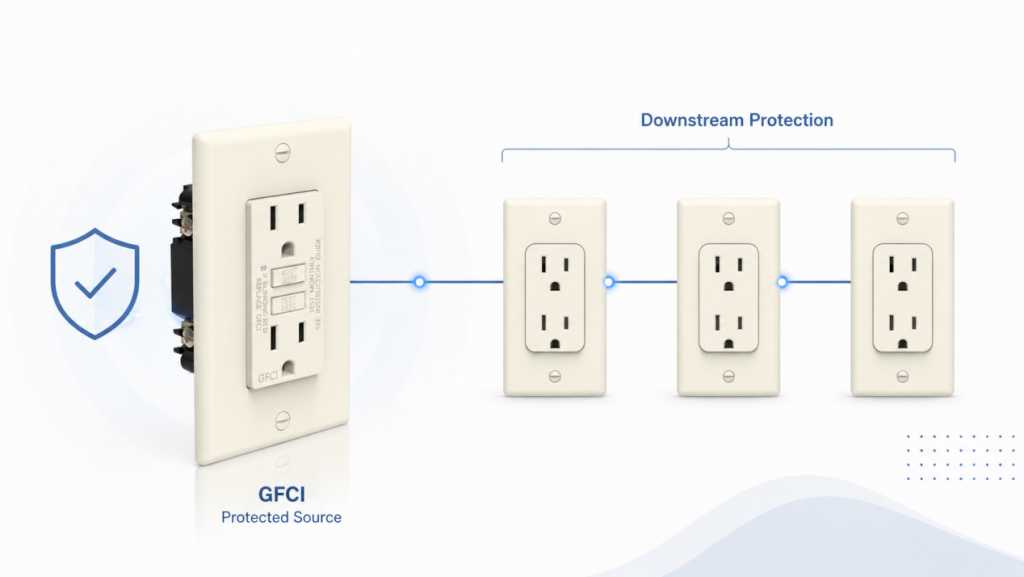
Yes. One GFCI receptacle can protect multiple downstream receptacles if it is wired correctly.
This is where many misunderstandings start.
A GFCI receptacle has LINE terminals and LOAD terminals. The LINE side receives incoming power. The LOAD side can send protected power to downstream receptacles on the same circuit.
That means a standard-looking receptacle with no TEST / RESET buttons may still be GFCI-protected by an upstream GFCI receptacle.
But there are limits.
A GFCI receptacle does not protect the wiring upstream between itself and the panel. It only protects the receptacle itself and the downstream side connected through LOAD.
Downstream protection also creates a practical troubleshooting issue. If an ordinary receptacle loses power, the user may not know that a GFCI receptacle in another room, garage wall, basement, or outdoor box has tripped.
For this reason, downstream protected receptacles should be correctly marked according to local requirements. Electricians also need to verify the LINE / LOAD connection carefully. Incorrect wiring can create false confidence or unexpected loss of protection.
This is one of the most important details in the GFCI outlet vs GFCI breaker discussion. Protection range depends on wiring, not just product type.
Code, Certification, and U.S. Market Compliance
GFCI protection is closely tied to electrical code and product certification, especially in the U.S. market.
Bathrooms, kitchens, garages, outdoor areas, basements, laundry areas, crawl spaces, and other wet or damp locations are common places where GFCI protection is required or expected. The exact requirement depends on the adopted NEC edition, local amendments, the authority having jurisdiction, and the actual circuit design.
Do not treat a blog article as a code ruling.
For procurement and project planning, certification also matters. A low-cost device without proper listing is not a serious option for the U.S. market.
Local Code and AHJ Requirements
The NEC, or National Electrical Code, provides the broad framework used across many U.S. jurisdictions, but local adoption varies. Some areas may use a newer edition. Others may have amendments.
The AHJ, or Authority Having Jurisdiction, has the final say on inspection and acceptance.
This affects the receptacle vs breaker decision. Some circuits may be acceptable with outlet-level GFCI protection. Other applications may favor or require breaker-level protection depending on the layout, equipment, and local interpretation.
For example, a simple bathroom receptacle replacement and a new outdoor equipment circuit are not the same design problem.
The correct approach is to choose the protection method after checking the circuit, location, device type, and local requirements.
UL / ETL Certification Matters
For the U.S. market, GFCI devices should be properly certified.
GFCI receptacles are commonly evaluated under UL 943, the standard associated with ground-fault circuit interrupters. Circuit breakers are commonly associated with UL 489. ETL Listed products are also tested by a recognized third-party laboratory to applicable safety standards.
For buyers, this is not a paperwork detail. Certification affects market access, contractor confidence, inspection acceptance, and liability risk.
When sourcing GFCI receptacles, check more than the face design. Review:
- UL / ETL listing
- 15A or 20A rating
- Tamper-resistant or weather-resistant design
- Self-test function
- Terminal structure
- Trip reliability
- Packaging and labeling
- Supply consistency for repeat orders
A certified product with stable quality is easier to sell, easier to install, and easier to defend in project documentation.
Final Selection Checklist: Which One Fits Your Project?
Use the following checklist as a practical decision tool.
Choose a GFCI Receptacle If…
A GFCI receptacle is usually the better choice when:
- You need protection at one outlet location
- The job is a replacement, retrofit, or local repair
- Users need visible TEST / RESET buttons
- The project is cost-sensitive
- You need flexible product options such as 15A, 20A, TR, WR, or self-test versions
- The wall box has enough space for proper installation
- You want a simple solution for bathrooms, kitchens, garages, laundry areas, or outdoor receptacles
This is the practical choice for many residential and light commercial outlet-level jobs.
Choose a GFCI Circuit Breaker If…
A GFCI circuit breaker is usually the better choice when:
- The entire branch circuit needs GFCI protection
- Several outlets on the same circuit require protection
- The project is new construction or a full circuit renovation
- You want standard receptacles on the wall without visible GFCI buttons
- Outlet box space is limited
- A maintenance team will manage testing and reset from the panel
- Local code or equipment requirements favor breaker-level protection
This is often the cleaner choice when protection is planned at the circuit level, not added one outlet at a time.
Avoid These Common Selection Mistakes
Several mistakes show up repeatedly in real projects.
The first is assuming a GFCI receptacle only protects itself. It may also protect downstream receptacles if wired through LOAD correctly.
The second is assuming GFCI protection creates an equipment ground. It does not. A GFCI device can provide ground-fault protection in some ungrounded retrofit situations, but it does not create a grounding path. Proper labeling and local code compliance still matter.
The third is adding both a GFCI breaker and a GFCI receptacle on the same circuit without a clear reason. More devices do not always mean better protection. Unnecessary double GFCI protection can make trip diagnosis harder.
The fourth is ignoring compatibility. Breakers must match the panel. Receptacles must fit the box and wiring method.
For special applications such as pools, spas, docks, and certain outdoor equipment, follow the applicable code, equipment instructions, and licensed electrician guidance. Those are not ordinary receptacle replacement cases.

FAQ: GFCI Receptacle vs. GFCI Circuit Breaker
Is a GFCI breaker better than a GFCI receptacle?
No. A GFCI breaker is not automatically better.
It is better for whole-circuit protection. A GFCI receptacle is better for local protection, visible reset access, and many retrofit projects.
The better choice depends on the circuit layout.
Do I need a GFCI outlet if I already have a GFCI breaker?
Usually, no.
If the GFCI breaker already protects the circuit, adding a GFCI receptacle on the same protected circuit is often unnecessary. It may also make troubleshooting harder because users may not know which device tripped first.
Specific applications should still follow local code and electrician guidance.
Can one GFCI outlet protect multiple outlets?
Yes. A GFCI outlet can protect downstream receptacles if the downstream wiring is connected through the LOAD terminals.
It does not protect the upstream portion of the circuit between the GFCI receptacle and the panel.
Can a GFCI receptacle be used on an ungrounded circuit?
In some retrofit situations, a GFCI receptacle may be used to provide ground-fault protection on an ungrounded circuit. But it does not create an equipment grounding conductor.
Labeling and local code requirements must be followed.
Which is cheaper, a GFCI outlet or a GFCI breaker?
A single GFCI outlet usually costs less than a GFCI breaker. But the total project cost depends on how many receptacles need protection, how the circuit is wired, and how much labor is required.
For one outlet, a GFCI receptacle is usually more economical. For a circuit with multiple protected locations, a GFCI breaker may make better project sense.
Final Recommendation
Choose a GFCI receptacle when the job needs local, visible, cost-effective protection at the outlet. Choose a GFCI circuit breaker when the circuit needs panel-side protection across multiple outlets or the project is planned around whole-circuit control.
For U.S. market projects, the device choice should also account for UL / ETL certification, 15A or 20A rating, TR / WR requirements, self-test function, local code, and long-term supply stability.
Faith Electric provides UL / ETL certified in-wall electrical solutions for the U.S. market, including GFCI receptacles, AFCI devices, USB receptacles, standard receptacles, switches, and wall plates. Contact us if you need support selecting certified wiring devices for residential, light commercial, or contractor supply programs.