Private labeling a GFCI outlet is not a logo-printing project. It is a controlled product program.
The face color, brand name, retail box, instruction sheet, model number, electrical rating, certification record, and production unit all need to describe the same device. If one item changes without the others, the buyer can end up with inventory that is difficult to list, sell, inspect, or support.
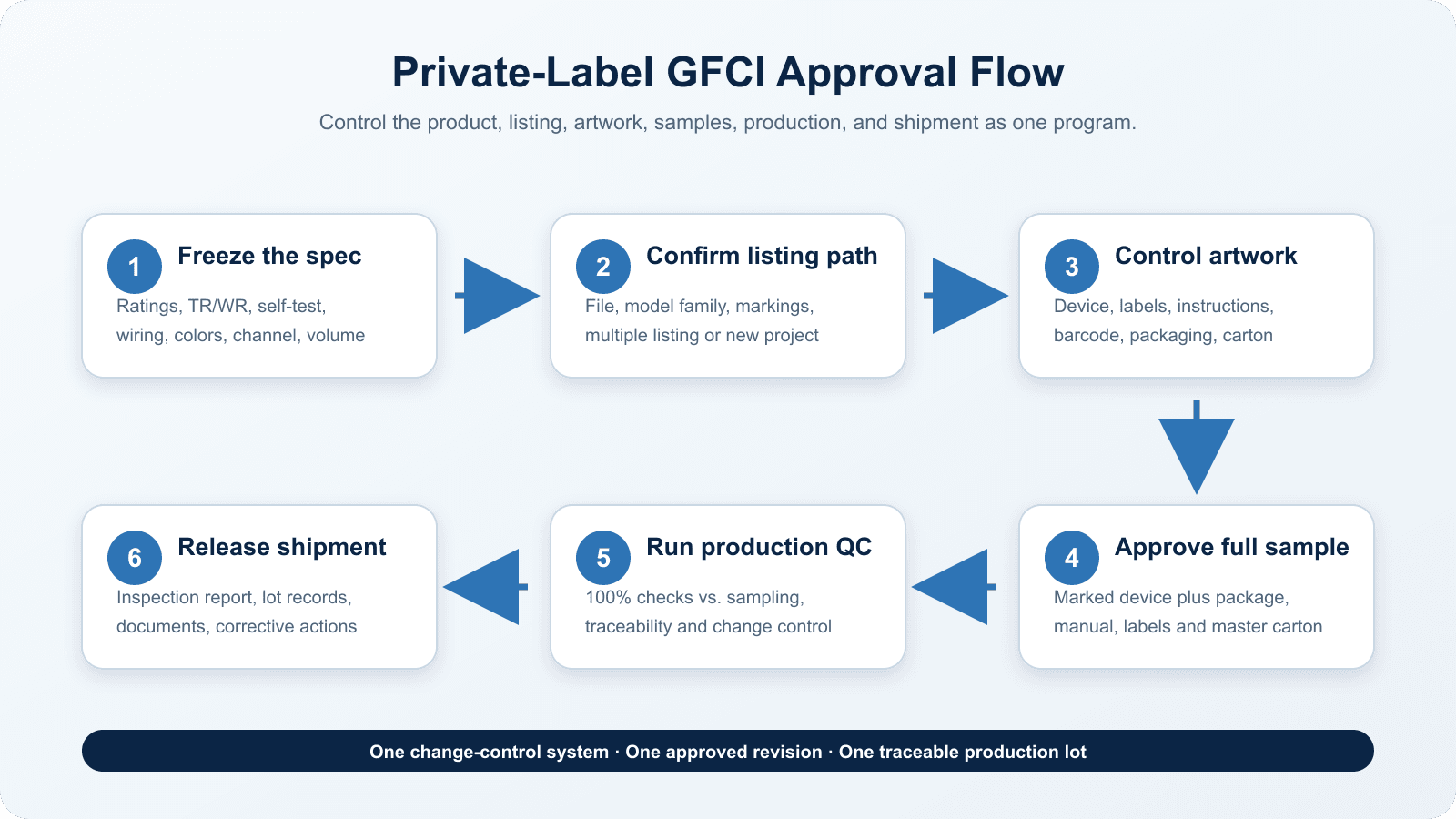
For U.S. distributors, importers, retail brands, and electrical supply companies, the safest order of work is simple:
- Freeze the product and market requirements.
- Confirm the certification path.
- Approve markings and documentation.
- Validate a branded pre-production sample.
- Release production under a written quality plan.
This guide explains each step in buyer language. It is not a substitute for advice from your certification body, customs broker, legal counsel, or local authority having jurisdiction.
The short answer: what should a buyer approve before placing a deposit?
Before paying a deposit for private-label GFCI outlets, approve one controlled package containing:
- The exact GFCI model and construction
- 15A or 20A rating, voltage, NEMA configuration, and feed-through rating
- Self-test behavior and indicator-light logic
- Tamper-resistant (TR), weather-resistant (WR), or other required versions
- The certification route and covered model numbers
- Device markings, certification mark authorization, and country-of-origin marking
- Retail or contractor packaging
- Installation instructions and wiring diagram
- Barcode, SKU, date/lot code, and master-carton mark
- Golden sample, test plan, inspection standard, warranty, and change-control process
If the supplier cannot put these items into one revision-controlled approval file, the program is not ready for mass production.
What “private-label GFCI” actually means
A private-label GFCI outlet is manufactured by one company and sold under another company’s brand. Depending on the project, customization may include:
- Brand name or logo
- Buyer-specific model number and SKU
- Device color and button color
- Retail box, contractor pack, or bulk pack
- Installation instructions
- Barcode and carton labels
- Product photography and data sheets
These changes do not all carry the same risk.
Changing a carton color is different from changing the device housing. Adding a buyer SKU is different from changing the model designation used in a certification record. Replacing a logo is different from changing terminals, printed circuit boards, plastics, contacts, firmware logic, or the self-test circuit.
The practical rule is: any change that touches the certified construction, required markings, model identity, ratings, or safety instructions must be reviewed before production. Do not let the purchasing team, graphic designer, and factory make those decisions in separate email threads.
Choose the certification path before approving artwork
There are three common sourcing paths. The right one depends on your brand strategy, sales channel, timeline, and the certification options available for the exact product.
| Sourcing path | What the buyer receives | Main advantage | Main limitation |
|---|---|---|---|
| Manufacturer-branded listed product | Product remains under the manufacturer’s existing brand and model system | Usually the simplest launch path | Limited private-label control |
| Private label under an authorized multiple-listing arrangement | Buyer’s brand can appear in the certification database for an identical certified product, subject to the certification body’s process | Stronger brand visibility and traceability | Requires formal approval; not every change is allowed |
| Buyer-owned certification project | Product is evaluated under the buyer’s own certification program | Maximum control over brand and product roadmap | Highest cost, longest timeline, and more ongoing compliance responsibility |
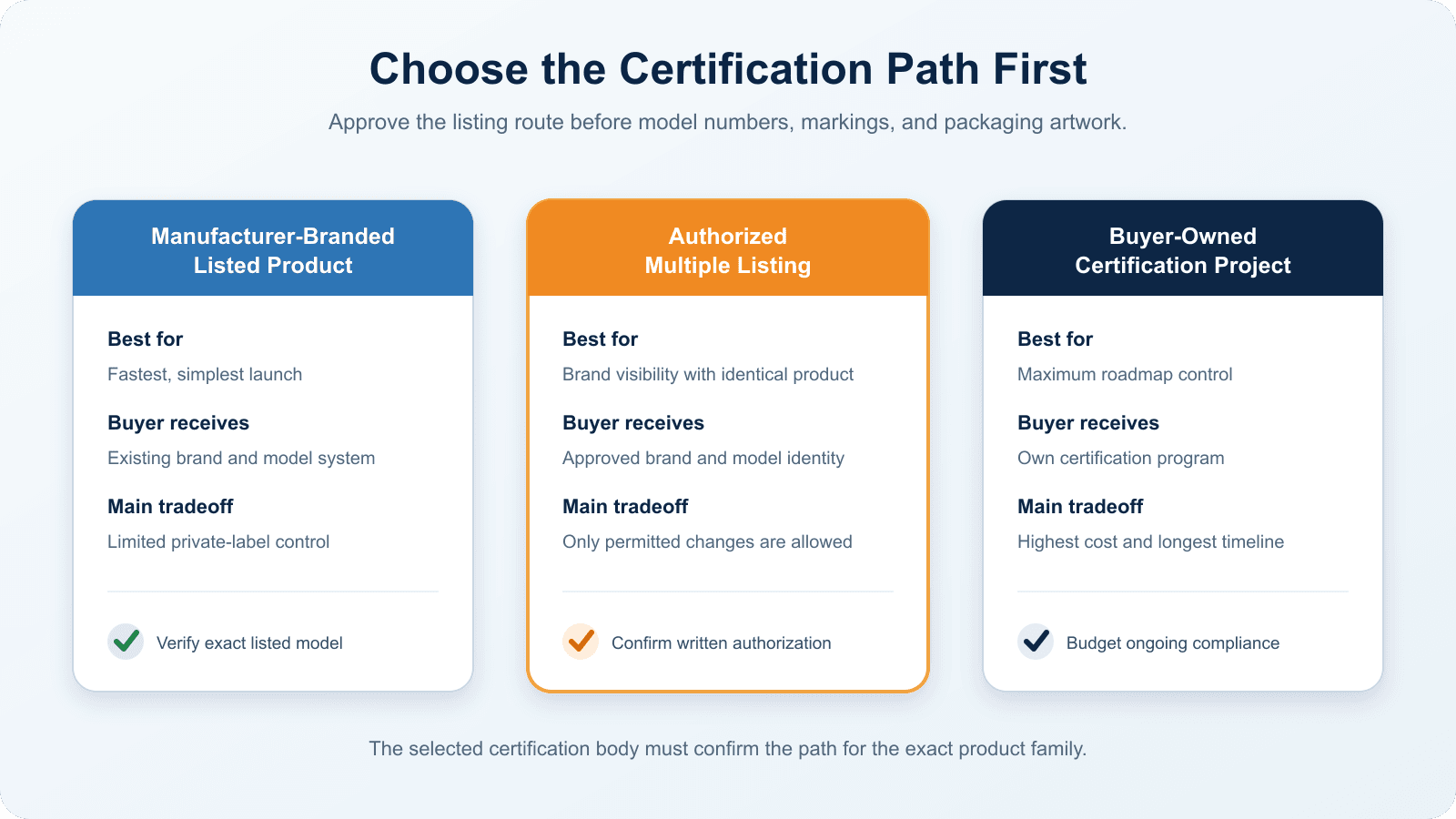
UL Solutions describes its Multiple Listing Service as a route for offering an identical UL Certified product under another brand name. The buyer’s brand can be included in UL Product iQ when the program is properly established.
That word—identical—deserves attention. A multiple listing is not permission to redesign a certified GFCI freely. The base manufacturer, private-label applicant, and certification body need to agree on what may change and how the product will be identified.
Other Nationally Recognized Testing Laboratories may use their own terminology and procedures. Ask the selected certification body for written instructions that apply to the exact GFCI family. Do not assume an arrangement used for one product category automatically applies to another.
A logo and a certificate image are not enough
OSHA explains that a properly certified product generally carries the registered mark of a recognized NRTL, is covered by a standard within that laboratory’s recognized scope, and is certified from a recognized site. OSHA also notes that NRTL recognition is not an endorsement of a particular brand. See the OSHA NRTL FAQ.
For a GFCI order, the buyer should verify at least:
- Certification body
- Certificate or file number
- Manufacturer name and manufacturing location where applicable
- Product category
- Applicable product standard
- Exact model or model family
- Electrical ratings
- Conditions or limitations stated in the listing
- Current certification status
UL Product iQ supports searches using details such as a file number, model number, product type, or company name. Save the verification record with the purchase-order file and repeat the check before a large reorder.
Freeze the product specification before requesting packaging
Buyers often ask for a branded box too early. That creates rework because packaging claims depend on the final product.
Start with a one-page specification sheet. It should answer the questions below without relying on catalog shorthand.
Electrical and configuration details
- Receptacle rating: 15A or 20A
- Rated voltage and frequency
- NEMA face configuration
- Feed-through rating, if downstream LOAD protection is provided
- Accepted conductor range
- Wiring method: side wire, back wire, or other listed method
- Terminal torque requirements
- Grounding and mounting features
Safety and application details
- Self-test or auto-monitoring behavior
- Failure response and reset behavior
- Indicator-light meaning
- TR, WR, hospital-grade, or other applicable designation
- Indoor, damp-location, or outdoor application limits
- Operating-temperature range where specified
- Compatible wall plate, box depth, and cover requirements
Do not select features by putting every available badge on the box. The combination must match the actual model and its intended channel.
For more background on feature selection, link readers to Faith Electric’s guides on 15A vs. 20A GFCI outlets, weather-resistant vs. tamper-resistant GFCIs, and self-test GFCI requirements.
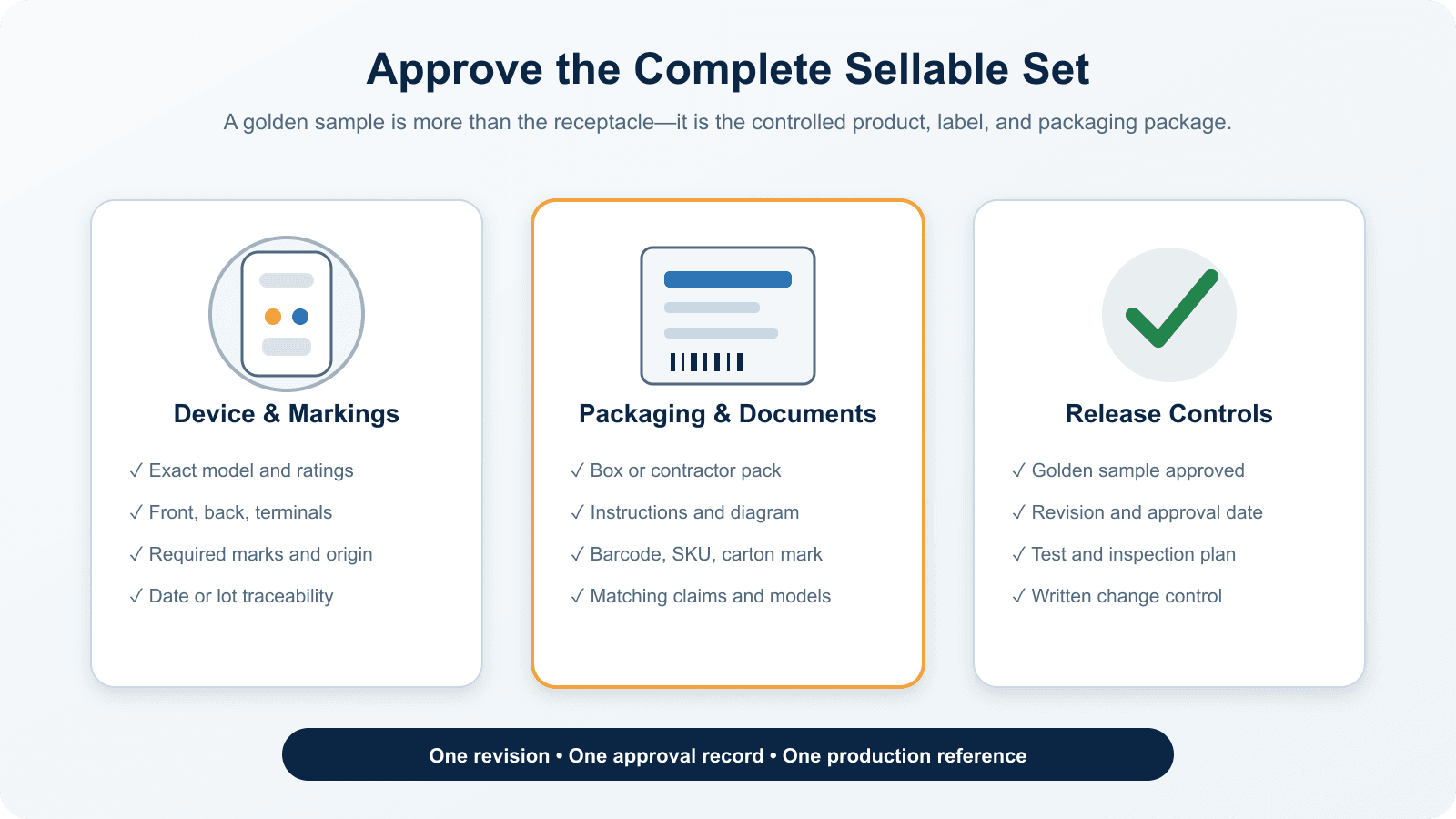
Build one controlled approval set
The approval set is the buyer’s reference for mass production. Give it a revision number and date. When a change is made, replace the complete set instead of approving a new box in one email and a new instruction sheet in another.
The set should include:
- Product front, back, side, and terminal-area artwork or photographs
- All molded, printed, laser-marked, or labeled information
- Buyer and manufacturer model numbers
- Certification mark and required control information
- Country-of-origin marking
- Retail box or contractor-pack dieline
- Installation and test instructions
- “GFCI Protected” and “No Equipment Ground” labels when supplied for the intended installation use
- Unit barcode, inner-pack label, and master-carton mark
- Revision code, date code, batch code, or other traceability method
Control the certification mark
Do not copy a certification mark from an old PDF or online image. The laboratory controls the mark and its use. UL Solutions maintains an Authorized Label Supplier Program to protect the integrity of UL Marks and reduce counterfeiting risk.
The approval process should confirm who is authorized to apply or supply the mark, where it appears, what control information accompanies it, and which models may carry it.
Keep country-of-origin marking visible and accurate
U.S. country-of-origin rules are separate from safety certification. CBP regulations implementing 19 U.S.C. 1304 generally require imported articles to be marked so the ultimate purchaser can identify the country of origin, subject to specific rules and exceptions. If U.S. geographic wording appears elsewhere on the product or package, additional presentation requirements may apply.
Have a customs professional review the actual device and packaging layout. Avoid vague phrases that could make a China-made product look U.S.-made. A private label changes the brand; it does not change the manufacturing origin.
Approve samples in stages
One hand-picked sample cannot prove that a private-label program is ready.
Use at least three approval stages:
1. Engineering sample
Purpose: confirm the product platform, function, dimensions, terminals, reset behavior, indicator logic, and application fit.
At this stage, branding may be temporary. The goal is to confirm that the base product is right before investing in final artwork.
2. Branded pre-production sample
Purpose: confirm the complete sellable unit.
Review the device, markings, box, instructions, labels, barcode scan, carton, and accessories together. Compare every model number and rating with the approved certification path.
3. Production-lot verification
Purpose: confirm that mass production matches the golden sample and approved documents.
Inspection should include packaging, workmanship, markings, model identity, critical dimensions, functional checks, and the agreed sampling or testing plan. The report should identify the production lot and inspection date.
For a broader supplier review, use Faith Electric’s 12-point GFCI manufacturer checklist.
Ask for evidence, not a list of test names
Many quotations contain a long testing list. The buyer still needs to know how production is controlled.
Ask the supplier:
- Which checks are performed on every unit?
- Which checks use lot sampling?
- What equipment and fixtures are used?
- How are stations calibrated and identified?
- What is the acceptance rule for a failed sample?
- Can the result be tied to a date code or production lot?
- How are rejected units contained and reworked?
- Who approves a process or component change?
- How long are test and inspection records retained?
The answer should distinguish design/type evaluation, routine production checks, and buyer inspection. Those are not interchangeable.
A useful quality agreement also covers traceability, retained samples, corrective action, complaint handling, field returns, and notification before changes to components, tooling, construction, labels, or production location.
Treat the importer role as a real responsibility
Private-label buyers sometimes assume the factory carries all U.S. product responsibility. That is a dangerous assumption.
The U.S. importer, distributor, and retailer may have independent duties. CPSC states that manufacturers, importers, distributors, and retailers can have a legal obligation to report information about defective or hazardous consumer products. Review the CPSC duty-to-report guidance and set an internal escalation path before products ship.
At minimum, the commercial agreement should identify:
- Who receives complaints and incident reports
- Who investigates returned units
- How both parties share lot and test records
- Who pays for reinspection, rework, or replacement
- How a stop-ship decision is made
- Who communicates with the certification body
- How regulatory reporting and a possible corrective action are handled
These clauses do not replace legal advice. They prevent the worst possible process: deciding responsibilities after a field problem occurs.
Common private-label GFCI mistakes
Approving the box before the model
The product changes, but old claims remain in the artwork. Freeze specifications first.
Using a certification mark without confirming authorization
A familiar mark on a rendering does not make the product listed. Confirm the current program and exact model.
Letting the buyer SKU replace the certified identity
Buyer SKUs are useful, but they must map clearly to the certified model and factory records.
Mixing TR, WR, and self-test claims
These features solve different problems. Only claim what the ordered model provides.
Accepting a “golden sample” without packaging
The approval sample must represent the sellable set, not only the device.
Failing to control revisions
An instruction-sheet change can create the same confusion as a product change. Put device, label, manual, box, and carton under one revision system.
Buying on unit price alone
The lowest quote may exclude listing support, private-label administration, packaging development, testing records, inspections, or after-sales obligations. Compare the total program, not only the receptacle price.
A practical RFQ checklist for private-label GFCI outlets
Send the supplier a structured RFQ containing:
- Destination market and sales channel
- Expected annual volume and first-order quantity
- Required 15A/20A and TR/WR variants
- Target colors and packaging format
- Preferred certification path
- Buyer brand, SKU, and barcode requirements
- Required instruction languages
- Sample stages and approval schedule
- Inspection and testing-record expectations
- Warranty, RMA, and corrective-action requirements
- Desired production and shipment timing
- Incoterm and destination port or warehouse
Ask for a response that separates one-time charges, certification or listing fees, packaging/tooling charges, sample fees, unit price, MOQ, lead time, and recurring compliance costs.
Working with Faith Electric
Faith Electric supplies GFCI outlets for North American applications and supports OEM/ODM requirements such as model selection, colors, packaging, documentation, and project-based product combinations.
To make an RFQ useful, send the target market, channel, annual volume, required ratings and features, packaging type, and preferred certification path. Faith’s team can then identify an existing product platform, confirm available customization, and prepare a sample and documentation plan.
Contact Faith Electric to request product specifications, listing information, sample options, and a private-label project review.
FAQ
Can I put my brand on a UL Listed GFCI outlet?
Potentially, yes—but not by simply printing a logo. The brand, model identity, certification record, and mark authorization must follow the certification body’s approved process. UL Solutions offers a Multiple Listing Service for eligible identical products sold under another brand.
Does private labeling require a new UL test project?
Not always. An eligible identical product may use a multiple-listing route. Product or construction changes may require additional review or a separate certification project. Confirm the route with the certification body before approving artwork or tooling.
Should the private-label model number appear in the certification database?
The model identification should follow the approved listing arrangement and map unambiguously to the product being sold. Verify the exact buyer and manufacturer model relationships in the current database and certification documents.
Can a private-label buyer change the housing, terminals, PCB, or self-test design?
Do not treat those as cosmetic changes. They can affect the certified construction and may require engineering review, testing, or a new project. Obtain written approval through the certification process before production.
What should be included with a private-label GFCI sample?
For final approval, include the marked device, retail or contractor packaging, instructions, wiring diagram, labels, barcode, inner pack, and master-carton mark. The sample should match the revision that will be produced.
How should buyers verify a supplier’s UL claim?
Search the current UL Product iQ database using the manufacturer, file number, product category, and model number. Confirm that the ratings and model family match the actual sample and purchase order. For an ETL program, use Intertek’s current directory and confirm the same details.
Is a private-label importer responsible if a product problem appears in the U.S.?
The factory is not the only party with responsibilities. Depending on the facts, U.S. manufacturers, importers, distributors, and retailers may have reporting and corrective-action obligations. Establish legal and operational responsibilities before launch.
Sources and further reading
- UL Solutions — Multiple Listing Service for UL Certified Products
- UL Solutions — Product Sourcing and Certifications Database
- UL Solutions — Authorized Label Supplier Program
- OSHA — Nationally Recognized Testing Laboratory Program FAQ
- CPSC — Duty to Report: Rights and Responsibilities of Businesses
- U.S. Customs and Border Protection — CROSS ruling discussing 19 U.S.C. 1304 and 19 CFR Part 134