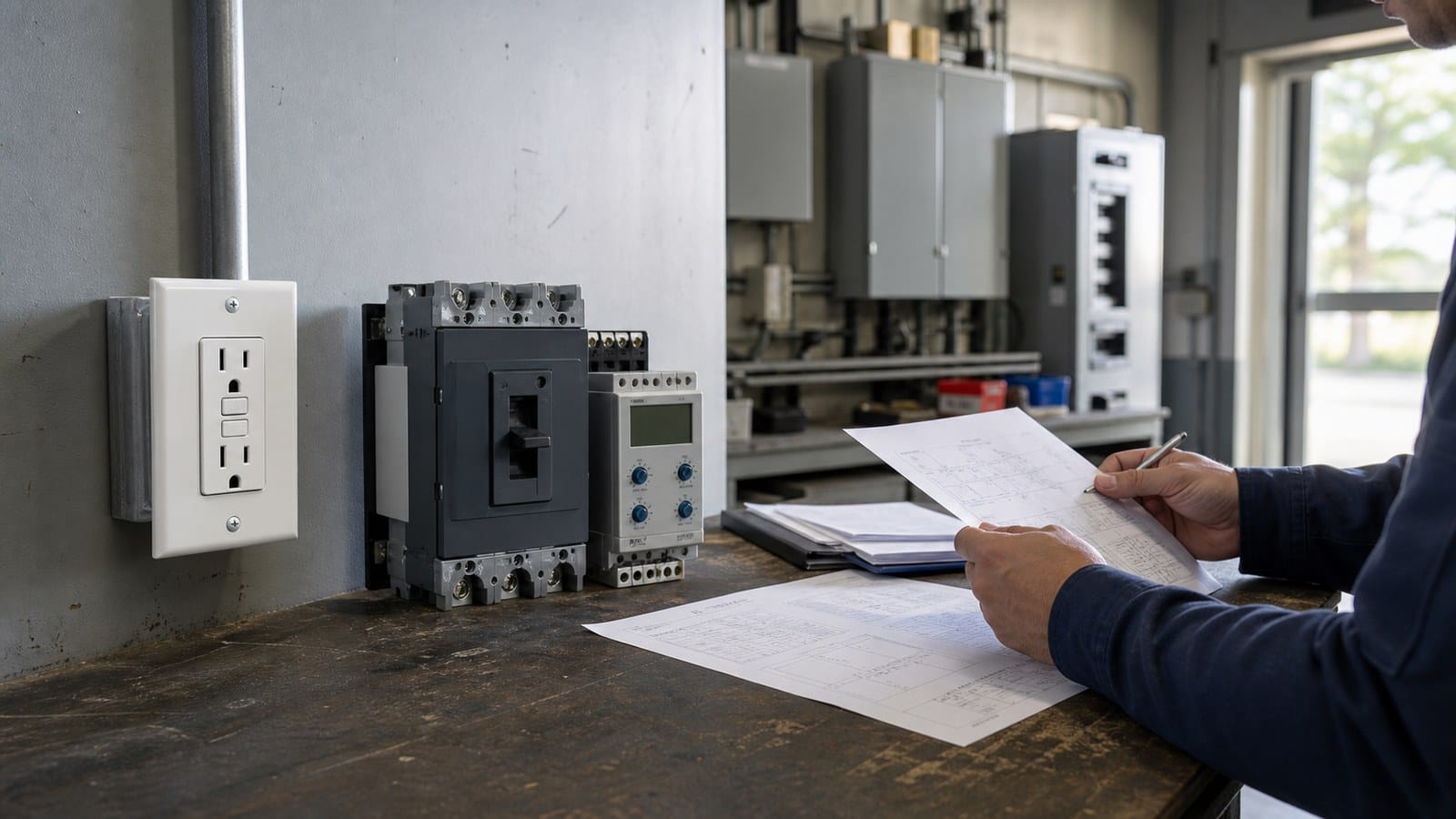
A weather-resistant GFCI outlet and a tamper-resistant GFCI outlet may look almost the same on the wall. Both may have TEST and RESET buttons. Both may be available in 15A or 20A versions. Both may be used in residential or light commercial projects.
But they are not designed to solve the same problem.
Weather-resistant, or WR, is about the installation environment.
Tamper-resistant, or TR, is about user safety and access.
GFCI is about ground-fault protection.
For electricians, contractors, distributors, and project buyers, this distinction matters. Choosing the wrong type can lead to failed inspections, premature product failure, callbacks, or unsafe installations.
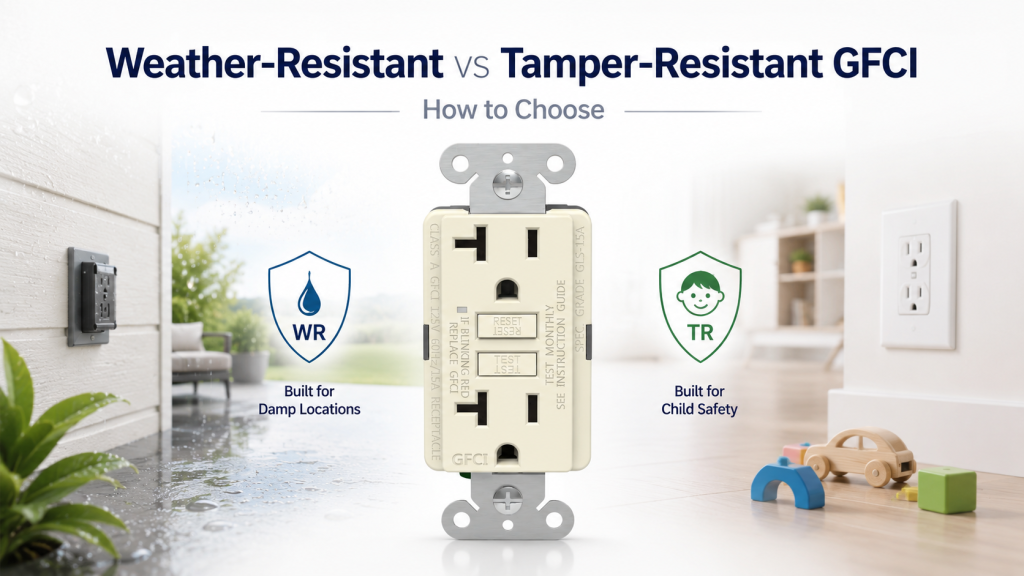
Weather-Resistant vs Tamper-Resistant GFCI: The Short Answer
A GFCI outlet, short for Ground-Fault Circuit Interrupter, is designed to reduce the risk of electric shock by detecting a ground fault and interrupting power. In North America, Class A GFCI devices are commonly designed to trip at around 5 mA of ground-fault current.
A weather-resistant GFCI outlet is a GFCI receptacle built with materials better suited for outdoor or damp environments. It is commonly marked WR.
A tamper-resistant GFCI outlet is a GFCI receptacle with internal shutters that help prevent foreign objects from being inserted into the receptacle slots. It is commonly marked TR.
The fastest way to choose is this:
- Choose WR GFCIwhen the outlet is exposed to weather, moisture, sunlight, humidity, or temperature changes.
- Choose TR GFCIwhen the outlet is installed in a residential, public, hospitality, school, or child-accessible area.
- Choose WR/TR GFCIwhen both conditions apply.
For many residential outdoor installations, the practical answer is not WR or TR. It is WR + TR GFCI.
What Is a GFCI Outlet?
A GFCI outlet is a receptacle that monitors the current flowing between the hot and neutral conductors. If the device detects an imbalance that may indicate current leaking through an unintended path, it trips and cuts power.
That is why GFCI protection is commonly used in areas where water and electricity may be close together, such as bathrooms, kitchens, garages, basements, laundry areas, outdoor locations, and near pools or spas.
GFCI protection can appear in several product formats, including:
- GFCI receptacles
- GFCI circuit breakers
- Portable GFCI devices
- Blank-face or dead-front GFCI devices
- Combination GFCI devices
This article focuses on receptacle-style GFCI outlets, especially the difference between weather-resistant GFCI and tamper-resistant GFCI products.
Here is the point that often gets missed:
GFCI is the protection function. WR and TR are product features.
A receptacle can be GFCI only, GFCI + WR, GFCI + TR, or GFCI + WR + TR.
What Does Weather-Resistant Mean on a GFCI Outlet?
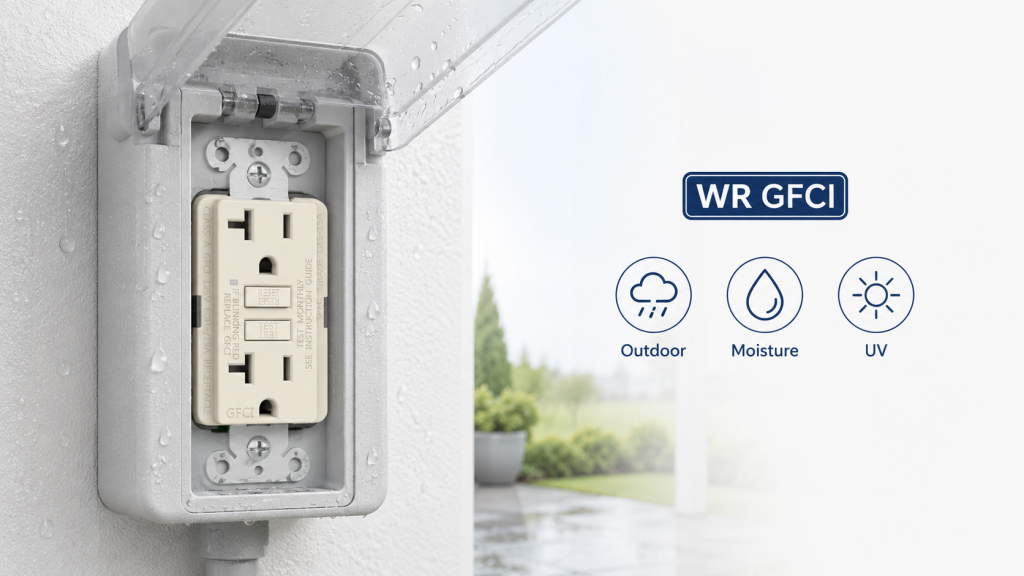
A weather-resistant GFCI outlet is designed for locations where the receptacle may be exposed to moisture, sunlight, temperature swings, and corrosive conditions. These devices are commonly used outdoors or in damp environments.
You can usually identify this type by the WR marking on the face of the receptacle.
What WR Is Designed to Protect Against
Weather-resistant construction helps the receptacle hold up better in harsh environments. Typical design considerations include UV-resistant plastics, corrosion-resistant metal components, and materials that tolerate outdoor exposure better than standard indoor receptacles.
A WR GFCI is commonly selected for environments affected by:
- Rain or wind-driven moisture
- Humidity and condensation
- UV exposure from sunlight
- Temperature changes
- Corrosion risk
- Dust and outdoor debris
This does not mean WR is the same as waterproof.
WR construction helps the device withstand outdoor exposure. GFCI protection is what detects ground faults and interrupts power. These are different safety functions.
Common Locations for WR GFCI Outlets
Weather-resistant GFCI outlets are commonly used in:
- Exterior wall outlets
- Patios and decks
- Balconies
- Garages
- Unfinished basements
- Outdoor kitchens
- Pool and spa areas
- Sheds and workshops
- Landscape equipment power points
- Outdoor service receptacles
For example, a 20A, 125V GFCI outlet installed near a garage workbench may face humidity, dust, and frequent power-tool use. If that garage is unconditioned or semi-exposed, a WR-rated option may be more suitable than a standard indoor GFCI.
For an exterior patio outlet, WR should be treated as the baseline, not an upgrade.
Why Weather-Resistant Does Not Mean Waterproof
A weather-resistant GFCI outlet is not waterproof by itself.
This is one of the most common mistakes in outdoor installations. The WR marking means the device is built for outdoor or damp-location durability. It does not mean the receptacle can sit uncovered in rain or snow.
Outdoor installations usually need the right combination of:
- Weather-resistant GFCI receptacle
- Weatherproof electrical box
- In-use cover or bubble cover
- Correct mounting and sealing method
- Code-compliant installation
A WR GFCI without a proper cover can still be exposed to water intrusion, debris, ice, and mechanical damage. In real projects, the cover and enclosure matter as much as the receptacle itself.
What Does Tamper-Resistant Mean on a GFCI Outlet?
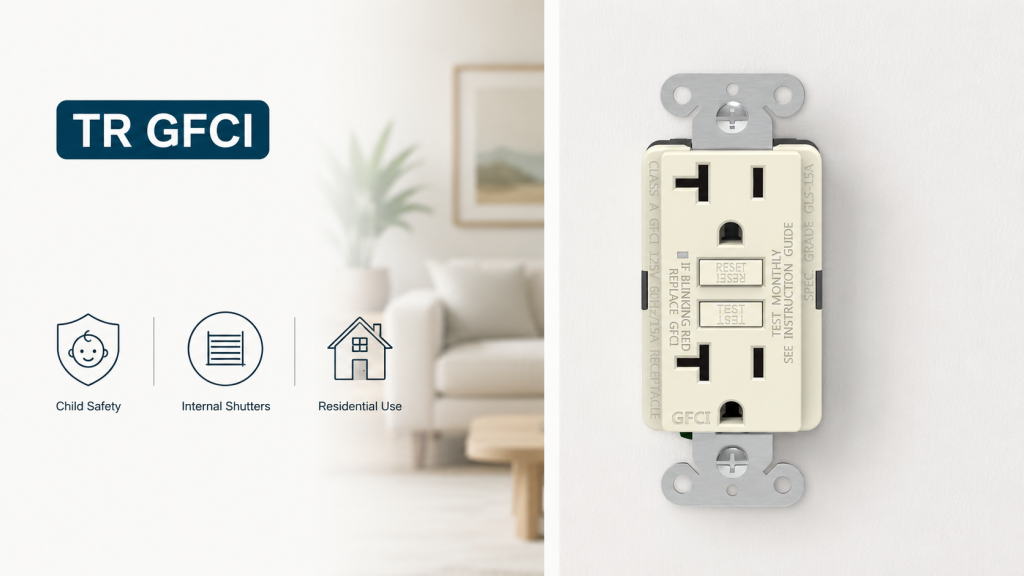
A tamper-resistant GFCI outlet is a GFCI receptacle with internal shutters designed to block foreign objects from entering the slots. These devices are commonly marked TR.
TR is not about weather. It is about access.
The goal is to reduce the risk of children or untrained users inserting objects such as keys, pins, paper clips, small tools, or metal pieces into one side of the receptacle.
How Tamper-Resistant Shutters Work
A tamper-resistant receptacle uses an internal shutter mechanism behind the slots. The shutters are designed to open when both plug blades are inserted at the same time with proper pressure.
A single object pushed into one slot should not open the shutter easily.
This is why TR receptacles are widely used in homes, apartments, schools, hotels, childcare facilities, and public-access spaces. The device adds a passive layer of protection without relying on plastic outlet caps that can be removed, lost, or broken.
For a hotel project with hundreds of guest room outlets, TR is not just a family-safety feature. It is part of a broader risk-control strategy for spaces used by many people, including children.
Common Locations for TR GFCI Outlets
Tamper-resistant GFCI outlets are commonly used in:
- Residential kitchens
- Bathrooms
- Laundry rooms
- Bedrooms
- Living rooms
- Apartments and condos
- Hotels and extended-stay housing
- Schools and childcare spaces
- Public-access areas
- Healthcare or assisted-living facilities
Modern electrical codes and project specifications often require or specify tamper-resistant receptacles in many residential and child-accessible areas. Requirements vary by local code adoption and authority having jurisdiction, so the safest approach is to check the applicable NEC edition, project documents, and local inspection requirements.
TR is usually not a feature to remove for cost saving in residential projects. The price difference is small compared with the cost of rework or failed inspection.
WR vs TR GFCI: Key Differences at a Glance
The difference between weather-resistant vs tamper-resistant GFCI comes down to risk.
WR handles environmental exposure.
TR handles foreign-object insertion and user access.
| Feature | Weather-Resistant GFCI | Tamper-Resistant GFCI |
| Common marking | WR | TR |
| Main purpose | Withstand outdoor or damp conditions | Help prevent foreign object insertion |
| Main risk addressed | Moisture, UV, corrosion, temperature changes | Child access, accidental contact, misuse |
| How it works | Weather-resistant materials and corrosion-resistant components | Internal safety shutters |
| Typical locations | Outdoor walls, garages, patios, decks, damp areas | Homes, apartments, hotels, schools, childcare spaces |
| Does it provide GFCI protection? | Yes, if it is a GFCI receptacle | Yes, if it is a GFCI receptacle |
| Does it mean waterproof? | No | No |
| Can it be combined with the other feature? | Yes | Yes |
| Best choice when | Environment is the main concern | Access and user safety are the main concerns |
How to Identify WR and TR Markings
Before specifying or buying a GFCI outlet, check the device face, packaging, and datasheet.
A proper product review should include:
| Marking or Specification | What It Means |
| TEST / RESET | GFCI receptacle function |
| WR | Weather-resistant construction |
| TR | Tamper-resistant shutter mechanism |
| UL Listed / ETL Listed | Third-party safety certification |
| 15A or 20A | Current rating |
| 125V | Voltage rating commonly used for North American receptacles |
| NEMA 5-15R / 5-20R | Receptacle configuration |
| Self-test | Automatic internal monitoring feature, common in modern GFCI products |
For B2B buyers, markings should be clear and consistent across product samples, cartons, datasheets, and production lots. Ambiguous markings create problems during inspection and channel distribution.
Do You Need WR, TR, or WR/TR GFCI?
The right choice depends on three questions:
- Where will the outlet be installed?
- Who can access it?
- What do the code and project specification require?
Choose WR GFCI for Outdoor or Damp Locations
Choose a weather-resistant GFCI outlet when the receptacle is installed outdoors, in damp areas, or in spaces affected by humidity and temperature changes.
Typical examples include exterior walls, patios, decks, garages, unfinished basements, outdoor kitchens, and poolside areas.
A contractor wiring a backyard patio should not treat a standard indoor GFCI as acceptable just because the outlet has TEST and RESET buttons. The GFCI function protects against ground faults. It does not make the housing or internal components suitable for outdoor exposure.
For outdoor use, WR should normally be paired with a proper weatherproof cover.
Choose TR GFCI for Residential or Child-Accessible Areas
Choose a tamper-resistant GFCI outlet when the receptacle is installed in a home, apartment, hotel, school, childcare area, or any space where children or the general public may access the outlet.
This is not limited to “homes with children.” In practice, electricians and project buyers often specify TR devices broadly across residential and hospitality projects because occupancy changes. A condo sold to one owner today may be rented to a family next year.
TR is a safety feature designed for real-world use, not ideal use.
Choose WR/TR GFCI When Both Conditions Apply
Choose WR/TR GFCI when the outlet is both exposed to environmental conditions and accessible to people.
Common examples include:
- Residential patio outlets
- Deck receptacles
- Balcony outlets
- Ground-level exterior outlets
- Garage outlets in damp or semi-exposed areas
- Outdoor areas at hotels or apartment buildings
- School courtyard or exterior service receptacles
- Pool-area power points, where permitted by code and project design
For these installations, WR/TR is often the cleanest specification. It combines ground-fault protection, weather-resistant construction, and tamper-resistant safety in one device.
That is why many North American residential outdoor projects should be evaluated around WR/TR GFCI, not WR vs TR as a strict either-or decision.
Quick Selection Guide by Installation Scenario
Use the table below as a practical selection guide. Final product choice should still follow local electrical code, project drawings, and manufacturer instructions.
| Installation Scenario | Recommended Direction | Why |
| Bathroom | TR GFCI or code-required GFCI configuration | GFCI protection is commonly required; residential access often points to TR |
| Kitchen countertop | TR GFCI or GFCI-protected TR receptacle | Water exposure and frequent appliance use increase shock risk |
| Laundry room | TR GFCI or project-specified GFCI | Moisture and appliance loads require careful protection |
| Bedroom or living room | TR receptacle; GFCI only where required | Main concern is tamper resistance |
| Garage | WR GFCI or WR/TR GFCI depending on exposure and access | Humidity, tools, dust, and semi-outdoor conditions are common |
| Unfinished basement | WR or TR GFCI depending on moisture and project requirements | Damp conditions may affect product selection |
| Exterior wall | WR/TR GFCI with weatherproof cover | Outdoor exposure plus user access |
| Patio or deck | WR/TR GFCI with in-use cover | Weather exposure and residential use overlap |
| Hotel room bathroom | TR GFCI | Public guest access and wet-area safety |
| School or childcare area | TR GFCI; WR/TR for outdoor areas | Child-accessible use drives TR selection |
This is how real selection usually works: the environment points you toward WR, the user profile points you toward TR, and mixed-risk locations point toward WR/TR.
What to Check Before Buying WR or TR GFCI Outlets
For a homeowner, the decision may look like a retail shelf choice. For a contractor, distributor, or procurement team, it is a specification decision.
A GFCI outlet is a small device, but a poor choice can multiply across hundreds or thousands of units.
Certification and Code Compliance
For North American projects, confirm third-party certification such as UL Listed or ETL Listed before purchasing. GFCI products should meet applicable safety requirements for the market where they will be installed.
Also check:
- Applicable NEC edition
- Local authority having jurisdiction requirements
- Project specification
- Installation location
- Product datasheet
- Labeling and packaging
- Manufacturer installation instructions
Commonly referenced NEC areas for receptacle selection include outdoor receptacles and tamper-resistant receptacles, but local adoption varies. Do not rely on a generic online answer when a project is subject to inspection.
For B2B procurement, certification should be verified before sample approval, not after shipment.
Electrical Ratings and Configuration
Most North American wall receptacle GFCI products are commonly specified around 125V and 15A or 20A ratings.
Buyers should confirm:
| Specification | Common Options or Notes |
| Current rating | 15A or 20A |
| Voltage rating | Commonly 125V for North American receptacles |
| Configuration | NEMA 5-15R or NEMA 5-20R |
| Features | WR, TR, WR/TR, self-test, LED indicator |
| Wiring method | Side wire, back wire, or clamp-type terminal depending on product design |
| Face style | Standard duplex GFCI format |
| Wall plate compatibility | Standard or matching wall plate options |
| Color | White, ivory, light almond, black, gray, or project-specific options |
| Packaging | Retail box, bulk pack, contractor pack, or private-label format |
A 20A GFCI should be selected only where the circuit and installation design support it. Device rating is not a decoration; it must match the electrical system and project requirement.
Product Markings and Packaging for Projects
For distributors and project buyers, clear markings matter. A WR/TR GFCI should be identifiable without guesswork.
Check whether the supplier can provide:
- Product datasheets
- Certification files or listing information
- Clear WR/TR markings
- Stable part numbers
- Consistent packaging
- Installation instructions
- Project samples
- Bulk supply capability
- Matching wall plates and related wiring devices
This is where manufacturer consistency becomes valuable. A product that looks acceptable in one sample but changes markings, plastics, terminal design, or packaging in later shipments creates risk for contractors and distributors.
Common Mistakes When Choosing WR or TR GFCI Outlets
Mistake 1: Assuming GFCI Means Weather-Resistant
A GFCI outlet with TEST and RESET buttons is not automatically suitable for outdoor use.
GFCI refers to ground-fault protection. WR refers to weather-resistant construction. If the outlet is installed outdoors or in a damp area, the WR marking should be checked directly.
This mistake often shows up in garage, patio, and exterior wall installations.
Mistake 2: Assuming Weather-Resistant Means Waterproof
WR does not mean the device can be installed without a cover.
Outdoor receptacles need suitable boxes, covers, and installation methods. A WR GFCI exposed to rain through a damaged or missing cover is still a problem.
The receptacle, box, cover, and installation method work as a system.
Mistake 3: Treating WR and TR as Mutually Exclusive
WR and TR are not opposing choices. They can be combined.
A residential outdoor receptacle may need weather resistance because it is outdoors and tamper resistance because it is accessible to residents, guests, or children.
For many outdoor residential projects, WR/TR GFCI is the more complete choice.
Mistake 4: Ignoring Certification and Project Requirements
A low-cost receptacle without clear certification, markings, or documentation can create more cost later.
For contractors, the cost of replacing failed or rejected devices is much higher than the unit price difference. For distributors, inconsistent product labeling can lead to returns and customer complaints.
When the project is in North America, certification and code alignment are part of the product, not optional paperwork.
Installation and Maintenance Tips for WR/TR GFCI Outlets
This article is not a wiring tutorial. GFCI devices should be installed according to manufacturer instructions, project drawings, and local electrical code.
Still, a few practical points are worth keeping in the selection conversation.
Test the GFCI Regularly
GFCI outlets include TEST and RESET buttons for a reason. Regular testing helps confirm the device is operating.
If a GFCI will not reset, trips repeatedly, or shows an abnormal indicator light, the circuit or device should be checked by a qualified electrician. Replacing the outlet without understanding the cause may not solve the problem.
Self-test GFCI models can add another layer of monitoring, but they do not remove the need for proper installation and inspection.
Inspect Outdoor Outlets for Damage
Outdoor outlets age faster than indoor outlets.
Look for:
- Cracked face or housing
- Loose cover
- Water marks
- Corrosion
- Discoloration
- Damaged gasket or cover
- Loose mounting
- Failed TEST / RESET operation
An exterior GFCI on a sun-facing wall, near sprinklers, or close to pool chemicals may see harsher conditions than the same product installed under a covered porch. Location details change product life.
Follow Local Code and Manufacturer Instructions
Do not invent installation shortcuts for WR or TR devices. Use the correct enclosure, cover, wiring method, and device rating.
When a project is inspected, the question is not only whether the outlet works. The question is whether the installed system matches code, listing, location, and project specification.
Faith Electric WR/TR GFCI Solutions for North America
Faith Electric is a professional electrical manufacturer with 28 years of experience, serving electricians, contractors, distributors, and project procurement customers in the North American market.
Our core product range includes UL/ETL certified GFCI and AFCI safety receptacles, with options for WR, TR, and WR/TR GFCI outlets. We also supply USB receptacles, standard receptacles, switches, wall plates, and related in-wall wiring device solutions.
For buyers managing residential, commercial, hospitality, or distribution programs, the goal is not only to find a GFCI that works. The goal is to specify a product that is certified, clearly marked, stable in production, and suitable for the installation environment.
Faith Electric supports customers with product specifications, samples, and project-based supply coordination.
FAQ: Weather-Resistant vs Tamper-Resistant GFCI
What does WR mean on a GFCI outlet?
WR means Weather-Resistant. A WR GFCI outlet is designed with materials better suited for outdoor or damp environments, including exposure to moisture, sunlight, humidity, and temperature changes.
WR does not mean waterproof. Outdoor installations still need proper weatherproof boxes and covers.
What does TR mean on a GFCI outlet?
TR means Tamper-Resistant. A TR GFCI outlet includes internal shutters that help block foreign objects from being inserted into the receptacle slots.
TR is commonly used in residential, hospitality, education, and child-accessible spaces.
Are WR and TR GFCI outlets the same?
No. WR and TR solve different problems.
WR addresses environmental exposure. TR addresses tamper resistance and foreign-object insertion. A GFCI outlet can have one feature, both features, or neither, depending on the product design.
Can a GFCI outlet be both WR and TR?
Yes. Many GFCI outlets are available with both weather-resistant and tamper-resistant features.
For residential outdoor areas, a WR/TR GFCI outlet is often the practical choice because it combines ground-fault protection, outdoor durability, and tamper-resistant safety.
Do outdoor GFCI outlets need to be weather-resistant?
Outdoor GFCI outlets should generally be selected with weather-resistant construction and installed with the correct weatherproof box and cover. Local code and project requirements should always be checked.
A standard indoor GFCI should not be assumed suitable for outdoor use.
Is a weather-resistant GFCI outlet waterproof?
No. Weather-resistant does not mean waterproof.
A WR GFCI is designed to withstand outdoor conditions better than a standard indoor device, but it still needs proper protection from direct water exposure through a suitable enclosure and in-use cover.
Do residential GFCI outlets need to be tamper-resistant?
Many residential applications require or specify tamper-resistant receptacles under modern electrical codes and project standards. Requirements can vary based on location, adopted code edition, and project type.
For residential projects, TR should usually be treated as a standard safety expectation rather than an optional feature.
Should I choose a 15A or 20A GFCI outlet?
Choose the amp rating based on the circuit, project specification, and applicable electrical code. Common North American GFCI receptacles are 15A or 20A, 125V.
Do not choose 20A only because it seems stronger. The receptacle rating must match the electrical design.
Choose by Environment, Access, and Compliance
The answer to weather-resistant vs tamper-resistant GFCI is straightforward once the risks are separated.
Choose WR when the outlet faces weather, moisture, humidity, UV exposure, or temperature changes. Choose TR when the outlet is in a residential, public, hospitality, school, or child-accessible space. Choose WR/TR when both conditions apply.
For North American projects, also check UL/ETL certification, WR/TR markings, amperage, voltage, NEMA configuration, installation accessories, and local code requirements.
Faith Electric supplies UL/ETL certified GFCI solutions for North American electrical professionals and project buyers. Contact us for WR/TR GFCI specifications, samples, and product support for your next program.