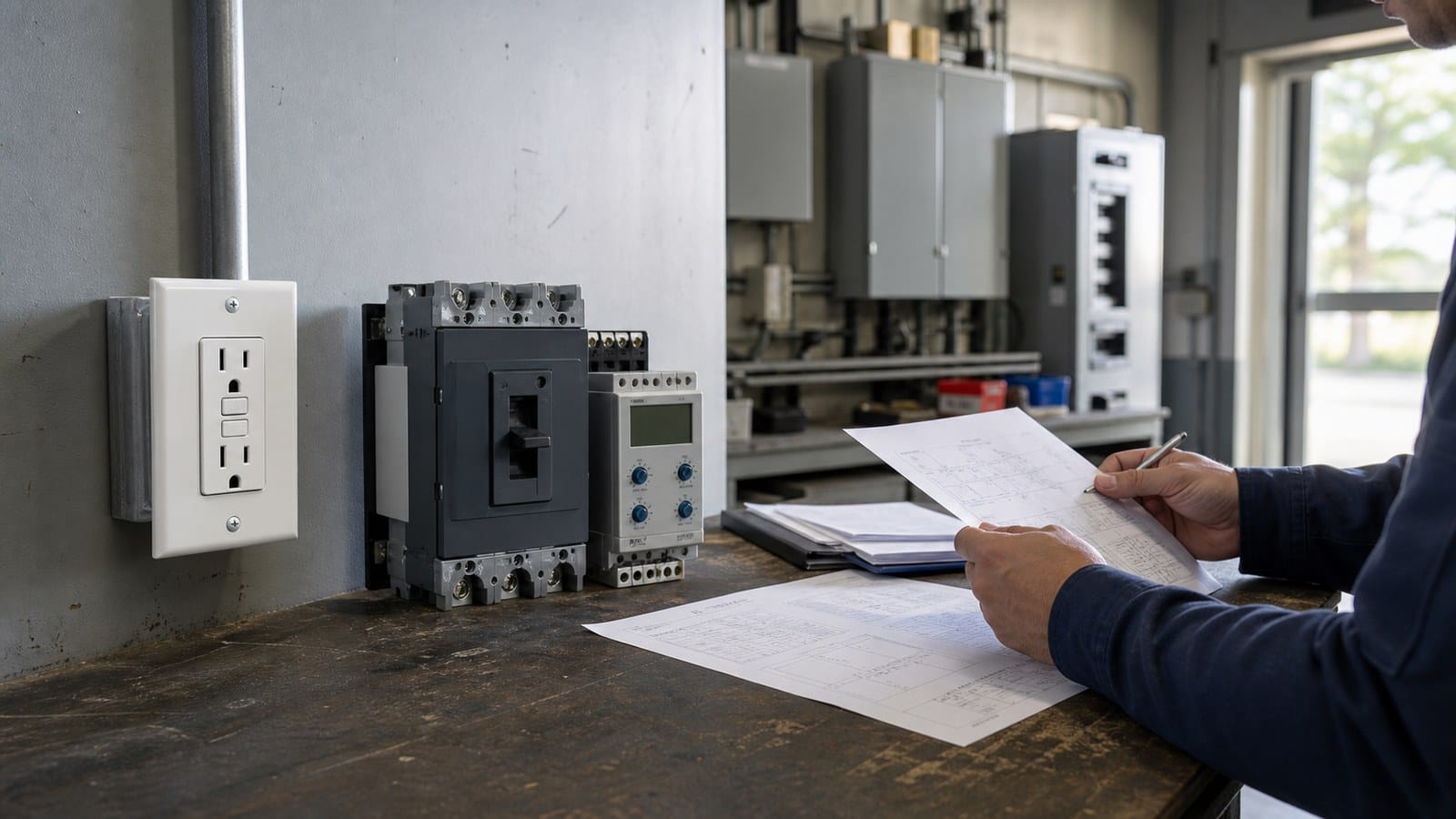
A 15 amp GFCI outlet and a 20 amp GFCI outlet can look similar at first glance, but they are not interchangeable in every installation.
The real difference is not the GFCI protection itself. Both devices are designed to protect people from ground-fault shock hazards. The difference is the outlet’s current rating, slot design, circuit compatibility, and the type of load the circuit is expected to serve.
A 20 amp GFCI outlet is not automatically “better” than a 15 amp GFCI outlet.
It is only the right choice when the circuit behind the wall is designed for 20 amps.
For homeowners, electricians, contractors, and electrical buyers, the key question is simple: does the outlet match the circuit, the load, and the code requirements of the location?
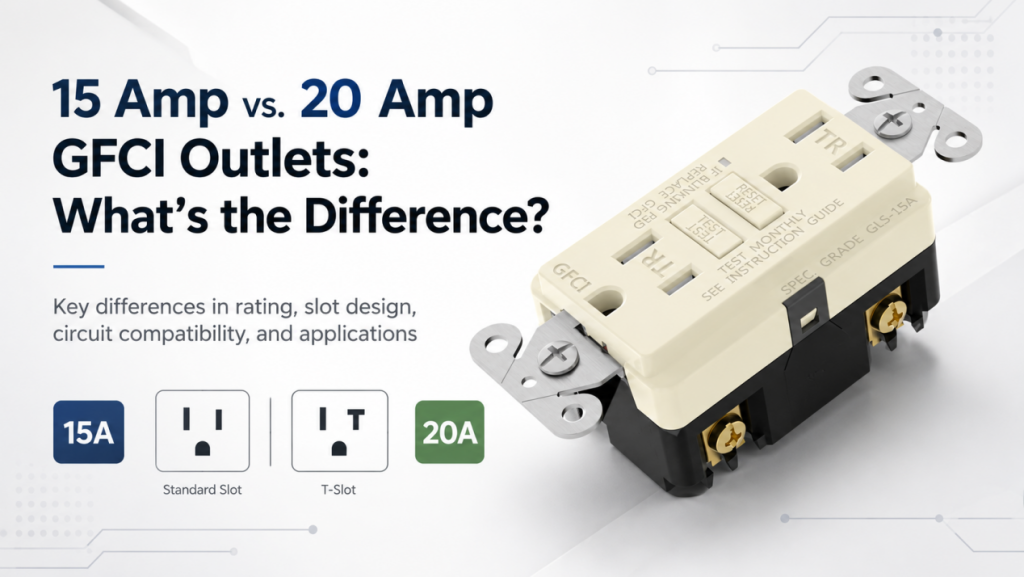
Quick Answer: What’s the Difference Between 15 Amp and 20 Amp GFCI Outlets?
A 15 amp GFCI outlet is designed for circuits and applications where the receptacle rating is 15 amps. It is common in standard residential areas and light-duty applications.
A 20 amp GFCI outlet is designed for properly rated 20 amp circuits. It is commonly used where higher current loads may be expected, such as kitchen countertop circuits, garages, workshops, utility areas, and some commercial applications.
The difference is mainly shown in three areas:
| Comparison Point | 15 Amp GFCI Outlet | 20 Amp GFCI Outlet |
| Current Rating | Rated for up to 15 amps | Rated for up to 20 amps |
| Slot Design | Standard vertical slots, commonly NEMA 5-15R | T-shaped slot, commonly NEMA 5-20R |
| Plug Compatibility | Accepts standard 15A plugs | Accepts 15A plugs and 20A plugs |
| Common Use | Standard residential use, light-duty loads | Higher-load circuits, kitchens, garages, workshops, commercial areas |
| Key Warning | May be used in certain 20A multi-outlet circuits if allowed by code | Should not be installed on a 15A circuit |
The most practical rule is this:
Never install a 20 amp GFCI outlet on a 15 amp circuit.
That one mistake creates a false signal. The outlet face suggests that the circuit can support a 20 amp plug, but the breaker and wiring may only be rated for 15 amps.
What Does the Amp Rating Mean on a GFCI Outlet?
A GFCI outlet, or Ground-Fault Circuit Interrupter outlet, is a receptacle designed to shut off power when it detects a ground-fault current imbalance. In plain terms, it protects people from electric shock in areas where moisture, damaged cords, or contact with grounded surfaces can create a hazard.
The amp rating is different. It tells you the current level the outlet is designed to serve.
This distinction matters.
A 20 amp GFCI does not provide “stronger” ground-fault protection than a 15 amp GFCI. Both are built to perform the same basic safety function. The 20 amp rating only means the receptacle is designed for a different circuit capacity and plug configuration.
The circuit itself is controlled by several parts:
- The circuit breaker rating, such as 15A or 20A
- The wire size used in the branch circuit
- The receptacle rating
- The expected load
- The local electrical code
In typical U.S. residential wiring, 15 amp circuits are often associated with 14 AWG copper conductors, while 20 amp circuits commonly use 12 AWG copper conductors. That is a common field reference, not a replacement for proper verification.
Changing the outlet does not change the circuit.
If a branch circuit is designed for 15 amps, installing a 20 amp GFCI does not upgrade it to 20 amps. The breaker, wiring, and circuit design still set the real limit.
15 Amp vs. 20 Amp GFCI Outlet: Key Differences
The difference between a 15 amp and 20 amp GFCI outlet is best understood through the physical design, circuit compatibility, and typical applications.
Slot Design and Plug Compatibility
The easiest visible difference is the slot shape.
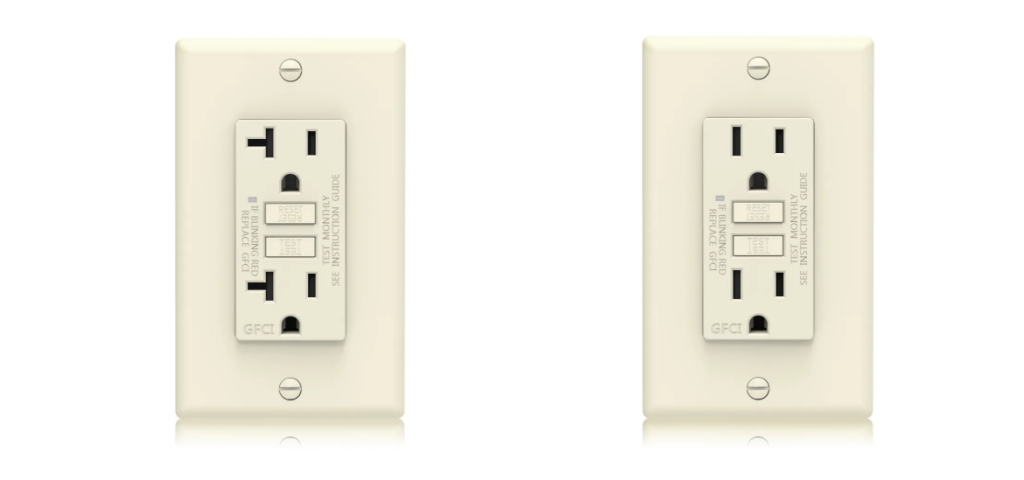
A 15 amp GFCI outlet usually has two vertical slots and a ground opening. This is the familiar receptacle face found in many U.S. homes. It is commonly associated with the NEMA 5-15R configuration.
A 20 amp GFCI outlet normally has a T-shaped slot. This is commonly associated with the NEMA 5-20R configuration. The T-slot allows the outlet to accept 20 amp plugs while still accepting standard 15 amp plugs.
That physical design is not decorative. It is a safety feature.
A 20 amp plug should not fit into a 15 amp receptacle because the connected device may demand more current than the circuit is designed to supply. The outlet face helps prevent that mismatch.
Still, the slot shape only tells part of the story. A receptacle face can help you identify the device type, but it does not prove the wiring behind the wall is correct.
Circuit Compatibility
The most important difference is circuit compatibility.
| Circuit Type | 15 Amp GFCI Outlet | 20 Amp GFCI Outlet |
| 15 Amp Circuit | Usually acceptable when properly installed | Not acceptable |
| 20 Amp Circuit | May be acceptable in certain multi-outlet configurations | Acceptable when properly matched |
A 20 amp GFCI outlet should only be installed on a properly rated 20 amp circuit.
A 15 amp GFCI outlet may appear on some 20 amp branch circuits, especially when the branch circuit has more than one receptacle. This is common in many residential and light commercial installations, but it still depends on the circuit design, device listing, and local code adoption.
Do not reduce this to a simple visual rule. A professional should confirm the breaker, wire size, and wiring method before replacement.
Common Applications
15 amp GFCI outlets are common in standard residential settings where the load is moderate. Think bathroom receptacles serving hair dryers or chargers, utility receptacles for light equipment, or standard replacement jobs where the circuit is 15 amps.
20 amp GFCI outlets are more common in higher-load areas. A kitchen countertop may serve a 1,200W coffee maker, a 1,500W toaster oven, or several small appliances used close together. At 120V, a 1,500W device draws about 12.5 amps. That does not leave much margin on a busy 15 amp circuit.
Garages and workshops create a different kind of load. A shop vacuum, portable compressor, battery charger, or power tool can pull high current during startup. In these areas, a 20 amp circuit with a matching 20 amp GFCI outlet may be the correct design.
The room name matters less than the actual circuit and load.
Can You Use a 15 Amp GFCI Outlet on a 20 Amp Circuit?
Yes, in some U.S. installations, a 15 amp GFCI outlet may be used on a 20 amp circuit, but only under the right conditions.
This question confuses many people because they see a 20 amp breaker in the panel and a 15 amp-looking receptacle on the wall. That can be normal in a multi-outlet branch circuit. The logic is that the circuit may serve multiple receptacles, and the total branch circuit is still protected by the 20 amp breaker.
But this is not permission to install anything anywhere.
The details matter:
- Is it a single receptacle or one of multiple receptacles on the branch circuit?
- Is the device listed for the intended installation?
- Does the circuit wiring support 20 amps?
- Does local code allow the configuration?
- Are there downstream outlets protected through the GFCI load terminals?
A 15 amp GFCI on a 20 amp circuit does not mean the outlet can accept a 20 amp plug. It still has a 15 amp face configuration. That limits the type of plug that can be inserted.
This is why a 15 amp receptacle may be seen on a 20 amp circuit, while a 20 amp receptacle should not be placed on a 15 amp circuit. Those are not equivalent situations.
Can You Replace a 15 Amp GFCI With a 20 Amp GFCI?
Not unless the circuit is verified as a 20 amp circuit.
This is one of the most common mistakes in outlet replacement. Someone removes an old 15 amp GFCI and thinks a 20 amp model is an upgrade. It looks more capable. It may only cost slightly more. It feels safer.
That thinking is wrong.
A 20 amp GFCI outlet allows a 20 amp plug to be inserted. If the branch circuit is only rated for 15 amps, the outlet face now suggests a capacity the wiring may not support. The breaker may trip repeatedly, or worse, the circuit may be used in a way it was not designed to handle.
Before replacing a 15 amp GFCI with a 20 amp GFCI, check:
- The breaker rating
- The conductor size
- The number and type of receptacles on the circuit
- The local code requirement
- The equipment or appliance expected to use the outlet
If the breaker is 15 amps, the answer is simple.
Do not install a 20 amp GFCI outlet.
If the breaker is 20 amps, that still does not end the inspection. The wiring and circuit configuration need to match. Old homes, remodels, DIY work, and mixed wiring conditions can create surprises behind the wall.
For a homeowner, the safe answer is to ask a licensed electrician. For contractors and project buyers, the correct answer is to follow the drawings, code requirements, and device listing.
Where Should You Use 15 Amp or 20 Amp GFCI Outlets?
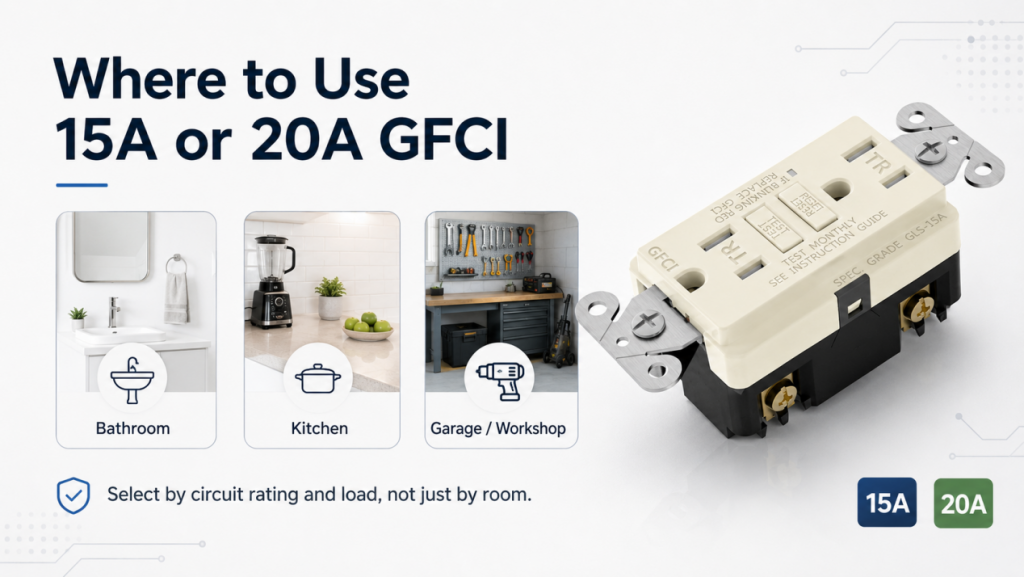
Choosing between 15 amp and 20 amp GFCI outlets should follow the circuit first, then the location, then the expected load.
Bathrooms and Standard Residential Areas
Bathrooms often require GFCI protection because water and grounded surfaces increase shock risk. That does not automatically mean every bathroom needs a 20 amp GFCI outlet.
In many residential replacement cases, a 15 amp GFCI is used where the branch circuit is rated for 15 amps and the load is typical. Electric toothbrush chargers, shavers, and small bathroom devices do not demand a 20 amp receptacle by themselves.
Hair dryers are different. Many full-size hair dryers run around 1,500W or higher. At 120V, that can draw about 12.5 amps. If the circuit serves other loads at the same time, nuisance tripping or overload concerns may appear.
The correct selection still comes back to the circuit rating.
Kitchens and Countertop Areas
Kitchen countertop areas often involve heavier and more frequent appliance loads. Toasters, coffee machines, blenders, air fryers, and countertop ovens can draw enough current to make circuit planning matter.
A 20 amp GFCI outlet may be appropriate when the kitchen branch circuit is designed for 20 amps. Many kitchen circuits are built with this higher demand in mind.
But do not write the rule too loosely. Not every kitchen receptacle should be assumed to be 20 amps. A remodel, older home, island outlet, dedicated appliance circuit, or local rule may change the answer.
For kitchen applications, match the GFCI device to the circuit and use products rated for the environment and installation method.
Garages, Workshops, and Utility Areas
Garages and workshops are where 20 amp GFCI outlets often make practical sense.
A homeowner may plug in a wet/dry vacuum, a power washer, a bench tool, a compressor, or a charger for outdoor equipment. Some tools draw a high starting current even if their running load is lower. A circuit designed only for light-duty use may become a weak point.
For commercial maintenance rooms, warehouse benches, or equipment service areas, the same issue appears at a larger scale. The receptacle is no longer just a convenience point. It is part of the working electrical system.
If the circuit is rated and wired for 20 amps, a 20 amp GFCI may be the better fit. If not, the outlet should not be upgraded just because the environment looks demanding.
Outdoor or Damp Locations
Outdoor and damp locations add another layer to the decision.
Here, amp rating is only one part of the product selection. The device may also need to be weather-resistant, commonly marked WR, and installed with the proper box, cover, and protection method. In outdoor applications, GFCI protection is often required because moisture can increase shock risk.
For patios, garages, exterior walls, pool-adjacent service areas, and similar locations, the buyer should check both the electrical rating and the environmental rating.
A 15 amp WR GFCI and a 20 amp WR GFCI solve different needs. The correct choice depends on the branch circuit and the application.
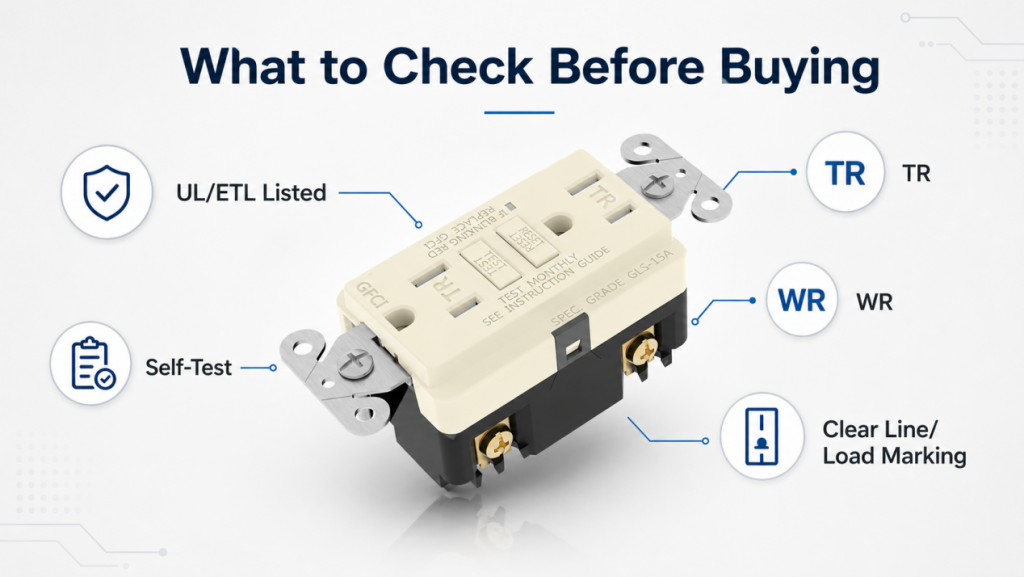
What Else Should You Check Before Buying a GFCI Outlet?
Amp rating is not the only buying factor. For contractors, distributors, and electrical product buyers, the device configuration matters just as much as 15A or 20A.
UL or ETL Certification
For the U.S. market, GFCI outlets should be properly listed by a recognized testing organization, such as UL or ETL. This is not a marketing label. It tells the buyer that the device has been evaluated to applicable safety requirements for its product category.
For B2B purchasing, certification reduces risk. It supports code acceptance, project approval, distributor confidence, and long-term product reliability.
If two GFCI outlets look similar, the listed product with clear ratings, markings, and documentation is the safer business choice.
Self-Test, LED Indicator, TR, and WR Features
Modern GFCI outlets often include functions beyond basic ground-fault protection.
A self-test GFCI outlet periodically checks its own protection function. This is useful in residential and commercial installations where the device may stay in service for years.
An LED indicator can help users identify power status, trip status, wiring error, or end-of-life conditions, depending on the product design.
A tamper-resistant GFCI outlet, often marked TR, helps reduce the chance of children inserting foreign objects into the receptacle slots. This is common in residential construction.
A weather-resistant GFCI outlet, often marked WR, is designed for damp or outdoor environments when installed with the correct enclosure and cover.
For distributors and contractors, these features affect SKU planning. A basic 15A indoor GFCI, a 20A TR GFCI, and a WR self-test GFCI are not the same product for the same customer.
Line/Load Terminals and Feed-Through Protection
GFCI outlets may protect only their own receptacle face, or they may also protect downstream receptacles through the LOAD terminals.
This is called feed-through protection.
It is useful, but it also creates room for wiring mistakes. LINE and LOAD terminals must be clearly marked and properly connected. If they are confused, downstream protection may not work as intended, or the device may fail to operate correctly.
This article is not an installation guide. The point for product selection is simple: clear terminal markings, reliable screws, proper back and side wiring options, and good instructions matter in the field.
For contractors installing dozens or hundreds of devices, small design details affect labor time and callback rates.
FAQ About 15 Amp and 20 Amp GFCI Outlets
Is a 20 amp GFCI outlet better than a 15 amp GFCI outlet?
No. A 20 amp GFCI outlet is not better in every situation. It is better only when the circuit is designed for 20 amps and the application requires that rating.
For a 15 amp circuit, a 20 amp GFCI is the wrong device.
How can I tell if my GFCI outlet is 15 amp or 20 amp?
Look at the slot design first. A 20 amp GFCI outlet usually has a T-shaped slot. A 15 amp GFCI usually has standard vertical slots.
That visual check is only a starting point. To confirm what should be installed, check the breaker, wiring, circuit design, and local code.
Can a 15 amp plug fit into a 20 amp GFCI outlet?
Yes, a standard 15 amp plug can usually fit into a 20 amp receptacle. That is part of the NEMA 5-20R design.
The opposite is not true. A 20 amp plug should not fit into a 15 amp receptacle.
Do kitchens need 15 amp or 20 amp GFCI outlets?
Kitchen countertop areas often use 20 amp circuits because small appliances can create higher load demand. A 20 amp GFCI may be correct when the circuit is designed for it.
Still, do not choose based on the word “kitchen” alone. Verify the branch circuit, code requirement, and project design.
Should contractors stock both 15A and 20A GFCI outlets?
Yes. Contractors and distributors usually need both.
Residential replacement jobs may require 15A GFCI outlets. Kitchen, garage, utility, outdoor, and commercial jobs may require 20A devices or WR/TR/self-test configurations. A useful product mix should reflect real jobsite needs, not only one amp rating.
Final Recommendation
The difference between 15 amp and 20 amp GFCI outlets comes down to current rating, slot design, circuit compatibility, and application. The GFCI function protects against ground faults. It does not increase circuit capacity.
Choose the GFCI outlet based on the circuit behind the wall, not just the room name or the idea that 20 amps sounds stronger.
For electrical contractors, distributors, and project buyers, the better decision is to source properly certified GFCI outlets with the right amp rating, TR/WR options, self-test functions, clear markings, and stable supply.
Faith Electric provides UL/ETL certified 15A and 20A GFCI outlets for the North American market, supporting residential, commercial, and project-based wall-in electrical solutions. Contact us to discuss your GFCI outlet specifications, packaging needs, or bulk purchasing requirements.