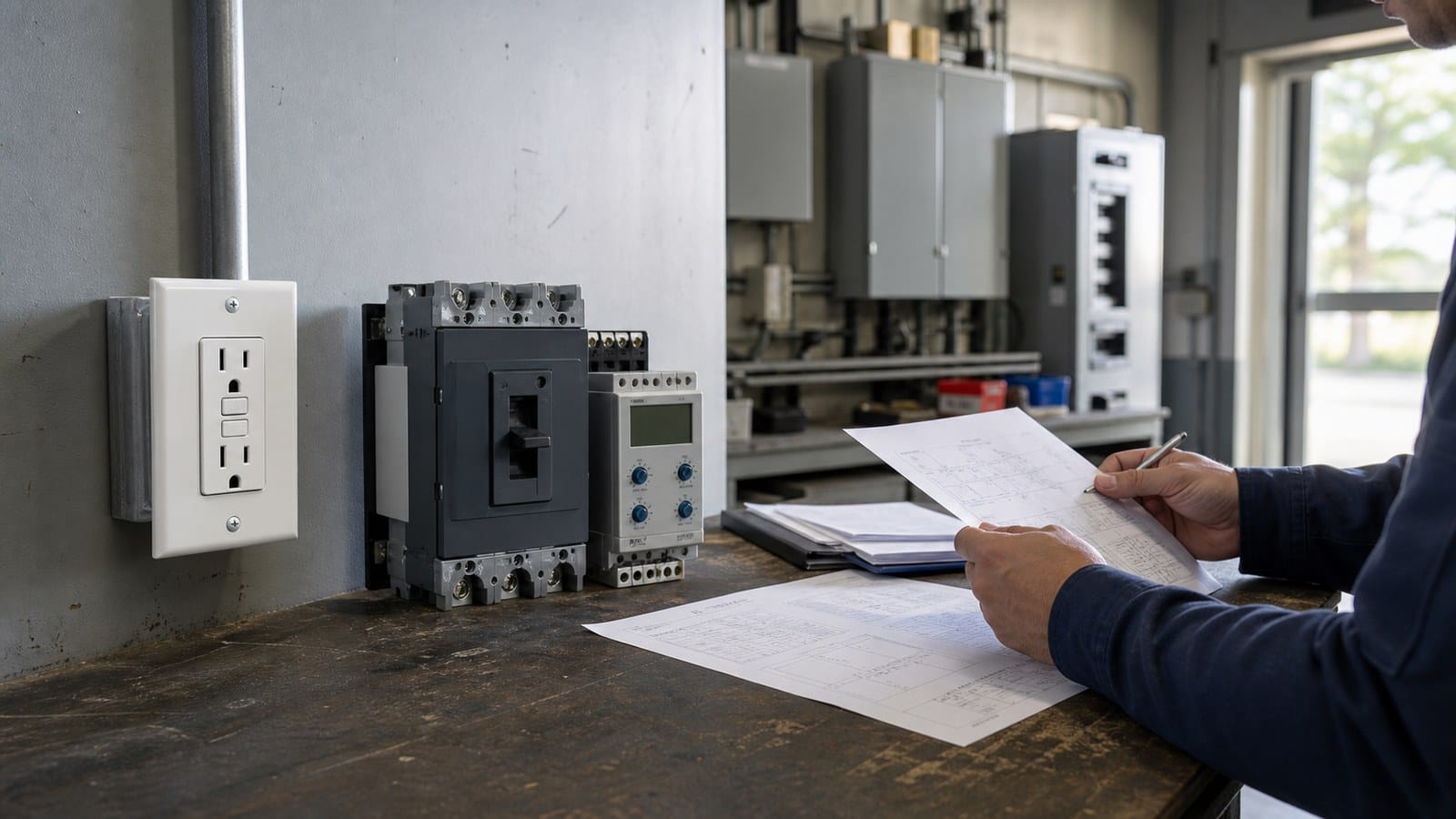
A GFCI outlet is not a standard receptacle with a different faceplate. A GFCI, or Ground-Fault Circuit Interrupter, is a safety device designed to interrupt power when it detects ground-fault current that may create an electric shock hazard.
That changes how buyers should evaluate a supplier.
For a standard receptacle, buyers may focus on copper thickness, terminal strength, flame-retardant material, packaging, and price. For a GFCI receptacle, those points still matter, but they are not enough. Buyers also need to verify safety certification, trip performance, self-test behavior, batch consistency, traceability, and after-sales responsibility.
A low price means little if the product cannot pass North American compliance review, fails during field use, or creates a recall risk.
This 12-point checklist is written for North American importers, distributors, contractors, engineering buyers, and OEM/private-label buyers who are evaluating a China GFCI manufacturer.
1. Verify UL or ETL Certification in the Official Database
The first question is simple: is the product actually listed?
For GFCI outlets sold into North America, buyers commonly look for certification from an NRTL, such as UL or Intertek ETL. These marks indicate that the product has been evaluated against applicable safety standards. For GFCI receptacles, the key standard often discussed is UL 943, the safety standard for ground-fault circuit interrupters.
Do not rely on a certificate image sent by email.
A proper verification should include:
- UL or ETL file number
- Manufacturer name
- Product category
- Model number
- Electrical rating, such as 15A or 20A
- Whether the listed model matches the exact SKU you plan to buy
A common risk is model mismatch. A supplier may have certification for one GFCI family but quote another model with different housing, PCB, self-test design, or terminal structure. From a buyer’s point of view, that is not a small paperwork issue. It can affect product acceptance, customer claims, and import risk.
Red flags
Be careful if the supplier only says “UL standard compliant” or “same as UL product.” That does not mean the product is UL Listed or ETL Listed.
Other warning signs include blurred certificate screenshots, missing file numbers, inconsistent model names, or a factory name that does not match the certified manufacturer.
A reliable UL listed GFCI outlet manufacturer in China should be able to provide verifiable listing information without hesitation.
2. Confirm the Product Meets North American GFCI Requirements
A manufacturer that understands the North American market will not describe a GFCI outlet only by color and amperage. They should be comfortable discussing the product in the language of North American buyers.
That includes terms such as:
| Requirement | Why Buyers Should Check It |
| 15A / 20A rating | Must match the target application and listing |
| 125V configuration | Common for North American residential and commercial wiring devices |
| Tamper-Resistant, or TR | Often required for residential applications |
| Weather-Resistant, or WR | Used for outdoor or damp-location applications when paired with proper installation |
| Self-Test / Auto-Monitoring | Used to check whether the GFCI protection function remains operational |
| End-of-life indication | Helps signal when the device can no longer provide proper protection |
| cUL / CSA coverage | Relevant when selling into Canada |
A GFCI receptacle supplier for North America should also provide clean documentation. Product specification sheets, installation guides, wiring diagrams, packaging labels, and model lists should match the certified product.
This is where many weak suppliers expose themselves. The sample may say one model number, the carton may show another, and the certificate may cover a third. That creates problems for distributors, inspectors, retailers, and project buyers.
The product, certificate, packaging, and sales documents need to tell the same story.
3. Make Sure You Are Dealing with a Real Manufacturer, Not Just a Trading Company
There are good trading companies in China, but GFCI is a category where direct manufacturing capability matters.
A real GFCI outlet factory in China should be able to show production lines, assembly stations, function test equipment, quality checkpoints, and engineering support. They should also be able to explain how the GFCI mechanism works at a practical level.
Ask for more than a catalog.
Buyers should request factory photos, production videos, business information, process flow, quality control steps, and, for larger orders, a third-party audit report. If possible, verify whether the supplier has its own test stations for GFCI-specific functions.
The difference becomes clear when a problem occurs. A trading company may forward your complaint to another factory. A true manufacturer can pull batch records, review test data, inspect component lots, and make process corrections.
That matters when you are buying safety devices.
What to look for
A qualified manufacturer should be able to explain:
- Where the GFCI is assembled
- Which tests are performed in production
- Which parts are made in-house and which are sourced
- How defective units are handled
- How batch records are kept
- Who supports technical questions from North American customers
If a supplier cannot explain the production and test process, they may not control it.
4. Check Production Capacity and North American Export Experience
Production capacity should be checked against reality.
A supplier may claim a monthly GFCI capacity of 200,000 pieces, but if the factory has only a few manual assembly lines and limited test stations, the number may not be credible. For GFCI products, testing can become the bottleneck. A factory cannot simply speed up output if every unit needs safety and function checks.
Ask about:
- Monthly GFCI output
- Number of assembly lines
- Number of GFCI test stations
- Standard lead time
- Peak-season lead time
- Recent export experience
- North American customer types served
Export experience also matters. A factory that has served North American distributors, contractors, or OEM/private-label buyers will usually understand packaging, labeling, installation instructions, barcode requirements, carton markings, and certification documents better than a factory focused only on domestic sales.
For engineering procurement buyers, consistency is often more valuable than aggressive lead time. A supplier that ships 30,000 pieces per month reliably is often safer than a supplier that promises 100,000 pieces but cannot prove recent output.
A capacity claim should match equipment, staffing, test capability, and shipment history.
5. Review GFCI-Specific Testing Capabilities
A GFCI manufacturer should not test the product like an ordinary receptacle.
Visual inspection and simple power-on checks are not enough. The core function of a GFCI outlet is to detect ground-fault conditions and interrupt power. That requires dedicated testing.
A professional self-test GFCI manufacturer should be able to discuss production testing for items such as:
- Ground-fault trip function
- Trip time
- Leakage current behavior
- Dielectric withstand
- Reset function
- Self-test function
- Reverse line-load protection
- End-of-life indication
- Terminal and wiring reliability
Some factories also maintain equipment for life-cycle testing, temperature and humidity testing, surge testing, or WR model validation. Not every test needs to be performed on every unit in mass production, but the manufacturer should know which tests are routine production checks, which are type tests, and which are third-party lab tests.
A practical question is this:
Which GFCI functions are tested on every unit before shipment?
For safety-related products, random visual inspection is not enough. Buyers should ask whether critical functions are tested 100%, how records are stored, and whether test stations are calibrated.
Equipment that indicates serious capability
A stronger factory may have:
| Equipment Type | What It Supports |
| Ground-fault test station | Checks trip behavior |
| Leakage current tester | Supports safety function verification |
| Dielectric withstand tester | Checks insulation strength |
| Life-cycle test bench | Supports durability validation |
| Temperature / humidity chamber | Helps evaluate environmental performance |
| Calibrated production test stations | Supports consistent mass-production testing |
Weak suppliers often avoid these details. They talk about price, shell material, and delivery, but cannot clearly explain the test process.
For GFCI outlets, testing is not a back-office detail. It is part of the product.
6. Evaluate Quality Control from Incoming Materials to Final Inspection
A good sample does not prove a good factory.
A supplier can send a hand-picked sample that looks clean, resets smoothly, and passes a simple function test. The real question is whether the factory can repeat that performance in every production batch.
Quality control should cover three layers: incoming materials, in-process control, and final inspection.
IQC, IPQC, and OQC
IQC, or Incoming Quality Control, checks materials and components before production. For GFCI outlets, this may include plastic housing, copper contacts, terminals, screws, PCB components, sensing parts, and trip mechanism parts.
IPQC, or In-Process Quality Control, monitors the production line. This includes assembly steps, soldering quality, test station output, process abnormalities, and defective product handling.
OQC, or Outgoing Quality Control, checks finished goods before shipment. For North American buyers, this should include function, appearance, labels, packaging, batch code, carton information, and documentation.
A mature factory should also maintain batch traceability. If a field issue occurs, the manufacturer should be able to trace the production date, batch number, key materials, test records, and shipment details.
That is not paperwork for paperwork’s sake. It is how problems get contained.
If a buyer reports that 2% of units in one shipment have reset problems, a capable manufacturer can identify the batch, review test data, isolate related inventory, and propose corrective action. A weak supplier can only apologize and offer a discount on the next order.
For a GFCI receptacle quality control review, traceability is a dividing line.
7. Inspect Key Materials and Internal Components
Many GFCI outlets look similar from the outside. The difference is inside.
The faceplate, buttons, and color may look acceptable, but the internal materials determine heat performance, contact reliability, mechanical life, and trip consistency.
Buyers should review the key material and component controls behind the product.
Components that affect safety and durability
For a GFCI outlet, pay attention to:
- Flame-retardant housing material
- Copper contacts and terminals
- PCB and electronic components
- Sensing components
- Trip mechanism
- Solenoid or relay components
- Screws, clamps, and terminal structure
Cost cutting often happens where buyers do not look. Thinner copper parts, unstable electronic components, poor terminal design, or lower-grade plastic can reduce cost while keeping the product visually similar.
This is especially risky for private-label buyers. If two suppliers offer similar-looking GFCI outlets at very different prices, the difference may be hidden in internal construction, testing coverage, or component sourcing.
A serious durable GFCI outlet manufacturer should be able to explain how key materials are specified and controlled. They may not share every proprietary detail, but they should not treat the inside of the product as a mystery.
When the supplier cannot explain the internal structure, the buyer is not evaluating a product. The buyer is guessing.
8. Confirm Self-Test and Failure Response Design
Self-Test, also called auto-monitoring, refers to a GFCI feature that regularly checks whether the protection function is still working. For North American GFCI buyers, this is a key topic because it relates directly to long-term safety performance.
The buyer does not need to become a circuit designer, but the manufacturer should be able to explain the function in practical language.
Ask these questions:
- Is the self-test function covered by the product listing?
- How does the product indicate a failure?
- What happens if the GFCI can no longer provide protection?
- Does the reset function behave correctly after a detected fault?
- Are the installation guide and packaging claims aligned with the certified model?
Some technical suppliers may provide a block diagram or functional description. That can be useful for OEM buyers and engineering teams. For most buyers, the key point is simpler: the supplier should understand the safety logic behind the product, not just repeat marketing language.
A salesperson who says “yes, it has self-test” but cannot explain failure response is not enough.
For safety products, function claims need engineering support.
9. Validate Samples Before Paying a Deposit
Sample approval is a necessary step, but it can also mislead buyers.
A factory may send a carefully selected sample. That sample may be assembled by the best workers, tested more carefully than usual, or made from a better component batch. This is common across many product categories, but the risk is higher with GFCI outlets because internal performance matters more than surface appearance.
Before paying a deposit, compare the sample against all related documents.
Check whether the sample matches:
- Certified model number
- Quotation
- Product specification
- Packaging label
- Installation guide
- Color and finish requirement
- Terminal structure
- Rating and marking
- Branding or private-label requirements
For larger orders, one sample is not enough. Ask for samples from different production dates or request recent batch test records. For OEM/ODM projects, approve a pre-production sample before mass production begins.
If you are buying a WR 20A GFCI, do not approve a generic indoor 15A sample and assume the final product will be equivalent. The certification, rating, structure, and packaging need to match the actual order.
A sample should reduce uncertainty, not create a false sense of security.
10. Use Factory Audits and Random Batch Inspection for Larger Orders
For small trial orders, document review and sample testing may be enough. For larger programs, factory audit and random batch inspection can prevent expensive mistakes.
A factory audit checks whether the supplier’s claimed process exists on the shop floor. It can review production flow, test stations, calibration records, QC checkpoints, warehouse control, defective product handling, and staff training.
A pre-shipment inspection, often called PSI, checks finished goods before they leave the factory. For GFCI outlets, this should not stop at carton count and appearance. The inspection should include model consistency, labeling, packaging, function checks, batch codes, and shipment documentation.
The best inspections use random samples from actual production batches.
This matters because supplier-selected samples do not always reflect mass production. A buyer may receive a perfect sample in March and a mixed-quality shipment in June if production control is weak.
For large orders, buyers may work with inspection companies such as SGS, Intertek, Bureau Veritas, QIMA, or other qualified third-party teams. The specific provider is less important than the inspection scope. The checklist must fit GFCI products, not generic consumer goods.
If a supplier refuses reasonable third-party inspection, treat that as a risk signal.
11. Review OEM/ODM, Packaging, and Documentation Support
Many North American buyers are not just purchasing loose devices. They need a sellable program.
That means the manufacturer must support branding, packaging, documentation, and SKU control. This is especially true for distributors, private-label brands, contractors’ supply channels, and engineering procurement customers.
A capable OEM GFCI outlet manufacturer should be able to support:
- Logo and private-label branding
- Color options
- Packaging design
- Retail or contractor packaging
- Installation manuals
- Barcodes and labels
- Carton markings
- SKU and model control
- Product combinations for projects
Documentation matters as much as packaging. Buyers may need specification sheets, certification documents, test reports, installation guides, product photos, and model comparison files.
There is one detail buyers often miss: customization can affect compliance.
A logo change may be simple. A model number change, packaging claim, wiring diagram change, or product structure change may require closer review. Before placing an OEM/ODM order, confirm whether the certification covers the exact branded configuration and model list.
For buyers managing multiple wiring devices, it may also help to work with a manufacturer that offers a broader wall-in electrical solution, not only one GFCI model. GFCI, AFCI, USB receptacles, standard receptacles, switches, and wall plates often need consistent appearance, packaging logic, and quality level.
A good supplier supports the product program, not just the product.
12. Clarify Warranty, RMA, Recall Responsibility, and Long-Term Support
After-sales terms are easy to ignore during price negotiation. That is a mistake.
A GFCI outlet is a safety product. If problems appear in the field, buyers need fast answers, not vague promises.
Before placing an order, ask how the manufacturer handles:
- Warranty period
- RMA process
- Failure analysis
- Replacement or credit policy
- Corrective action reports
- Batch review
- Quality complaint response time
- Long-term product change notification
For large North American programs, buyers may also need to discuss product liability terms, recall responsibility, and written quality agreements. The goal is not to turn every order into a legal battle. The goal is to avoid unclear responsibility when a defect occurs.
A weak supplier may say, “If there is a problem, we will solve it.” That is not a process.
A stronger supplier can explain who receives complaints, how samples are analyzed, how test records are reviewed, how corrective action is documented, and how future batches are controlled.
For GFCI products, long-term support is part of supplier quality.
Reliable GFCI Manufacturer vs. Risky Supplier
The table below gives buyers a quick way to compare suppliers during sourcing.
| Evaluation Area | Reliable China GFCI Manufacturer | Risky Supplier |
| Certification | Provides verifiable UL or ETL file number | Sends only certificate images |
| Model Control | Certificate, sample, quotation, and packaging match | Model numbers are inconsistent |
| Market Knowledge | Understands North American GFCI requirements | Only says “UL standard compliant” |
| Factory Capability | Has production lines, testing stations, and QC process | Cannot prove manufacturing control |
| GFCI Testing | Performs safety and function tests on critical features | Only checks appearance or power-on |
| Traceability | Keeps batch records and test data | Cannot trace material or production lots |
| Components | Controls key materials and internal parts | Cannot explain internal construction |
| Samples | Supports batch-based validation | Sends only hand-picked samples |
| Inspection | Accepts audit or PSI for larger orders | Avoids third-party inspection |
| Documentation | Provides specs, guides, labels, and reports | Documentation is incomplete |
| OEM/ODM | Controls branding, packaging, and SKU details | Treats customization as only a logo change |
| After-Sales | Has warranty, RMA, and corrective action process | Offers only verbal promises |
The best supplier is not always the one with the longest catalog or lowest quote. For GFCI, the better choice is the manufacturer that can prove control over certification, production, testing, documentation, and responsibility.
Final Thoughts: Choose the Manufacturer That Reduces Risk
Vetting a China GFCI manufacturer is not about collecting more brochures. It is about reducing the risks that matter most: false or mismatched certification, unstable trip performance, weak production testing, inconsistent batches, poor documentation, and unclear after-sales responsibility.
A strong supplier can answer direct questions. They can show listings, explain the product, control components, test critical functions, support inspections, and respond when issues occur.
That is the kind of manufacturer buyers should look for.
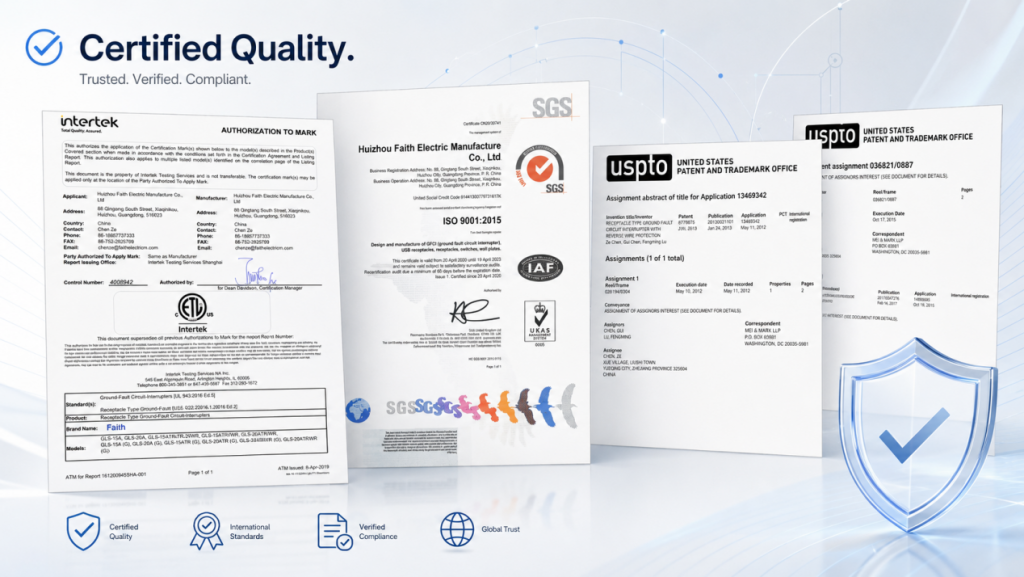
Faith Electric is a professional electrical manufacturer with 28 years of experience serving North American electrical, contractor, and engineering procurement customers. Our core products include UL/ETL certified GFCI and AFCI safety outlets, along with USB receptacles, standard receptacles, switches, and wall plates for complete wall-in electrical solutions.
If you are evaluating a GFCI outlet supplier for the North American market, contact Faith Electric to request certification information, product specifications, samples, or a factory capability overview.