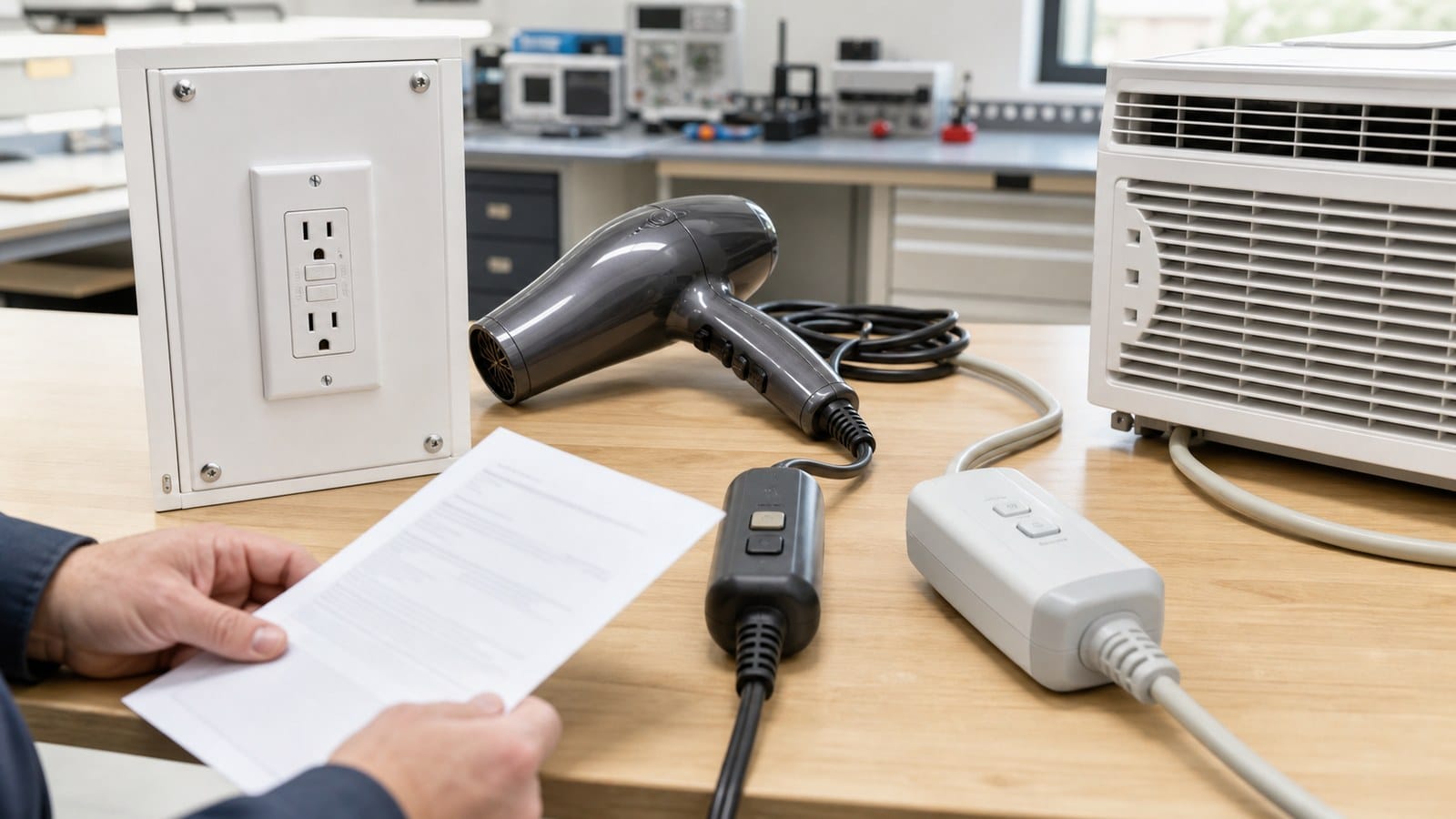
Pool and spa electrical systems need more than a standard outdoor outlet. Under recent editions of the National Electrical Code (NEC), listed GFCI protection applies to many receptacles, pump motors, heaters, lighting circuits, and other equipment around pools and spas. The exact rule depends on the equipment, voltage, current rating, connection method, distance from the water, and the NEC edition adopted by the local authority.
For buyers, contractors, and facility operators, the practical approach is to treat the pool area as a system. Confirm the circuit and equipment first; then specify the correct GFCI device, weather-resistant receptacle, enclosure, cover, wiring method, disconnect, bonding, and documentation. A GFCI receptacle alone does not make an entire pool installation compliant.
Code note: The NEC is adopted locally, often with amendments and on different schedules. This guide discusses the 2023 NEC framework and current U.S. safety guidance, but the adopted code, equipment instructions, project drawings, and authority having jurisdiction (AHJ) control each installation.
Pool and Spa GFCI Requirements at a Glance
| Application | Typical GFCI question | Practical specification point |
|---|---|---|
| Receptacles near a pool | Recent NEC rules cover receptacles rated 125 V through 250 V, 60 A or less, within the prescribed 20-foot zone | Verify distance, voltage, rating, WR marking, cover, and whether protection is at the receptacle or upstream |
| Pool pump motors | Pool-associated motors can require GFCI protection whether cord-connected or directly connected | Match the protective device to the motor circuit; a 15/20 A receptacle GFCI is not a substitute for a correctly rated motor-circuit solution |
| Pool equipment rooms | At least one general-purpose 125 V, 15 or 20 A GFCI-protected receptacle is required, with broader protection for other covered receptacles | Keep the device readily accessible for testing and service; confirm the room, vault, or pit classification |
| Spas and hot tubs | Receptacles and connected equipment have Article 680 requirements that vary by indoor/outdoor and permanent/storable installation | Follow the spa listing, instructions, disconnect rules, bonding requirements, and local amendments |
| Outdoor receptacles and covers | GFCI, weather resistance, and weatherproof covering address different risks | Use the required WR device, box, gasket, and cover; do not call a bare GFCI “weatherproof” |
Why Pool GFCI Protection Is a High-Consequence Requirement
Water lowers skin resistance, and wet decks, metal rails, pumps, lighting, and grounded surfaces can create a severe shock path. The U.S. Consumer Product Safety Commission (CPSC) reports that it was aware of 33 fatalities involving electrocutions in swimming pools and spas from 2002 through 2018. Its guidance identifies pumps, filters, underwater lights, heaters, cords, outlets, and switches as possible electrical sources around the water.
A Class A GFCI monitors the current leaving and returning through the circuit conductors. When the difference reaches the device’s trip criteria, it interrupts the circuit quickly. That protection reduces shock risk, but it does not replace overcurrent protection, equipment grounding, equipotential bonding, correct conductor routing, proper enclosures, or qualified maintenance.
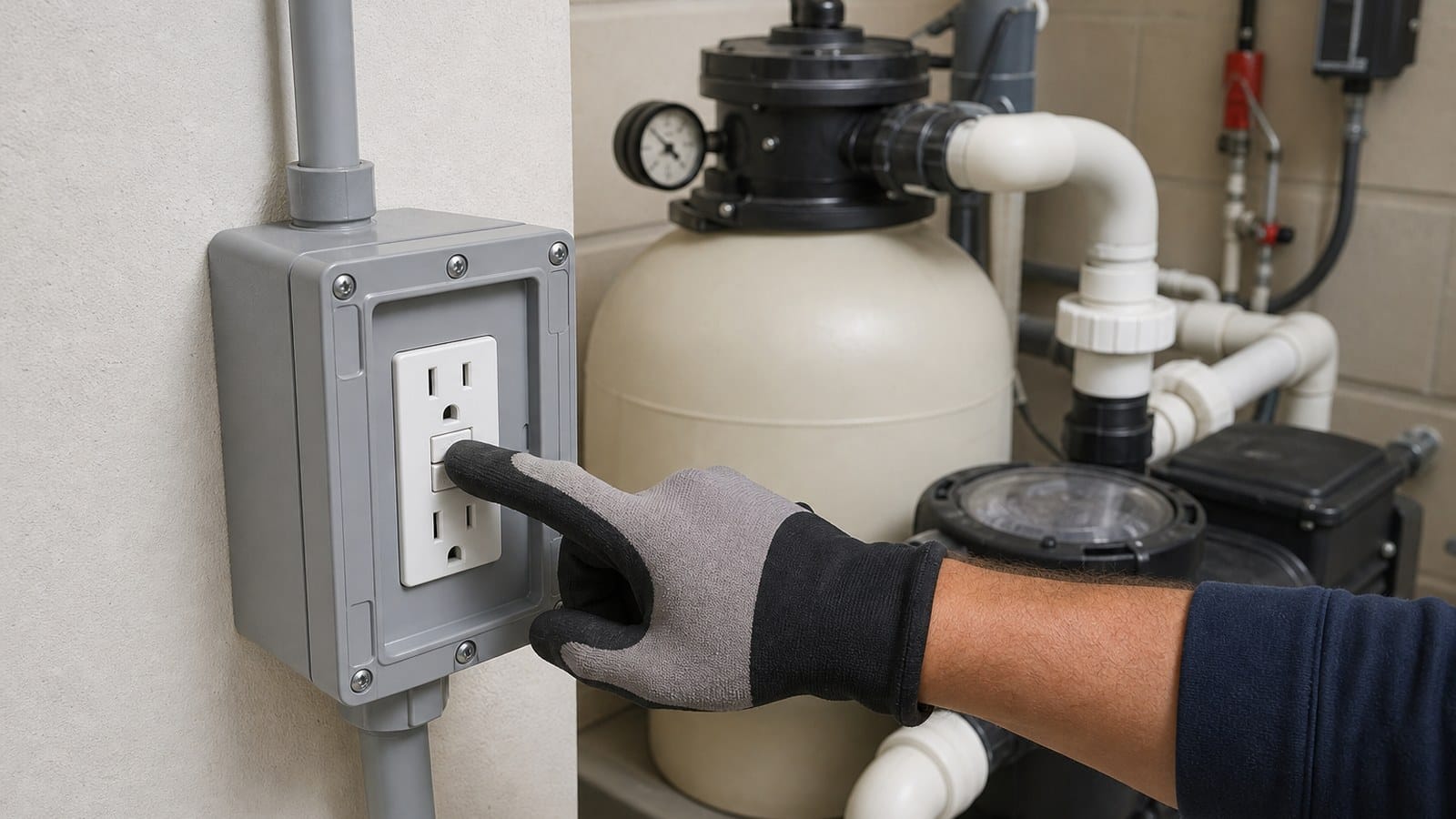
What NEC Article 680 Covers
Article 680 addresses swimming pools, fountains, spas, hot tubs, and similar installations. Within that article, different sections cover definitions, GFCI and special-purpose GFCI protection, equipment rooms, wiring methods, motors, receptacles, lighting, bonding, storable pools, and spas. A single sentence such as “all outlets within 20 feet need GFCI” is useful as a starting point, but it is not a complete design rule.
The 2023 NEC framework distinguishes ordinary Class A GFCI protection from special-purpose GFCI (SPGFCI) applications. UL Solutions explains that SPGFCIs are used for certain systems above the ordinary Class A voltage-to-ground range. Buyers should never assume that a familiar 15 A or 20 A receptacle-style GFCI can protect every higher-voltage pool load.
Receptacles within the pool area
Recent NEC editions require GFCI protection for covered receptacles within 20 feet of the inside wall of the pool. The 2023 language addresses receptacles rated 125 V through 250 V and 60 A or less. Placement rules also establish minimum separations for receptacles serving pool circulation equipment and for other receptacles. Measurements are made by the shortest path an appliance cord would follow without piercing a floor, wall, ceiling, doorway, window, or fixed barrier.
Do not use the 20-foot GFCI zone as permission to place a receptacle anywhere inside it. Minimum distance, locking configuration where applicable, general-purpose receptacle availability, cord length, enclosure, and equipment listing still matter. Local amendments can be more restrictive.
Pool pump motors and replacement motors
Pumps are a major focus because they combine line voltage, water circulation, vibration, and outdoor exposure. Article 680 includes GFCI requirements for outlets supplying covered pool pump motors, including directly connected equipment. Trade guidance based on the 2023 NEC notes that covered pool motors rated 60 A or less require GFCI protection and that replacement pool pump motors also need protection.
A 120 V cord-connected pump may be served from a correctly located, listed GFCI-protected receptacle. A 240 V hardwired variable-speed pump normally calls for a correctly rated GFCI circuit breaker or another listed protection method suitable for the circuit. The motor nameplate, installation instructions, conductor ampacity, breaker compatibility, control system, and local inspection requirements must agree.
Pool equipment rooms, vaults, and pits
One of the clearest 2023 NEC changes is the equipment-room rule. Leviton’s Captain Code portal reproduces Section 680.12(B) with NFPA permission: a permanently installed pool equipment room needs at least one GFCI-protected 125 V, 15 or 20 A general-purpose receptacle. It also describes GFCI protection for other covered receptacles in equipment rooms, vaults, and pits.
This service receptacle is useful for installers and maintainers, but it should not be treated as the universal supply point for every pump, heater, chlorinator, controller, or maintenance tool. Document what the receptacle serves and whether any downstream outlets are connected to its LOAD terminals.
GFCI Receptacle or GFCI Circuit Breaker?
Both can provide personnel ground-fault protection when listed and correctly applied. The right location depends on the circuit.
- Choose a GFCI receptacle for an accessible 125 V, 15 or 20 A service point where local TEST and RESET access helps maintenance.
- Choose a GFCI circuit breaker when the entire branch circuit needs protection, the load is hardwired, the circuit is 240 V, or no receptacle-style device matches the equipment rating.
- Avoid redundant protection without a reason. A GFCI receptacle downstream of a GFCI breaker can make trip diagnosis confusing.
- Keep reset access practical. A protective device hidden behind equipment or in a locked location may not meet accessibility requirements or the owner’s maintenance needs.
Faith Electric’s guide to GFCI receptacles versus GFCI circuit breakers explains the placement tradeoff in more detail.
Weather-Resistant Does Not Mean Waterproof
A GFCI interrupts ground faults. A weather-resistant (WR) receptacle uses materials intended to withstand outdoor temperature, moisture, and ultraviolet exposure. A weatherproof or extra-duty cover helps keep water and debris away from the face and plug connection. These are separate layers.
For an outdoor pool-area receptacle, review the complete assembly:
- Listed GFCI protection suitable for the circuit.
- WR-marked receptacle where the code requires it.
- Correct outdoor box, gasket, hub, conduit entry, and drainage details.
- Cover suitable for the damp or wet location and for use while a cord is connected where required.
- Mounting position that limits physical damage and does not create a trip hazard.
- Cord and connected equipment listed for the location and kept away from the water.
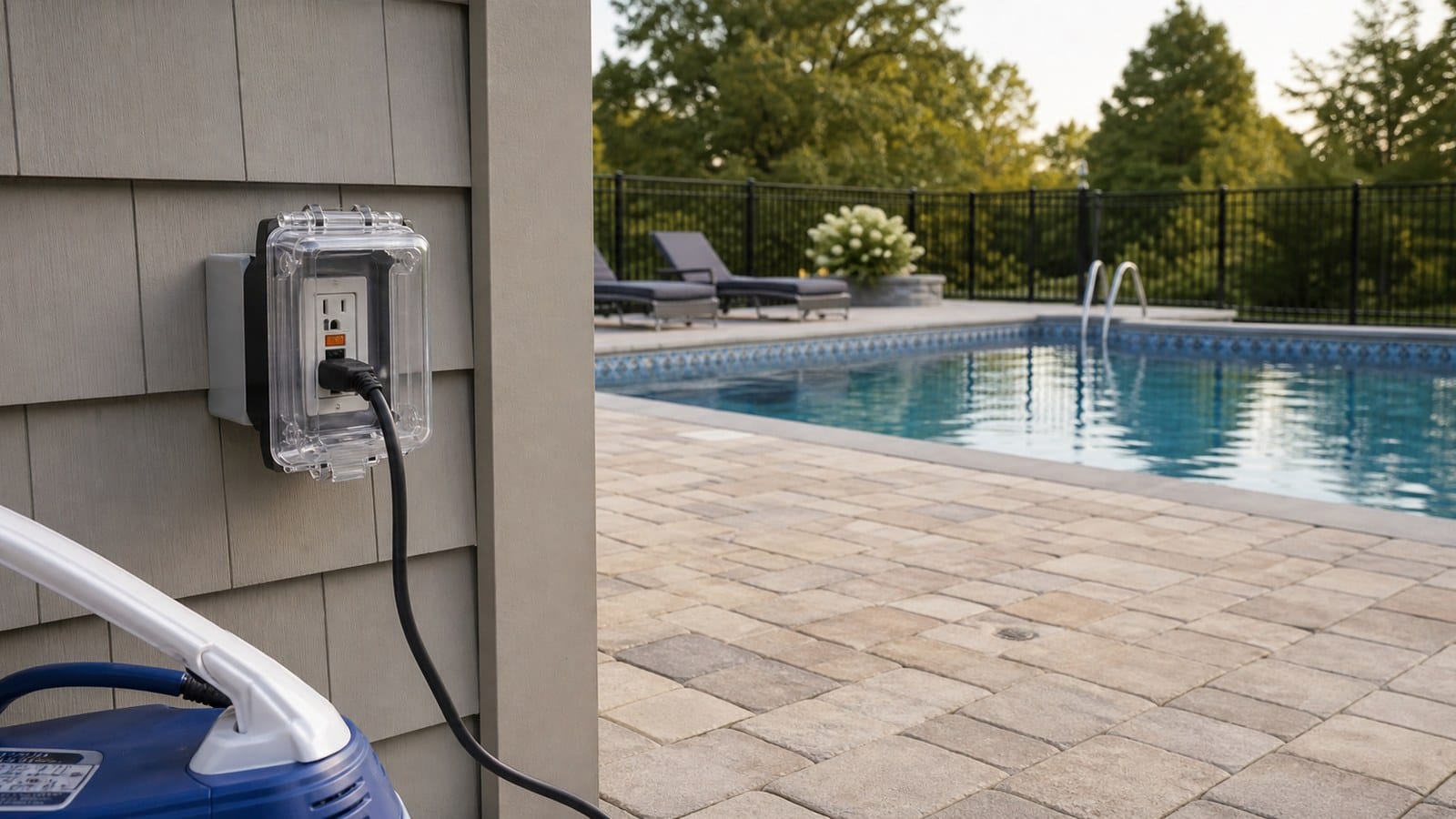
See Faith Electric’s comparison of weather-resistant and tamper-resistant GFCIs. In many residential pool environments, a buyer may need both WR and TR features, not one or the other.
Buyer Checklist for Pool and Spa GFCI Devices
Use this checklist before approving a submittal, sample, or private-label order:
- Define the installation. Permanent pool, storable pool, indoor spa, outdoor spa, fountain, equipment room, vault, or pit.
- Record the adopted code. Identify the NEC edition, local amendments, project specification, and AHJ.
- Map every load. List receptacles, pump motors, heaters, lights, controls, chlorinators, service tools, and replacement equipment.
- Capture electrical ratings. Voltage, voltage to ground, phase, frequency, full-load current, branch-circuit rating, and connection method.
- Select the protection format. Receptacle, circuit breaker, equipment-integrated protection, or SPGFCI where applicable.
- Verify the listing. Match the exact model, rating, product category, certification record, markings, and installation instructions.
- Specify environment features. WR, TR, enclosure type, corrosion resistance, cover, gasket, and mounting hardware.
- Confirm accessibility. TEST and RESET operation, disconnect location, emergency shutoff where applicable, and service clearance.
- Review compatibility. Motor drives and electronic controls should be checked against the protective device and equipment instructions.
- Retain records. Approved drawings, directory evidence, instructions, inspection results, and change-control documentation.
When choosing a receptacle rating, do not treat 20 A as automatically better. Match the circuit and load using Faith’s 15 A versus 20 A GFCI guide.
Testing and Maintenance
CPSC recommends testing permanently installed GFCIs at least monthly and testing infrequently used or portable units before each day’s use. Follow the device manufacturer’s instructions because indicator-light meanings and self-test behavior vary. A self-test GFCI still needs the user checks specified by its instructions.
If a pool-area GFCI trips repeatedly, do not bypass it. Turn off affected equipment, keep people out of the water, and have qualified personnel inspect the circuit and equipment. Flickering underwater lights, tingling sensations, or unusual swimmer behavior are emergency warning signs. CPSC advises turning off all power and calling emergency services when electrical shock in the water is suspected.
Common Specification Mistakes
- Specifying only “outdoor GFCI” without voltage, ampere rating, WR/TR features, cover, or listing evidence.
- Using a 15/20 A receptacle-style GFCI as the assumed answer for a 240 V hardwired pump.
- Confusing GFCI protection with bonding or grounding.
- Placing receptacles based only on convenience and ignoring minimum pool separation.
- Assuming the pump’s internal electronics provide the required personnel protection.
- Hiding the only TEST/RESET point behind equipment or inside an inaccessible enclosure.
- Calling a WR receptacle waterproof or omitting the required cover.
- Applying one pool rule to a spa, fountain, or storable pool without checking the applicable part of Article 680.
Frequently Asked Questions
Does every outlet within 20 feet of a pool need GFCI protection?
Covered receptacles within the Article 680 zone require GFCI protection under recent NEC editions, but the exact voltage, current, location, and installation rules must be checked. Minimum placement distances still apply.
Does a 240 V pool pump need a GFCI?
Covered pool pump motor circuits can require GFCI protection even when directly connected at 240 V. A correctly rated two-pole GFCI breaker or other listed solution is commonly used. Follow the adopted code and pump instructions.
Can I use a standard indoor GFCI outdoors if it has a cover?
Not where a WR receptacle is required. The cover protects the opening; the WR marking addresses the receptacle’s environmental durability. Both may be necessary.
Do I need a GFCI receptacle if the circuit already has a GFCI breaker?
Usually not for the same protection zone. Verify that the breaker protects the entire relevant circuit and that local reset access is not required by the design.
Is GFCI protection enough to make a pool safe?
No. Correct bonding, grounding, wiring methods, equipment listing, clearances, enclosures, disconnects, inspection, and maintenance are also essential.
How often should pool GFCIs be tested?
CPSC recommends monthly testing for permanently installed GFCIs and testing portable or infrequently used GFCIs before each day’s use. Always follow the manufacturer’s instructions.
Bottom Line
Pool and spa GFCI requirements apply to more than the convenience receptacle on the deck. Receptacles, motors, equipment rooms, heaters, lighting, and special-purpose systems can each require a different protection method. Specify from the circuit and application outward: adopted code, load rating, connection method, listing, GFCI format, WR/TR features, enclosure, cover, and maintenance access.
Faith Electric has manufactured wiring devices since 1996. For U.S. project or private-label programs, request the exact device configuration and certification documentation rather than approving a generic “pool GFCI” description.
Disclaimer: This article provides general U.S. procurement and safety information. It is not a substitute for project engineering, the adopted NEC, local amendments, equipment instructions, or AHJ approval. Pool and spa electrical work should be performed and inspected by qualified professionals.