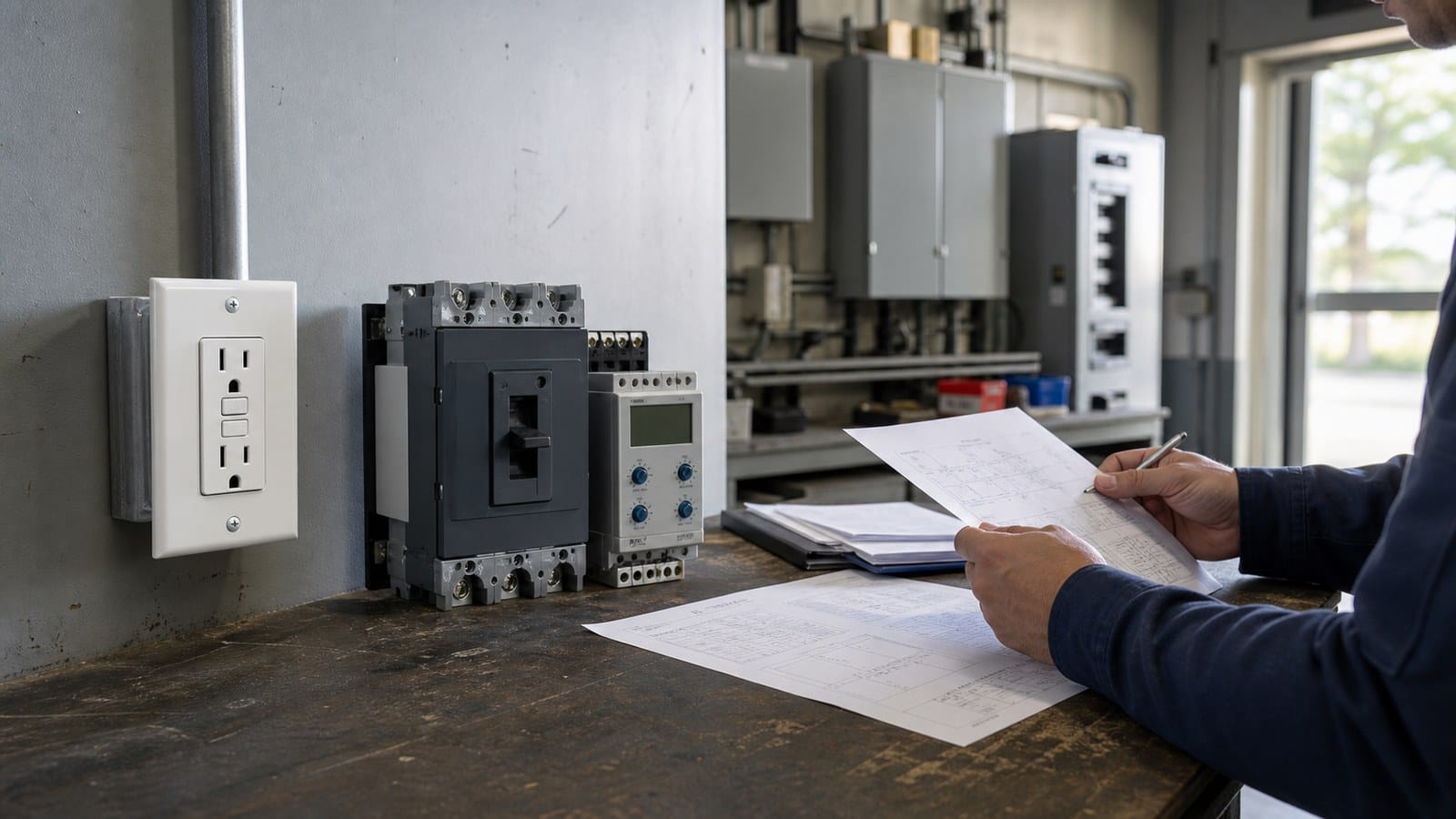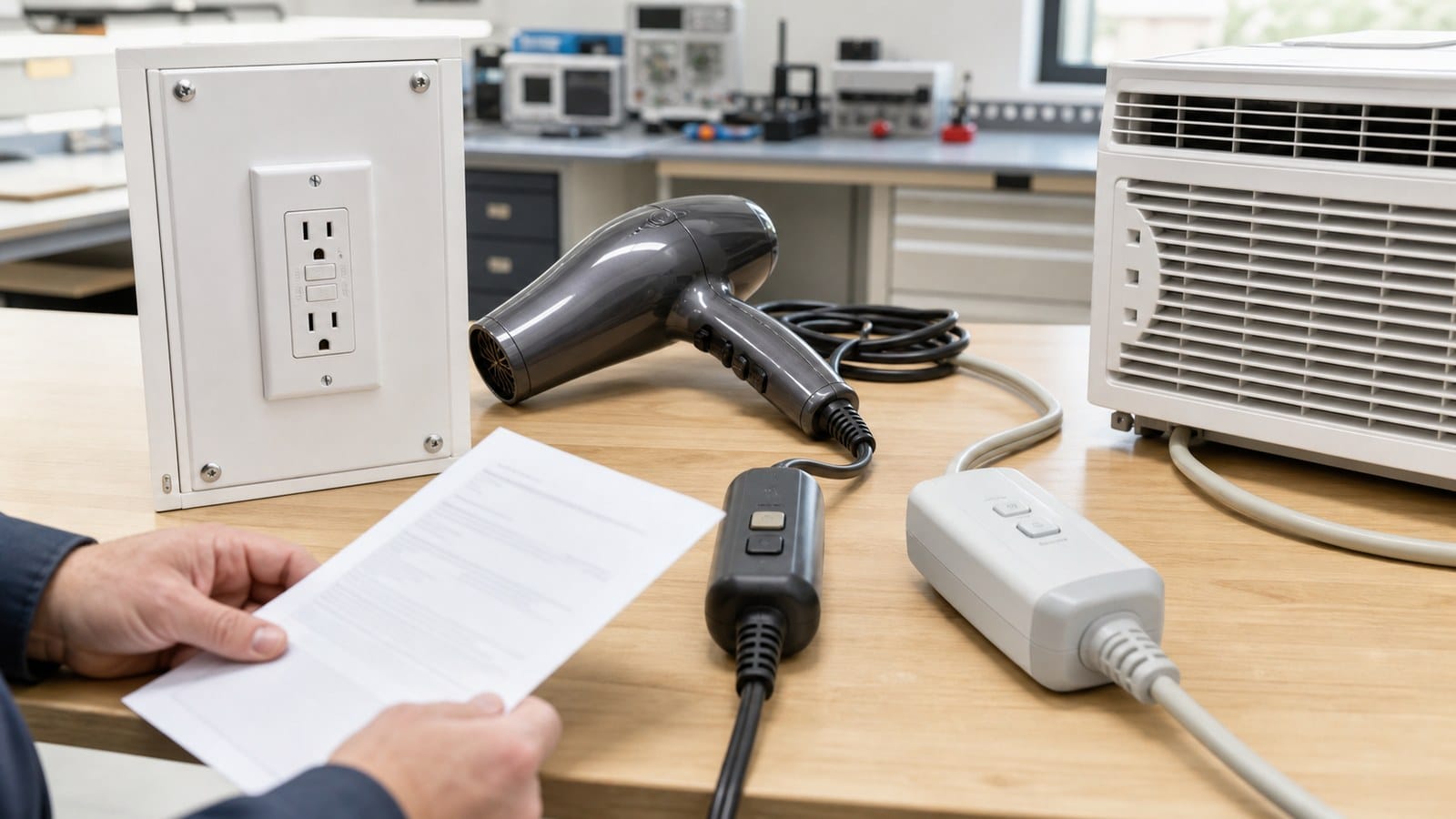
Commercial kitchens generally need GFCI protection far beyond the receptacles closest to a sink. Under recent National Electrical Code (NEC) editions, the requirement can apply to receptacles throughout kitchens and to food-preparation, beverage-preparation, cooking, and buffet-serving areas in non-dwelling occupancies. Separate appliance rules may also require protection for specified equipment, whether it is cord-connected or hardwired.
The final design depends on the NEC edition adopted by the state or city, local amendments, circuit voltage and phase, equipment ratings, installation instructions, and the authority having jurisdiction (AHJ). A restaurant owner, electrical contractor, consultant, or purchasing team should therefore treat GFCI protection as a system-design decision—not a last-minute outlet substitution.

Commercial Kitchen GFCI Requirements at a Glance
| Question | Practical answer |
|---|---|
| Are only receptacles within 6 feet of a sink covered? | No. Recent NEC rules cover broader kitchen and food/beverage preparation areas. The six-foot rule remains relevant to certain sink-adjacent locations, but it is not the entire commercial-kitchen rule. |
| Are 208- or 240-volt receptacles automatically exempt? | No. Recent editions extend coverage beyond ordinary 125-volt, 15- and 20-amp receptacles, subject to the limits and conditions in the adopted code. |
| Does hardwiring always avoid GFCI? | No. Appliance-specific rules can require protection at the branch circuit or outlet supplying named appliances. |
| Is a receptacle-type GFCI always best? | No. A GFCI breaker may be more practical for higher-current, multiwire, three-phase, inaccessible, or whole-circuit applications. |
| Can an equipment grounding conductor replace GFCI protection? | No. Grounding and GFCI protection perform different safety functions; both may be required. |
| Which code controls today? | The locally adopted edition and amendments, not simply the newest national edition or the date printed on a blog. |
Why Commercial Kitchens Receive Broad Protection
A working restaurant combines electricity with conductive floors, stainless-steel equipment, water, steam, cleaning chemicals, heat, and frequent handling. Power cords are moved during cleaning. Plugs may be inserted with damp hands. Motors, heaters, refrigeration components, pumps, and electronic controls can develop leakage as insulation ages.
A Class A GFCI compares current leaving and returning on the circuit conductors and opens the circuit when the imbalance indicates that current may be taking an unintended path. OSHA describes a GFCI as a fast-acting device intended to interrupt a ground fault before it causes serious injury. Its restaurant safety guidance recommends GFCIs where electricity and wetness coexist.
GFCI protection does not replace the branch-circuit breaker, equipment grounding conductor, bonding, proper enclosure, cord inspection, or lockout procedures. It adds personnel protection for a type of fault that a standard overcurrent breaker may not detect.
The Main NEC Paths That Can Trigger GFCI Protection
Commercial projects often reach the same answer through more than one rule. The design review should check all applicable paths instead of stopping after the first one.
1. Kitchens in occupancies other than dwelling units
NEC 210.8(B) addresses GFCI protection in non-dwelling locations. Recent editions cover commercial kitchens broadly. The rule is no longer limited to a narrow group of small 125-volt countertop receptacles.
The Leviton 2023 code-change guide, which reproduces relevant NEC material with NFPA permission, explains that covered non-dwelling kitchen receptacles can include 125- through 250-volt single-phase receptacles within the applicable current and voltage-to-ground limits, plus qualifying three-phase receptacles.
That matters for mixers, warming equipment, cooking equipment, refrigeration, and specialty appliances that use configurations larger than the familiar 5-15 or 5-20 receptacle.
2. Food or beverage preparation areas
A space may require protection even if someone argues that it is not a “full kitchen.” Recent language separately identifies areas with a sink and permanent provisions for food preparation, beverage preparation, or cooking.
This can affect coffee counters, beverage stations, ice-cream preparation areas, bars, concession areas, employee break areas, and similar spaces. The important facts are the permanent provisions and how the area is actually used—not the label on the architectural plan.
3. Buffet-serving areas
The 2023 NEC added clearer treatment of buffet-serving areas with permanent provisions for food serving, beverage serving, or cooking. A hotel breakfast station, institutional cafeteria line, or restaurant buffet may therefore need GFCI protection even when it is physically separated from the back-of-house kitchen.
4. Receptacles and equipment close to sinks
The familiar six-foot measurement still matters in some non-dwelling applications. Recent requirements address receptacles and certain cord-and-plug-connected fixed or stationary appliances located within 1.8 m (6 feet) of the top inside edge of a sink bowl.
Measure the actual installation. Do not measure only in a straight horizontal line through cabinets or assume that moving a receptacle a few inches settles every other applicable rule.
5. Specific appliances
NEC 210.8(D) can require GFCI protection for the branch circuit or outlet supplying specified appliances within its rating limits. The list includes equipment frequently found in food-service projects, such as dishwashers, electric ranges, wall-mounted ovens, counter-mounted cooking units, microwave ovens, drinking-water coolers, bottle-fill stations, and vending machines.
Eaton’s 2023 appliance GFCI overview emphasizes that the protective function can be located at a breaker, receptacle, or another listed upstream point. The rule addresses the branch circuit supplying the appliance, so changing from a cord-and-plug connection to hardwiring is not a universal workaround.
What the 2026 NEC Changes—and What It Does Not
The 2026 NEC was issued in 2025, but publication does not mean immediate nationwide enforcement. Jurisdictions adopt different editions on different schedules and may amend them. At the time of specification, record the locally enforced edition.
The 2026 edition did not broadly expand the commercial-kitchen location list again. One important development is recognition of high-frequency-rated Class A GFCIs for compatibility with modern power-conversion equipment. UL Solutions explains that optional HF-marked GFCIs are evaluated for immunity to certain high-frequency differential currents produced by equipment using inverters or variable-frequency drives.
Do not read “HF” as permission to increase the ordinary personnel-protection trip threshold. It is a product-evaluation and interoperability marking. Confirm availability, listing, application, and the adopted-code treatment before specifying it.
GFCI Receptacle or GFCI Breaker?
Both formats can provide Class A personnel protection when correctly listed, rated, and installed. The right choice depends on the circuit and operating environment.
Use a GFCI receptacle when
- The protected point is a compatible 125-volt, 15- or 20-amp receptacle.
- TEST and RESET controls can remain readily accessible.
- One device can protect a clearly identified group of downstream receptacles.
- The box has enough volume and the environment is suitable for the device.
- Local staff can identify which device controls which outlets.
Use a GFCI breaker or upstream device when
- The load uses a higher-current or 208/240-volt connection not served by a duplex GFCI receptacle.
- The branch circuit supplies several protected outlets.
- The equipment connection is hidden behind an appliance or otherwise not readily accessible.
- A multiwire or three-phase circuit needs an appropriate common protective device.
- The project also needs AFCI protection and a listed dual-function solution is compatible with the panel and circuit.
Faith Electric’s comparison of GFCI receptacles and GFCI circuit breakers covers reset location, downstream protection, and maintenance tradeoffs in more detail.

Design the Protection Around Operations
A code-compliant circuit can still be inconvenient or difficult to maintain. In a busy kitchen, a poorly planned trip can interrupt more equipment than expected and make the fault hard to locate.
Avoid excessive downstream grouping
One GFCI receptacle can protect downstream outlets through its LOAD terminals, but putting too many unrelated appliances behind one device increases cumulative leakage and expands the outage when a trip occurs. Group loads intentionally and label the protected outlets.
Keep reset points readily accessible
Do not bury a receptacle-type GFCI behind a permanently installed refrigerator, range, or fixed stainless cabinet. If the reset point cannot be reached without moving equipment, use another listed arrangement that preserves accessibility.
Separate critical loads when appropriate
Refrigeration, cooking, dishwashing, beverage, and point-of-sale equipment have different operational consequences. Dedicated circuits may simplify load calculations and troubleshooting, but “dedicated” does not remove a GFCI requirement.
Account for cleaning and washdown
Standard indoor devices and covers are not automatically suitable for wet or washdown exposure. Specify boxes, covers, gaskets, device ratings, corrosion resistance, and installation methods for the actual environment. A weather-resistant (WR) receptacle is designed for outdoor exposure conditions, but it is not a waterproof washdown device.

Purchasing Checklist for Commercial Kitchen GFCIs
Before approving a product or purchase order, verify the following:
- Listing and category. Require a traceable certification from an OSHA-recognized NRTL for the exact model and configuration. UL Solutions lists receptacle, portable, and breaker GFCIs under the UL 943 testing and certification program.
- Electrical rating. Match voltage, current, frequency, phase, feed-through rating, conductor range, and terminal temperature rating to the circuit design.
- Trip class. Confirm that the device provides the personnel-protection class called for by the design. Do not substitute equipment-protection ground-fault devices.
- Self-test function. For receptacle GFCIs, specify current UL 943-compliant auto-monitoring/self-test behavior and the required indication or power-denial response.
- Environmental suitability. Identify dry, damp, wet, outdoor, corrosion-prone, and washdown locations separately. Specify the complete assembly, not only the receptacle.
- Tamper resistance. Apply TR requirements where the adopted code and occupancy require them; do not assume every commercial application uses the same face configuration.
- Accessibility. Confirm that TEST/RESET controls remain reachable after equipment, millwork, and backsplashes are installed.
- Panel compatibility. Breaker-type devices must be listed for the exact panel, poles, voltage, interrupting rating, and neutral arrangement.
- Documentation. Collect listing references, data sheets, installation instructions, date/lot traceability, and approved submittal information.
- Replacement consistency. Define the approved replacement device so maintenance staff do not substitute a standard receptacle after a trip problem.
Faith Electric has manufactured wiring devices since 1996. For private-label or project purchasing, buyers should still verify the exact model’s listing, ratings, markings, and approved configuration rather than relying on a company-level claim.
Commissioning and Maintenance
GFCIs are safety devices, not install-and-forget accessories.
- Test each device using its integral TEST button after installation and according to the manufacturer’s instructions.
- Confirm that every intended downstream outlet loses power and that no unintended outlet is interrupted.
- Record which breaker or GFCI controls each appliance and receptacle.
- Verify labels after kitchen equipment is set in its final position.
- Inspect cords, plugs, strain reliefs, boxes, covers, and seals during routine maintenance.
- Investigate repeated trips instead of installing an unprotected replacement.
- Replace a device that will not pass its built-in test or shows damage, heat, corrosion, or unreliable reset behavior.
OSHA has cautioned that an external plug-in tester is not a substitute for the GFCI’s own integral testing circuit when evaluating GFCI operation in the context addressed by its guidance.
Common Specification Mistakes
- Writing “GFCI near sinks” and overlooking the broader kitchen, beverage, buffet, and appliance rules.
- Assuming hardwired equipment is automatically exempt.
- Selecting only 5-15/5-20 receptacle devices when the project includes higher-voltage or three-phase loads.
- Protecting too many unrelated appliances from one downstream GFCI.
- Locating TEST/RESET controls behind fixed equipment.
- Using a WR receptacle without the correct box, cover, and sealing system.
- Treating a GFCI as a substitute for grounding, bonding, overcurrent protection, or equipment maintenance.
- Accepting an unverified certification mark or a listing that does not cover the exact model.
For amperage-selection basics, see Faith Electric’s guide to 15-amp vs. 20-amp GFCI outlets.
Frequently Asked Questions
Do all commercial kitchen receptacles need GFCI protection?
Under recent NEC editions, commercial-kitchen receptacle coverage is broad and can include qualifying 125- through 250-volt single-phase receptacles and qualifying three-phase receptacles. The exact scope depends on the adopted edition, ratings, location, and local amendments.
Does the six-foot-from-a-sink rule cover the whole requirement?
No. It is one possible trigger. Kitchen, food/beverage preparation, buffet-serving, and appliance-specific provisions can require protection even when a receptacle is more than six feet from a sink.
Do hardwired dishwashers and cooking appliances need GFCI?
They may. Appliance-specific rules can apply to the branch circuit or outlet supplying named appliances, including hardwired equipment within the rule’s rating limits. Check the adopted code and equipment instructions.
Can one GFCI receptacle protect several restaurant outlets?
Yes, when the device is listed for feed-through protection and LINE/LOAD wiring is correct. Avoid grouping unrelated critical loads without evaluating leakage, outage scope, accessibility, and labeling.
Is an HF-marked GFCI required in every commercial kitchen?
No. HF marking is an optional evaluation related to high-frequency interoperability. It should be specified only when appropriate, available, listed, and accepted under the project’s adopted code and design.
Can a GFCI replace an equipment grounding conductor?
No. GFCI protection and equipment grounding are different functions. Follow grounding and bonding requirements in addition to GFCI rules.
Bottom Line
Commercial kitchen GFCI requirements are no longer a simple “outlets within six feet of the sink” checklist. Review the entire kitchen and every food-preparation, beverage, buffet, and appliance location. Match the protective method to the circuit, keep reset points accessible, specify listed products for the environment, and plan maintenance before equipment blocks the walls.
This article is general U.S. educational information, not project-specific engineering or legal advice. The adopted code, local amendments, manufacturer instructions, approved plans, and AHJ decision control each installation. Electrical work should be performed by qualified persons.