
A blank-face GFCI—also called a dead-front or faceless GFCI—is a ground-fault circuit interrupter with TEST and RESET buttons but no plug-in receptacle slots. It is installed to protect a hardwired load or downstream receptacles while keeping the reset point accessible and avoiding an extra convenience outlet. Common applications include spas, pumps, outdoor receptacles, commercial equipment, and dedicated branch circuits.
The important distinction is simple: a blank-face GFCI is a protection and control point, not a place to plug in equipment. It can be the right choice when a specification calls for Class A personnel protection but an additional usable receptacle would be unwanted, confusing, or contrary to the intended dedicated-circuit design.

What Is a Blank-Face GFCI?
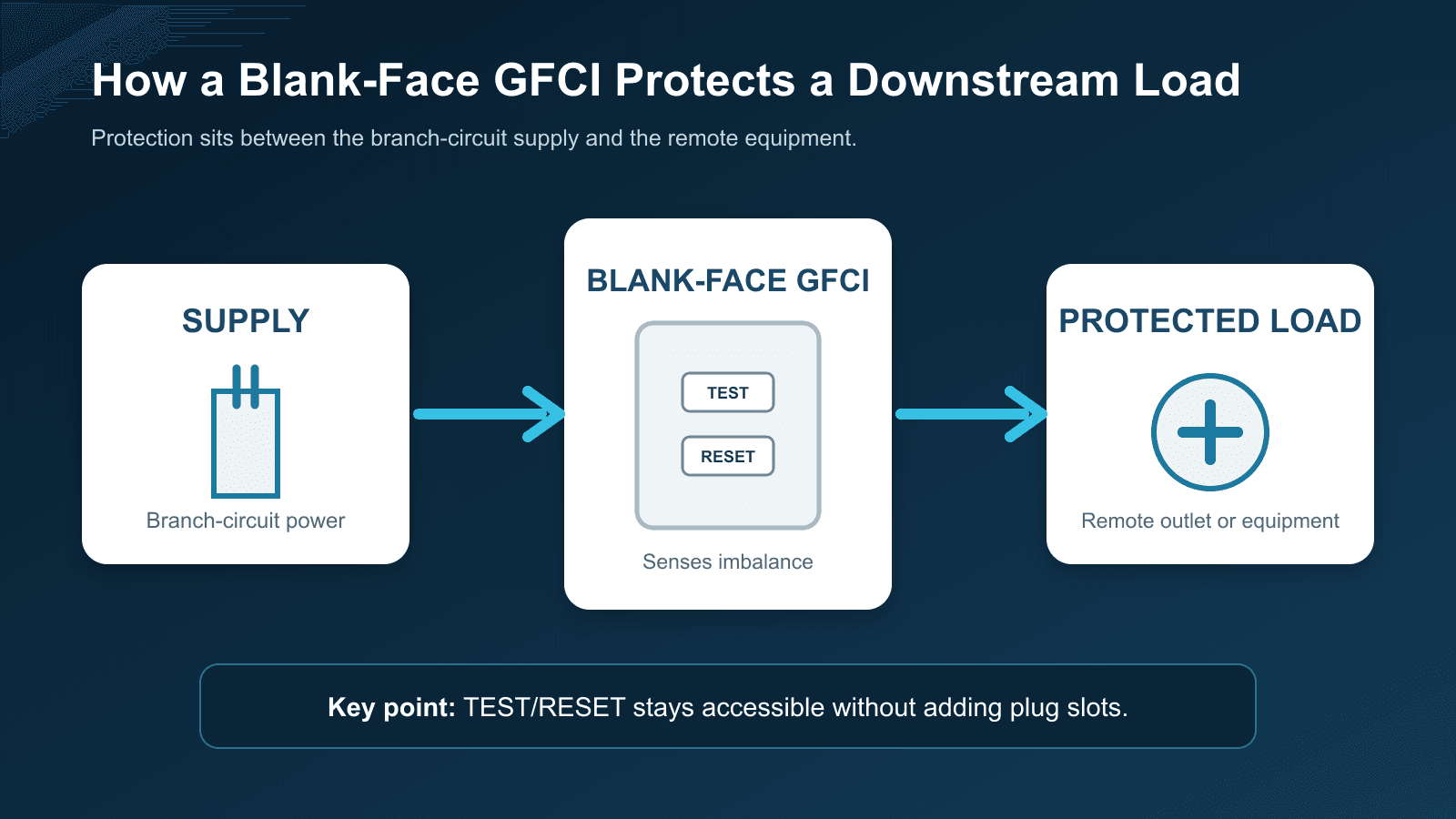
A blank-face GFCI contains the sensing, trip, self-test, and reset functions associated with a modern GFCI, but its front has no receptacle contacts. Power enters through the LINE terminals. When the application calls for downstream protection, the protected circuit leaves through the LOAD terminals and supplies a remote receptacle or hardwired equipment.
Manufacturers use several names for the same basic format:
- Blank-face GFCI
- Dead-front GFCI
- Faceless GFCI
- Blank GFCI device
“Dead front” can also describe a protective panel cover in other electrical contexts, so product schedules should say “dead-front GFCI” or “blank-face GFCI” clearly. A buyer should never assume that the words “dead front” alone identify the intended wiring device.
For personnel protection in common U.S. branch-circuit applications, the relevant product family is generally evaluated to UL 943. UL Solutions identifies receptacle, portable, and circuit-breaker GFCIs as the main GFCI types under that standard. A blank-face model should be verified by its exact catalog number and listing record, not by appearance or a generic certificate image.
How a Blank-Face GFCI Works
Like a duplex GFCI, a blank-face device compares the current leaving on the ungrounded conductor with the current returning on the grounded conductor. A difference indicates that current may be taking an unintended path. A Class A GFCI is designed to interrupt the circuit at a very small leakage level for personnel protection.
The U.S. Consumer Product Safety Commission explains that a GFCI monitors circuit current and interrupts power quickly when the outgoing and returning current differ. That function is different from an overcurrent circuit breaker, which responds to overloads and short circuits. See the CPSC GFCI fact sheet for the agency’s consumer-safety overview.
A modern blank-face unit may also include:
- automatic self-test or auto-monitoring;
- line-load reversal protection;
- end-of-life lockout or denial of power;
- a status indicator;
- feed-through protection for downstream equipment;
- back-wire and side-wire termination options.
Self-test does not eliminate the manual TEST button. Users and maintenance teams should follow the manufacturer’s instructions, including the stated manual test interval. Faith’s detailed overview of self-test GFCI requirements under UL 943 explains why model documentation and indicator behavior matter to buyers.
Where Blank-Face GFCIs Are Commonly Used
Spas, hot tubs, and hydromassage equipment
A spa or tub pump may be hardwired or served by a receptacle located behind an access panel. A blank-face GFCI can place the TEST/RESET point in a more serviceable location while protecting the remote load. Accessibility, equipment instructions, local code, and the approved design still control the installation.
Outdoor receptacles protected from indoors
A blank-face device may be mounted in a dry, accessible indoor location and feed an outdoor receptacle. That arrangement can keep the GFCI electronics away from harsh exposure and put the reset point where maintenance personnel can reach it. The downstream outdoor receptacle, box, cover, and installation must still meet all environmental and code requirements.
Dedicated equipment circuits
Some designers do not want an extra convenience receptacle on a circuit intended for one load. A blank face prevents a user from plugging in a vacuum, heater, or tool at the protection point. That can support the circuit’s intended use, but the device itself does not create a code-compliant dedicated circuit; the entire branch-circuit design must do that.
Pumps, commercial equipment, and remote outlets
Sump pumps, display equipment, food-service equipment, and other loads may need GFCI protection depending on location and applicable code. A blank-face unit can offer a local reset point when a panel-mounted GFCI breaker is inconvenient or incompatible with the existing panel. It is not a universal answer for every motor load, and nuisance-tripping concerns should never be solved by removing required protection.
Blank-Face GFCI vs. GFCI Receptacle vs. GFCI Breaker
| Decision point | Blank-face GFCI | Duplex GFCI receptacle | GFCI circuit breaker |
|---|---|---|---|
| Plug-in outlets at device | None | Usually two | None |
| Reset location | Wall box or accessible enclosure | At receptacle | At panel |
| Typical protection scope | Remote load or downstream branch | Its face plus optional downstream outlets | Entire protected circuit |
| Best fit | Hardwired, remote, or dedicated loads | Point-of-use convenience and protection | Centralized whole-circuit protection |
| Key limitation | No place to plug in equipment | Adds a usable outlet | Reset requires panel access |
For a broader cost, access, and protection-scope comparison, see Faith’s guide to GFCI receptacles versus GFCI circuit breakers.
Can You Replace a Blank-Face GFCI With a Regular GFCI Outlet?
Not automatically. The fact that both devices fit a similar wall box does not mean they are interchangeable for the project. A blank-face unit may have been chosen to protect a dedicated load, prevent casual plug-in use, satisfy equipment instructions, or locate the reset point away from the load.
Before any substitution, a qualified electrician should determine:
- what the device protects;
- whether the downstream equipment is hardwired or receptacle-connected;
- whether the branch circuit is intended to be dedicated;
- the branch-circuit rating and device feed-through rating;
- the applicable NEC edition and local amendments;
- manufacturer instructions for the connected equipment;
- whether adding a convenience receptacle changes the approved design.
Do not treat a blank-face device as an ordinary switch. Repeatedly using TEST and RESET to control equipment may be outside the intended operating method unless the manufacturer explicitly permits it.
Selection Checklist for Contractors and Buyers
1. Confirm the exact electrical rating
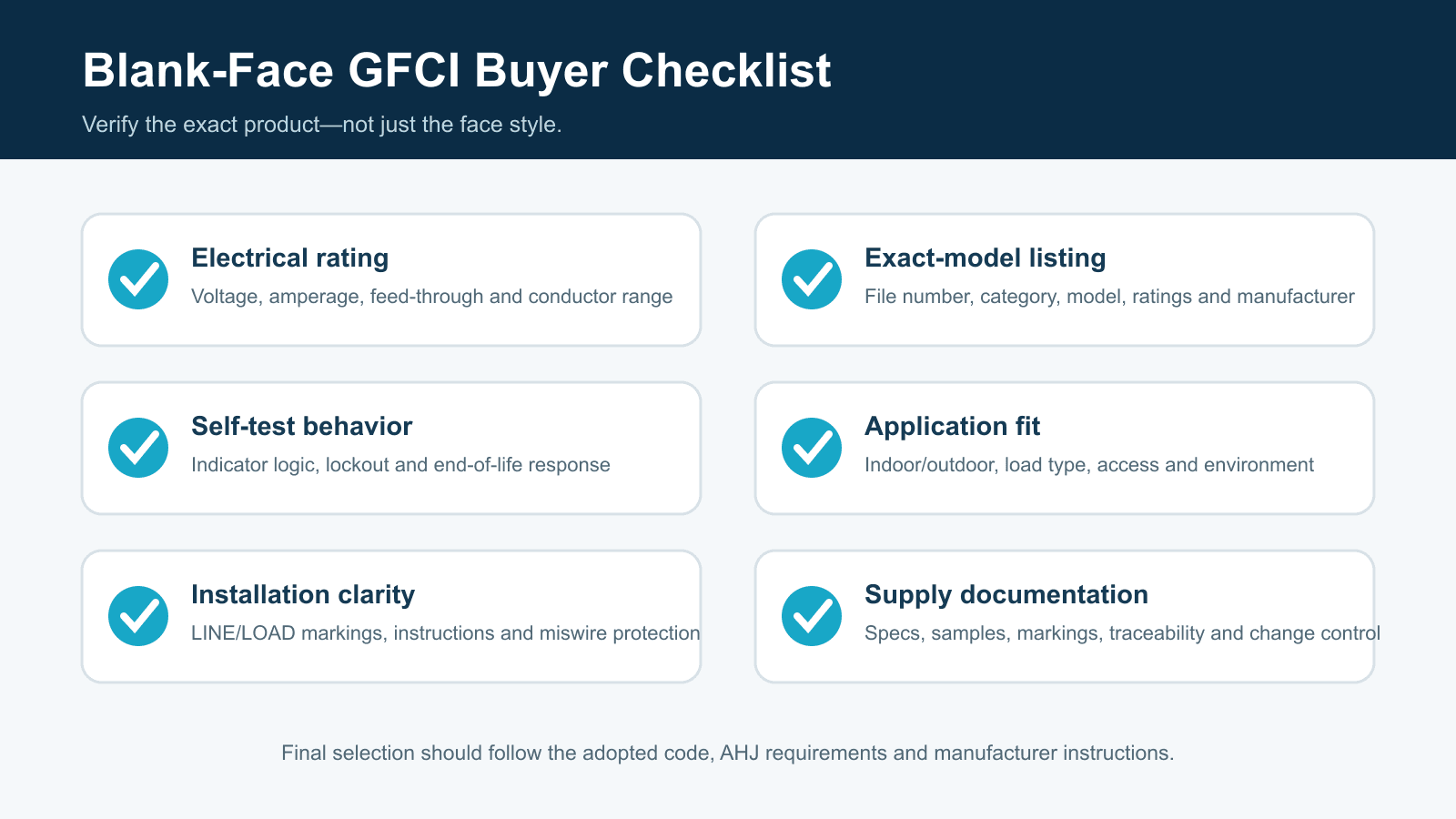
Check voltage, amperage, frequency, feed-through rating, conductor range, terminal method, short-circuit rating where specified, and operating temperature. Do not infer these from the face color or enclosure size.
2. Verify the listing for the exact model
Ask for the certification file number, product category, model family, rating, and manufacturer name. Confirm the information in the listing organization’s database. “Designed to UL 943” is not the same claim as a current listing for the quoted SKU.
3. Review self-test and end-of-life behavior
Modern product documentation should explain automatic monitoring, manual testing, indicator meanings, and what happens if the device can no longer provide protection. The preferred behavior and required markings must match the destination market and project specification.
4. Match environmental and application requirements
A blank-face device located indoors may protect an outdoor receptacle, but that does not make every part of the system weather-resistant. Check enclosure, cover, corrosion resistance, temperature, and connected-equipment requirements separately.
5. Confirm LINE and LOAD identification
Clear terminal markings, factory-applied LOAD terminal protection, a legible instruction sheet, and line-load miswire protection reduce field errors. Installation must follow the supplied instructions and be performed by a qualified person with the circuit de-energized and verified safe.
6. Review project documentation
For OEM, distributor, and project purchasing, collect the product specification, installation instructions, listing information, model/variant matrix, packaging artwork, traceability plan, and change-control process. Faith’s 12-point GFCI manufacturer checklist covers supplier-level verification in more detail.
Installation and Commissioning: What to Verify
This article is not a substitute for the NEC, local amendments, equipment instructions, or a licensed electrician. Blank-face GFCI work involves energized electrical hazards and should be performed by qualified personnel.
A practical project closeout should verify:
- Protection scope: Identify every downstream outlet or load controlled by the device.
- Location and access: Make sure TEST and RESET remain readily serviceable as required for the project.
- Device and circuit ratings: Confirm the installed catalog number matches the approved submittal.
- Wiring verification: Confirm LINE and LOAD are not reversed and neutrals are not improperly shared across protected paths.
- Functional test: Use the device’s TEST/RESET procedure and verify that intended downstream loads lose and regain power correctly.
- Labeling: Label downstream receptacles when required and document which blank-face device protects them.
- Recordkeeping: Add the device to the facility’s testing and replacement log.
Common Mistakes to Avoid
- Buying by appearance alone. Similar faces can hide different ratings, features, and listing scopes.
- Assuming “20A feed-through” means every receptacle configuration is 20A. Branch-circuit and receptacle rules are separate selection questions.
- Placing the reset point where it cannot be accessed. Convenience and serviceability are core reasons to use this format.
- Ignoring connected-equipment instructions. A spa, pump, dishwasher, or other appliance may have specific protection and disconnect requirements.
- Treating a nuisance trip as a device problem. Moisture, leakage, damaged equipment, neutral errors, or excessive combined leakage may be the real cause.
- Using a listing logo without model verification. Certification must match the exact production model and its ratings.
FAQ
Does a blank-face GFCI protect downstream outlets?
Yes, when the device is specifically designed for feed-through protection and the downstream circuit is correctly connected to its LOAD terminals. Confirm the manufacturer’s instructions and listing.
Is a blank-face GFCI the same as a GFCI breaker?
No. Both can protect downstream wiring, but the blank-face device installs in an outlet box or enclosure, while the breaker installs in a compatible panel and also provides overcurrent protection.
Can a blank-face GFCI be used outdoors?
Only if the exact product and enclosure system are identified for the environment. An indoor blank-face device can sometimes be located inside to protect an outdoor receptacle, but the entire outdoor assembly must still meet applicable requirements.
Does a blank-face GFCI need manual testing?
Yes. Follow the manufacturer’s instructions. Automatic self-test monitors internal functions but does not eliminate the manual TEST/RESET procedure.
Why use a blank face instead of a normal GFCI outlet?
It provides an accessible protection point without creating an additional plug-in location. That is useful for hardwired, remote, or dedicated loads.
What should OEM buyers request from a supplier?
Request exact-model listing data, product specifications, instruction sheets, rating and feature matrices, samples, packaging/marking files, traceability details, and written change-control procedures.
Bottom Line
A blank-face GFCI is the right tool when a project needs accessible Class A ground-fault protection but does not need—or should not add—a usable receptacle at the protection point. Choose it by the exact listing, rating, self-test behavior, feed-through capability, environment, and connected load. For U.S.-market sourcing, evaluate the device, documentation, and production model as one package.
Faith Electric has developed wiring devices for the U.S. market since 1996. Buyers evaluating GFCI receptacles, project variants, or OEM/ODM programs can review Faith’s GFCI and wiring-device product range and request model-specific certification and technical information.
Safety note: Electrical code adoption and amendments vary by jurisdiction. Product selection and installation should be reviewed by the authority having jurisdiction and performed by qualified electrical professionals.