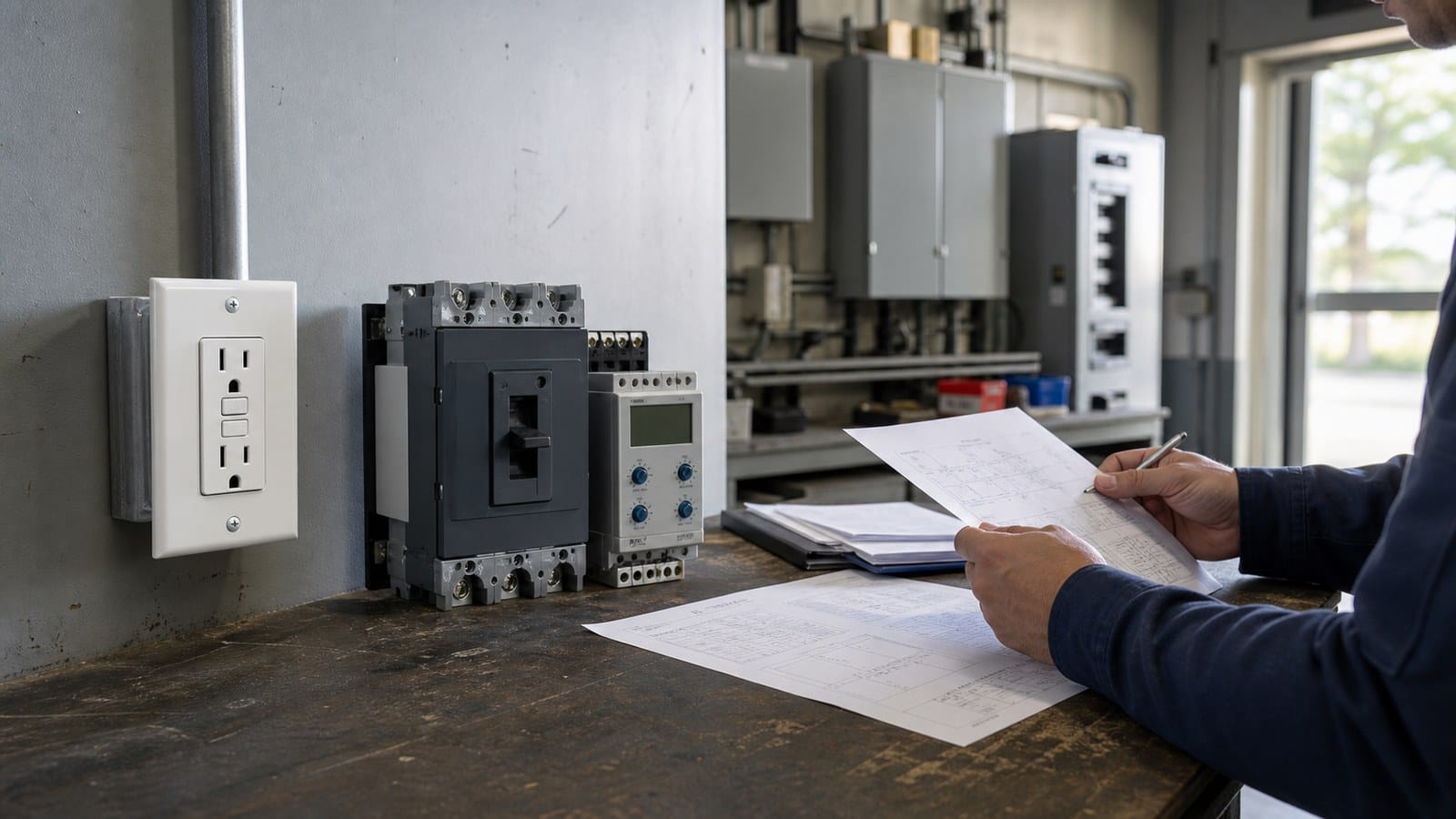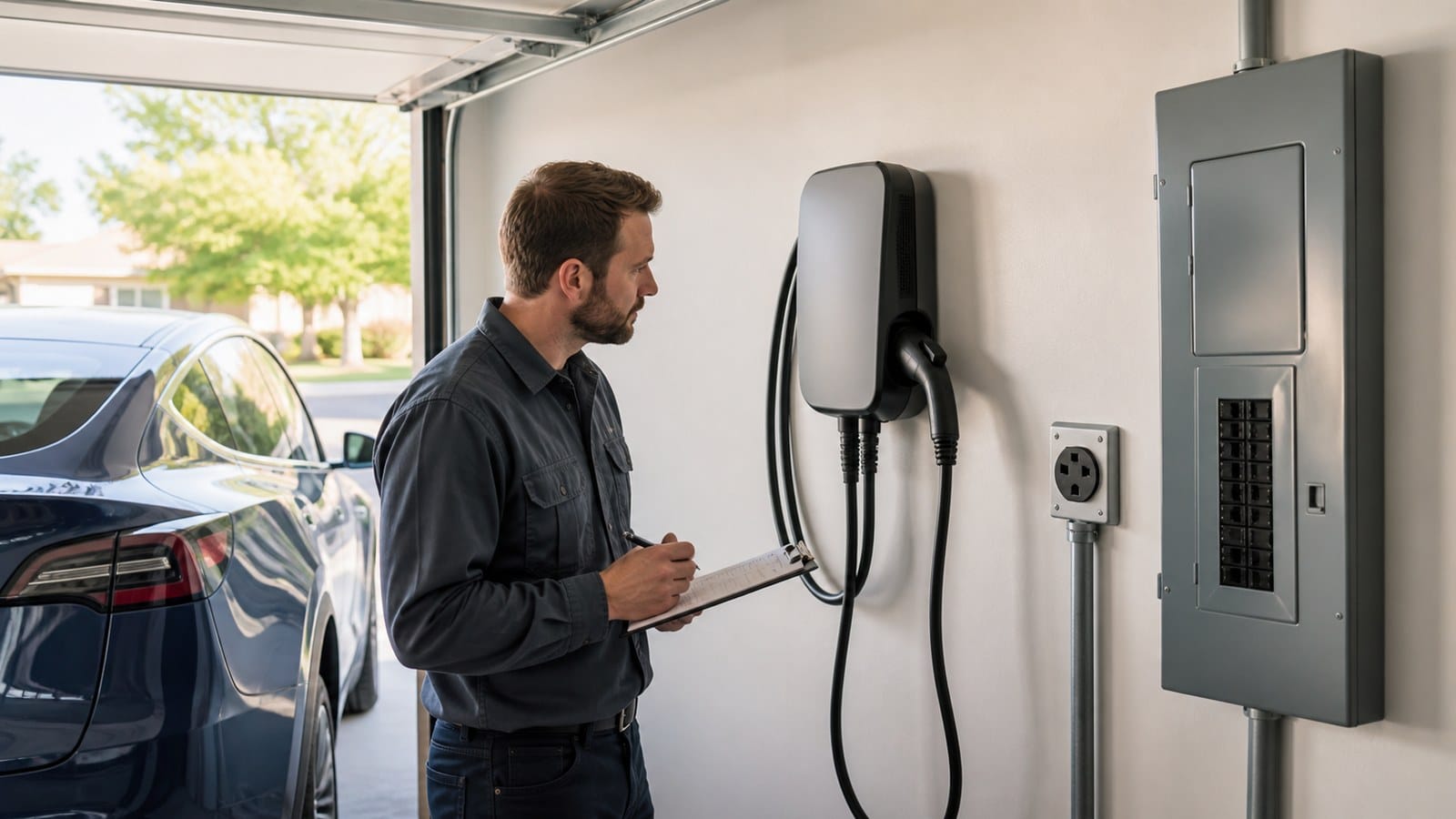
Yes – for a typical cord-and-plug residential opener, the garage receptacle generally needs GFCI protection under modern NEC rules. Mounting the receptacle on the ceiling does not take it out of the garage rule, and dedicated use is not a general exemption. The enforceable answer still comes from the edition adopted locally, local amendments, the opener’s listing and instructions, and the authority having jurisdiction (AHJ).
The reset device can be somewhere more practical than the ceiling. A wall-mounted GFCI, a wall-mounted blank-face device, or a compatible GFCI breaker can protect the opener circuit when the complete installation is listed, correctly wired, and permitted. The maintenance test should not require a ladder.
Repeated tripping is a diagnosis problem, not a reason to bypass protection. Start by identifying whether the GFCI or the branch-circuit breaker opened. Then disconnect loads, check for moisture or visible damage, and stop if the trip returns.
Research and review method: Faith Editorial Team checked NFPA 70 (2023 edition) Section 210.8(A)(2) through NFPA LiNK, the formal NFPA 70 document page, current Chamberlain electrical-specification guidance, a LiftMaster installation manual, and UL Solutions guidance for Class A GFCIs. No licensed-electrician, garage-door technician, or AHJ review is claimed.
Quick decision table
| Situation | Likely requirement or action | What to verify |
|---|---|---|
| Cord-and-plug opener in an attached dwelling garage | The receptacle generally needs GFCI protection under the modern NEC garage rule | Adopted NEC edition, local amendments, opener instructions |
| Ceiling receptacle above the opener | Height does not create a general garage exemption | Put TEST/RESET controls in a readily accessible location |
| GFCI breaker protects the circuit | Can be a valid method when listed and compatible | Panel location, breaker compatibility, downstream scope |
| Wall GFCI protects the ceiling receptacle | Can provide accessible local reset | Correct LINE/LOAD wiring and labels |
| Hardwired opener | The garage receptacle rule does not directly apply to a connection with no receptacle | Equipment listing, manufacturer instructions, other applicable rules |
| Older installation | May have been compliant under an earlier edition | Local existing-installation and alteration rules |
| GFCI trips when the door moves | Treat as a fault or compatibility symptom, not permission to remove protection | Opener, cord, receptacle, wiring, moisture, and other loads |
Why the ceiling outlet is included
NFPA LiNK provides the formal 2023 edition of NFPA 70. In that edition, Section 210.8(A)(2) is the dwelling-unit garage location. Read it together with the charging language in 210.8(A), its exceptions, and the edition and amendments adopted locally. The model code is not a substitute for the rule actually adopted where the home is located.
The rule is based on the location, not on whether a person normally touches the receptacle. A ceiling outlet can supply a grounded, cord-connected opener and still be exposed to leakage from a damaged cord, moisture, wiring problems, or the connected equipment.
Older articles sometimes describe a former exception for a dedicated or inaccessible opener receptacle. Do not carry that historical advice into a modern project without checking the adopted code.
Where should the GFCI device be located?
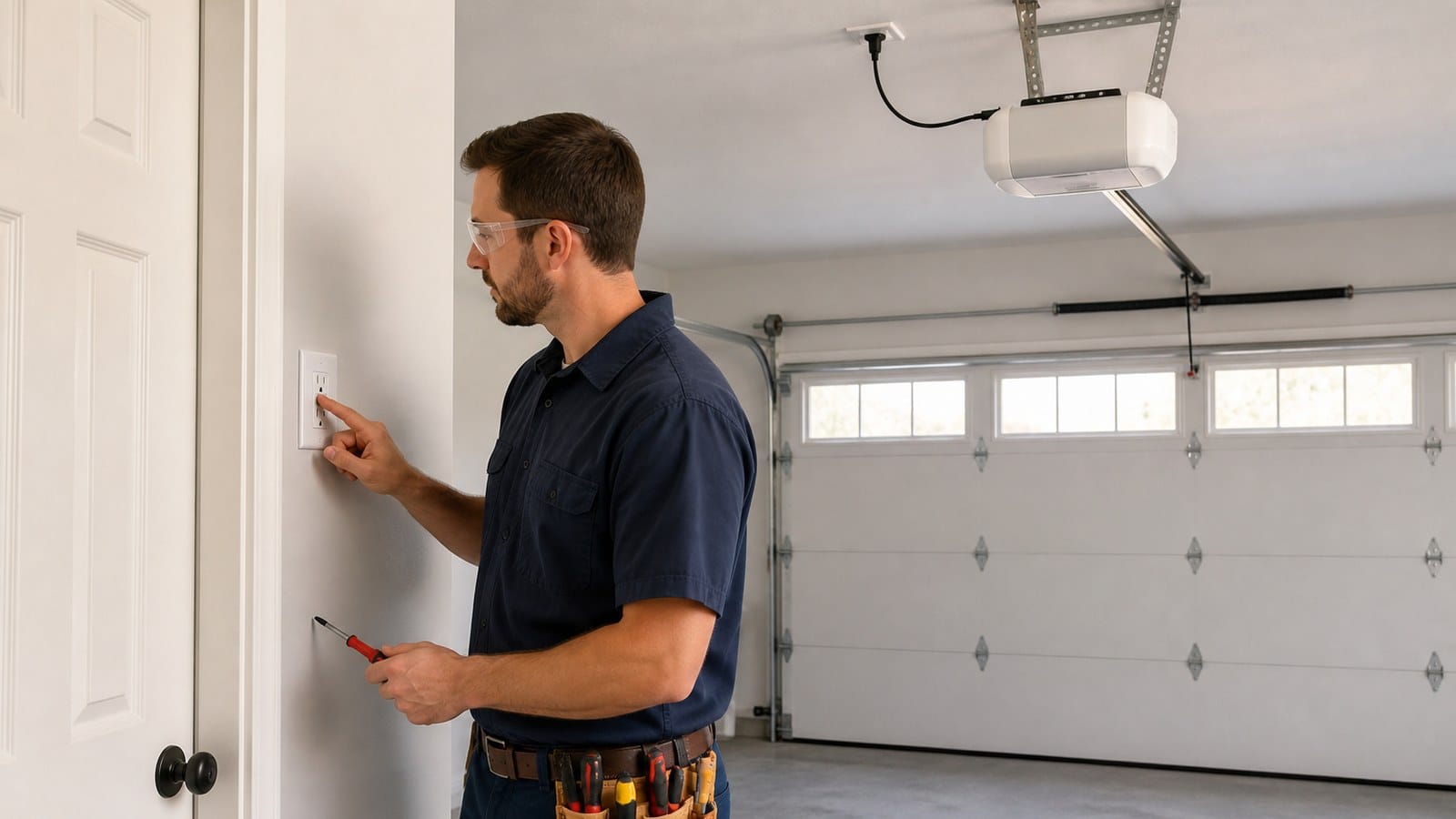
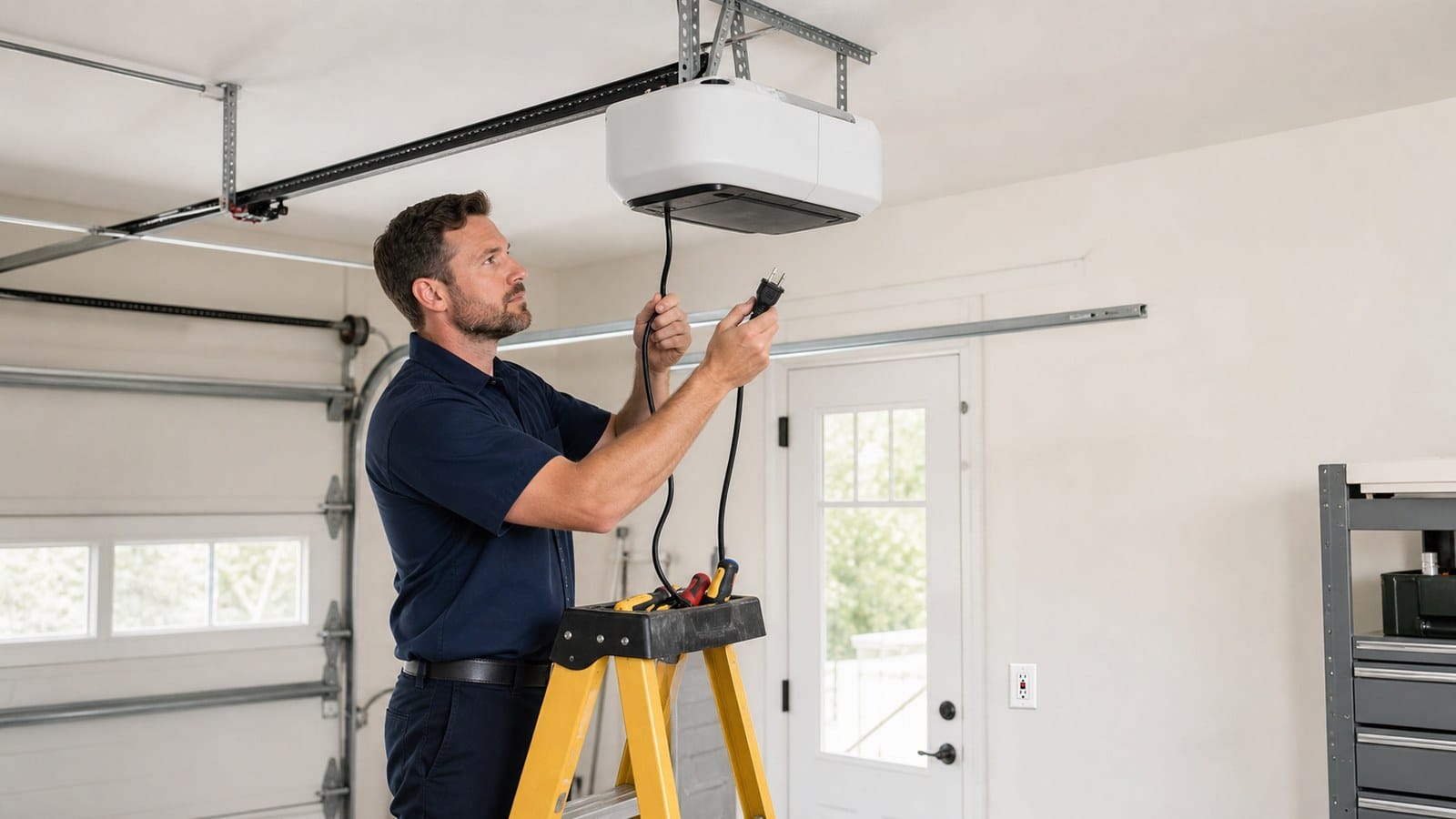
The test and reset function should be readily accessible. Mounting a receptacle-type GFCI on the ceiling beside the opener may satisfy the electrical function, but it creates a poor maintenance point if the buttons require a ladder.
Common arrangements include:
- Wall-mounted GFCI receptacle with load-side protection. The ceiling receptacle is connected to the protected load terminals of a wall GFCI. The wall device should be clearly identified and should not be hidden behind storage or a large appliance.
- Blank-face GFCI on the wall. A blank-face device provides test and reset controls without adding another plug-in point. This can make the protection boundary easier to manage.
- GFCI circuit breaker. The breaker protects the branch circuit from the panel. This is useful when several outlets need protection, but a trip may require access to the electrical panel.
- GFCI receptacle at the ceiling. This may be electrically acceptable when permitted, but accessibility and safe testing must be considered.
Faith’s GFCI receptacle vs. GFCI circuit breaker guide explains the broader tradeoff. A blank-face device is another possible form factor, but its exact listing, rating, wiring, and location still need to be checked for the project.
Does the opener need a dedicated circuit?
GFCI protection and a dedicated branch circuit are separate questions. The garage location can require GFCI protection without automatically requiring an individual circuit for every opener.
The correct circuit design depends on:
- the garage receptacle branch-circuit requirements in the adopted code;
- the opener’s nameplate load and installation instructions;
- whether one or more openers share the circuit;
- other receptacles and loads connected to the branch circuit;
- local amendments and project specifications; and
- the desired behavior if another load trips the protective device.
Do not size the circuit from a generic internet amp value. Chamberlain’s electrical specification guidance directs users to the model label for voltage and current information and notes that operating demand varies. A LiftMaster 8500W installation manual instructs users to plug that model into a grounded outlet and to follow local electrical and building codes. The manual for the exact opener model remains the authority for that product.
An individual circuit can improve operational separation. It remains a design choice unless the code, manufacturer, or project documents make it mandatory.
Should the opener share GFCI protection with exterior outlets?
It may be possible, but shared protection has operational consequences. If an exterior receptacle gets wet and trips the upstream GFCI, the garage door opener can lose power even though the opener is healthy. The same issue can occur when a freezer, pressure washer, irrigation controller, or damaged extension cord shares the protected circuit.
Before connecting the opener downstream of an existing GFCI, map every load on the protected side. Ask:
- Which receptacles lose power when the GFCI TEST button is pressed?
- Could rain or outdoor equipment disable the garage door?
- Does a freezer or security-related device share the outage?
- Is the reset device accessible from inside the garage?
- Will labels tell the homeowner which device protects the ceiling outlet?
Separating the opener from unrelated exterior loads can reduce the outage scope, but the opener’s receptacle still needs the required GFCI protection.
Does GFCI protection cause nuisance tripping?
A GFCI does not trip because the motor simply uses more current than normal. Overcurrent is the job of the branch-circuit breaker. A GFCI trips when it detects an imbalance between outgoing and returning current. Some electronic equipment can produce leakage or high-frequency components that complicate compatibility, but repeated trips still require investigation.
Possible causes include:
- moisture in a receptacle, box, exterior outlet, or damaged cord;
- insulation deterioration in the opener motor, light, power supply, or wiring;
- a neutral-to-ground connection downstream of the GFCI;
- incorrect shared-neutral or LINE/LOAD wiring;
- cumulative leakage from several devices on the protected circuit;
- a damaged plug or flexible cord;
- a failing GFCI device; or
- an opener that does not operate correctly with the installed protective device.
Do not replace a 15-amp GFCI with a 20-amp model as a way to increase the trip threshold. Class A personnel protection is not an adjustable overcurrent setting. The receptacle rating, branch-circuit rating, and permitted feed-through use must be selected correctly, but changing the ampere marking is not a repair for ground-fault leakage.
Safe troubleshooting sequence
If the opener loses power, first determine what actually opened.
1. Identify the tripped device
Check the branch-circuit breaker and the known GFCI test/reset locations. A tripped GFCI may be on a wall, at the panel, in another part of the garage, or upstream from the ceiling receptacle.
Chamberlain’s no-power troubleshooting guidance advises checking a garage GFCI and breaker when the opener outlet has no power.
2. Unplug the opener and other loads
Disconnect the opener from the ceiling receptacle and unplug other readily accessible devices on the same protected circuit. Do not open the opener housing or touch exposed conductors.
3. Reset once with no load
If the GFCI will not reset with all accessible loads unplugged, stop. The problem may be in the GFCI, the fixed wiring, moisture, or another downstream connection. A qualified electrician should diagnose the circuit.
4. Check visible, de-energized surfaces
Look for water, a damaged cover, a loose or scorched plug, crushed cord insulation, corrosion, or an exterior receptacle exposed to rain. Do not use the opener until damaged components are repaired.
5. Reconnect only the opener
If the GFCI resets with no load, reconnect only the opener. If it trips again during standby or door movement, the opener or its cord may need service. Do not power it from an unprotected extension cord as a permanent workaround.
6. Test the door mechanically only as instructed
A binding door, broken spring, or improper balance can strain the opener, but door-system work has its own serious hazards. Use the manufacturer’s manual-release and balance-check procedure. Garage door springs and cables should be serviced by trained personnel.
GFCI trip versus breaker trip
| Symptom | More likely protective function | Next question |
|---|---|---|
| GFCI TEST/RESET device is tripped | Ground-fault or leakage detection | Does it reset with the opener and other loads unplugged? |
| Branch-circuit breaker handle is tripped | Overcurrent, short circuit, or breaker issue | What loads were operating, and is there equipment or wiring damage? |
| Both appear on | Loss of supply, switched receptacle, loose connection, or failed equipment | Does a qualified person confirm voltage at the receptacle? |
| Trip occurs only during rain | Moisture at an outdoor or garage component is likely | Which boxes, covers, cords, or outlets are exposed? |
| Trip occurs only when opener is connected | Opener, cord, or compatibility problem | Does the same verified GFCI circuit hold with a simple known-good load? |
| Several remote outlets lose power | One upstream GFCI protects multiple outlets | Is the downstream protection map documented? |
When several remote outlets lose power together, treat that as evidence of shared upstream protection until the wiring map proves otherwise. Label the reset location and the protected ceiling receptacle so the next person does not have to search the garage during an outage.
Battery backup does not remove the GFCI requirement
A battery-backup opener may continue to operate temporarily after the AC supply trips. That improves access during an outage, but it does not make an unprotected receptacle acceptable. The battery is an operational feature, not a substitute for branch-circuit safety requirements.
Include battery maintenance in the homeowner instructions. A dead or disconnected battery can make a future GFCI trip look like an opener failure, while a healthy battery can temporarily hide the loss of AC power.
New construction buyer checklist
For builders, electricians, and wiring-device buyers, specify the complete arrangement:
- Adopted NEC edition and local amendments.
- Opener model, voltage, current rating, cord length, and installation instructions.
- Ceiling receptacle configuration and grounding type.
- GFCI method: receptacle, blank-face device, upstream receptacle, or breaker.
- Readily accessible TEST and RESET location.
- Exact downstream protection boundary and labels.
- Branch-circuit rating, conductor size, and breaker compatibility.
- Whether other garage, exterior, freezer, or workshop loads share the circuit.
- Box depth, device terminals, faceplate, and mounting details.
- Required TR or WR markings based on location and adopted rules.
- Listed Class A GFCI certification information for the exact model.
- Commissioning test: TEST button, opener operation, battery backup, wall control, safety-reversal system, and labels.
For volume procurement, do not approve a product from the face appearance alone. Match the model, rating, terminal configuration, listing record, instructions, and private-label artwork. Faith has manufactured wiring devices since 1996; its private-label GFCI checklist provides a broader approval process for U.S. programs.
Five documents that should agree before approval
For a builder or private-label program, place these five items side by side:
| Document or item | Fields to compare |
|---|---|
| Opener nameplate and manual | Model, input voltage, frequency, current, plug type, grounding instructions |
| Electrical schedule | Circuit number, breaker rating, conductor size, other connected loads |
| GFCI sample and data sheet | Exact model, receptacle rating, feed-through rating, LINE/LOAD terminals, self-test behavior |
| Certification record | Certification body, product category, file number, exact covered model and production site |
| Device and carton artwork | Model identity, ratings, listing mark authorization, TR/WR claims, lot or date traceability |
A mismatch is a hold point. For example, a 20A carton does not correct a 15A device marking, and a listing for one model family does not automatically cover a private-label suffix. Keep the signed comparison with the purchase-order revision.
Existing garages and replacement work
An older garage may have an unprotected ceiling receptacle because it was installed under an earlier code or exception. That does not automatically mean the whole property must be rewired today, and it does not mean the old arrangement should be copied during an alteration.
Before replacing the opener, receptacle, or branch-circuit equipment, check:
- the local code edition and existing-installation rules;
- whether the work counts as repair, replacement, or alteration;
- receptacle-replacement GFCI requirements;
- permits and inspection requirements;
- the new opener’s instructions; and
- whether upstream GFCI or AFCI protection is already present.
Do not install a second GFCI blindly on a circuit already protected by a GFCI breaker. Redundant devices may both be safe, but they can make troubleshooting confusing without adding useful protection. First identify the existing device and protection boundary.
Common mistakes
- Assuming a ceiling receptacle is exempt because it is not readily accessible.
- Installing the only TEST/RESET buttons beside the opener where a ladder is required.
- Connecting the opener downstream of exterior outlets without considering rain-related trips.
- Calling every power loss a GFCI trip without checking the breaker.
- Replacing the GFCI repeatedly without unplugging downstream loads.
- Using an extension cord to bypass required protection.
- Confusing a 20-amp receptacle rating with a higher GFCI leakage threshold.
- Ignoring a damaged door, cord, plug, or wet box.
- Forgetting labels that identify the upstream GFCI protecting the ceiling receptacle.
- Treating battery backup as a substitute for compliant AC power.
FAQ
Does a ceiling outlet for a garage door opener need GFCI protection?
Generally yes under modern NEC dwelling-garage rules. The outlet height and dedicated use do not create a broad exemption. Verify the locally adopted edition and amendments.
Can the GFCI reset be on the garage wall?
Yes, an appropriately listed wall receptacle or blank-face GFCI can protect a downstream ceiling receptacle when it is correctly wired and permitted. The reset location should remain readily accessible and clearly identified.
Can a GFCI breaker protect the opener?
Yes, when the breaker is listed, correctly rated, compatible with the panel, and the installation complies with the adopted code and opener instructions.
Does a hardwired garage door opener need GFCI protection?
The garage receptacle rule does not directly apply if there is no receptacle. Other code rules, the equipment listing, manufacturer instructions, and local requirements may still apply. Do not convert a cord-connected listed product to hardwired use unless the manufacturer permits it.
Why does the opener work on another outlet but trip the garage GFCI?
The other outlet may not be GFCI protected, may be on a different circuit, or may have different leakage conditions. This test does not prove the opener is safe. If the opener repeatedly trips a verified GFCI circuit, have the equipment and circuit evaluated.
Should I replace the GFCI if the opener trips it?
Not automatically. Unplug the opener and other loads, check whether the device resets with no load, inspect for visible moisture or damage, and obtain qualified diagnosis. Replace the GFCI only when testing supports that conclusion and use a correctly listed, rated device.
Can an outdoor outlet trip the garage door opener?
Yes, if both are on the load side of the same GFCI. Moisture or a fault at the outdoor outlet can interrupt every downstream receptacle, including the opener outlet.
Bottom line
A cord-and-plug residential garage door opener generally needs GFCI-protected receptacle power. The useful design question is not whether the ceiling outlet can be exempted; it is where the listed protection and accessible reset point should be placed.
If the opener trips the GFCI again after other loads are disconnected, stop treating it as a nuisance. Record when it trips, note whether rain or door movement is involved, and have the circuit and opener checked by the appropriate qualified person.
Sources / References
Accessed August 11, 2026.
- NFPA 70, National Electrical Code, 2023 edition, Sections 210.8(A) and 210.8(A)(2), via NFPA LiNK
- NFPA 70 formal document and product page
- UL Solutions – GFCI personal protection devices testing and certification under UL 943
- Chamberlain Group – Electrical specifications for garage door openers
- LiftMaster 8500W – Installation manual and grounded-outlet instructions
- Chamberlain Group – No-power troubleshooting guidance
- Faith Electric – Private-label GFCI model, marking, packaging, and approval checklist
- Faith Electric – About Faith, including the documented 1996 start
This article provides general U.S. code-planning and troubleshooting information. It is not a substitute for the locally adopted electrical code, manufacturer instructions, permits, inspection, or professional diagnosis. Electrical work should be performed by qualified persons, and garage door springs and cables should be serviced by trained personnel.