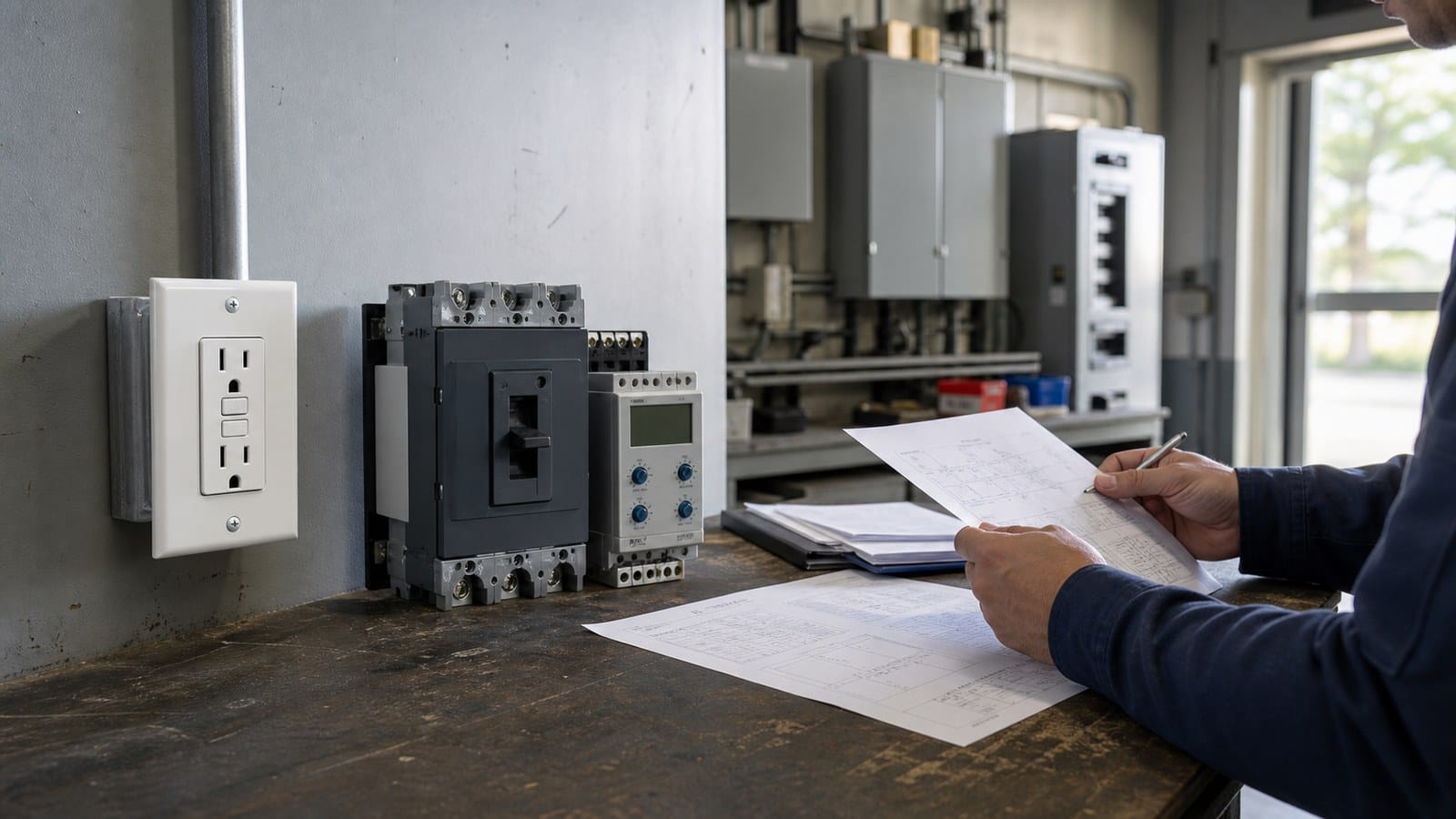
Quick answer: For most new or substantially altered U.S. dwelling-unit dishwasher installations, plan GFCI protection. The requirement applies to the outlet supplying the dishwasher, whether the appliance is cord-and-plug connected or hardwired. A GFCI circuit breaker, a readily accessible GFCI receptacle, or another permitted listed protection method may be used when the complete installation follows the locally adopted National Electrical Code, local amendments, and the dishwasher instructions.
The word “outlet” in electrical rules does not mean only a wall receptacle. It is the point where current is supplied to utilization equipment, so a hardwired dishwasher is not automatically outside the requirement. At the same time, no blog can tell you which NEC edition your city has adopted, whether a permit triggers an upgrade, or how local amendments treat an existing installation. Confirm those details with the authority having jurisdiction (AHJ).
Dishwasher GFCI Requirements in One Table
| Project question | Practical answer |
|---|---|
| New dwelling-unit dishwasher | Plan GFCI protection unless the adopted code or a specific local rule says otherwise |
| Cord-and-plug-connected dishwasher | Protect the receptacle/outlet; keep the disconnect and reset method accessible as required |
| Hardwired dishwasher | GFCI protection can still apply because the rule addresses the outlet supplying the appliance |
| Existing older dishwasher | A change may not be required until replacement, alteration, or local rules trigger it; ask the AHJ |
| Dedicated circuit | Often required by instructions or design practice; GFCI protection does not replace overcurrent and load planning |
| Repeated GFCI trips | Do not bypass protection; isolate the appliance, branch circuit, moisture, neutral, and device causes safely |
The protection decision is only one part of a compliant installation. The branch-circuit rating, conductor size, overcurrent protection, disconnecting means, cord route, receptacle location, accessibility, grounding, and equipment instructions all matter.
What the NEC History Actually Shows
Online answers frequently say dishwasher GFCI is a “2020” or “2023” rule. That is incomplete. The 2014 NEC introduced a dwelling-unit dishwasher GFCI requirement in 210.8(D). The 2017 and 2020 editions retained dishwasher protection in that area. The 2023 NEC reorganized appliance GFCI provisions, including dishwashers, into Article 422.5.
Why does the history matter? It prevents two mistakes:
- Treating dishwasher GFCI as a brand-new national change that applies identically everywhere.
- Assuming an older installation is compliant forever without checking the code edition, permit scope, local amendments, and equipment replacement rules.
The official NFPA standards-development material for the 2023 NEC documents the movement and treatment of appliance GFCI provisions. See the NFPA 70 second-draft statements. The adopted code text and your AHJ—not a search snippet—control the project.
Leviton’s code-resource page also explains the earlier dishwasher requirement in NEC 210.8(D). It is a useful history reference, but always compare secondary guidance with the adopted official text.
Why a Dishwasher Is Treated as a Ground-Fault Risk
A dishwasher combines water, grounded metal, a heating element, pumps, valves, wiring, and an electronic control system in a confined space. A leaking seal, damaged conductor, degraded heater, wet junction box, or insulation failure can allow current to take an unintended path.
A GFCI compares current leaving and returning through the monitored conductors. When the imbalance reaches its operating threshold, the device opens the circuit quickly. It is intended to reduce shock risk; it is not an overload protector and does not replace the branch-circuit breaker.
That distinction matters during troubleshooting. A standard breaker may remain closed during a small ground-leakage condition that causes a GFCI to trip. Conversely, a stalled motor or short circuit can open the overcurrent device even when the GFCI function is not the primary cause.
Cord-Connected vs. Hardwired Dishwashers
Cord-and-Plug Connection
Many residential dishwashers use a listed power cord connected to a receptacle in the adjacent sink-base cabinet. This can provide an accessible disconnect without pulling the appliance out. The receptacle should not sit in a location subject to plumbing leaks, cord damage, or blocked access, and the cord must be routed according to the appliance instructions.
Do not place a receptacle directly behind the dishwasher simply because it is close. A device hidden behind an installed appliance may be difficult to disconnect, test, or reset, and the plug can interfere with the machine or be exposed to heat and vibration. Follow the manufacturer’s allowed location and the local inspector’s interpretation.
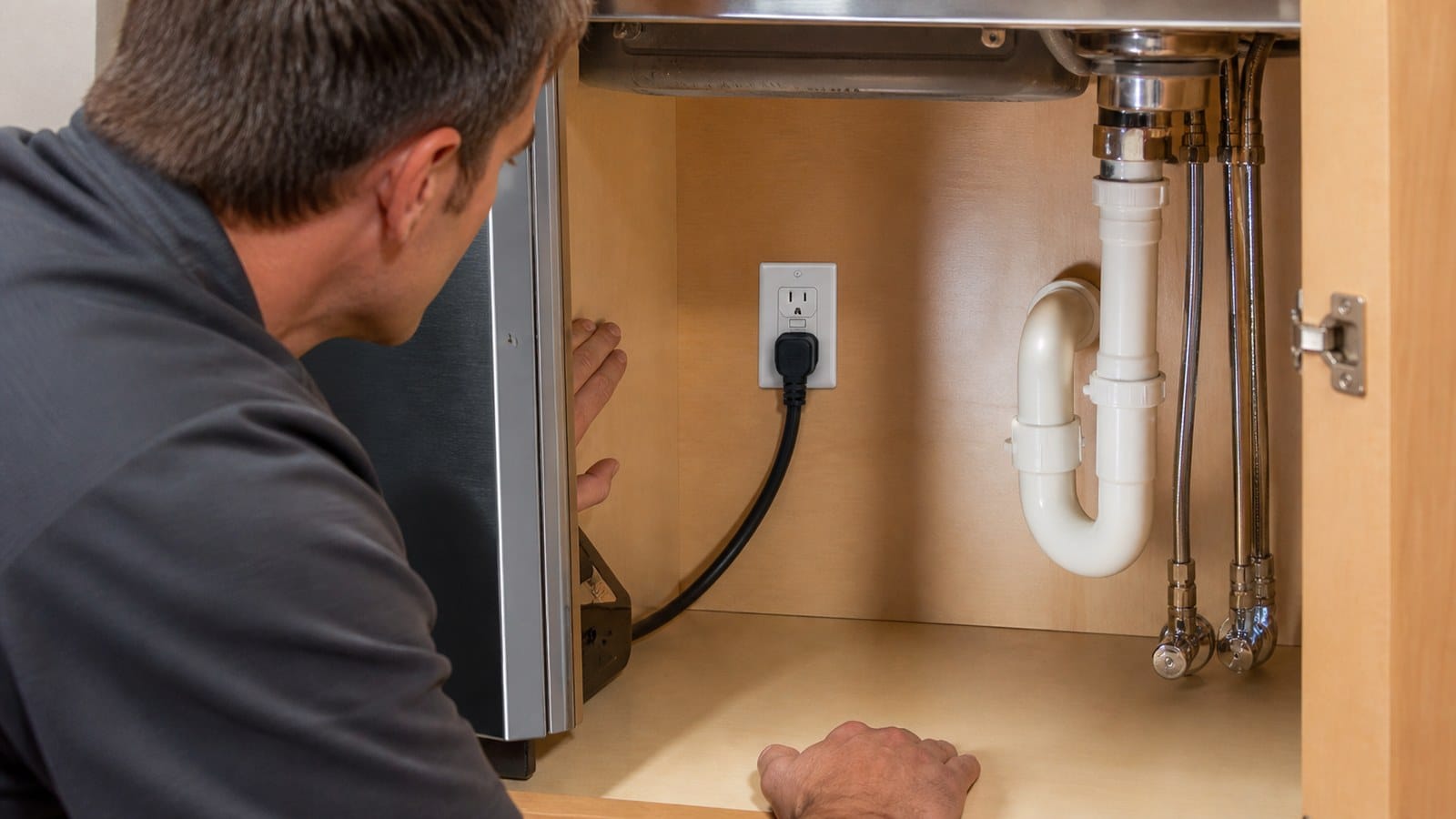
Editorial application scene: a dishwasher cord connected at an accessible, dry cabinet location rather than hidden behind the appliance.
Hardwired Connection
A hardwired dishwasher typically connects through a junction box or wiring compartment on the appliance. The absence of a receptacle does not remove the GFCI question. The outlet is the supply point to the equipment, and the protection may be provided by a GFCI breaker or another permitted upstream device.
Hardwiring also raises disconnect and servicing questions. The branch-circuit breaker may serve as the disconnect only when the applicable requirements are satisfied, including accessibility and lockability where required. Some installations use a listed switch or other disconnecting means. The dishwasher instructions and local code determine the acceptable arrangement.
Whirlpool’s official dishwasher installation instructions show why the exact model documents should be part of the installation package. Voltage, circuit, grounding, cord kit, routing, and connection details can differ.
Does a Dishwasher Need a Dedicated Circuit?
Often, yes, but the correct answer comes from the nameplate, manufacturer instructions, load calculation, adopted code, and local practice. Many built-in dishwashers are specified on an individual 120V branch circuit, commonly 15A or 20A depending on the model and instructions. Some permitted designs share a circuit with a disposal under specific load and circuit conditions; others do not.
Do not infer the circuit rating from the plug alone. Confirm:
- Dishwasher voltage, frequency, and rated load.
- Minimum circuit ampacity or branch-circuit requirement in the instructions.
- Breaker rating and conductor size.
- Other loads on the circuit, including a food-waste disposer.
- GFCI and, where applicable, AFCI requirements.
- Whether the disconnecting means is accessible and properly identified.
GE Appliances publishes an official dishwasher electrical requirements guide that illustrates the value of model-specific requirements. A project specification should request and review the actual installation sheet for every approved model, not substitute a generic blog table.
GFCI Receptacle or GFCI Circuit Breaker?
Both can protect a dishwasher outlet when permitted and correctly installed.
| Protection method | Best fit | Watch for |
|---|---|---|
| GFCI receptacle in adjacent cabinet | Cord-connected dishwasher with an accessible, dry reset location | Cabinet leaks, blocked access, box depth, cord routing, and labeling |
| Blank-face GFCI device | Protection and TEST/RESET access are needed without a plug-in receptacle at that point | Clear circuit labeling and an accessible location |
| GFCI circuit breaker | Hardwired appliance, panel-based protection, or limited cabinet space | Panel access, breaker compatibility, neutral routing, and identifying the correct circuit |
| Upstream GFCI receptacle | Existing protection chain intentionally supplies the dishwasher | Unexpected trip impact, reset location, LOAD wiring, and finished-installation testing |
A receptacle hidden under a sink is not automatically the best choice. If occupants stack cleaning products in front of it or a plumbing leak reaches the box, serviceability suffers. A GFCI breaker can move TEST/RESET to the panel, but that is helpful only when the panel is accessible and correctly labeled.
Faith’s blank-face GFCI guide and GFCI receptacle vs. breaker comparison explain the tradeoffs in more detail.
When AFCI Protection Also Applies
GFCI and AFCI address different hazards. GFCI responds to ground-fault current that can create shock risk. AFCI responds to signatures associated with dangerous arcing. A kitchen or dwelling-unit dishwasher circuit may need both functions under the adopted code.
Protection can be provided with a dual-function circuit breaker, separate compatible devices, or another permitted arrangement. Product compatibility and neutral routing matter. Do not assume that adding a GFCI receptacle satisfies an AFCI requirement, or that an AFCI breaker provides GFCI protection unless it is specifically identified as dual-function.
New Construction, Replacement, and Existing Homes
The NEC is not applied retroactively in exactly the same way in every jurisdiction. A dishwasher replacement may be treated differently from a new branch circuit, kitchen remodel, service upgrade, or permitted renovation.
Ask the AHJ or electrician these questions before purchasing:
- Which NEC edition and local amendments are currently adopted?
- Is the work repair, appliance replacement, alteration, or new construction?
- Does replacing a hardwired dishwasher with a cord-connected model trigger receptacle, GFCI, AFCI, or disconnect changes?
- Is the existing branch circuit allowed to remain, and has its grounding and conductor condition been verified?
- Will the protection device be readily accessible for TEST and RESET?
Avoid the claim “grandfathered” without a project-specific basis. Existing work can lose that status when it is extended, altered, damaged, or unsafe.
Why a Dishwasher Keeps Tripping the GFCI
A trip is a symptom, not a diagnosis. Do not replace the GFCI automatically and do not bypass it.
Common cause categories include:
- Moisture or leakage: a hose, pump seal, valve, tub, sink trap, or drain connection leaks into the appliance or electrical area.
- Heating-element insulation breakdown: leakage may appear only during the heated wash or dry portion of the cycle.
- Motor, pump, or wiring fault: damaged insulation or a failing component can leak current to ground.
- Cord, plug, or junction-box damage: pinched conductors, loose terminals, heat damage, or moisture can create an intermittent fault.
- Neutral problem: a shared, crossed, or grounded neutral can trip a GFCI even when the appliance appears to run.
- Protection-device problem: a worn, damaged, incorrectly wired, or incompatible device can fail, but it should be tested before replacement.
- Cumulative leakage: multiple electronic loads on a shared protected circuit can contribute leakage current; the circuit design and equipment should be evaluated.
The point in the cycle is useful evidence. An immediate trip when power is applied suggests a different fault category from a trip that occurs only when the heater turns on or the drain pump starts.

Editorial application scene: a qualified service electrician testing the protection device and dishwasher circuit.
Safe Troubleshooting Sequence
Homeowners can perform only limited observations without opening energized equipment.
- Stop if there is water, burning odor, heat damage, buzzing, or a shock sensation. Turn off the circuit if it can be done safely and call qualified service.
- Note when the trip occurs. Record the cycle phase, displayed fault code, recent plumbing work, and whether a leak is visible.
- Check other loads. Determine whether the GFCI controls only the dishwasher or other outlets too. Unplug accessible unrelated loads without moving the dishwasher.
- Follow the GFCI instructions once. Use TEST and RESET only as directed. A device that will not reset may be indicating no line power, a remaining fault, miswiring, or end of life.
- Do not use an extension cord or non-GFCI outlet. That defeats the protection plan and can add cord and grounding hazards.
- Call the right professional. Appliance service can evaluate internal components; an electrician can test the branch circuit, protection device, neutral routing, grounding, and leakage current.
GE’s official dishwasher no-power support guidance includes checking the home’s GFCI and breaker, but a reset that immediately trips again is a reason to diagnose—not to keep resetting.
For general device symptoms, Faith’s GFCI won’t reset guide provides a safe decision path.
Product Selection for Dishwasher Circuits
For builders, distributors, private-label buyers, and project specifiers, include these items:
- U.S.-market listing and the exact models covered by the certification.
- Voltage, amperage, frequency, feed-through rating, and conductor range.
- Self-test or auto-monitoring behavior and reset lockout.
- Device type: receptacle, blank-face, breaker, or dual-function strategy.
- Tamper-resistant construction where required for the receptacle location.
- Environmental suitability for the installed location; WR does not make a wet cabinet acceptable.
- Clear LINE/LOAD markings, torque values, wiring diagram, and English instructions.
- Status-indicator behavior stated by model, not guessed from LED color.
- Lot/date traceability, packaging control, warranty process, and change notification.
- Samples tested in the actual box, plate, cabinet, panel, and appliance configuration.
Faith Electric has manufactured wiring devices since 1996. For an OEM or private-label program, listing scope, model differences, markings, artwork, and approval samples should be closed before production. Faith’s private-label GFCI checklist provides a 12-point procurement workflow.
Commissioning Checklist
Before handover, the installer or project team should document:
- Dishwasher make, model, electrical rating, and instruction-sheet revision.
- Circuit number, breaker type/rating, conductor size, and other connected loads.
- GFCI device location, catalog number, listing mark, and reset access.
- AFCI or dual-function protection when required.
- Connection type and approved cord kit or hardwire method.
- Correct grounding, terminal torque, strain relief, and junction-box cover.
- Dry, accessible receptacle or disconnect location.
- TEST/RESET result and confirmation that the dishwasher loses and regains power as intended.
- Labels, as-built record, and homeowner or maintenance instructions.
This record helps distinguish an appliance fault from a branch-circuit fault months later. It also prevents occupants from searching the kitchen for a reset button that is actually at the panel.
Frequently Asked Questions
Does a hardwired dishwasher need GFCI protection?
Generally, plan for it in new U.S. dwelling-unit work. The rule concerns the outlet supplying the dishwasher, not only a receptacle. Confirm the locally adopted edition, amendments, and installation instructions.
Can a dishwasher share a GFCI with a garbage disposal?
Possibly, but not automatically. The appliance instructions, branch-circuit rating, calculated load, applicable GFCI/AFCI rules, and local interpretation must permit the arrangement. Separate circuits can reduce the service impact of a trip.
Can the dishwasher GFCI receptacle be under the sink?
An adjacent cabinet is a common location when the receptacle remains accessible, dry, protected from damage, and allowed by the dishwasher instructions and local code. Keep it clear of plumbing leaks and stored products.
Why does the GFCI trip only during the dry cycle?
That timing can point toward a heating-element or related insulation-leakage problem, but it is not proof. Stop using the appliance and have the dishwasher and circuit tested.
Should I replace the GFCI with a standard outlet to stop trips?
No. Bypassing required protection can expose users to shock risk and conceal an appliance or wiring fault. Diagnose the cause.
Does a GFCI breaker also protect a hardwired dishwasher?
Yes, a correctly selected and installed GFCI breaker can protect the branch circuit and its hardwired outlet. It must be compatible with the panel and wired according to the breaker and panel instructions.
Bottom Line
For current U.S. residential project planning, treat dishwasher GFCI protection as the default. Apply it to cord-connected and hardwired outlets, then verify the NEC edition and amendments adopted locally.
The best installation is not simply “add a GFCI.” It coordinates the appliance instructions, branch-circuit load, overcurrent protection, AFCI requirements, disconnect access, cord or junction-box method, GFCI test/reset location, and finished-installation testing. If the protection trips, preserve it and diagnose the appliance and circuit instead of working around the warning.
Safety disclaimer: This article provides general U.S. planning and procurement information. Electrical and appliance work can cause shock, fire, water damage, or equipment damage. Follow the locally adopted code, the AHJ, site safety procedures, and the instructions for the exact dishwasher and protection device. Use qualified electrical and appliance-service professionals for installation and diagnosis.