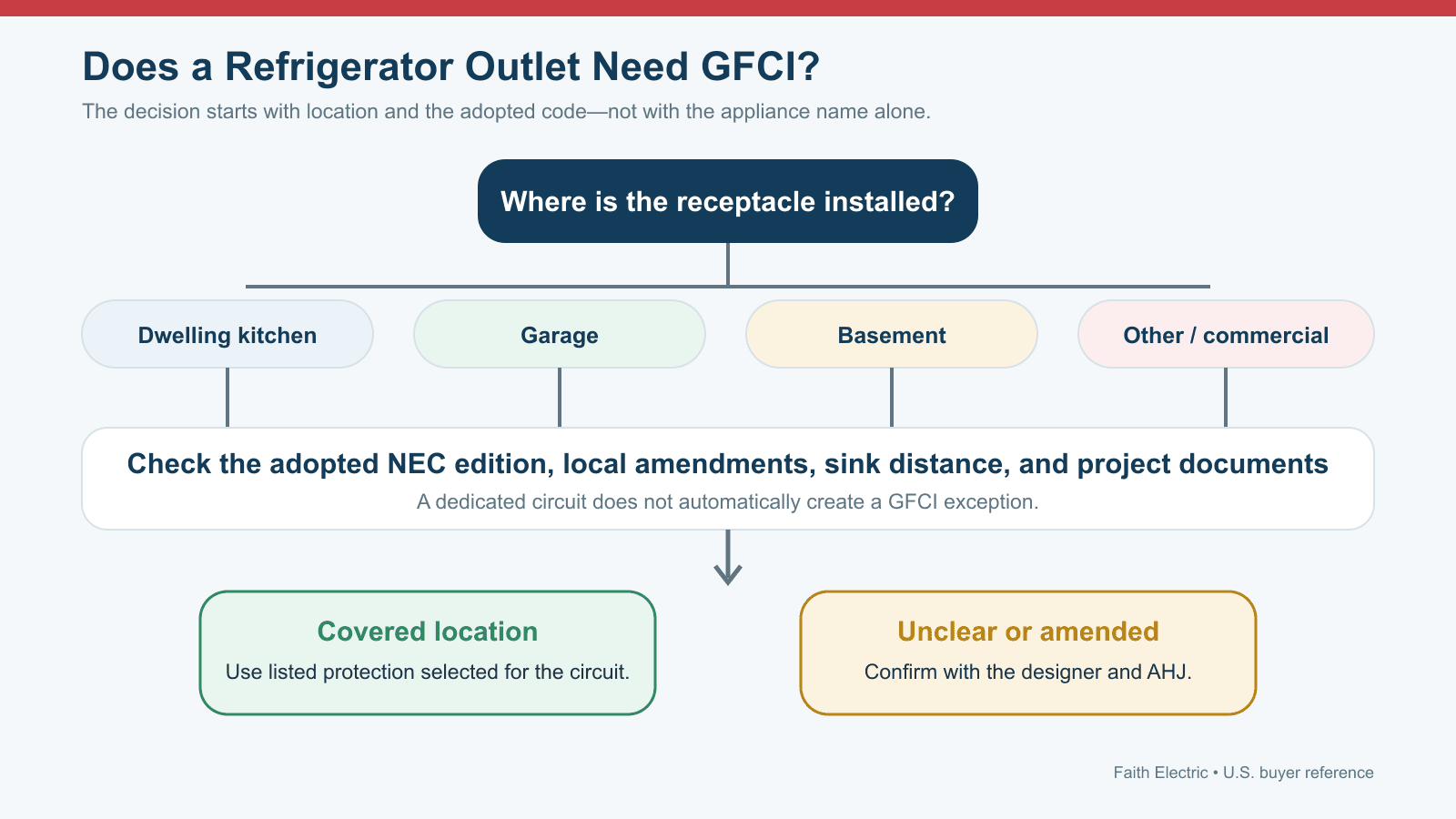
A refrigerator may need GFCI protection because of where its outlet is installed—not simply because the load is a refrigerator. Under newer U.S. electrical-code editions, dwelling-unit kitchens, garages, basements, and other listed locations can require GFCI protection. A dedicated circuit does not automatically create an exemption, and local adoption or amendments can change the answer.
If a refrigerator keeps tripping a GFCI, do not remove required protection or use a grounding adapter as a shortcut. The trip can come from a real appliance leakage path, a damaged cord, moisture, a wiring problem, accumulated leakage from other loads, an aging GFCI, or an interoperability issue with high-frequency electronics. A qualified electrician and, when needed, an appliance technician should identify the cause.
Quick Answer by Refrigerator Location
| Location | Likely GFCI question | What to verify |
|---|---|---|
| Dwelling kitchen | Newer NEC editions expanded kitchen GFCI coverage beyond countertop receptacles | Adopted NEC edition, local amendments, exact outlet and circuit design |
| Garage | Garage receptacles are generally among the locations requiring GFCI protection | Local code, any approved exceptions, dedicated circuit, accessibility |
| Basement | Coverage has expanded across code editions and may include finished areas | Adopted edition, local amendments, room classification |
| Within 6 ft of a sink | Sink-proximity rules may trigger GFCI protection even outside a typical kitchen | How the required distance is measured under the adopted code |
| Commercial food area | Non-dwelling rules differ from dwelling-unit rules | Occupancy, receptacle rating, location, equipment, project specification |
This table is a starting point, not an inspection decision. The National Electrical Code is adopted and amended by states and local jurisdictions on different schedules. Always check with the authority having jurisdiction (AHJ) before changing an installed circuit.
Why the Answer Changed Across NEC Editions
Many older installations were designed when dwelling-unit kitchen GFCI rules focused heavily on countertop receptacles and outlets near sinks. That history created a common belief that the receptacle behind a refrigerator was automatically exempt. Newer code language broadened the location-based requirement, so advice based on an older edition may no longer apply to a new project.
The practical comparison is:
- Older adopted codes: a refrigerator receptacle away from a sink and not serving a countertop may have been outside the kitchen GFCI rule.
- 2023 NEC: dwelling-unit kitchen receptacles were brought broadly into the GFCI location rule, making many refrigerator outlets subject to protection.
- 2026 NEC: GFCI coverage remains location driven, while new information addresses compatibility between modern high-frequency loads and GFCI devices.
NFPA standards development records also show that proposed broad exceptions for refrigerators and certain appliances were debated rather than simply becoming a universal exemption. That is why a contractor should not rely on the statement “refrigerators never go on GFCI” or “a dedicated circuit never needs GFCI.”
What Is an HF-Rated GFCI?
Modern appliances may use variable-frequency drives, inverter power supplies, electronic controls, and filters that create high-frequency leakage components. These signals can interact with some GFCIs even when there is no dangerous 60 Hz ground fault.
UL Solutions explains that UL 943 was revised in 2025 to introduce an optional high-frequency immunity evaluation. A qualifying Class A device can be marked “HF.” The 2026 NEC includes an informational reference to this type of GFCI for modern equipment that produces high-frequency leakage.
HF does not mean the device ignores ground faults. It is intended to retain Class A personnel protection while improving immunity to specified high-frequency signals. Buyers should verify the current certification record, exact marking, availability, installation instructions, and local acceptance. Do not assume an ordinary “self-test” label or a marketing phrase such as “nuisance-trip resistant” proves an HF rating.
Why a Refrigerator Can Trip a GFCI
1. A real ground-fault or leakage path
A damaged power cord, deteriorated compressor winding, defrost heater insulation failure, icemaker component, door-hinge wiring, connector contamination, or moisture can allow current to escape its intended path. A GFCI trip may therefore be a valid safety warning, even if the refrigerator still cools normally.
2. The defrost cycle
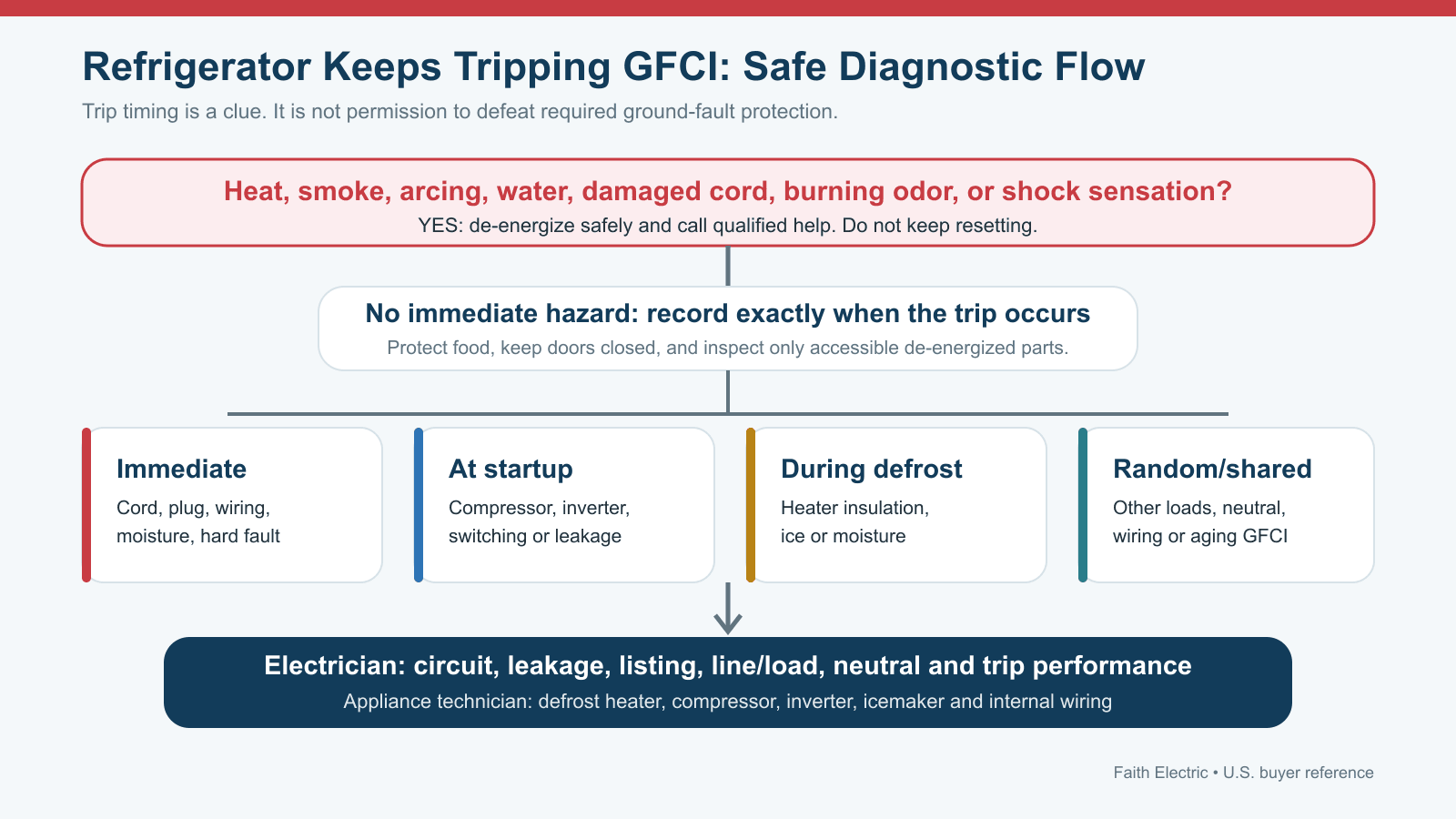
If the trip appears every several hours rather than immediately, the defrost heater or related wiring deserves attention. Heat, ice, condensation, and aging insulation can make leakage intermittent. The timing may seem random because many refrigerators schedule defrost based on compressor run time rather than a fixed clock time.
3. Compressor or electronic switching
A trip that occurs at startup, shutdown, or speed changes may involve the compressor, inverter, filter network, or high-frequency electronic noise. That pattern is one reason the industry developed the optional HF evaluation—but it is not proof that the appliance is fault-free.
4. Shared-circuit leakage
A GFCI monitors the combined current on the conductors it protects. Several loads with small normal leakage can add together, or a downstream wiring problem can affect the refrigerator circuit. Unplugging other loads during a controlled check can help an electrician narrow the source.
5. Wiring or GFCI condition
Incorrect line/load connections, a shared or crossed neutral, neutral-to-ground contact downstream, moisture in the box, loose terminals, or a device at end of life can cause loss of power or repeated trips. Replacement should use a properly rated, listed device and should not be treated as proof that the root cause is fixed.
Safe Refrigerator GFCI Troubleshooting Sequence
Homeowners can make a few observations without opening the panel, receptacle box, or appliance. Stop immediately if there is heat, smoke, arcing, burning odor, damaged insulation, water intrusion, or a shock/tingling sensation.
- Protect the food first. Keep the doors closed and note when power was lost. The USDA says an unopened refrigerator generally keeps food safe for up to four hours; use its current temperature and disposal guidance.
- Record the trip pattern. Does it trip immediately when plugged in, when the compressor starts, during defrost, after using the icemaker, only in humid weather, or when another appliance runs?
- Inspect accessible parts. With the refrigerator unplugged, look for a crushed or damaged cord, loose plug, water, corrosion, overheated plastic, or a blocked receptacle area. Do not disassemble energized equipment.
- Remove other loads. Unplug other equipment on the protected circuit if it is safe and practical. Do not run the refrigerator through an extension cord to another room as a permanent workaround.
- Follow the GFCI instructions. Use TEST and RESET only as the manufacturer directs. A device that will not reset, repeatedly trips, shows an end-of-life signal, or fails its test requires qualified evaluation.
- Call an electrician. The electrician can verify the adopted code, circuit arrangement, grounding and neutral paths, line/load wiring, GFCI trip performance, insulation resistance, and leakage current.
- Call an appliance technician when indicated. Component-level checks may be needed for the defrost heater, compressor, inverter, icemaker, cord, and internal wiring.
- Evaluate an HF-rated device only after diagnosis. If a listed HF GFCI is available for the circuit and accepted by the AHJ, it may address a documented compatibility issue. It must not be used to conceal a real appliance fault.
What Not to Do When a Fridge Trips GFCI
- Do not replace a required GFCI with a standard receptacle without an electrician and AHJ-confirmed code basis.
- Do not cut off the grounding pin or use a three-to-two-prong adapter to stop trips.
- Do not keep resetting a device that trips immediately or shows signs of heat, water, or damage.
- Do not blame “nuisance tripping” before testing. A repeatable trip can be the first indication of insulation breakdown or moisture.
- Do not use a power strip or extension cord as the permanent refrigerator supply. Follow the appliance instructions and circuit design.
- Do not assume a dedicated circuit removes GFCI requirements. Dedicated overcurrent protection and location-based ground-fault protection answer different questions.
Refrigerator Circuit and GFCI Buyer Checklist
For builders, property managers, appliance programs, and electrical distributors, document these items before choosing the protective device:
| Check | Required project information |
|---|---|
| Jurisdiction | State/local code edition, amendments, AHJ interpretation, effective date |
| Location | Kitchen, garage, basement, commercial food area, sink distance, indoor/outdoor exposure |
| Circuit | Voltage, ampere rating, dedicated/shared, breaker type, AFCI requirement, downstream loads |
| GFCI | Receptacle or breaker, UL 943 listing, self-test behavior, TR/WR needs, possible HF marking |
| Appliance | Nameplate rating, installation instructions, cord condition, electronics/inverter design, service history |
| Commissioning | TEST/RESET result, trip pattern, measured leakage if investigated, labels, handover record |
For ordinary kitchen GFCI selection, review Faith Electric’s guide on choosing GFCI outlets for a kitchen. If the device trips repeatedly, the detailed article on what causes a GFCI to keep tripping provides a broader circuit-level checklist. If the controls will not latch, see the GFCI won’t reset guide.
GFCI Receptacle or GFCI Breaker for a Refrigerator?
Either approach may provide the required protection when listed and installed correctly, but service access matters. A receptacle behind a refrigerator can be difficult to reach for monthly testing or reset. A breaker is accessible at the panel but may disconnect more than one outlet if the circuit is shared. A blank-face GFCI at a readily accessible location can be another design option for downstream protection, subject to listing instructions and project design.
Compare the choices in Faith’s GFCI receptacle vs. circuit breaker guide and blank-face GFCI guide. The designer should also coordinate AFCI and overcurrent requirements; GFCI protection does not replace either one.
Frequently Asked Questions
Does a kitchen refrigerator need GFCI in the 2023 NEC?
In many installations under the 2023 NEC, yes, because the dwelling-unit kitchen location is broadly covered. Local adoption, amendments, and the exact installation still control.
Does a garage refrigerator need GFCI?
Garage receptacles are generally covered by dwelling-unit GFCI rules in modern NEC editions. Do not remove protection solely to prevent food loss; diagnose the trip and check local requirements.
Will a dedicated circuit stop GFCI tripping?
It can isolate the refrigerator from leakage or faults caused by other loads, but it will not fix leakage inside the appliance, faulty wiring, or a compatibility problem. A dedicated circuit also does not automatically waive a location-based GFCI requirement.
Can a bad refrigerator trip a GFCI but not a regular breaker?
Yes. A GFCI responds to a small imbalance or leakage to ground, while a standard breaker primarily responds to overloads and short circuits. The fault may be far below the current needed to trip the breaker.
Should I replace the GFCI first?
An aging or failed GFCI is possible, but replacement should be part of a diagnosis, not a guess. A qualified electrician can test the circuit and install the correct listed device.
Will a surge protector stop a refrigerator from tripping a GFCI?
Not reliably. Surge protection and ground-fault protection address different hazards. A surge protector should not be used to mask repeated GFCI trips; see the GFCI vs. surge protector comparison.
Is an HF-rated GFCI required for every refrigerator?
No. HF is an optional evaluation and marking intended for specified high-frequency compatibility. Verify product availability, listing, instructions, project design, and AHJ acceptance rather than assuming it is mandatory for every refrigerator.
Bottom Line
Whether a refrigerator needs GFCI protection depends mainly on the outlet location, the adopted electrical code, and local amendments. Under newer NEC editions, many kitchen, garage, and basement refrigerator outlets are covered. If the refrigerator trips a GFCI, preserve food safety, document the timing, inspect only accessible de-energized parts, and have the circuit and appliance diagnosed. Do not defeat required protection. A listed HF-rated GFCI may become a useful option for verified high-frequency interoperability problems, but it is not a substitute for fixing a real fault.
Disclaimer: This article provides general U.S. electrical-safety information and is not a substitute for the adopted code, appliance instructions, engineering design, or AHJ decision. Electrical installation, leakage testing, and internal appliance service should be performed by qualified personnel.