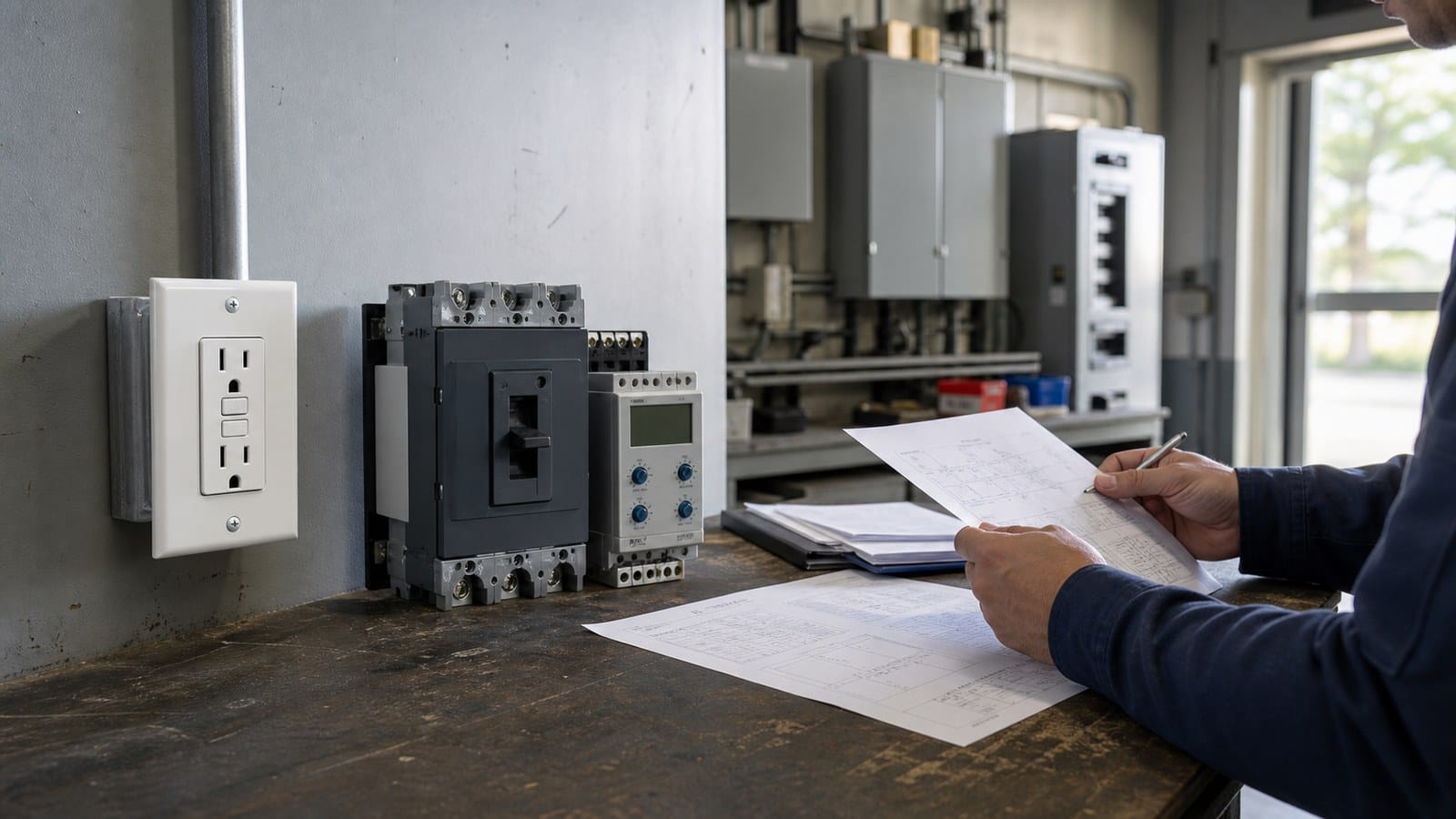
Outdoor electrical work has changed. Under recent NEC cycles, GFCI protection is no longer something you only think about when installing a standard wall receptacle on the outside of a house.
The key issue is this: NEC 210.8(F) refers to outdoor outlets, not only outdoor receptacles.
That wording matters. A receptacle is the device where a plug is inserted. An outlet, in NEC language, is a point in the wiring system where current is taken to supply equipment. That can include a receptacle, but it can also include a hardwired outdoor equipment connection.
For garages, boathouses, and outdoor outlets, the practical question is not just “Do I need a GFCI outlet?” The better question is:
Where does the outdoor circuit supply power, what equipment is connected, and how should GFCI protection be provided?
This guide explains the main requirements, common field situations, and product choices for outdoor GFCI protection. Always verify the adopted NEC edition and local AHJ requirements before installation or specification.
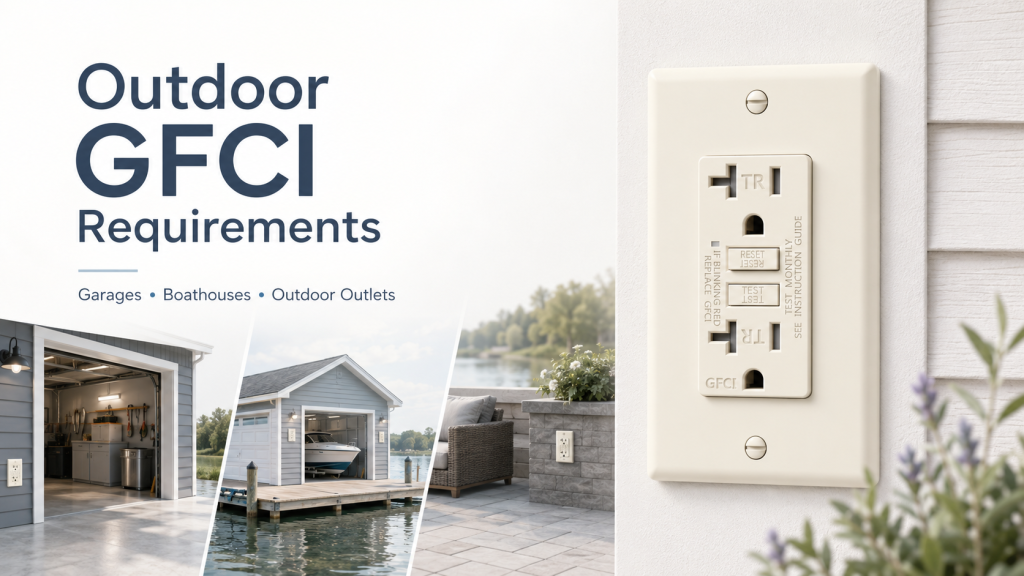
What NEC 210.8(F) Means for Outdoor GFCI Protection
A GFCI, or ground-fault circuit interrupter, is a protective device designed to reduce electric shock risk. It monitors the current leaving and returning through a circuit. If it detects leakage current to ground above its trip threshold, it opens the circuit quickly.
For outdoor locations, that protection matters because the body can become part of the fault-current path. Wet soil, concrete, rain, metal equipment housings, water lines, and grounded structures all increase the risk.
NEC 210.8(F), introduced in the 2020 NEC and addressed further in later code cycles, focuses on outdoor outlets at dwelling units supplied by qualifying branch circuits. The commonly discussed scope includes single-phase branch circuits rated 150 volts or less to ground and 50 amperes or less, though exact language and exceptions must be checked against the NEC edition adopted locally.
The practical impact is simple:
Outdoor GFCI requirements may apply beyond the familiar 15A or 20A outdoor wall receptacle.
Outlet vs. Receptacle: Why This Word Matters
Many installation mistakes begin with this misunderstanding.
A receptacle is the device that accepts an attachment plug. A common duplex outlet on an exterior wall is a receptacle.
An outlet is broader. It can be the point where current is supplied to a piece of utilization equipment. For example, an outdoor HVAC condenser, pump, or hardwired equipment connection may involve an outlet even when no plug-in receptacle is present.
That is why NEC 210.8(F) gets attention from contractors, inspectors, equipment manufacturers, and specifiers. It pushed the conversation from “Which outdoor receptacles need GFCI?” to “Which outdoor power points need personnel protection?”
Scope, Limits, and Local Code Adoption
NEC requirements are adopted differently across states, cities, and counties. One project may be under the 2020 NEC, another under the 2023 NEC, and another under a locally amended version.
This is especially relevant for outdoor equipment such as HVAC units, pumps, and equipment serving waterfront areas. Some requirements have been debated because certain equipment types can create nuisance tripping if the protection method and equipment design are not well matched.
The right approach is to design around three checks:
| Check | What to Confirm |
| Code edition | Which NEC version has the local jurisdiction adopted? |
| Circuit rating | Voltage to ground, amperage, phase, and equipment type |
| Authority review | Local AHJ interpretation, equipment listing, and any amendments |
A code-compliant outdoor GFCI installation starts with the circuit and location, not with the assumption that one device type solves every case.
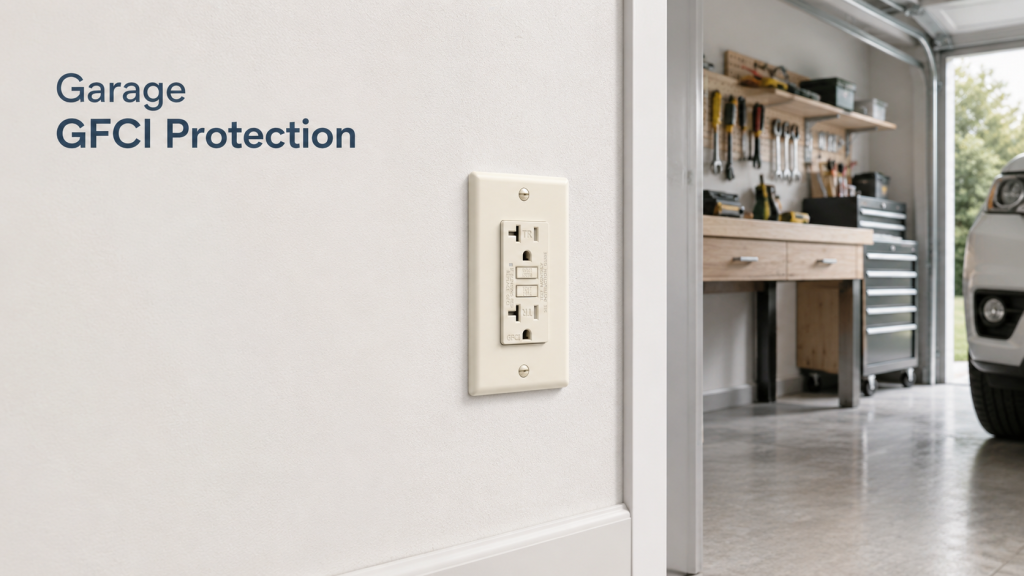
GFCI Requirements for Garages
Garage receptacles are one of the most common GFCI inspection points. They are used for tools, freezers, compressors, garage door openers, battery chargers, pressure washers, and increasingly EV charging equipment.
For dwelling units, garage receptacles are generally addressed under residential GFCI rules such as NEC 210.8(A). NEC 210.8(F) becomes more relevant when the garage includes exterior outlets, outdoor equipment, or detached structures with outdoor circuits.
A useful way to look at garage GFCI protection is this:
If a person can plug in equipment, handle a cord, stand on concrete, or work near moisture, the shock risk is real.
Common Garage Outlets That Need Attention
Typical garage locations that should be evaluated for GFCI protection include:
- Wall receptacles near workbenches
- Ceiling receptacles for garage door openers
- Receptacles for refrigerators or freezers
- Outlets serving compressors, welders, or power tools
- Exterior receptacles mounted on detached garage walls
- Branch circuits feeding outdoor lighting or equipment near the garage
Older habits cause problems here. Some installers still assume that a ceiling receptacle for a garage door opener or a dedicated appliance receptacle does not need the same attention as a wall outlet. Under modern GFCI rules, that assumption can lead to failed inspection.
The garage is not a “dry interior room” in the way a bedroom is. Concrete floors, open doors, wet vehicles, pressure washing, extension cords, and metal equipment all change the risk profile.
240V Garage Receptacles and EV Charging
One of the bigger changes in recent NEC cycles is the broader attention to 125V through 250V receptacles in certain locations. That means a 240V receptacle in a garage should not be judged only by old 125V receptacle habits.
This matters for:
| Garage Load | Typical Circuit | GFCI Concern |
| EV charging receptacle | 40A–50A, 240V | Often requires careful GFCI evaluation |
| Welder receptacle | 30A–50A, 240V | Check local code and receptacle type |
| Air compressor | 20A–50A | May be cord-and-plug or hardwired |
| Workshop tools | 120V or 240V | Wet concrete and user contact increase risk |
For EV charging, manufacturers and panel brands have developed GFCI breaker solutions suited to higher-current applications. The breaker, receptacle, EVSE listing, and local code must be coordinated. Do not treat a 50A garage receptacle as automatically outside GFCI rules because it is not a standard 15A outlet.
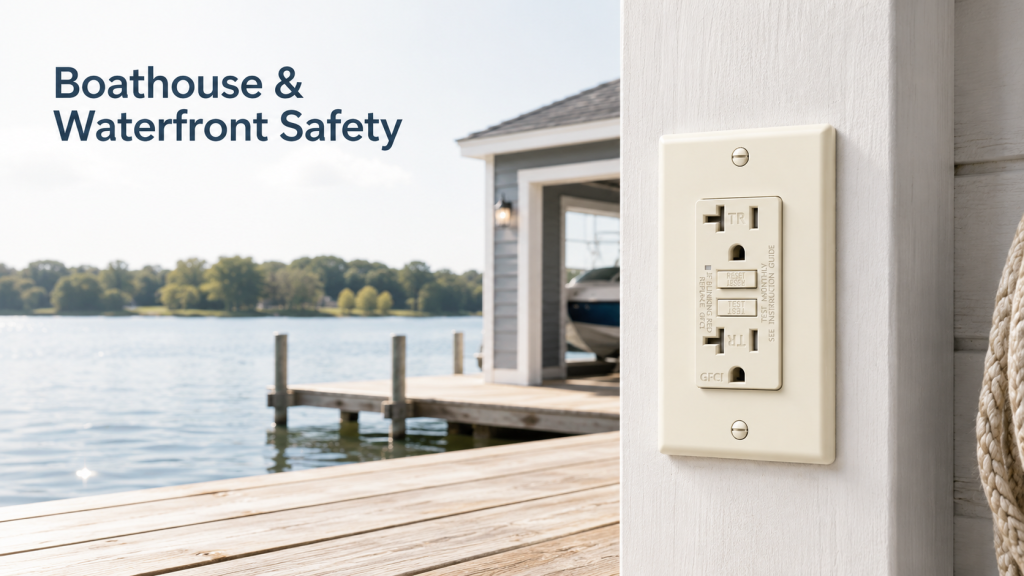
GFCI Requirements for Boathouses and Waterfront Areas
Boathouses deserve separate treatment because water changes everything. A ground fault near water is not just a nuisance. It can create a shock path through wet surfaces, metal parts, or the water itself.
A boathouse receptacle, if installed, is typically expected to have GFCI protection. The code may not require a receptacle to be installed in every boathouse, but once receptacles are present, they must be evaluated under the applicable NEC rules for that location.
Why Boathouses Are Higher-Risk Locations
Boathouses combine several risk factors:
- Water exposure
- Damp or wet surfaces
- Metal framing or hardware
- Pumps, lifts, chargers, and power tools
- Extension cords used near boats
- People standing barefoot or on wet decking
Electric shock drowning, often called ESD, is a known hazard in waterfront electrical systems. The risk is not limited to large marinas. Smaller private boathouses can also create dangerous conditions if wiring, grounding, bonding, and GFCI protection are poorly handled.
A normal residential-grade device may not be enough for harsh waterfront service. Moisture, corrosion, and leakage current can affect long-term reliability. Product selection should consider both the electrical protection requirement and the installation environment.
GFCI vs. GFPE in Waterfront Projects
GFCI and GFPE are not the same thing.
GFCI protection is mainly for personnel shock protection. Class A GFCI devices are commonly associated with a trip level around 5 mA.
GFPE, or ground-fault protection of equipment, is designed to protect equipment and systems. In some waterfront or marina-related applications, GFPE may be applied at higher trip levels, such as 30 mA, depending on the relevant code section and system design.
For a simple residential boathouse receptacle, the discussion often starts with GFCI. If the project involves a dock, marina, shore power, boat lift, or broader waterfront electrical system, Article 555 and local AHJ requirements may come into play.
Do not replace one concept with the other. A GFPE device does not automatically satisfy a personnel GFCI requirement unless the code and equipment listing support that design.
Outdoor Receptacles and Outdoor Equipment Outlets
Outdoor receptacles are the most visible part of outdoor GFCI compliance. They appear on exterior walls, patios, porches, decks, detached garages, sheds, pool-adjacent areas, and service locations.
But NEC 210.8(F) is also why hardwired outdoor equipment needs attention.
Exterior Wall, Deck, Patio, and Porch Outlets
Standard outdoor receptacle locations commonly need GFCI protection. These include:
| Location | Typical Use | Main Concern |
| Exterior wall outlet | Yard tools, holiday lights, pressure washer | Wet conditions and cord handling |
| Deck or patio outlet | Grills, lighting, portable appliances | User contact and weather exposure |
| Porch outlet | Seasonal loads, cleaning equipment | Damp location and frequent plugging |
| Detached structure outlet | Tools, chargers, outdoor equipment | Grounding and branch-circuit design |
In these cases, GFCI protection is only one layer. The device also needs to be suited for the environment. A GFCI receptacle designed for indoor use is not automatically suitable for outdoor installation.
Hardwired Outdoor Equipment and Service Outlets
Outdoor HVAC condensers, heat pumps, pumps, and other equipment can create confusion. The equipment may not have a plug. The installer may look at the disconnect and think, “This is not a receptacle, so GFCI does not apply.”
That is the wrong starting point.
NEC 210.8(F) uses the term outlet. If the outdoor equipment is supplied by a covered branch circuit, GFCI protection may be required depending on the NEC edition, equipment listing, and local AHJ interpretation.
Typical equipment that should be reviewed includes:
- HVAC condensing units
- Heat pumps
- Outdoor pumps
- Hardwired yard or site equipment
- Equipment service receptacles near outdoor units
- Detached outdoor structure circuits
HVAC has been one of the more complex areas because some equipment can interact poorly with certain GFCI devices. Modern inverter-driven compressors, variable-speed motors, and electronic controls may have leakage characteristics that require matched protection equipment.
The safe specification path is to verify both the equipment listing and the protection device. Guessing based on old practice is how nuisance tripping and failed inspections happen.
GFCI Receptacle vs. GFCI Breaker: Which One Should You Use?
A GFCI requirement does not always mean a GFCI receptacle is the best product.
GFCI protection can be provided in different ways. The two most common are a GFCI receptacle and a GFCI circuit breaker.
A GFCI receptacle protects the device itself and, when wired through the load terminals, can protect downstream outlets. A GFCI breaker protects the branch circuit from the panel.
When a GFCI Receptacle Makes Sense
A GFCI receptacle is often a good fit for single-point protection. It is easy to identify, easy to test, and convenient to reset at the point of use.
It works well for:
- Exterior wall receptacles
- Garage workbench outlets
- Patio or porch outlets
- Replacement projects where a local protective device is preferred
- Downstream receptacles on a simple branch circuit
For outdoor applications, the receptacle should be selected with the right environmental features, such as WR marking, proper cover compatibility, and self-test function where required or preferred.
When a GFCI Breaker Is the Better Option
A GFCI breaker is often better when protection should begin at the source.
This can be the cleaner choice for:
- Multiple outdoor outlets on one branch circuit
- Detached garage circuits
- Hardwired outdoor equipment
- 240V garage or outdoor receptacles
- Multi-outlet outdoor runs
- Installations where the first outlet is not an ideal reset point
The tradeoff is reset location. If the breaker trips, someone must go to the panel. For a contractor or facility user, that may be acceptable. For a homeowner, it may be less convenient.
Comparison Table: Protection Scope and Use Cases
| Option | Protection Starts At | Best For | Watch For |
| GFCI receptacle | The receptacle location | Single outdoor outlets, garage wall outlets, simple downstream protection | Must be outdoor-suitable when installed outdoors |
| GFCI breaker | Electrical panel | Whole branch circuits, hardwired equipment, 240V loads, detached structures | Reset happens at the panel |
| Dead-front GFCI | Device location without plug slots | Downstream protection where no receptacle face is needed | Must remain accessible |
| Two-pole GFCI breaker | Panel, both ungrounded conductors monitored | Multi-wire or 240V circuits | Must match circuit design and panel system |
The choice is not just cost. It is about where the protection begins, what needs downstream protection, and how the user will test and reset the device.
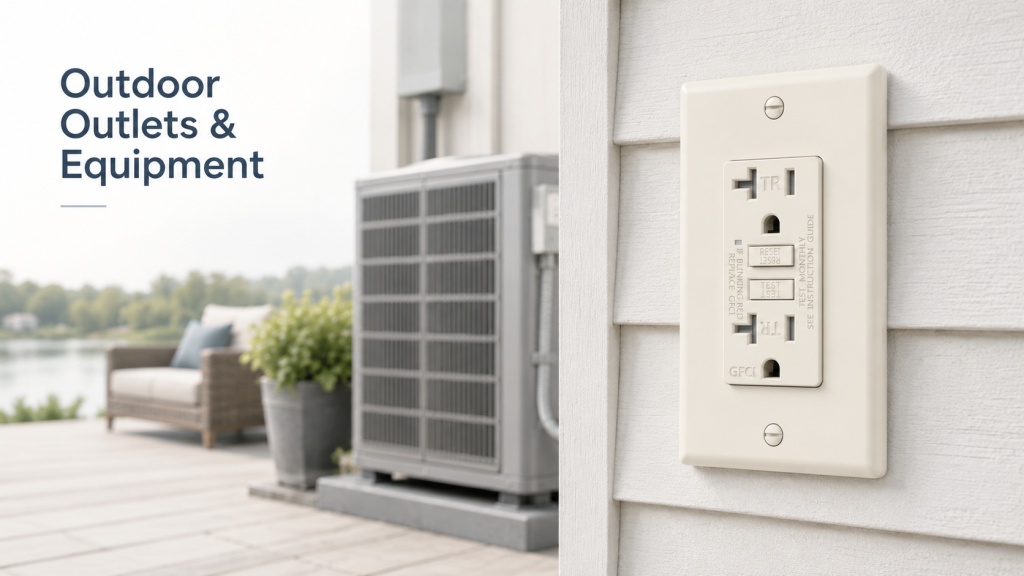
Practical Compliance: WR Outlets, Covers, Accessibility, and Certification
Outdoor GFCI compliance is not complete just because a GFCI device is present.
Outdoor installations require a combination of electrical protection, environmental protection, and maintainability. This is where many low-cost installations fail.
Weather-Resistant WR Marking
A weather-resistant receptacle, often marked WR, is built with materials better suited to temperature changes, moisture exposure, and outdoor service. WR does not mean waterproof. It means the device is designed for outdoor-rated receptacle applications when installed with the proper box and cover.
GFCI and WR solve different problems.
GFCI protects people from shock. WR helps the device survive the outdoor environment.
For exterior wall outlets, patio outlets, and garage exterior receptacles, both may be needed.
In-Use Covers and Weatherproof Boxes
An in-use cover, often called a bubble cover, protects the receptacle while a cord is plugged in. This matters in wet locations. A flat cover that only protects the receptacle when closed may not be enough if the outlet is used during rain, snow, or washdown.
The box, gasket, cover, device, and installation method must work together. A good GFCI receptacle installed in a poor enclosure is still a poor installation.
Readily Accessible Test and Reset
GFCI devices need testing and resetting. That means the device providing protection should be readily accessible, not buried behind fixed equipment, sealed inside a hard-to-open enclosure, or placed where the user cannot reach it safely.
Self-test GFCI receptacles and clear trip indicators help users and service personnel identify problems faster. In outdoor and garage environments, that is not a luxury feature. It reduces confusion during maintenance.
Certification and Product Reliability
For B2B buyers, product consistency matters as much as the individual feature list. Outdoor GFCI products should be selected with attention to:
- Applicable listing or certification requirements
- WR and TR options where needed
- Self-test performance
- Reset and trip indication
- Material stability in outdoor environments
- Compatibility with weatherproof covers and boxes
- Stable batch quality for distribution or project supply
Faith Electric manufactures electrical devices for residential and commercial applications, including GFCI receptacles, switches, sockets, and outdoor electrical solutions. For distributors, contractors, and OEM/ODM customers, the right product line should support both code-conscious design and repeatable field performance.
Common Outdoor GFCI Compliance Mistakes
Outdoor GFCI mistakes usually come from oversimplifying the rule. The installer protects the obvious receptacle and misses the actual risk point.
Assuming GFCI Only Applies to Plug-In Receptacles
This is the main NEC 210.8(F) mistake. The word outlet may include hardwired equipment connection points. Outdoor HVAC units, pumps, and other equipment should be reviewed instead of dismissed because they do not use a plug.
Confusing GFCI Protection with Weather Resistance
A weather-resistant outlet is not automatically GFCI protected. A GFCI device is not automatically weather-resistant.
Outdoor installations often need both.
Ignoring 240V or Outdoor Equipment Loads
Garage 240V receptacles, EV charging outlets, compressors, welders, and outdoor equipment loads need code review under the adopted NEC edition. Old assumptions based on 125V convenience receptacles are no longer safe.
Forgetting the Locally Adopted NEC Edition
A design that passes in one jurisdiction may be rejected in another. NEC adoption, local amendments, and AHJ interpretation all affect outdoor GFCI requirements. This is especially true for HVAC equipment, waterfront structures, and detached buildings.
The safest field habit is to check the circuit, location, equipment, code edition, and AHJ before selecting the protection method.
FAQ
Do all outdoor outlets need GFCI protection?
Many outdoor outlets at dwelling units require GFCI protection under NEC 210.8(F), but the final answer depends on the NEC edition, circuit rating, equipment type, and local AHJ interpretation. The key point is that “outlet” can mean more than a plug-in receptacle.
Do garage outlets need GFCI protection?
Garage receptacles generally require GFCI protection under residential GFCI rules. This includes many common garage outlets used for tools, appliances, garage door openers, and equipment. Newer NEC editions also bring more attention to 125V through 250V receptacles.
Do boathouse outlets need GFCI protection?
If receptacles are installed in a boathouse, they typically need GFCI protection because of the elevated shock risk near water. If the boathouse is tied to docks, marina systems, boat lifts, or shore power, additional requirements may apply.
Is a weather-resistant outlet the same as a GFCI outlet?
No. A weather-resistant outlet is designed for outdoor environmental exposure. A GFCI outlet provides personnel shock protection. Outdoor receptacles often need both GFCI protection and weather-resistant construction, along with a proper weatherproof cover.
Can I use a GFCI breaker instead of a GFCI receptacle?
Yes, in many installations a GFCI breaker can provide the required branch-circuit protection. It is often preferred for multiple outdoor outlets, hardwired outdoor equipment, 240V loads, and detached garage circuits. The final choice should match the circuit design, equipment listing, and local code requirement.
Outdoor GFCI requirements are not just about installing a device with TEST and RESET buttons. For garages, boathouses, and outdoor outlets, the real task is to identify the power point, the environment, the connected equipment, and the correct method of GFCI protection.
NEC 210.8(F) made that discussion more precise by focusing on outdoor outlets, not only receptacles.
Faith Electric supports customers with GFCI receptacles, switches, sockets, and outdoor electrical device solutions for residential and commercial markets. For product selection, OEM/ODM projects, or outdoor wiring device sourcing, contact our team to discuss the right configuration for your market and application.