Under the 2023 edition of NFPA 70, a qualifying vending machine needs GFCI protection at the branch circuit or outlet that supplies it. Section 210.8(D) applies to the listed appliances when they are rated 150 volts or less to ground and 60 amperes or less, single- or three-phase. Vending machines are directly named in that list. A GFCI built into the plug or cord does not, by itself, replace the 2023 branch-circuit-or-outlet requirement. Earlier NEC editions used different coordination between Articles 210 and 422, so the edition adopted at the site still controls.
This edition split matters during replacement work. An older machine may have a cord-integral device installed to satisfy an earlier rule, while a 2023-NEC project also needs protection in the supply path. Facility staff should record both devices, know which controls to test, and keep every required reset accessible. Do not remove or bypass an integral device merely because upstream protection is present.
Outdoor machines add environmental requirements beyond GFCI: weather exposure, enclosure, receptacle construction, cover, corrosion, cord routing, anchoring, and water drainage must be coordinated.
How this article was prepared: Faith Electric’s editorial team used AI-assisted drafting to organize cited public sources, then checked NFPA 70 (2023) Section 210.8(D) in NFPA LiNK, Leviton’s licensed 2020 and 2023 NEC portals, UL Solutions GFCI certification information, and public code-history material. The 2020 material is used only to explain the earlier plug/cord-versus-branch-circuit framework; it is not presented as the 2023 requirement. No field testing, licensed-electrician review, vending-equipment technician review, manufacturer approval, or AHJ approval is claimed.
Protection map by adopted code edition
| Machine condition | Possible GFCI location | Buyer’s verification |
|---|---|---|
| 2023 NEC site; machine has GFCI attachment plug | Branch circuit or outlet, plus the integral device if supplied | Both protection layers, listing, test/reset function, cord model, instructions |
| Earlier adopted edition; original or remanufactured machine | Integral plug/cord or upstream method may apply under that edition | Exact adopted text, manufacture/rebuild date, listing, accessibility, replacement part |
| Machine without integral protection | Branch-circuit breaker or upstream GFCI device | Correct circuit, protected outlet, labeling |
| Outdoor machine | Permitted GFCI method plus environmental protection | WR/enclosure/cover/cord suitability and site drainage |
Why vending machines are specifically addressed
NFPA LiNK provides the 2023 edition of NFPA 70. Section 210.8(D) applies to listed appliances rated 150 volts or less to ground and 60 amperes or less, single- or three-phase, and includes vending machines in the specific-appliance list. Leviton’s 2023 explanation states that GFCI protection is provided for the supplying branch circuit or outlet for the listed appliances within those limits.
The 2020 edition used more detailed coordination with Article 422. Leviton’s 2020 portal explains the earlier integral cord/plug and upstream-protection paths. The 2023 language is different: Section 210.8(D) requires protection for the branch circuit or outlet supplying the listed appliance. Do not merge the two cycles; write the locally adopted edition on the inspection record.
The hazard is not limited to beverages or refrigeration. The public touches the machine and payment interface, cords can be damaged during moves, and metal enclosures can become energized under fault conditions.
How to identify the existing protection
Before changing a receptacle or breaker:
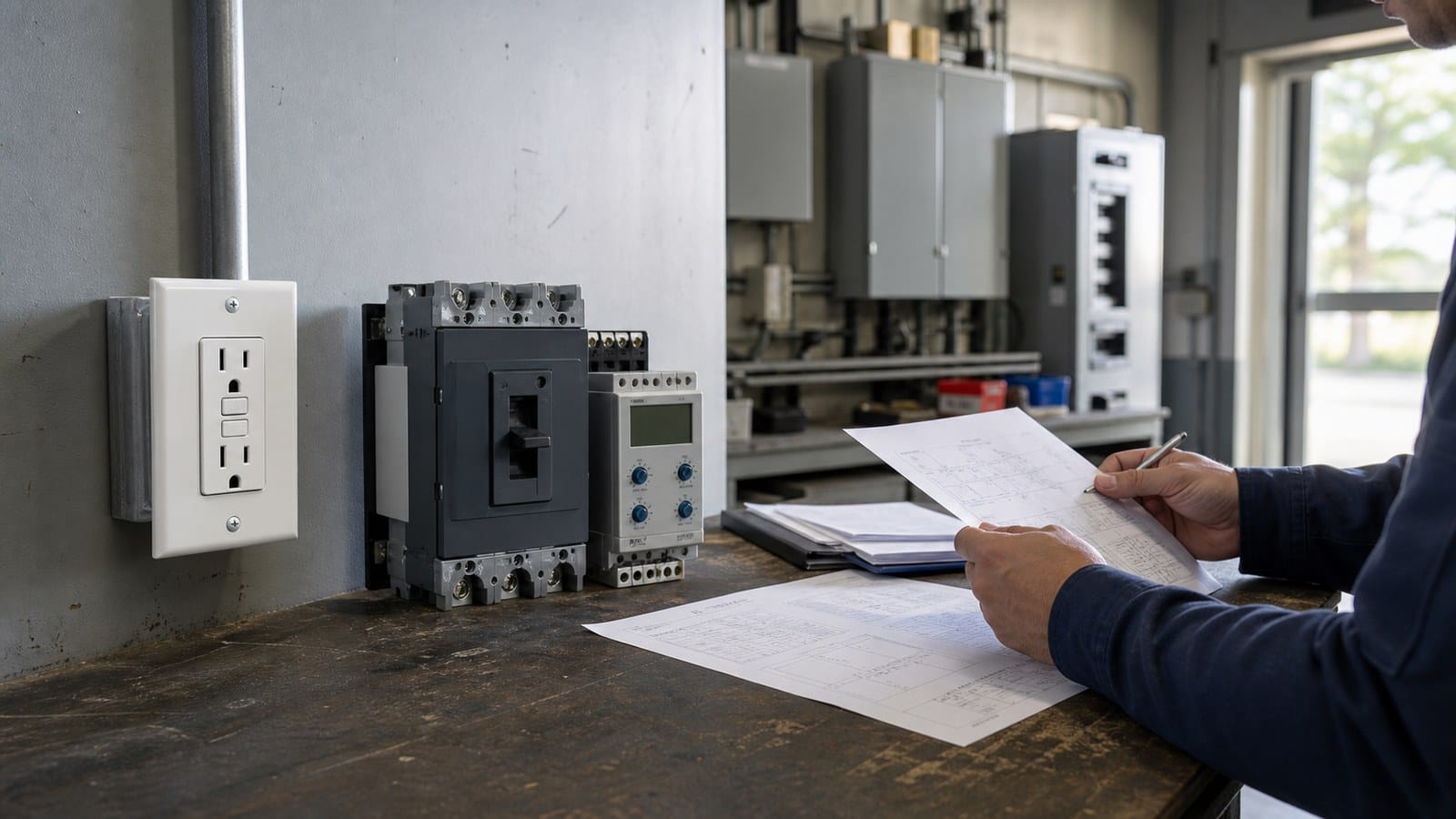
- Unplug and inspect the machine’s attachment plug for TEST/RESET buttons.
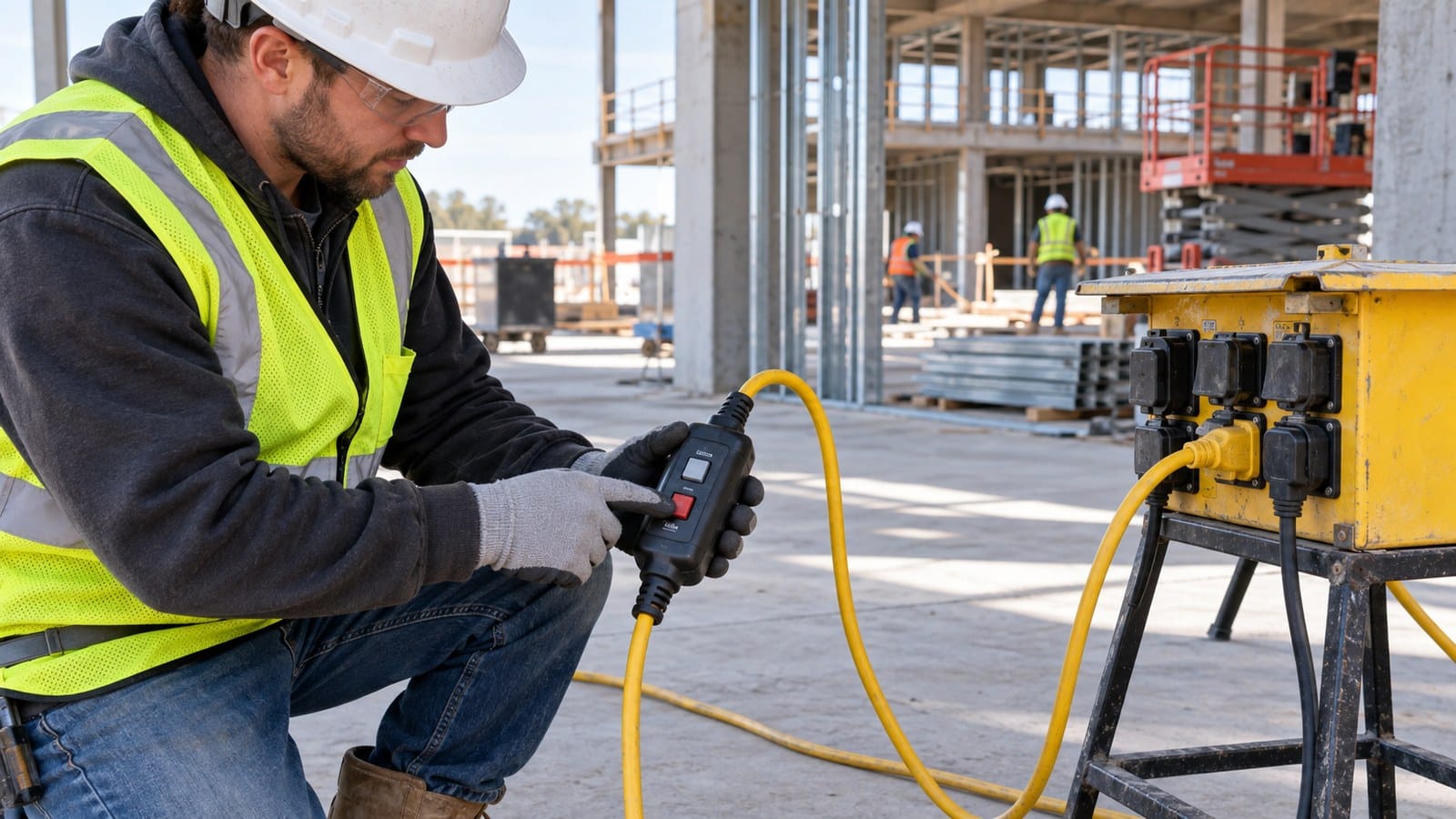
- Inspect the supply cord near the plug for an integral GFCI module.
- Look for a local GFCI receptacle, upstream blank-face device, or labeled protected outlet.
- Check the panel schedule for a GFCI breaker.
- Verify the machine installation manual and nameplate.
- Test only according to the device and equipment instructions.
Do not assume that a standard-looking receptacle is unprotected; it may be downstream of another device. Conversely, a “GFCI Protected” label is not proof that the upstream device works or even remains connected.
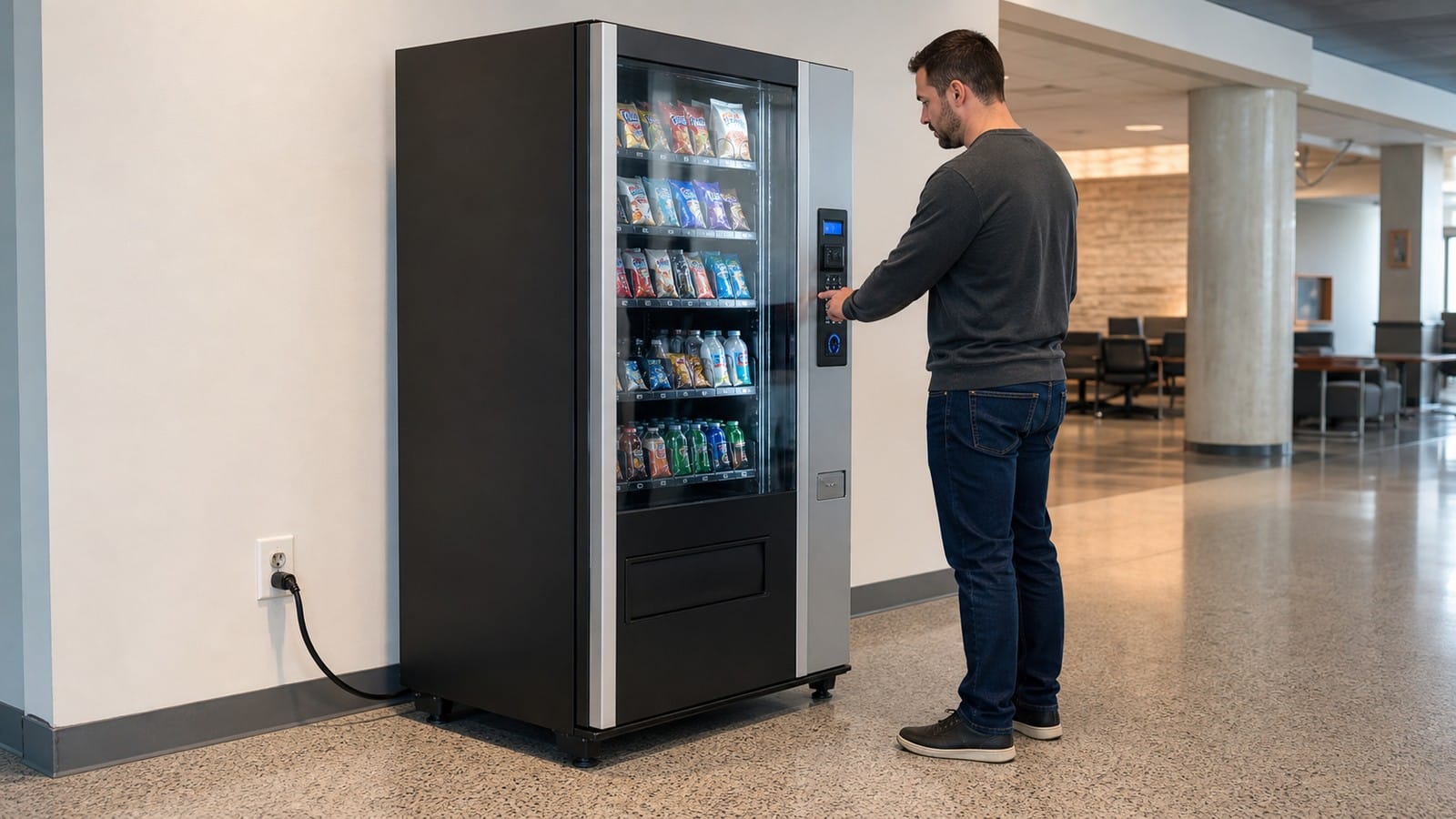
New, older, and remanufactured machines
Vending-machine GFCI requirements have evolved over multiple NEC cycles. Older and remanufactured machines may have different factory protection from current equipment. When a machine changes location, the electrical installation also changes context.
For each machine, record the manufacturer, model, serial number, manufacture or rebuild date, electrical nameplate, cord and plug assembly, integral GFCI type if present, installation instructions, anchoring requirements, supply circuit, receptacle and maintenance owner. This single equipment record supports both code review and future replacement decisions.
Do not remove a cord-integral device because the wall receptacle is also GFCI-protected. Multiple protection layers require manufacturer and code evaluation; field-modifying a listed cord assembly can invalidate the product configuration.
Circuit loading and multiple machines
GFCI protection does not prevent overload. Refrigerated vending machines have compressor starting current, heaters, controls, lights, payment terminals, and communications equipment. Two machines that fit physically beside one duplex receptacle may not belong on one circuit.
The project electrical schedule should record each model’s rated current, branch-circuit requirement, plug configuration, and whether any loads are continuous. Confirm conductor, breaker, receptacle, and available capacity. If one upstream GFCI protects several machines, a single trip can take all of them offline.
For locations that sell temperature-sensitive food, include an outage response. GFCI protection is a safety function, not a food-temperature monitoring system.
Indoor versus outdoor vending machines
Outdoor exposure changes the complete installation. Verify the machine, receptacle, box and cover are suitable for the environment; use WR construction where required; protect the cord from pinch, abrasion and vehicle impact; route drainage away from the connection; and confirm corrosion, sunlight, temperature, anchoring and service-access requirements.
Faith’s outdoor outlet selection guide covers environmental features, while its WR versus TR GFCI comparison distinguishes separate device markings.
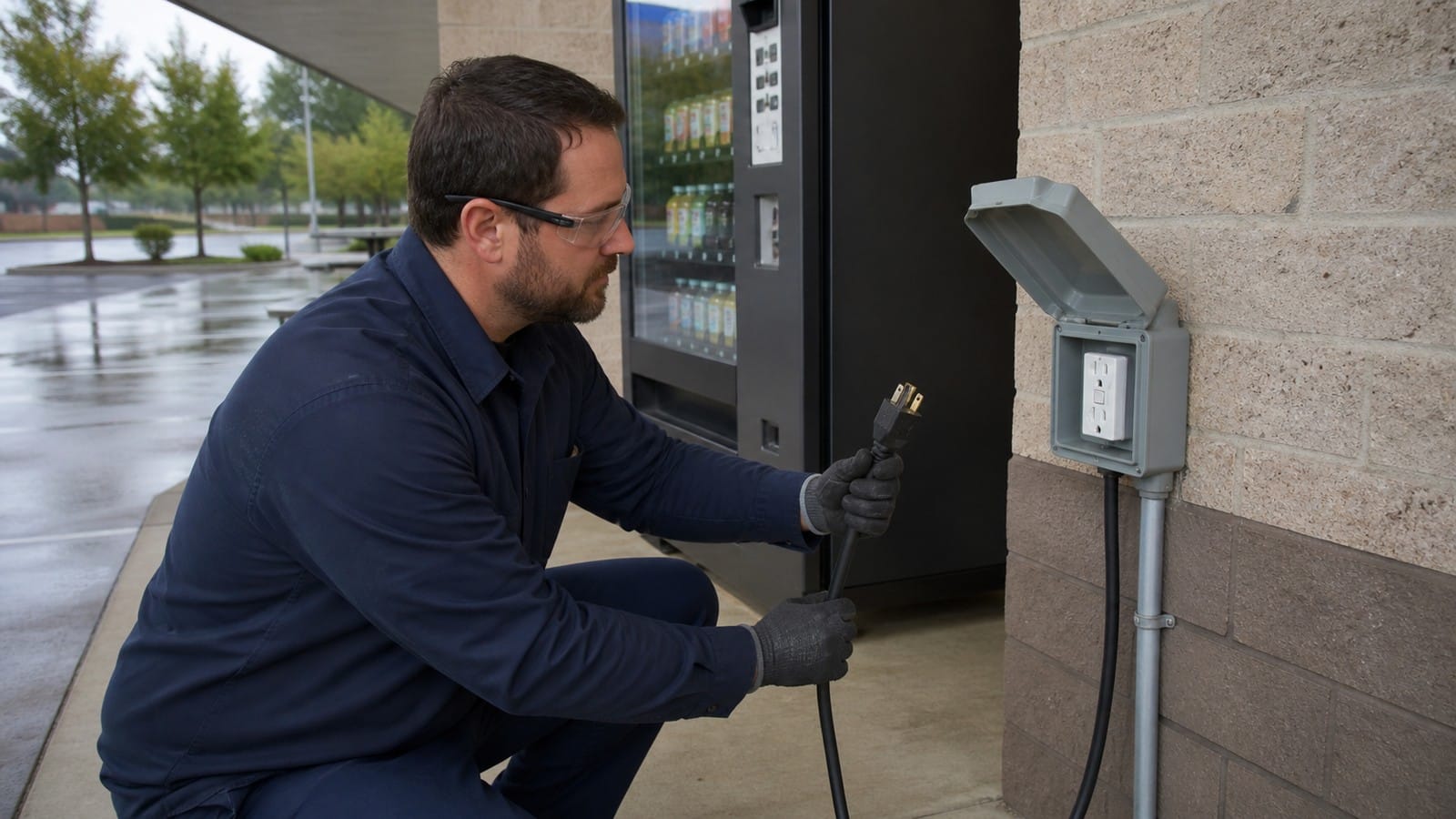
What if a vending machine trips the GFCI?
| Trip pattern | Possible cause | Safe next step |
|---|---|---|
| Trips immediately on plug-in | Cord, plug, machine wiring, filter, or supply fault | Leave unplugged; qualified diagnosis |
| Trips when compressor starts | Refrigeration electrical leakage or compatibility issue | Appliance and circuit testing |
| Trips after rain or cleaning | Moisture intrusion at machine, cord, plug, box, or cover | De-energize and correct environmental defect |
| Several machines lose power | Shared upstream GFCI | Map circuit and consider outage segmentation |
| Integral cord GFCI will not reset | No supply, failed device, machine fault, or wet condition | Follow manufacturer procedure; do not bypass |
| Breaker trips, not GFCI | Overload or short circuit | Verify all loads and circuit rating |
Do not tape a reset button, substitute a non-GFCI cord, or move the machine to an unprotected extension cord. Record whether the integral device, wall device, or panel breaker operated and at which operating stage.
Buyer specification fields
| Field | Required detail |
|---|---|
| Machine identity | Manufacturer, model, options, manufacture/rebuild status |
| Electrical supply | Voltage, phase, frequency, rated current, plug |
| GFCI method | Plug-integral, cord-integral, receptacle/upstream, or breaker |
| Protective device | Exact catalog number, ratings, listing evidence |
| Accessibility | TEST/RESET and disconnect reachable without moving machine |
| Environment | Indoor/outdoor, damp/wet exposure, temperature, cover/enclosure |
| Circuit scope | Dedicated/shared, downstream loads, outage consequence |
| Documentation | Manual, wiring diagram, certificate record, replacement parts |
| Acceptance | Visual inspection, functional test, labeling, log entry |
For imported or private-label protective devices, match catalog number, electrical ratings, certification record, markings, wiring diagram, instructions, and packaging as one approval set. Faith’s manufacturer vetting checklist can support supplier due diligence, but it does not replace project-specific product approval.
Place TEST/RESET controls and the disconnect where maintenance staff can reach them without shifting the equipment. A machine that must be moved to reach the reset is not a practical maintenance arrangement.
Commissioning and maintenance decisions
Assign one owner for periodic testing and record the device location, circuit, machine model, inspection result and test date. Recheck the cord, plug, cover and evidence of moisture or impact whenever a machine moves or after a trip. Repeated trips require diagnosis; they are not a normal operating condition. Replacement components should match approved catalog numbers and the equipment instructions.
For purchasing, treat the vending machine model, supply rating, GFCI method, environmental rating, certification record, cord assembly, markings, and installation instructions as one approval set.
FAQ
Does every vending machine need a GFCI outlet, or is an integral cord device enough?
Under the 2023 NEC, Section 210.8(D) requires GFCI protection for the branch circuit or outlet supplying a qualifying vending machine, even if the cord has an integral device. Earlier adopted editions may coordinate integral plug or cord protection differently. Verify the adopted edition, machine instructions and AHJ requirements before changing either protection layer.
Can one GFCI protect multiple vending machines?
Feed-through or breaker protection can cover several outlets, but circuit capacity, required wiring, labeling, reset access, and outage scope must be designed.
Does an indoor machine need a WR GFCI?
Not automatically. WR relates to environmental exposure; determine the actual location classification.
Why does the machine trip only when the compressor starts?
That pattern can indicate a refrigeration electrical fault, insulation leakage, or a circuit/protection issue. Arrange coordinated testing rather than bypassing the device.
Sources / References
Accessed August 17, 2026.
- NFPA 70, 2023 edition, Section 210.8(D), via NFPA LiNK
- NFPA 70 formal document page
- Leviton Captain Code 2023 – GFCI Protection for Specific Appliances
- Leviton Captain Code 2020 – GFCI protection for specific appliances
- UL Solutions – GFCI personal protection devices testing and certification
- IAEI Magazine – Vending Machines code history
This article provides general U.S. code-planning, procurement, and maintenance information. It does not replace the locally adopted code, equipment instructions, listing conditions, health regulations, project documents, permits, or AHJ approval. Installation and diagnosis should be performed by qualified persons.