The best outdoor outlet matches the location, load, exposure level, code requirements, and certification needs.
Many projects fail not because of a single weak component, but because the receptacle, cover, protection device, and wiring do not form a coherent system for real-world outdoor conditions.
What Makes an Outdoor Outlet the “Best” Choice?
Outdoor outlets face rain, constant humidity, UV radiation, temperature swings, dust, and corrosion from salt air or chemicals. An ordinary indoor receptacle placed outside degrades quickly and creates hazards.
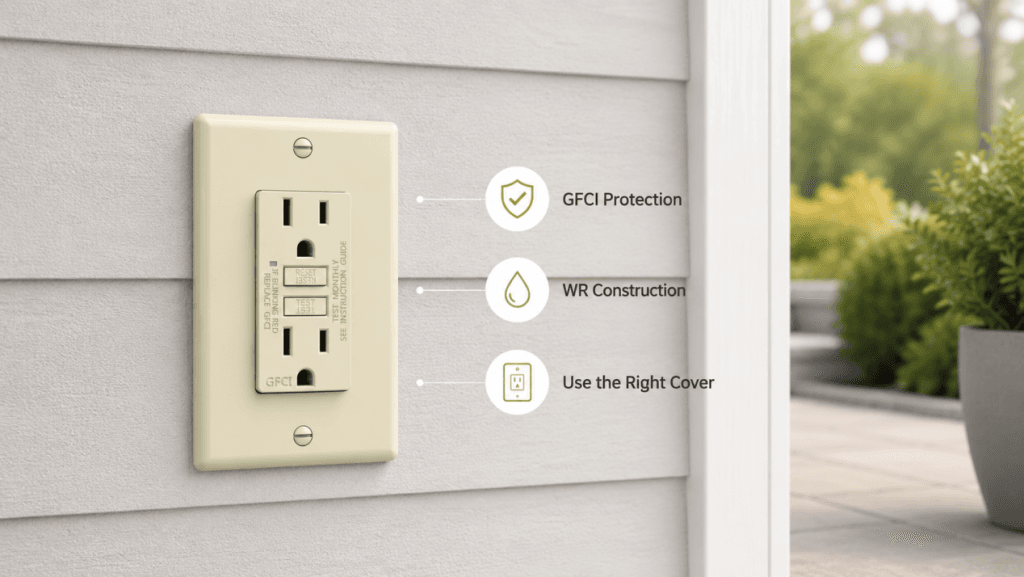
A solid outdoor outlet combines several elements:
- GFCI protection
- Weather-resistant (WR) construction
- Proper outdoor cover
- Correct amperage rating
- UL or ETL certification
- Suitability for damp or wet locations
The best choice depends on how the outlet will actually get used. A patio light needs different considerations than a pressure washer connection or landscape lighting circuit.
Why Outdoor Outlets Need More Protection Than Indoor Outlets
Outdoor environments multiply electrical risks. Water lowers insulation resistance. Corrosion attacks terminals. UV makes plastic brittle. A tripped breaker or short circuit in the backyard often means dealing with wet conditions and higher shock potential.
Using extension cords as a permanent solution creates trip hazards, voltage drop, and overload risks. Proper outdoor receptacles eliminate these problems for patio lights, garden tools, holiday decorations, garage equipment, and landscape systems.
Treat the entire assembly — receptacle, cover, box, and upstream protection — as one system. Cutting corners on any part undermines the rest.
Key Features to Look for in Outdoor Outlets
GFCI Protection
GFCI (Ground Fault Circuit Interrupter) devices monitor current flow and cut power within milliseconds if they detect imbalance caused by a ground fault.
In outdoor settings, moisture makes this protection essential. NEC 210.8(F) generally requires GFCI protection for outdoor outlets at dwellings (15- and 20-amp, 125-volt circuits). Local AHJs (Authorities Having Jurisdiction) enforce the adopted version of the code.
Protection can come from a GFCI receptacle or a GFCI breaker. Either works, but test monthly using the TEST button.
Weather-Resistant Construction
WR (Weather-Resistant) marking shows the manufacturer built the receptacle with corrosion-resistant materials, UV-stabilized plastics, and better sealing for outdoor exposure.
WR does not mean fully waterproof. It improves longevity in wet and humid conditions but still requires a proper cover.
Weatherproof or In-Use Cover Compatibility
Covers protect the receptacle openings and plugged-in cords.
Standard weatherproof covers work when nothing is plugged in. In-use covers (often called bubble covers) maintain protection while a cord remains connected. Use in-use covers wherever equipment runs for extended periods, such as holiday lighting or pumps.
Tamper-Resistant Design
TR (Tamper-Resistant) outlets use internal shutters that block foreign objects. They add value in residential yards, near public areas, or commercial sites with foot traffic.
Outdoor Outlet Requirements for U.S. Market Projects
NEC and Local Code Considerations
The National Electrical Code (NEC) sets baseline requirements, but local jurisdictions adopt specific editions and add their own rules. Always verify with the local AHJ before finalizing specifications.
Qualified electricians must handle installation. This is not a DIY topic for code compliance and inspection.
GFCI and WR Requirements
Most 15A and 20A, 125V outdoor receptacles need GFCI protection and WR construction. Indoor-grade receptacles fail faster and violate code in outdoor applications.
UL / ETL Certification
For U.S. contractors, distributors, and project bids, UL or ETL listing is non-negotiable. Both are OSHA-recognized NRTLs and test to the same core safety standards. Inspectors and procurement teams accept them.
Certification reduces risk across the supply chain and supports smoother inspections and insurance requirements.
Weather-Resistant Outlet vs Weatherproof Cover: What’s the Difference?
These terms confuse many buyers. They serve different purposes and do not replace each other.
| Item | Main Function | Cannot Replace |
| Weather-Resistant (WR) Outlet | Improves body and terminal durability against moisture, UV, temperature | Proper cover or GFCI |
| Weatherproof Cover | Protects openings and connection area | WR receptacle or GFCI |
| In-Use Cover | Maintains protection with plug inserted | GFCI protection |
| GFCI Protection | Detects ground faults and cuts power | Physical weather protection |
The reliable combination remains: WR receptacle + GFCI protection + suitable weatherproof or in-use cover.
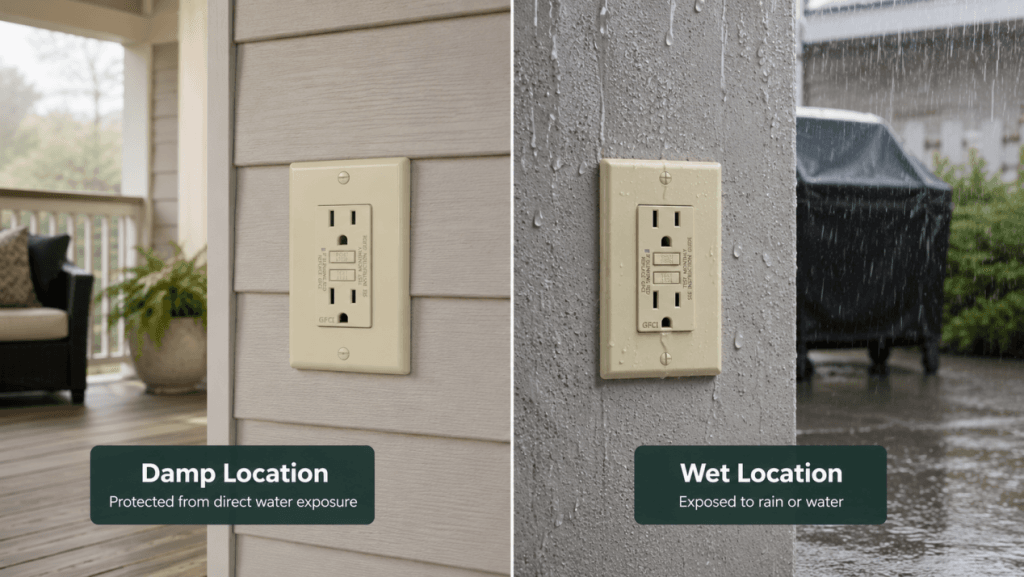
Damp Location vs Wet Location: Why It Matters
Damp Locations
Damp locations experience moderate moisture but avoid direct rain or splashing. Think covered porches, eaves, or semi-protected garage exteriors.
WR receptacles with standard weatherproof covers (closed when not in use) often suffice here, along with GFCI.
Wet Locations
Wet locations face direct rain, spraying water, or constant exposure. Examples include open walls, patios without overhangs, pool areas, and landscape zones.
These demand in-use covers for any prolonged plugged-in use and stricter attention to installation height and drainage.
15A vs 20A Outdoor Outlets: How to Choose the Right Rating
Match the receptacle to the circuit breaker and expected load.
| Feature | 15A Outdoor Outlet | 20A Outdoor Outlet |
| Common Configuration | NEMA 5-15R | NEMA 5-20R |
| Typical Voltage | 125V | 125V |
| Common Uses | Lighting, small tools, chargers | Power tools, higher-load equipment |
| Circuit Requirement | 15A breaker, 14 AWG wire | 20A breaker, 12 AWG wire |
Never install a 20A receptacle on a 15A circuit. On a 20A circuit, 15A receptacles are allowed in some cases, but 20A receptacles provide better future-proofing when loads justify it.
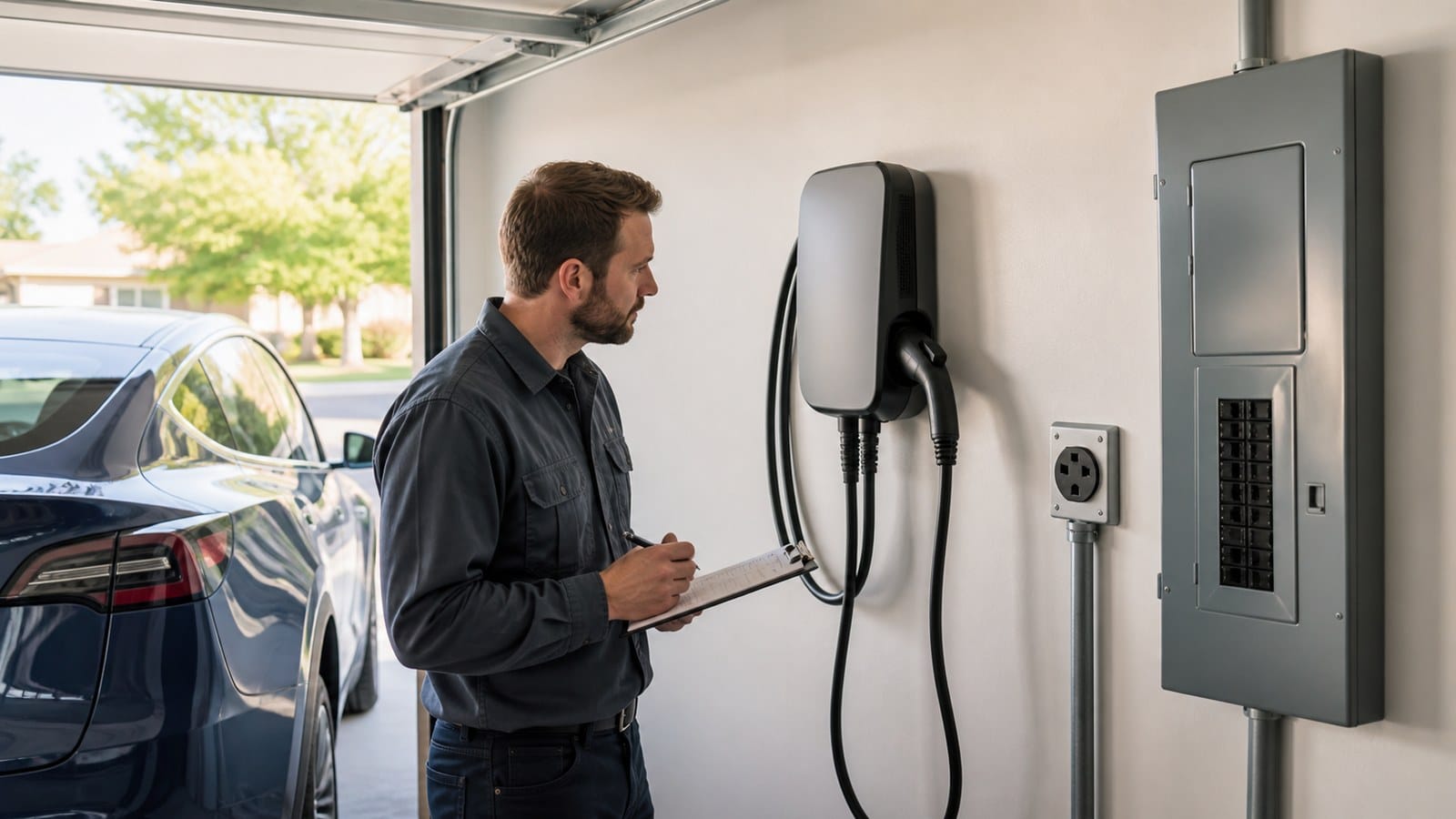
Heavy equipment like EV chargers or welders requires dedicated circuits and specialized receptacles outside standard outdoor outlet selection.
How to Choose Outdoor Outlets for Different Applications
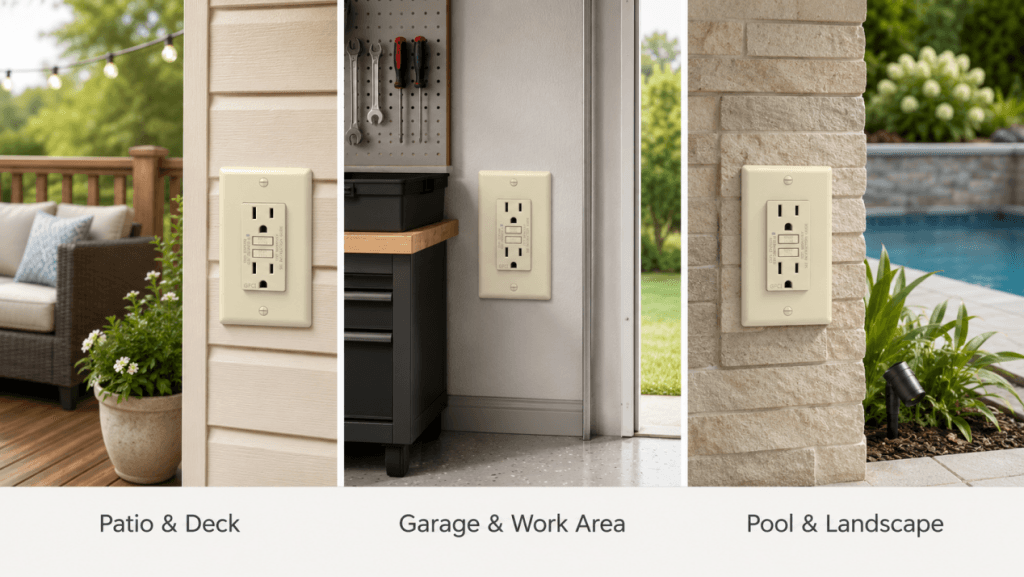
Residential Exterior Walls, Patios, and Decks
Prioritize GFCI + WR + TR receptacles with in-use covers where cords stay connected. Place them for convenient access without excessive extension cord runs. Common loads include string lights, pressure washers, and outdoor speakers.
Garages and Outdoor Work Areas
These often see higher and more frequent loads. Consider 20A options where tools and compressors run. Focus on durability and easy testing access.
Pool, Spa, and Landscape Areas
Water proximity raises risks. Follow stricter GFCI rules and maintain clear separation distances per code. Professional input is essential here.
Commercial and Project Use
Projects demand consistent quality, batch traceability, and full documentation. Certification, reliable supply, and a broad product line for complementary devices matter more than single-unit price.
Outdoor Outlet Buying Checklist and Common Mistakes
Buying Checklist
- GFCI protection included or planned
- WR marking present
- TR design where needed
- 15A or 20A rating matched to circuit
- Compatible with proper weatherproof/in-use covers
- UL or ETL listed
- Suitable for damp or wet location
- Clear technical data and certification files
- Supplier capable of stable bulk supply and full wiring device range
Common Mistakes to Avoid
- Installing standard indoor receptacles outdoors
- Relying on a cover alone without WR and GFCI
- Using non-in-use covers for constantly plugged equipment
- Mismatching amperage with circuit protection
- Purchasing non-certified products for U.S. projects
- Skipping regular inspection of covers, seals, and GFCI test/reset function
Why Choose Faith Electric for Outdoor Wiring Devices?
Faith Electric brings 28 years of experience as a professional electrical manufacturer serving the U.S. market. We deliver complete UL/ETL certified wiring device solutions, including GFCI outlets, weather-resistant receptacles, switches, wall plates, and more.
Contractors, distributors, and project teams value our consistent quality, broad product line, and support for bulk requirements and OEM needs.
For outdoor electrical projects, choosing the right outlet means addressing safety, code compliance, consistency, and long-term reliability.
Contact Faith Electric to discuss your requirements for UL/ETL certified outdoor wiring devices. Our team supports U.S. market contractors and distributors with technical details and project solutions.