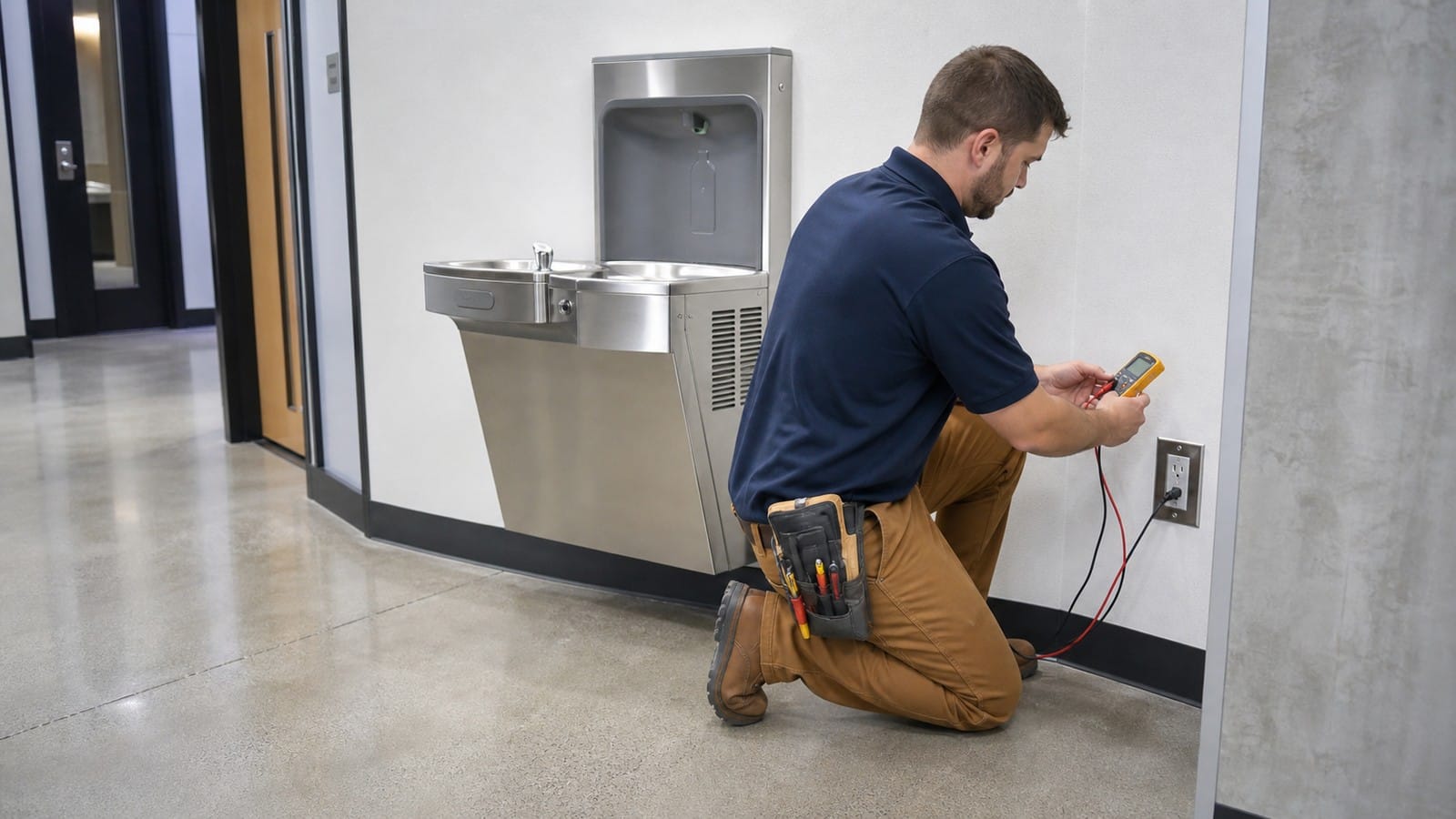
Drinking water coolers and bottle filling stations within the electrical limits of the locally adopted code generally require GFCI protection for the supplying branch circuit or outlet. In the 2023 edition of NFPA 70, Section 210.8(D) directly lists drinking water coolers and bottle fill stations. Earlier Article 422 provisions also addressed drinking water coolers. The final design must follow the adopted edition, local amendments, exact equipment listing, and manufacturer instructions.
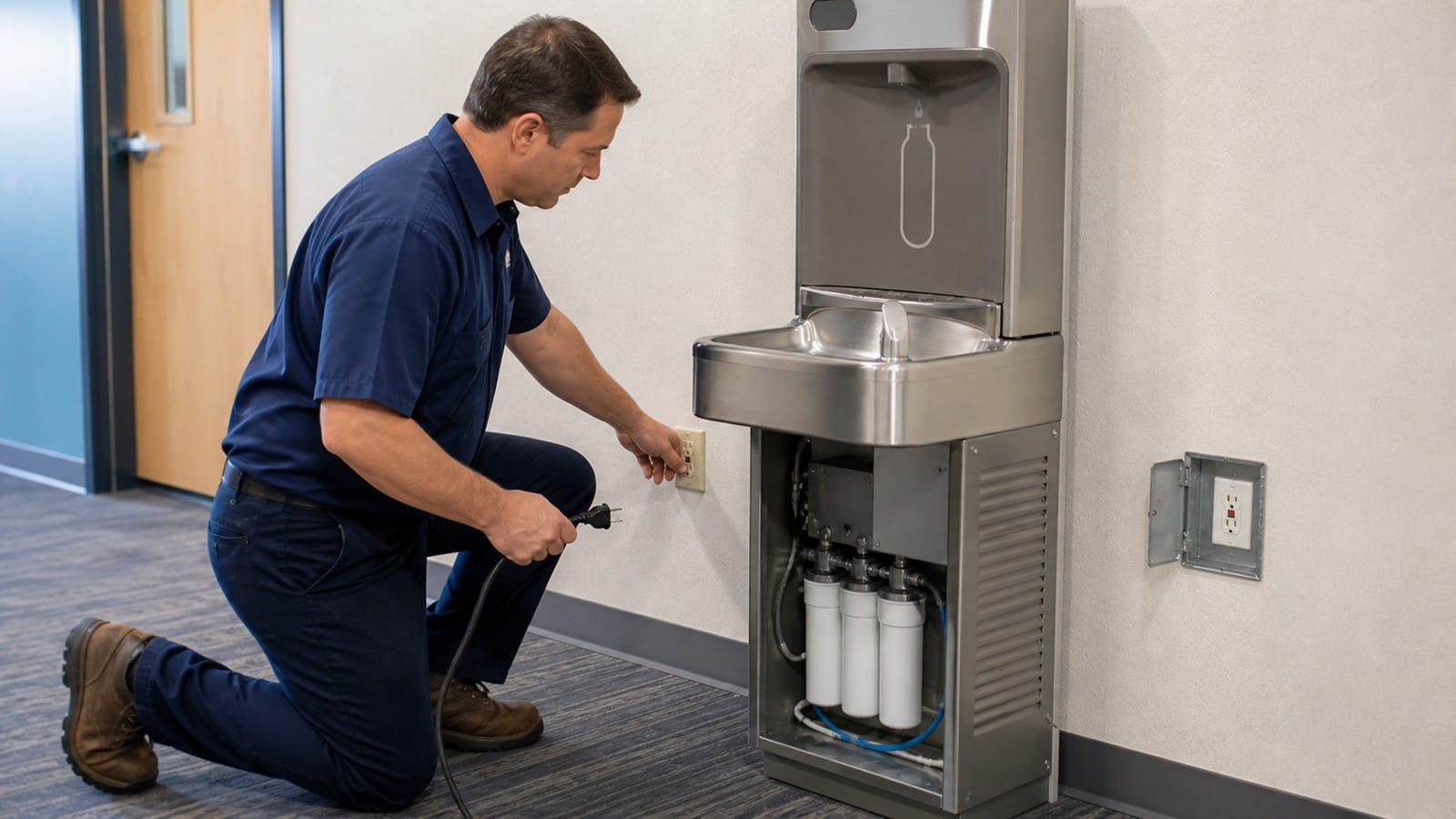
The equipment may be cord-connected, hardwired, wall-mounted, recessed, refrigerated, non-refrigerated, or paired with a bottle filler. Those differences affect circuit rating, connection location, service access, and where the GFCI protective device should be installed. A reset hidden behind a fixed cooler defeats practical inspection and maintenance.
Procurement should treat the water appliance and protective device as coordinated but separately documented products. “GFCI included” is not enough unless the submittal identifies where the protective function is located, what it protects, how it is tested, and which listing covers it.
Document set reviewed: Faith Editorial Team checked NFPA 70 (2023) Section 210.8(D) in NFPA LiNK, the Leviton Captain Code portal, UL Solutions information on UL 943 GFCIs, and Elkay’s product and installation documents for ezH2O model EZO8WSLK (installation document 1000005925). The Elkay example is not generalized to other coolers or bottle fillers. No licensed-electrician, plumbing designer, manufacturer, or AHJ review is claimed.
Identify the exact water appliance first
| Equipment | GFCI planning point | Buyer must confirm |
|---|---|---|
| Refrigerated wall cooler | Listed in the modern specific-appliance rule | Voltage, current, cord/hardwire method, reset access |
| Bottle filler attached to cooler | May share or add electrical loads | Complete assembly data and circuit schedule |
| Standalone bottle filler | Do not assume it has the same circuit as a cooler | Model-specific installation sheet |
| Non-refrigerated fountain | Electrical functions may still exist for sensors or controls | Whether it is powered and what listing applies |
| Outdoor cooler/filler | GFCI is only one layer | Environmental rating, enclosure, cover, freezing, and location |
| Existing older unit | Retrofit duties vary | Local alteration and replacement requirements |
The code path
NFPA LiNK provides the 2023 edition of NFPA 70. Section 210.8(D) identifies drinking water coolers and bottle fill stations among specific appliances requiring GFCI protection for the branch circuit or outlet within the section’s electrical limits. Leviton’s licensed 2023 NEC portal reproduces the list and explains that the protection is placed in the supply path, not assumed from the appliance alone.
Article 422 also historically grouped GFCI requirements for particular appliances. Read the adopted edition as a complete document; do not splice language from different cycles. A specification should state the actual adopted version and section used for the design.
Elkay’s EZO8WSLK product page identifies that model as a 115V/60Hz indoor refrigerated bottle-filling station and links installation instruction 1000005925. This is a useful procurement example because it ties electrical data to one catalog number; a different filler can be non-refrigerated, battery-powered, or configured with a separate chiller.
Cord-connected versus hardwired equipment
Cord-and-plug-connected cooler
The receptacle location should be coordinated with the cooler’s cord and access panel. If the receptacle-type GFCI is behind the cooler, staff may be unable to test or reset it without moving a plumbed fixture. An upstream GFCI, blank-face device, or compatible breaker can improve access when permitted by the complete installation.
Hardwired cooler or bottle filler
Hardwiring does not automatically eliminate a specific-appliance protection rule. Under the 2023 framework, the branch circuit or outlet supplying the listed appliance is the focus. Confirm the disconnecting means, junction box, service access, and protective-device location.
Combined cooler and bottle filler
Combination equipment may include refrigeration, sensors, filters, counters, UV treatment, pumps, or status displays. The electrical schedule should use the complete model number and factory options. Do not add the wattages of unrelated catalog examples.
Where should the GFCI reset be located?
The protective device should be readily accessible. Practical options include:
- a GFCI breaker in an accessible panel;
- a blank-face GFCI in a nearby serviceable wall location;
- an upstream GFCI receptacle that protects the equipment outlet through correct LOAD wiring; or
- cord/plug-integral protection when explicitly listed and permitted for the appliance and adopted code.
For public buildings, consider who will respond to a trip. A school custodian, hotel engineer, or facility technician should not have to unbolt a cooler. Label the panel circuit and any downstream protected outlet.
Water, drainage, and electrical coordination
GFCI protection does not make poor plumbing coordination acceptable. Leaks, blocked drains, sweating lines, filter replacement, and cleaning can expose the connection area to moisture.
Coordinate:
- water supply and shutoff;
- drain and trap location;
- filter service clearance;
- electrical box or junction point;
- cord routing and strain relief;
- leak path away from energized parts;
- wall backing and mounting fasteners;
- accessible reset and disconnect; and
- finished-wall and accessibility dimensions.
The outlet should not sit directly below a likely leak point simply because that is the shortest wiring route.
Indoor, outdoor, and wet-location product choices
An indoor school-corridor cooler and an outdoor recreation-area filler are not the same environment. GFCI function addresses ground-fault personnel protection; environmental suitability is covered by separate product and enclosure ratings.
For outdoor or damp installations, verify enclosure type, ingress and weather exposure, WR receptacle requirements where applicable, cover requirements, corrosion, freeze protection, and manufacturer limitations. Faith’s WR versus TR GFCI guide explains why weather resistance and tamper resistance are separate markings.
What to do when the cooler trips
| Symptom | Possible cause | Response |
|---|---|---|
| Trips immediately after connection | Wiring, cord, plug, compressor, filter, or appliance insulation fault | Disconnect and arrange qualified diagnosis |
| Trips when compressor starts | Refrigeration-system electrical fault or leakage | Appliance technician and electrician coordinate testing |
| Trips after filter service | Water reached connection area or cord was disturbed | De-energize, correct leak, inspect before reset |
| Multiple fixtures lose power | Shared upstream protection | Map circuit and evaluate outage scope |
| GFCI will not reset with equipment disconnected | Device, wiring, supply, or downstream fault | Qualified electrical diagnosis |
| Breaker trips instead of GFCI | Overcurrent, short circuit, or overload | Do not upsize; verify circuit and loads |
Record when the trip occurs—on plug-in, compressor start, dispensing, filter service, or cleaning. Do not treat “nuisance trip” as a diagnosis or remove protection to keep the cooler operating.
Submittal checklist for buyers
- Exact cooler/bottle-filler model and options
- Refrigerated or non-refrigerated configuration
- Voltage, phase, frequency, current, and overcurrent requirement
- Cord-and-plug or hardwired connection
- Plug/receptacle configuration or junction-box details
- GFCI method, device catalog number, and reset location
- Panel compatibility if a breaker is used
- Equipment and protective-device listing evidence
- Indoor/outdoor environmental suitability
- Plumbing, drain, filter, and service clearances
- Accessibility requirements
- Installation manual and wiring diagram
- Replacement parts and approved substitutions
- Commissioning test and maintenance instructions
For OEM/private-label GFCI procurement, compare the device catalog number, electrical ratings, certification record, front and rear markings, wiring diagram, instructions, and packaging artwork. Faith’s private-label GFCI checklist provides a document-control workflow. Do not approve a device from a logo alone.
Facility acceptance test
Before turnover:
- Confirm model and electrical ratings against the approved submittal.
- Verify the outlet or connection is dry, intact, and serviceable.
- Confirm the GFCI device is readily accessible and labeled.
- Test using the protective-device manufacturer’s instructions.
- Confirm the cooler loses and regains power as intended.
- Check that unrelated critical loads are not unexpectedly downstream.
- Inspect for water leakage during operation and filter service.
- Record the circuit, panel, device model, and test result.
Faith has manufactured electrical wiring devices since 1996. The exact GFCI model used on a project still requires model-specific verification and approval.
FAQ
Does every drinking fountain need GFCI protection?
Powered drinking water coolers and bottle fill stations are specifically listed in the 2023 NEC framework within its limits. Determine whether the equipment is powered and which edition is adopted locally.
Can the GFCI receptacle be behind the cooler?
The protective device needs ready access. A breaker or upstream reset point is often more maintainable than a device blocked by a fixed plumbed fixture.
Does hardwiring remove the GFCI requirement?
Not under the 2023 specific-appliance framework merely because the connection is hardwired. Verify the branch circuit or outlet rule and exact appliance.
Does a bottle filler need its own circuit?
Not universally. Follow the complete model’s electrical data and project design; combination units and options can change load.
Is a WR GFCI required indoors?
Not simply because the equipment handles water. Determine whether the receptacle is in a damp or wet location and apply the correct environmental requirements.
What if the cooler keeps tripping?
Disconnect it and investigate moisture, cord/wiring damage, refrigeration components, appliance leakage, and circuit problems. Do not bypass protection.
Sources / References
Accessed August 17, 2026.
- NFPA 70, 2023 edition, Section 210.8(D), via NFPA LiNK
- NFPA 70 formal document page
- Leviton Captain Code 2023 – GFCI Protection for Specific Appliances
- Leviton Captain Code 2017 – Article 422 appliance GFCI protection background
- Elkay ezH2O model EZO8WSLK – product data and installation instruction 1000005925
- UL Solutions – GFCI personal protection devices testing and certification
This article is general U.S. code-planning and procurement information. It does not replace the locally adopted code, plumbing rules, equipment instructions, listing conditions, accessibility requirements, project documents, or AHJ approval. Installation and testing should be performed by qualified persons.