Yes—under recent National Electrical Code (NEC) editions, a typical residential sump pump generally needs GFCI protection. The requirement can arise from the appliance-specific rule for sump pumps and from the GFCI rule for basement receptacles. The final answer still depends on the NEC edition adopted locally, amendments, pump rating, connection method, and installation location.
Do not remove or bypass GFCI protection because a sump pump trips. A trip can mean water has entered a cord, float switch, motor, connector, receptacle box, or downstream circuit. Because the pump also protects the building from flooding, the right solution is to find the electrical fault and add independent flood-risk controls such as a high-water alarm and backup pump.
Code note: U.S. jurisdictions adopt different NEC editions and may add exceptions or amendments. The adopted code, product instructions, project design, and authority having jurisdiction (AHJ) control the installation.
Sump Pump GFCI: The Short Answer
| Question | Practical answer |
|---|---|
| Does a sump pump need GFCI? | Generally yes under recent NEC editions; verify the locally adopted edition and amendments |
| Can I use a GFCI receptacle? | Yes for a compatible 125 V, 15 or 20 A cord-connected pump when the device, circuit, and location are suitable |
| Can I use a GFCI breaker? | Yes when whole-circuit protection is preferred or required; match the panel, circuit, load, and any AFCI requirements |
| Is startup current a reason to remove GFCI? | No. A GFCI responds to current imbalance, while the branch breaker responds to overload and short circuit |
| What if tripping could flood the basement? | Diagnose the fault and add an alarm, battery or water-powered backup, and monitoring—do not permanently defeat shock protection |
Where the Requirement Comes From
The 2020 NEC added sump pumps to the appliance GFCI requirements in Section 422.5(A). The 2023 NEC reorganized specific-appliance protection into Section 210.8(D). Eaton’s 2023 NEC material identifies sump pumps among the covered appliances and explains that the protection can be placed at the breaker, receptacle, or another listed upstream point in the branch circuit.
There is often a second path to the same result. Section 210.8(A) requires listed GFCI protection for covered dwelling-unit receptacles in basements. A cord-connected sump pump commonly plugs into a basement receptacle, so the location rule applies even before the appliance is considered.
Eaton’s dwelling-unit overview notes that the 2023 NEC basement language no longer carries the former narrow exception in the same way. Its 2023 NEC pocket guide shows the progression of GFCI and AFCI/GFCI requirements for sump-pump applications.
Older installations may have been legal when built, and some states or cities retain specific amendments. That does not make a non-GFCI receptacle the automatic answer for replacement work. Equipment replacement, circuit modification, or a new pump may trigger current requirements. Ask the AHJ or a licensed electrician instead of relying on the age of the house.
GFCI Receptacle vs. GFCI Breaker for a Sump Pump
Both formats can work when listed and correctly installed. The better choice depends on accessibility, circuit layout, panel compatibility, and whether other protection is required.
GFCI receptacle
- Provides visible, point-of-use TEST and RESET controls near the pump.
- Can protect downstream receptacles through the LOAD terminals when the design calls for it.
- Fits many retrofit projects without changing the panel breaker.
- Should remain readily accessible and above areas likely to be exposed to water.
GFCI circuit breaker
- Protects the branch circuit from the panel onward.
- Can simplify protection when the pump circuit has more than one outlet or when dual-function AFCI/GFCI protection is needed.
- Requires compatibility with the exact panel and circuit configuration.
- Moves the reset point to the panel, which may be less convenient during a storm.
A dedicated branch circuit is often recommended by pump manufacturers or designers to reduce voltage drop, shared-load problems, and the chance that unrelated equipment disables the pump. Dedicated does not mean unprotected. It means the circuit serves the intended pump load without unrelated receptacles or appliances.
For a broader comparison, see Faith Electric’s GFCI receptacle versus GFCI breaker guide.
Why a Sump Pump Trips a GFCI
A GFCI compares current on the ungrounded and grounded circuit conductors. It trips when some current takes an unintended path. A standard breaker, by contrast, responds to overcurrent and short circuit. This distinction makes troubleshooting much faster.
1. Water in the cord or float-switch connector
Moisture is a leading suspect because the pump operates in or beside water. Pentair’s sump-pump troubleshooting guidance specifically identifies water entering a cord or float-switch connector as a possible cause when a GFCI breaker trips. A loose connector, cracked seal, low-mounted plug connection, or flooded pit can create leakage to ground.
2. Damaged pump cord
Cords can be pinched by a lid, abraded against concrete, pulled at the strain relief, attacked by chemicals, or damaged during maintenance. A cord may look acceptable from above while the section near the pump has deteriorated. Do not tape a damaged submersible-pump cord and return it to service unless the manufacturer provides an approved repair procedure.
3. Motor-winding or seal failure
As insulation ages, leakage from the winding to the grounded motor frame can increase. A failed seal may allow water into the motor housing. The GFCI can detect this before a normal breaker sees enough current to trip. Repeated trips after the pump has run for a few minutes can point to heat- or moisture-related insulation failure.
4. Faulty float switch
The float switch starts and stops the motor in a harsh environment. Water intrusion, a damaged piggyback plug, stuck contacts, or a pinched switch cable can create an intermittent fault. Some manufacturers allow the pump and float switch to be tested separately by qualified personnel; follow the exact manual rather than improvising.
5. Wet receptacle box or wiring problem
The pump may be innocent. Condensation, foundation leakage, corroded terminals, reversed LINE and LOAD conductors, a neutral-to-ground connection downstream, or another load on the protected circuit can trip the device. If the GFCI trips with the pump unplugged, the receptacle, downstream wiring, or another connected load needs investigation.
6. Aging or damaged GFCI device
GFCIs are electronic safety devices and do not last forever. Heat, moisture, corrosion, frequent trips, loose mounting, and electrical disturbances can cause failure. If a correctly installed device will not pass its own TEST/RESET procedure or cannot hold with the load disconnected, it may need replacement after the circuit is checked.
Faith Electric’s articles on common GFCI tripping causes and GFCIs that will not reset cover the wider circuit-level diagnosis.
What Startup Current Does—and Does Not—Explain
A pump motor can draw several times its running current for a short moment at startup. That inrush may contribute to a standard breaker trip if the circuit is overloaded, undersized, damaged, or incompatible with the motor. It should not, by itself, create the hot-to-neutral imbalance that a GFCI measures.
If the GFCI trips exactly when the motor starts, investigate leakage that appears under startup stress, a deteriorated motor, a wet switch or connector, cumulative leakage from other loads, a wiring fault, or a failing protective device. Do not replace the GFCI with a standard receptacle merely because someone calls the event “nuisance tripping.”
Safe Troubleshooting Sequence
- Protect the building first. If water is rising, activate a safe backup pump or emergency service plan. Keep people out of water near energized equipment.
- Disconnect power. Unplug the pump with dry hands from a dry location, or have a qualified person open the circuit. Do not reach into the pit while equipment is energized.
- Inspect the visible system. Look for a damaged cord, wet connector, cracked plug, loose cover, corrosion, pinched float cable, debris, blocked discharge, or evidence of overheating.
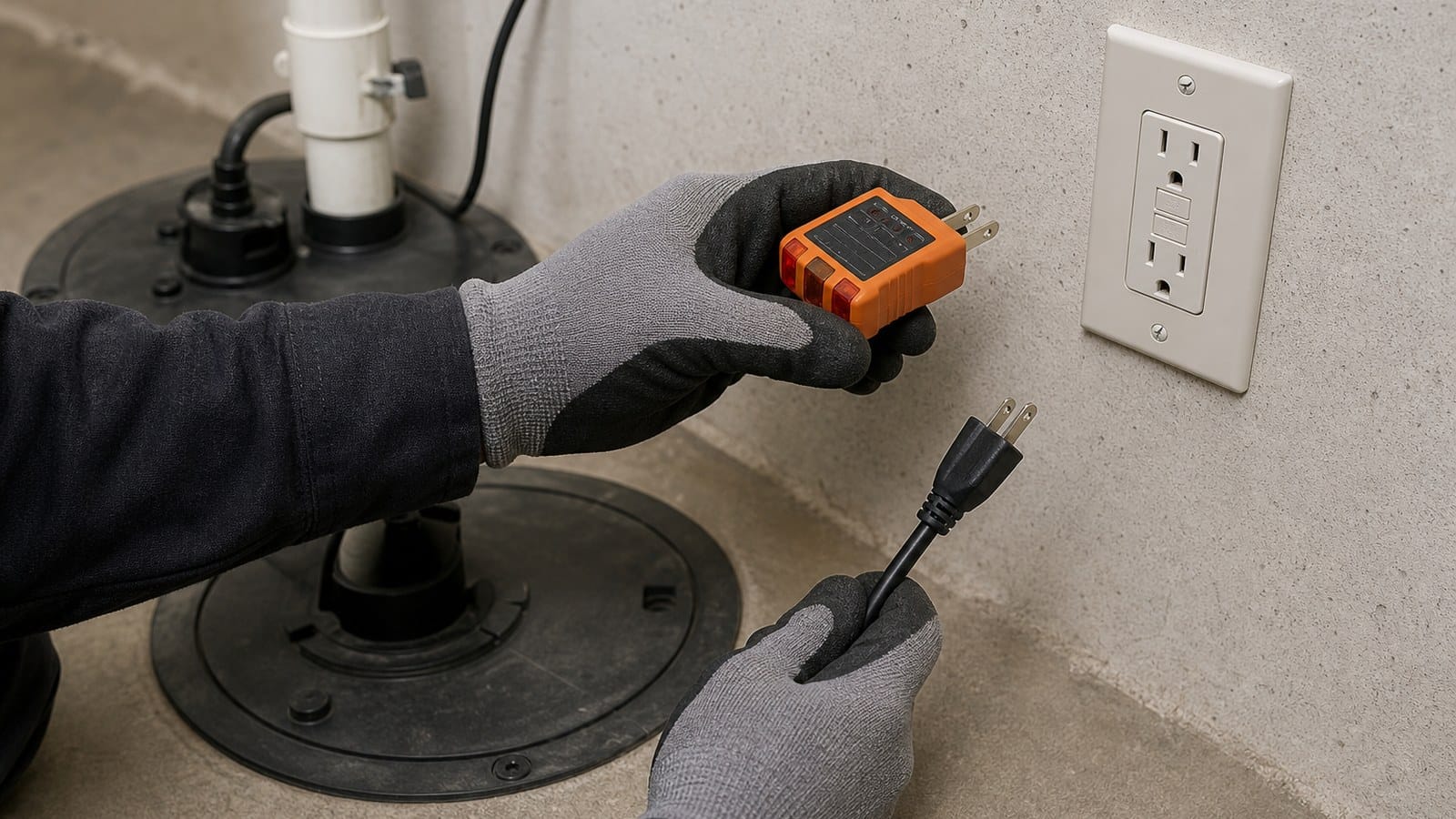
- Test the GFCI as instructed. With the pump disconnected, use the device’s TEST and RESET controls. If it will not reset or trips again with no connected loads, stop and have the circuit checked.
- Separate pump from circuit diagnosis. A qualified technician can test the receptacle, grounding, leakage current, insulation resistance, float switch, and pump on appropriate equipment without defeating protection.
- Correct the cause. Replace or repair the failed pump, switch, cord, GFCI, box, or wiring using listed parts and manufacturer instructions.
- Run a controlled water test. After repair, cycle the pump with clean water while observing the discharge, check valve, float movement, GFCI, alarm, and backup system.
Do not use a two-prong adapter, remove the grounding pin, hold the RESET button in, move the pump permanently to a non-GFCI extension cord, or bond neutral to ground. These actions can hide the warning while increasing shock risk.
How to Reduce Flood Risk Without Removing GFCI Protection
The best design assumes that any single component can fail. A pump can seize, a GFCI can trip, utility power can go out, a discharge pipe can freeze, or a float can stick. Use layers:
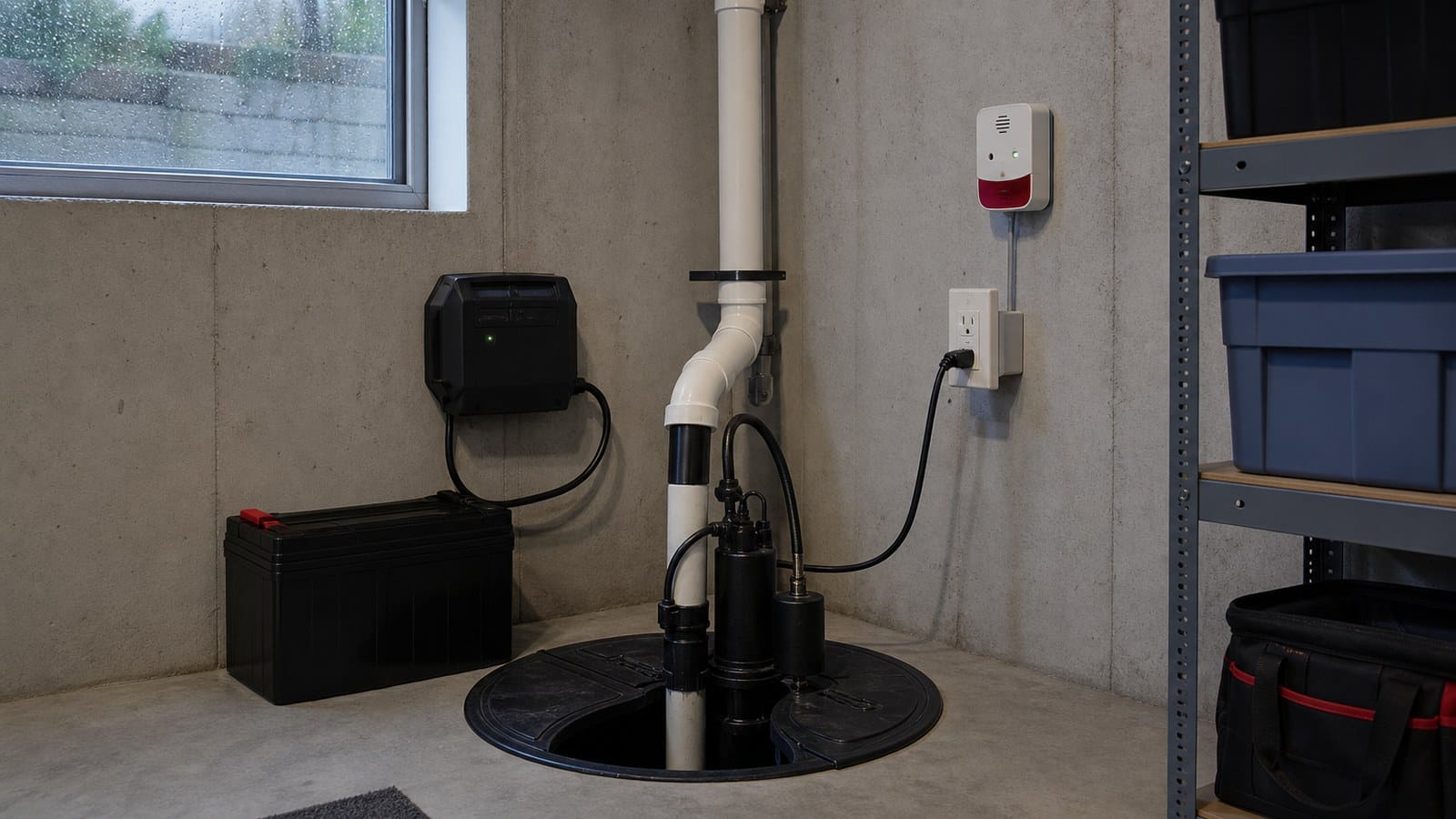
- High-water alarm: Mount a sensor above the primary pump’s normal operating level and place the alarm where it can be heard or monitored remotely.
- Battery-backup pump: Use a listed system with independent pump, float, charger, and battery sized for the expected outage and inflow.
- Water-powered backup: Where permitted and supported by the plumbing system, this can operate during an electrical outage.
- Separate failure paths: Avoid putting the primary pump, backup controller, alarm, freezer, and unrelated basement loads on one downstream GFCI chain.
- Routine testing: Exercise the primary pump, backup pump, alarm, check valve, and GFCI before the wet season and after electrical work.
- Remote notification: Add power-loss and high-water monitoring when the property may be unattended.
What to Specify for a Sump Pump GFCI Receptacle
For a 125 V cord-connected pump, a procurement or installation specification should state:
- 15 A or 20 A receptacle configuration matched to the branch circuit and pump plug;
- listed Class A GFCI protection and current certification record;
- self-test and end-of-life behavior;
- tamper resistance where the adopted code requires it;
- weather-resistant construction only when the location calls for it;
- accessible TEST/RESET position above likely water exposure;
- correct box size, cover plate, grounding, terminal range, and mounting method;
- clear identification of any downstream LOAD protection;
- compatibility with any required AFCI or dual-function protection.
Use Faith Electric’s 15 A versus 20 A GFCI guide to avoid treating the T-slot as a cosmetic upgrade. Faith Electric has manufactured wiring devices since 1996; project buyers should still verify the exact model, listing, rating, markings, and instructions for the intended installation.
Frequently Asked Questions
Can a sump pump be on a non-GFCI dedicated outlet?
Do not assume so. Recent NEC editions specifically require GFCI protection for sump pumps, and basement receptacle rules may apply independently. Check local adoption and amendments.
Should a sump pump have its own circuit?
A dedicated circuit is often a sound design choice and may be required by instructions or local practice. It reduces shared-load and voltage-drop problems, but it does not automatically remove GFCI or AFCI requirements.
Why does the GFCI trip only when it rains?
Heavy rain increases pump runtime and can expose weak seals, wet connectors, cord damage, foundation moisture, or leakage that appears after the motor heats. Treat the pattern as evidence, not as proof the GFCI is defective.
Can I replace the GFCI with a higher-amp model?
Only if the branch circuit, wiring, receptacle configuration, and pump plug support it. A 20 A GFCI on a 15 A circuit is not an upgrade and should not be installed.
Will a battery backup stop GFCI trips?
No. A backup system limits flood consequences when the primary system loses power. It does not repair a ground fault in the pump or circuit.
How often should I test the system?
Follow the GFCI and pump manufacturers’ instructions. A practical maintenance plan tests the GFCI monthly and cycles the pump, alarm, and backup system before heavy-rain seasons and after service work.
Bottom Line
A sump pump generally needs GFCI protection under recent U.S. electrical codes. Repeated tripping is not a reason to defeat the protection; it is a reason to locate the leakage, moisture, equipment, wiring, or device fault. Pair a correctly specified GFCI solution with a dedicated design where appropriate, a high-water alarm, backup pumping capacity, and regular testing so electrical safety and flood protection do not depend on a single component.
Disclaimer: This article is general U.S. safety and procurement information, not project engineering or legal advice. Electrical diagnosis and installation should be performed by qualified personnel. The adopted code, local amendments, pump instructions, and AHJ requirements control.