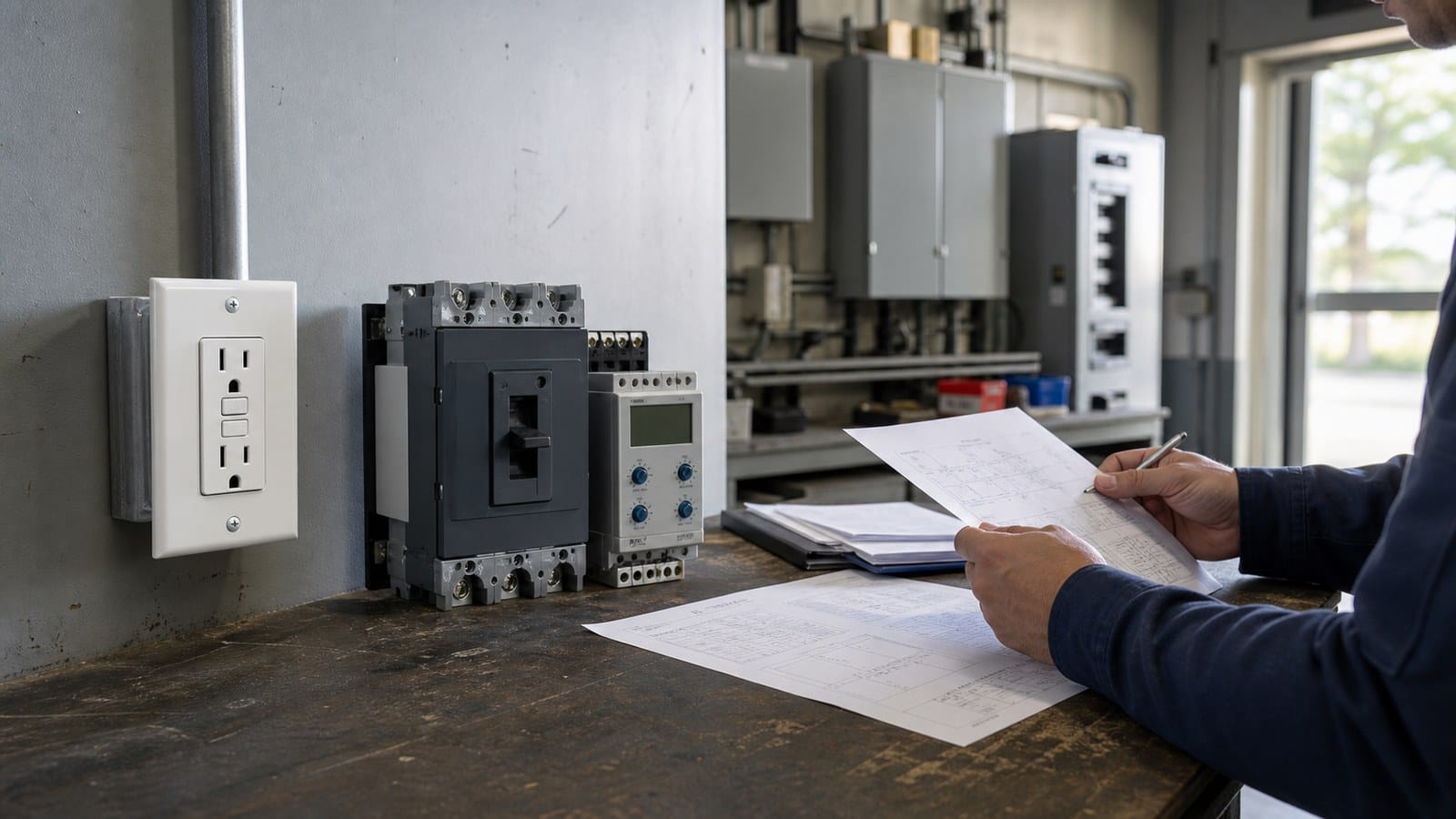
A hospital-grade GFCI is not simply a standard GFCI with a green dot. It must combine two separate qualifications: the receptacle construction and performance requirements associated with hospital use, commonly evaluated under UL 498, and the personnel ground-fault protection requirements for a GFCI, evaluated under UL 943. U.S. buyers should specify it only where the project documents, adopted electrical code, healthcare facility standard, or owner requirements call for hospital-grade devices.
For distributors and project buyers, the practical rule is simple: confirm the application first, then verify the exact model’s certification record, markings, electrical rating, self-test behavior, and required features. A green dot is an identification mark, not a substitute for a listing review.
Hospital-Grade GFCI vs. Standard GFCI at a Glance
| Specification point | Hospital-grade GFCI | Standard listed GFCI |
|---|---|---|
| Ground-fault function | Provides Class A personnel ground-fault protection when listed for the application | Provides the same basic type of Class A personnel ground-fault protection when properly listed and installed |
| Receptacle construction | Additional hospital-use construction and performance requirements, including grounding reliability, assembly integrity, strength, and durability | General-use receptacle construction and performance requirements |
| Typical face marking | Green dot, plus hospital-grade wording where required on the device | No hospital-grade green-dot identification |
| Primary applications | Patient bed locations and other healthcare applications where the governing documents require hospital-grade receptacles | Homes, offices, hospitality, retail, light commercial, and other ordinary GFCI locations |
| Procurement effect | More specific listing, marking, documentation, and durability checks | Application, ampere rating, TR/WR needs, self-test, and listing still require verification |
The word standard in this comparison means a properly listed general-use GFCI receptacle. It does not mean an unlisted, counterfeit, or low-quality device. Both products can be safe and appropriate when their certification, rating, installation, and application match the job.
What “Hospital Grade” Actually Means
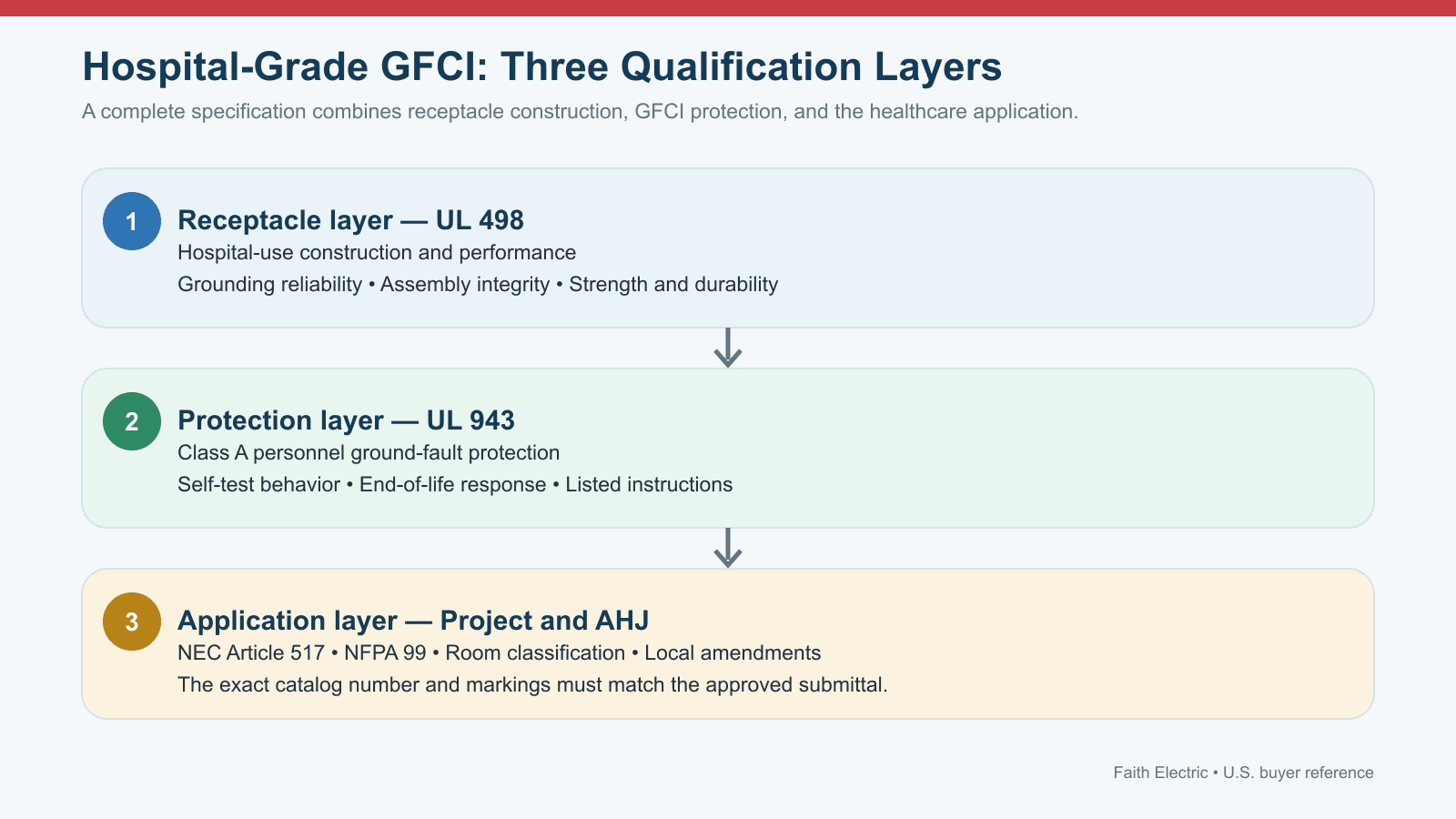
UL Solutions explains that all UL Listed receptacles, including hospital-grade models, must meet the applicable requirements of UL 498, the Standard for Attachment Plugs and Receptacles. Hospital-grade receptacles are also subjected to additional performance requirements for grounding reliability, assembly integrity, strength, and durability. Those added requirements support dependable plug retention and grounding in demanding patient-care environments.
That qualification applies to the receptacle portion of the device. When the same product also provides GFCI protection, its ground-fault function must be evaluated under the applicable GFCI standard. UL Solutions identifies UL 943 as the principal standard for Class A receptacle, portable, and circuit-breaker GFCIs used for personnel protection.
This creates an important purchasing distinction:
- A hospital-grade receptacle is not automatically a GFCI.
- A GFCI receptacle is not automatically hospital grade.
- A hospital-grade GFCI must be evaluated and marked for both functions represented in the specification.
What the Green Dot Tells You—and What It Does Not
The green dot on the face identifies a receptacle as hospital grade so the marking remains visible after the cover plate is installed. Buyers should also expect hospital-grade wording on the device in accordance with the applicable certification and marking rules.
However, a visual mark alone cannot answer every procurement question. The green dot does not by itself confirm:
- the exact certification body and active listing record;
- whether the model is 15 A or 20 A;
- whether the device includes GFCI protection;
- whether it is tamper resistant, weather resistant, isolated ground, or suitable for another special condition;
- whether the catalog number matches the product, packaging, and project submittal.
Do not confuse the green dot with other wiring-device symbols. For example, an orange triangle generally identifies an isolated-ground receptacle. Hospital grade and isolated ground are different attributes; a project may require one, both, or neither.
Where Is a Hospital-Grade GFCI Required?
Healthcare electrical requirements are application-specific. Article 517 of the National Electrical Code and NFPA 99 address healthcare facilities, but not every receptacle in every building with a medical tenant automatically requires a hospital-grade GFCI. Patient bed locations, general-care spaces, critical-care spaces, wet-procedure locations, dental offices, clinics, laboratories, corridors, waiting rooms, and staff areas can have different requirements.
A hospital-grade receptacle may be required at a patient bed location, while GFCI protection depends on the location, voltage, use, and adopted code provisions. In some healthcare applications, an isolated power system or other design may be used under specific rules. The electrical engineer, project specifications, adopted code, and authority having jurisdiction (AHJ) determine the final solution.
For that reason, avoid broad statements such as “all hospital outlets need GFCI” or “a green dot is required everywhere in a clinic.” Both can produce incorrect bids. Ask for the room type, patient-care classification, circuit information, and governing specification before selecting a catalog number.
Does a Hospital-Grade GFCI Protect Better Against Shock?
A listed Class A hospital-grade GFCI and a listed Class A general-use GFCI are designed to perform the same essential personnel ground-fault function: detect an imbalance between the current leaving and returning through the monitored conductors and interrupt the circuit when the device’s trip criteria are met.
The hospital-grade distinction primarily adds requirements around the receptacle’s mechanical integrity, grounding reliability, and durability. It does not mean the device should be used as a substitute for overcurrent protection, surge protection, proper grounding, or the healthcare facility’s required electrical distribution design.
Five Specification Layers U.S. Buyers Should Check
1. Applicable certification and active listing
Verify the exact catalog number in the certification body’s public directory. Check that the listing covers the product category and standards claimed in the submittal. A recognized NRTL mark can come from UL Solutions, Intertek, or another OSHA-recognized laboratory, but the mark, control number, model, and scope must agree. For a deeper explanation, see Faith Electric’s guide to UL Listed vs. ETL Listed GFCI outlets.
2. Electrical configuration
Confirm voltage, ampere rating, NEMA configuration, frequency, conductor range, terminal type, feed-through rating, and maximum load limitations. A 20 A branch circuit does not automatically mean every receptacle face must have a 5-20R T-slot; the project designer should determine the permitted configuration under the adopted code.
3. Hospital-grade identification
Confirm the green-dot marking and the required hospital-grade wording on the physical device and submittal. Packaging artwork should not be treated as the primary proof of a product’s certification status.
4. GFCI self-test and end-of-life behavior
Modern GFCIs include auto-monitoring requirements. Verify how the product indicates a failed self-test or end-of-life condition, whether power is denied when protection is unavailable, and what the instructions require the user to do. Indicator-light conventions vary by manufacturer, so procurement documents should not assume that every red or green LED means the same thing. Faith’s self-test GFCI guide explains this distinction.
5. Independent project features
Hospital grade, GFCI, tamper resistance, weather resistance, isolated ground, alarm contacts, color, face style, and mounting configuration are separate attributes. Build a complete ordering string rather than assuming one feature includes the others.
Buyer Checklist for Hospital-Grade GFCI Receptacles
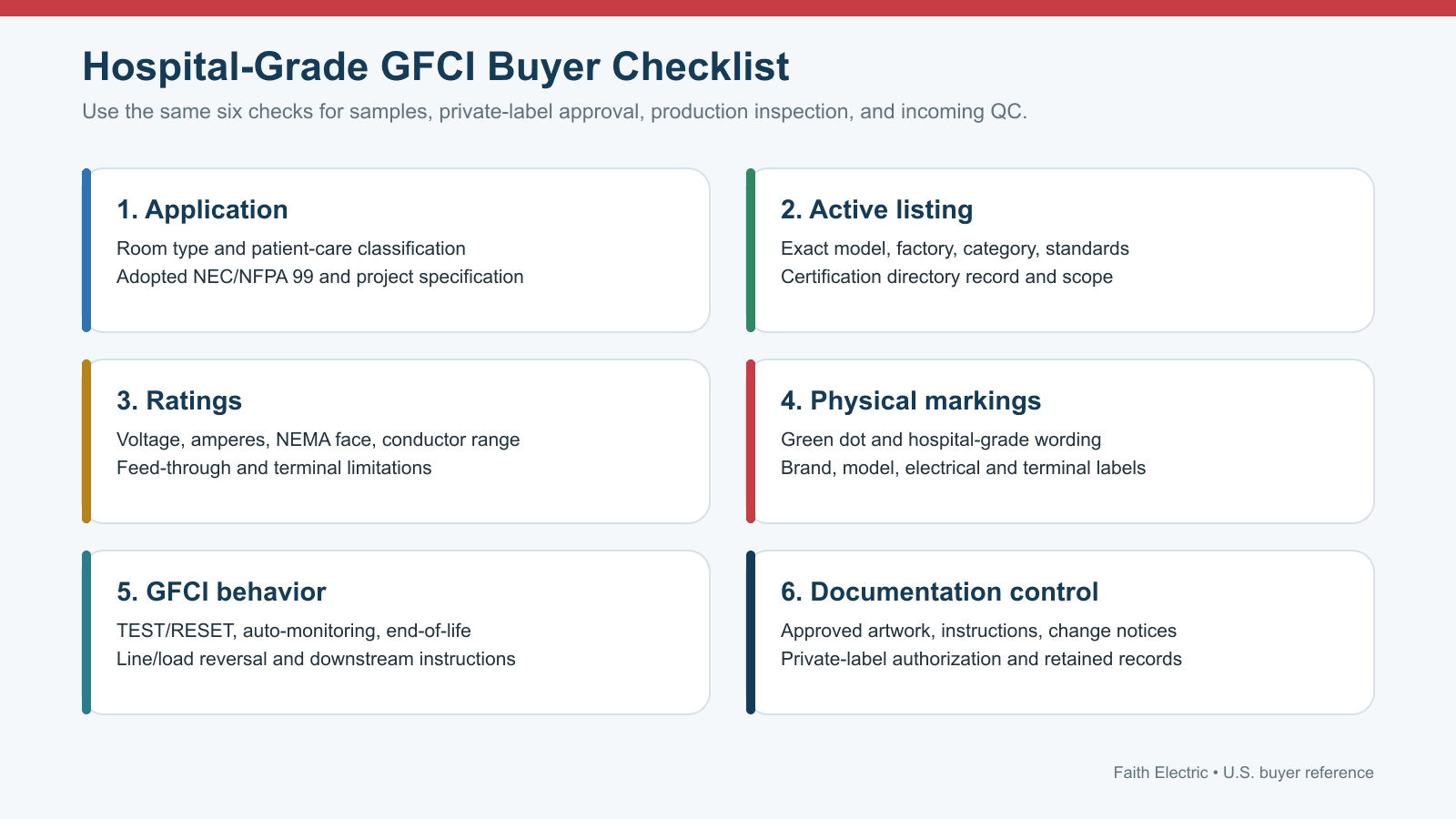
Use this checklist before issuing a purchase order or approving a private-label sample:
- Define the room and use. Record whether the device serves a patient bed location, general-care space, critical-care space, wet area, staff area, or non-patient area.
- Identify the adopted rules. List the NEC edition, NFPA 99 edition if applicable, local amendments, project specification section, and AHJ instructions.
- Verify the certification directory. Match manufacturer, factory, catalog number, product category, standards, ratings, and listing status.
- Review the physical sample. Check the green dot, hospital-grade wording, electrical markings, terminal labels, TEST/RESET operation, and instructions.
- Confirm GFCI behavior. Review self-test interval, status indication, end-of-life response, line/load reversal behavior, and downstream protection instructions.
- Confirm additional attributes. Specify TR, WR, isolated ground, color, plate, alarm, back/side wiring, and packaging requirements separately.
- Control private-label claims. Make sure the brand owner, listed manufacturer, multiple-listing arrangement, model identity, carton, labels, and instruction sheet are aligned before mass production.
- Retain compliance records. Save directory screenshots or reports, approved drawings, change notices, test reports supplied under the certification program, and incoming inspection results.
Common Procurement Mistakes
- Buying by appearance. A green dot printed on a rendering is not evidence of an active hospital-grade listing.
- Treating “commercial grade” as hospital grade. Commercial durability language does not replace the specific hospital-use evaluation and marking.
- Assuming every hospital-grade receptacle is a GFCI. The catalog number must include the required protective function.
- Assuming every healthcare room has the same rule. The patient-care classification and project documents matter.
- Ignoring downstream loads. If feed-through protection is used, the installer must follow the listed instructions and apply required labels.
- Mixing listing files during private labeling. Product, brand, model, factory, markings, and packaging must remain within the authorized certification arrangement.
Questions to Send a Manufacturer Before Ordering
A useful RFQ asks for evidence, not just a “yes” answer. Request the exact catalog number, current certification directory link or file reference, applicable standards and edition, hospital-grade marking photos, electrical ratings, self-test/end-of-life description, line/load reversal response, terminal range, TR/WR/IG options, packaging drawings, instruction sheet, and change-control process.
For private-label programs, also ask who owns the base listing, how the multiple-listing relationship is structured, which brand and model appear in the directory, and how artwork changes are approved. Faith Electric has manufactured wiring devices since 1996; buyers can use the private-label GFCI checklist to organize the OEM review. A current hospital-grade GFCI product page can help define configuration questions, but the final purchase specification should always control.
Frequently Asked Questions
Is a green-dot receptacle always a GFCI?
No. The green dot identifies hospital grade. Look for the TEST and RESET controls, the catalog information, and the certification record to confirm GFCI functionality.
Can a standard GFCI be used in a hospital?
Only where the adopted rules and project specification permit it. A standard GFCI should not replace a required hospital-grade device at a patient-care location.
Are hospital-grade GFCIs required in medical offices?
Not automatically in every room. The answer depends on how the space is classified and on the adopted NEC, NFPA 99, local amendments, design documents, and AHJ interpretation.
Is hospital grade the same as tamper resistant?
No. Hospital grade and tamper resistance are independent attributes. Specify TR separately when required.
Does ETL listing count for a hospital-grade GFCI?
An OSHA-recognized NRTL can certify a product to the applicable U.S. standards, but buyers must verify the exact certification scope, model, markings, and acceptance requirements for the project.
Is a 20 A hospital-grade GFCI always the best choice?
No. Select the receptacle configuration and rating from the branch-circuit design, loads, code, and project documents. A higher ampere marking is not a universal upgrade.
Bottom Line
Choose a hospital-grade GFCI when the application and governing documents require the combination of hospital-grade receptacle performance and GFCI personnel protection. Do not choose it solely because it appears more durable, and do not accept a green dot as the only compliance evidence. The safest procurement path is to verify the active listing, exact model, physical markings, electrical rating, self-test behavior, and room-specific requirements before ordering.
Disclaimer: This article is general U.S. procurement information, not engineering, medical-facility design, or legal advice. The adopted code, NFPA 99 requirements, project specifications, product instructions, and authority having jurisdiction control each installation. Installation and testing should be performed by qualified personnel.