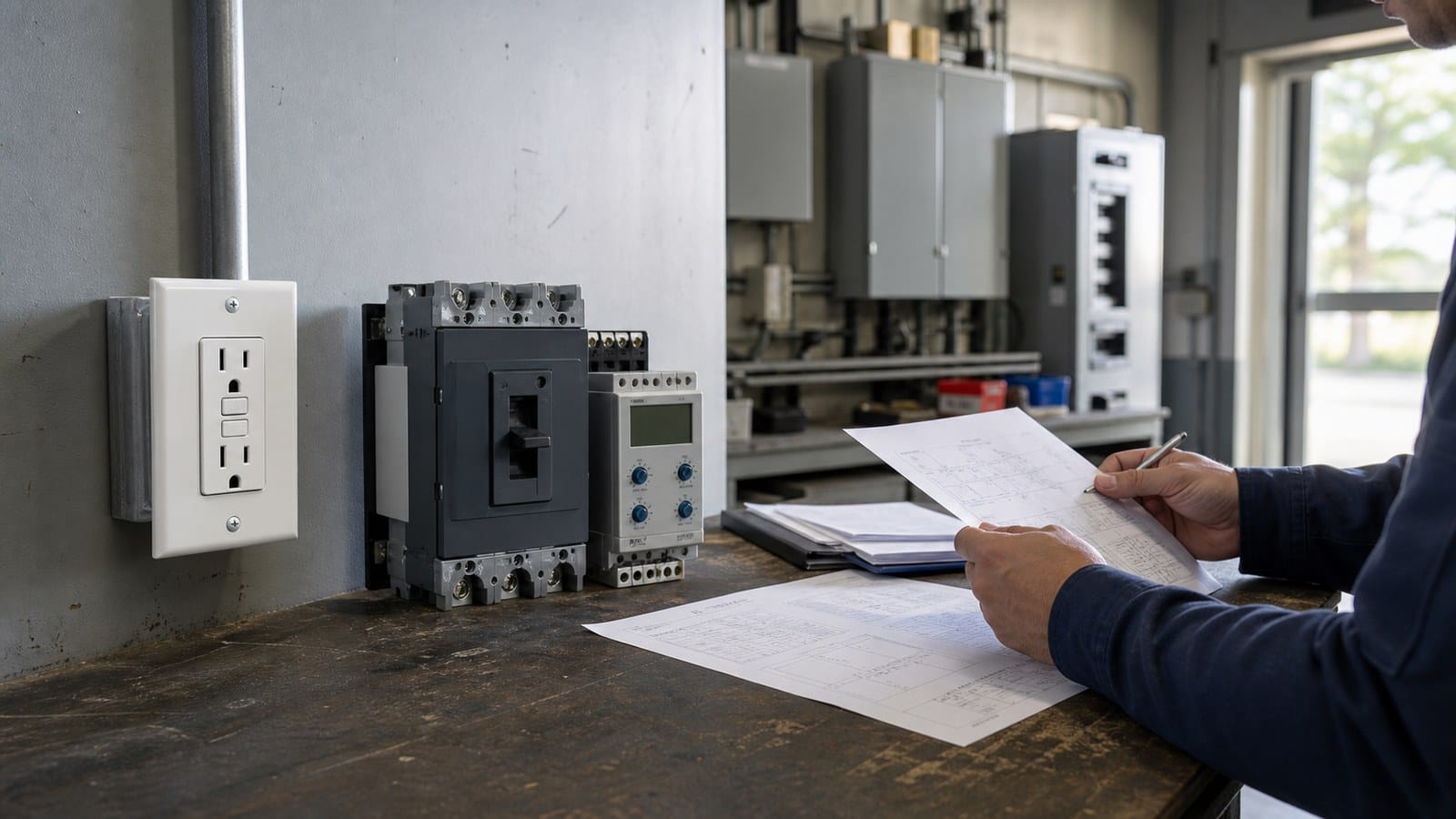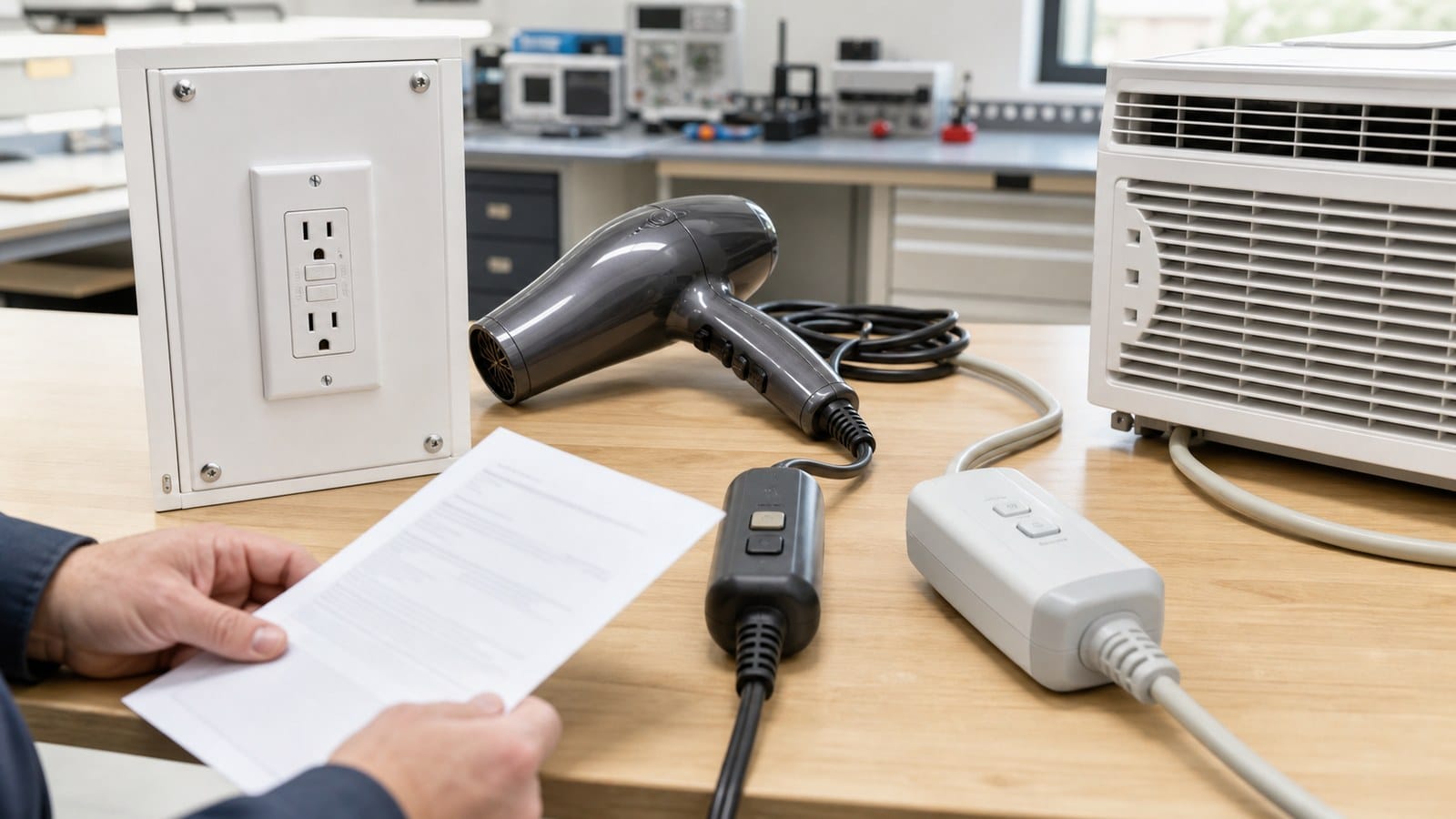
Quick answer: A GFCI outlet does not have one universal expiration date. Online estimates often range from roughly 5 to 25 years, but age alone cannot prove that a device is safe or unsafe. The practical replacement rule is condition-based: test every GFCI after installation, at least monthly, after a power failure, and as the manufacturer instructs. Replace a device that fails its TEST/RESET sequence, cannot restore power, shows damage or overheating, has unreliable plug contacts, or displays an end-of-life condition.
For homes and commercial facilities, the better question is not “Has this GFCI reached a birthday?” It is “Can this exact device still demonstrate its protective function, and is the installation still suitable for the environment?”
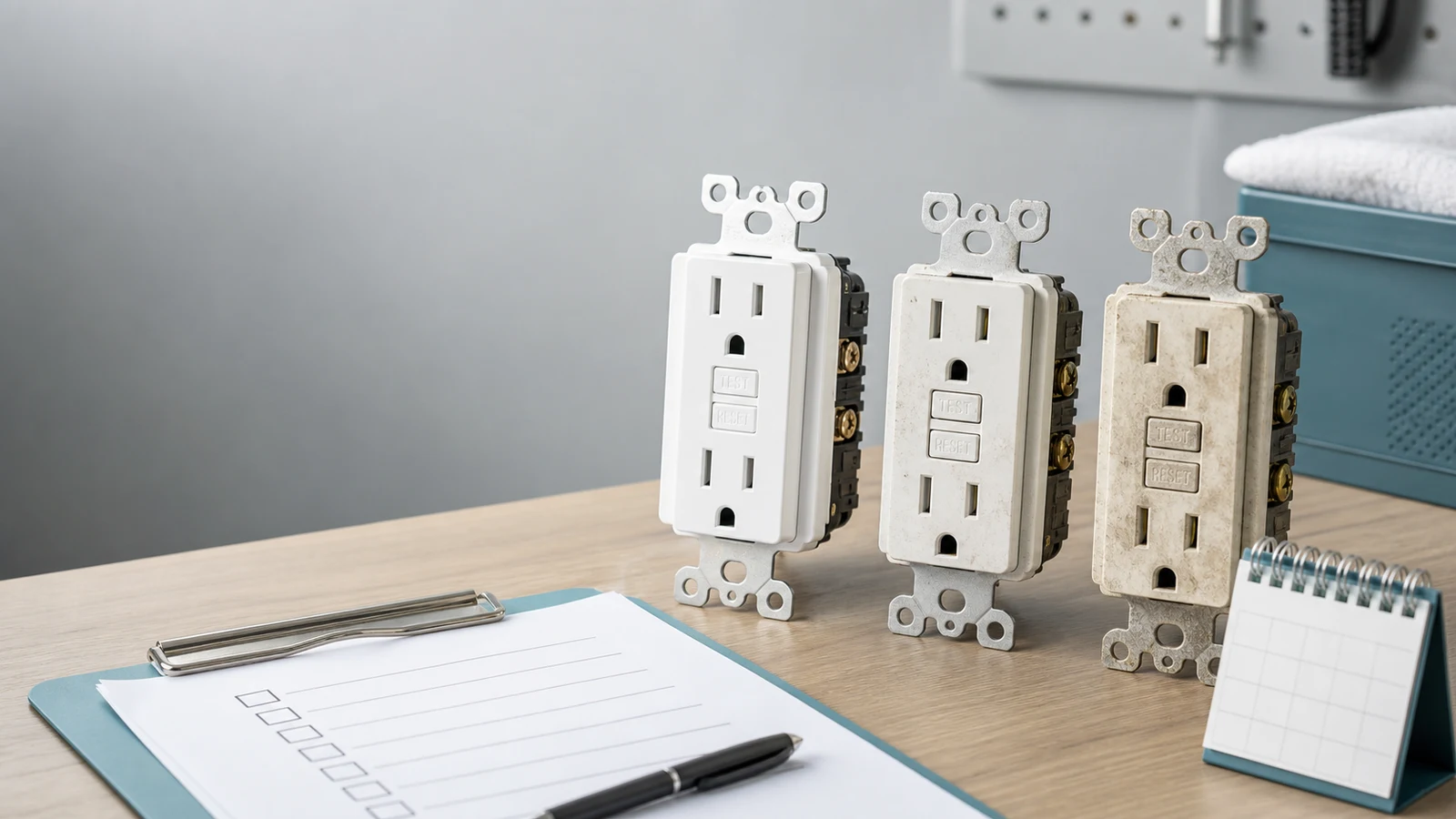
There is no single official replacement age
Search results contain many confident numbers: 5 years, 10 years, 15 years, or 25 years. Those estimates may reflect local service experience, product generations, and installation conditions, but they should not be presented as a universal code rule or manufacturer warranty.
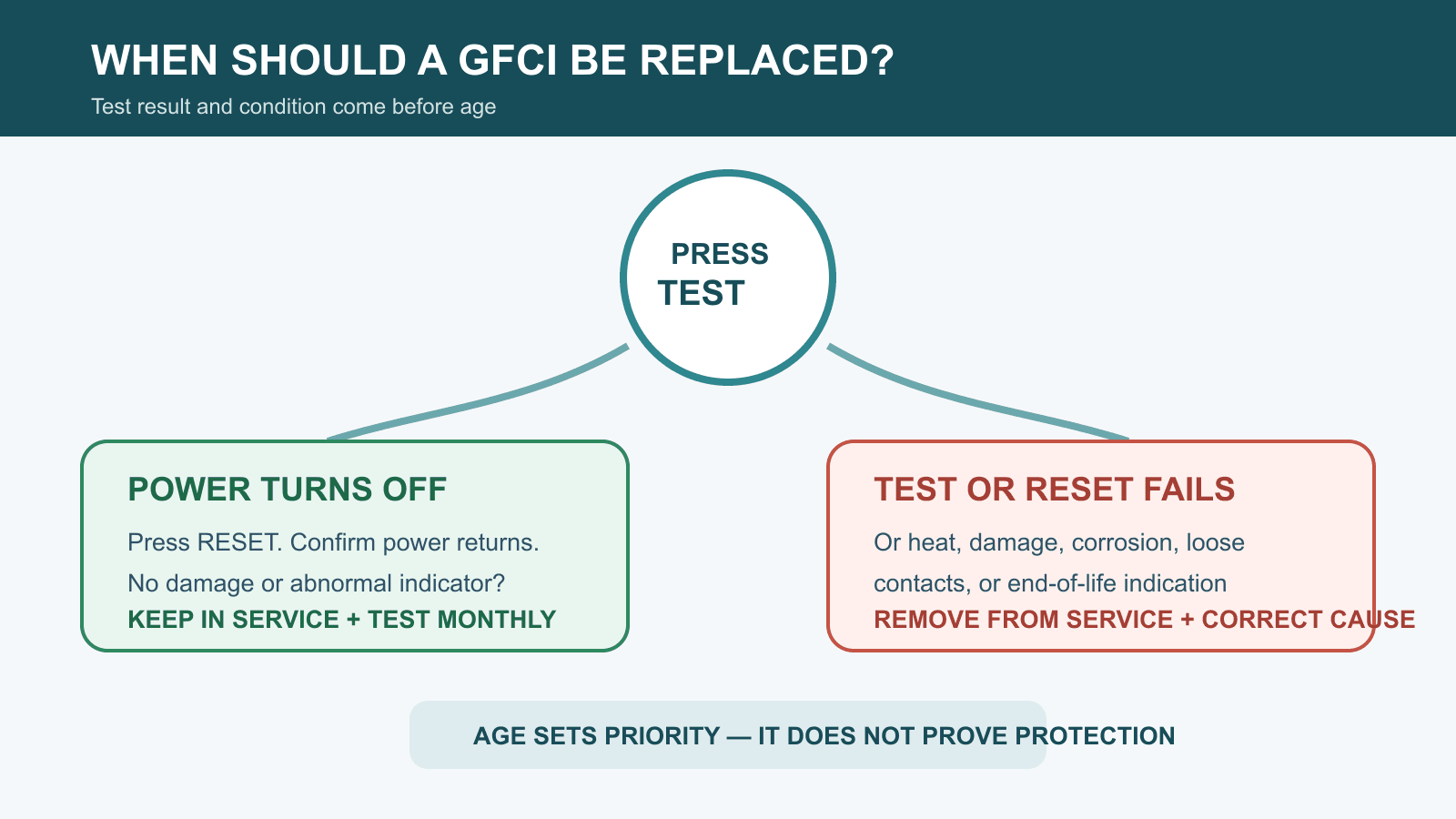
The U.S. Consumer Product Safety Commission focuses on functional testing. Its GFCI fact sheet calls for testing after installation, at least once a month, after a power failure, and according to the manufacturer’s instructions. If the TEST button does not remove power, the GFCI is not working or may be installed incorrectly. If RESET does not restore power, the device should be replaced.
That guidance is more useful than a calendar-only rule because a two-year-old outdoor GFCI exposed to water intrusion may be in worse condition than a much older device in a dry, stable indoor location.
What determines GFCI service life?
Electrical disturbances
Power failures, surges, lightning-related events, switching transients, and repeated faults can stress protective electronics. CPSC specifically recommends a test after a power failure because disturbances can affect a GFCI’s ability to function properly.
Moisture and contamination
Outdoor boxes, garages, basements, laundry areas, kitchens, and washdown locations expose devices to humidity, condensation, dust, salts, and chemicals. A WR-rated receptacle improves resistance to environmental exposure but still needs the correct box, gasket, cover, drainage, and installation.
Heat and connection quality
Loose terminations and worn contacts create heat. Heat accelerates material aging and can damage the device and surrounding conductors. A warm face under a normal modest load, discoloration, a melted smell, or crackling is not normal service aging; it is a stop-use condition.
Mechanical use
Frequent plugging and unplugging wears receptacle contacts. Repeated TEST/RESET operation also exercises the mechanism, but that is necessary maintenance, not something to avoid. A plug that falls out or makes intermittent contact points to replacement even if the GFCI still resets.
Product generation and self-test design
Modern self-test devices periodically monitor key parts of their protective function and may enter lockout or indicate end of life. The indicator pattern is model-specific. Leviton, for example, states that its self-test receptacles still require a manual monthly test. Always use the instructions for the exact product rather than applying another brand’s light chart.
Seven signs a GFCI should be replaced or removed from service
| Condition | Why it matters | Action |
|---|---|---|
| TEST does not cut power | The protective function is not demonstrated | Stop using and replace after checking installation |
| RESET does not restore power | No incoming power, a fault, miswiring, lockout, or device failure may exist | Troubleshoot safely; replace if the device is confirmed faulty |
| End-of-life or fault indicator | Self-test logic has detected a problem | Follow the exact model instructions and replace when directed |
| Cracks, warping, scorching, or discoloration | Physical or thermal damage can compromise insulation and contacts | Switch off the circuit and inspect the box and wiring |
| Buzzing, crackling, heat, or burning odor | Possible loose connection, arcing, or overheating | Disconnect power and call a qualified electrician |
| Loose plug retention or intermittent power | Worn contacts can overheat and interrupt equipment | Replace the receptacle and inspect terminations |
| Water intrusion or corrosion | Moisture can create leakage and damage internal parts | Correct the enclosure problem and replace affected components |
Frequent tripping by itself does not prove that the GFCI is old. A faulty appliance, accumulated leakage, wet wiring, or a downstream problem may be the real cause. Use Faith’s guide to GFCI outlets that keep tripping before blaming the receptacle.
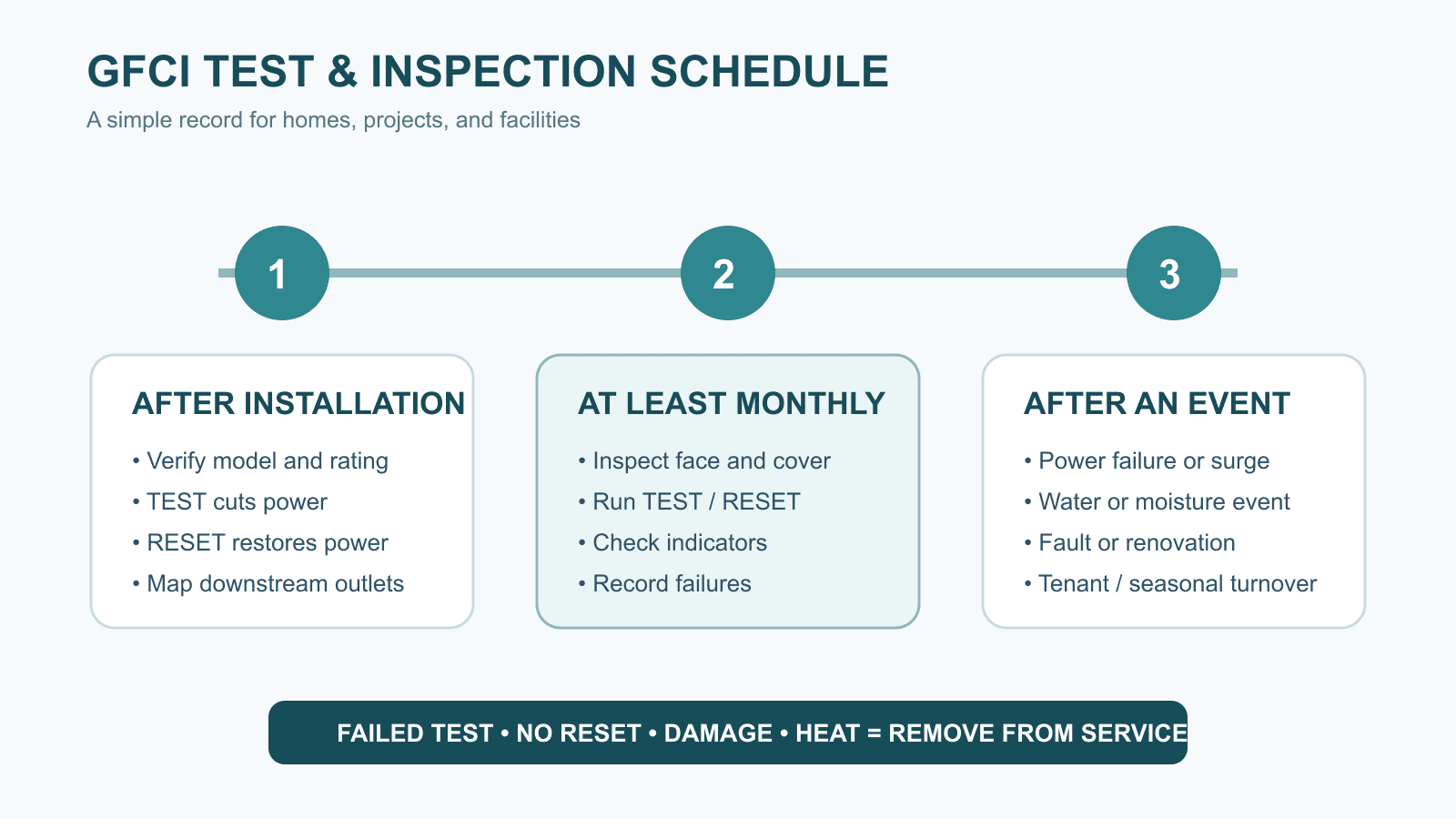
A practical GFCI test schedule
After installation
- Confirm the exact model, rating, and required markings.
- Verify that the circuit and connected loads operate as intended.
- Press TEST and confirm power is removed at the GFCI and every identified downstream receptacle.
- Press RESET and confirm power returns.
- Record which outlets are protected from the LOAD terminals.
- Keep the manufacturer’s instructions with the facility or project record.
At least monthly
CPSC recommends testing every GFCI at least monthly. The Electrical Safety Foundation International (ESFI) likewise says that if the test or reset functions do not work, the GFCI should be replaced. A monthly routine can be brief:
- Look for damage, water, looseness, heat, or an abnormal indicator.
- Plug in a known-working nightlight or lamp when appropriate.
- Press TEST. The connected load should turn off.
- Press RESET. Power should return.
- Record failures and remove failed locations from service.
For self-test products, automatic monitoring does not necessarily replace the user test. Faith’s self-test GFCI guide explains the distinction.
After a power failure or electrical event
Test after an outage, surge event, nearby lightning incident, flooding, equipment fault, renovation, or work on the branch circuit. Also test after a tenant turnover or before reopening a seasonal facility. A device can still deliver power even when its protective function has failed, so “the outlet works” is not a sufficient check.
How facilities should prioritize older GFCIs
A commercial property may have dozens or hundreds of devices. Replacing every unit at the first rumor of a ten-year lifespan can waste budget, while waiting for visible failure can leave gaps. Use a risk-based register.
| Priority | Examples | Maintenance response |
|---|---|---|
| High | Outdoor, washdown, pool/spa support, commercial kitchen, roof, HVAC service, corrosive or high-humidity areas | Frequent visual checks, strict monthly functional tests, rapid correction of enclosure defects |
| Medium | Bathrooms, laundry rooms, garages, unfinished basements, maintenance rooms | Monthly test and condition review; track nuisance trips and moisture events |
| Lower exposure | Dry indoor locations with stable temperature and limited use | Monthly functional test and replacement on failure or damage |
Record device location, model, rating, installation or last-replacement date if known, test result, downstream coverage, environment, observed damage, and corrective action. The date is a planning signal; the test result and condition determine serviceability.
Should you replace all GFCIs during a renovation?
Not automatically, but a renovation is a good inspection point. Replace devices that fail testing, are damaged, lack required features for the remodeled space, or cannot be matched to reliable instructions and listing information. Also review whether current project specifications require TR, WR, self-test, a different ampere configuration, or additional protection locations.
Do not assume that changing the receptacle alone makes the whole installation compliant. The adopted code, branch circuit, box, grounding and bonding, downstream wiring, covers, and connected equipment all matter. Local authorities may enforce a different NEC edition or amendments.
Replacement versus troubleshooting
A low-cost device can tempt people to “swap and see,” but replacement should not hide a circuit problem.
- Replace promptly: failed TEST/RESET operation after power and installation are confirmed, physical damage, poor plug retention, end-of-life indication, corrosion, or thermal damage.
- Diagnose the circuit first: repeated immediate trips, several dead downstream outlets, a problem that began after wiring changes, or tripping linked to rain or one appliance.
- Correct the environment: water entry, a broken in-use cover, poor sealing, condensation, or a non-WR device in a location requiring a WR product.
If your immediate symptom is a button that will not latch, see Faith’s guide: GFCI Outlet Won’t Reset?
How to specify replacement GFCIs for a project
For distributors, contractors, property managers, and OEM buyers, a replacement program should standardize more than face color.
- Match the electrical design. Confirm 15A or 20A configuration, voltage, feed-through rating, conductor range, and wiring method.
- Match the location. Specify TR and WR designations where applicable, plus the correct box, cover, and wall plate.
- Verify the current listing. Search the certification body’s database for the exact model and rating. A logo image or old certificate is not enough.
- Control indicator instructions. Maintenance staff must know what normal, trip, fault, and end-of-life states mean for the selected model.
- Approve labels and documentation. Include wiring diagrams, downstream-protection labels, lot/date traceability, and installation instructions.
- Plan spares. Keep approved replacement stock for critical or high-exposure areas so failed devices are not bypassed while procurement catches up.
Faith Electric has supplied wiring devices since 1996. Buyers can review Faith’s GFCI outlet range and use the contact page to request specifications, samples, packaging options, and project support.
FAQ
Do GFCI outlets expire after 10 years?
There is no universal code rule that every GFCI expires on its tenth birthday. Ten years is a common planning estimate, not a substitute for testing. Follow the exact manufacturer’s instructions and replace any device that fails or shows damage.
Can a GFCI still provide power after its protection fails?
Yes, some failure conditions can leave a receptacle apparently energized without demonstrating proper protection. That is why the built-in TEST button and verification of power loss are important.
Do self-test GFCIs need monthly manual testing?
Follow the model instructions. Manufacturer guidance commonly continues to call for a monthly manual TEST/RESET check even when the device automatically monitors parts of its electronics.
Should I replace a GFCI that trips often?
Not before checking for a real fault. Moisture, a damaged appliance, accumulated leakage, or downstream wiring may be the cause. Replace the GFCI when testing and diagnosis show that the device itself is unreliable.
Why do outdoor GFCIs fail sooner?
They face moisture, condensation, temperature changes, contaminants, UV exposure at covers, and outdoor equipment faults. A WR device and a correct enclosure system reduce risk but still require inspection.
What is the best replacement feature?
No single feature fits every project. A current NRTL listing, correct rating, self-test/lockout behavior, clear indicators, TR or WR features where required, and reliable documentation should be considered together.
The bottom line
Do not manage GFCIs by age alone. Use a documented test schedule, inspect the installation environment, and act on the exact device’s indicators and instructions. Age is most useful for prioritizing unknown or high-exposure inventory. A passed monthly test does not excuse visible heat, corrosion, loose contacts, or enclosure damage, and a young device is not automatically good after a surge or water event. When a GFCI cannot demonstrate both trip and reset functions, remove it from service, correct any circuit or environmental cause, and install a properly specified replacement.
Sources and further reading
- U.S. Consumer Product Safety Commission – GFCI Fact Sheet
- Electrical Safety Foundation International – How to Use GFCIs
- Leviton – Self-Test GFCI Indicators
This article provides general safety, maintenance, and procurement information. It is not a substitute for the adopted electrical code, the manufacturer’s instructions, or an inspection by a qualified electrician.