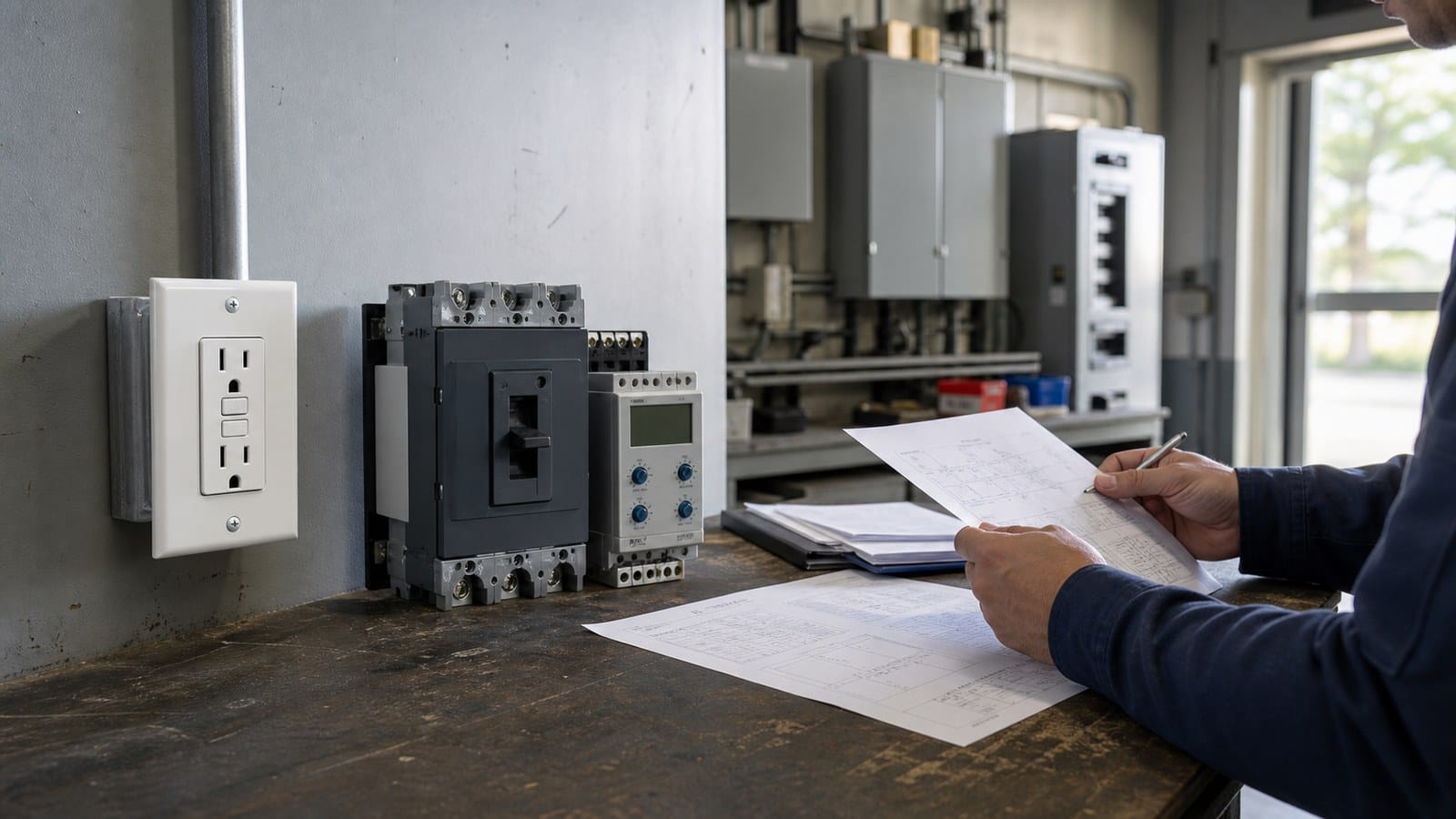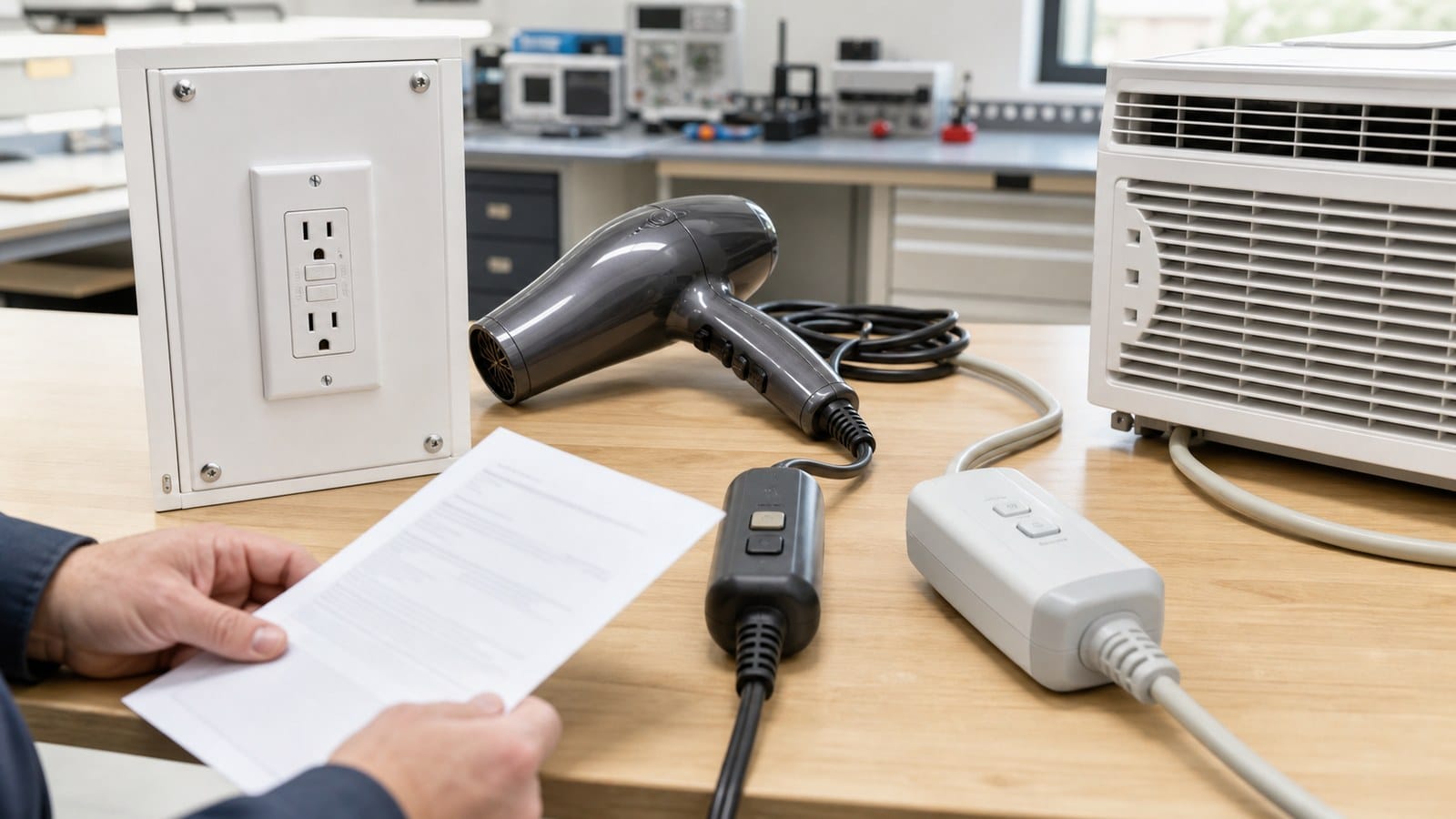
Quick answer: A GFCI outlet that will not reset usually has no incoming power, is still detecting a fault, has a wiring problem, or has reached a condition where its reset-lockout or self-test function will not allow power to return. Unplug connected equipment, reset the circuit breaker fully OFF and then ON, and try the RESET button once. If the device trips again, will not latch, is wet, hot, damaged, buzzing, or recently rewired, stop and have the circuit checked by a qualified electrician.
Do not defeat the GFCI, hold the button in, or replace it with a standard receptacle just to restore power. A refusal to reset is a safety signal, not merely an inconvenience.
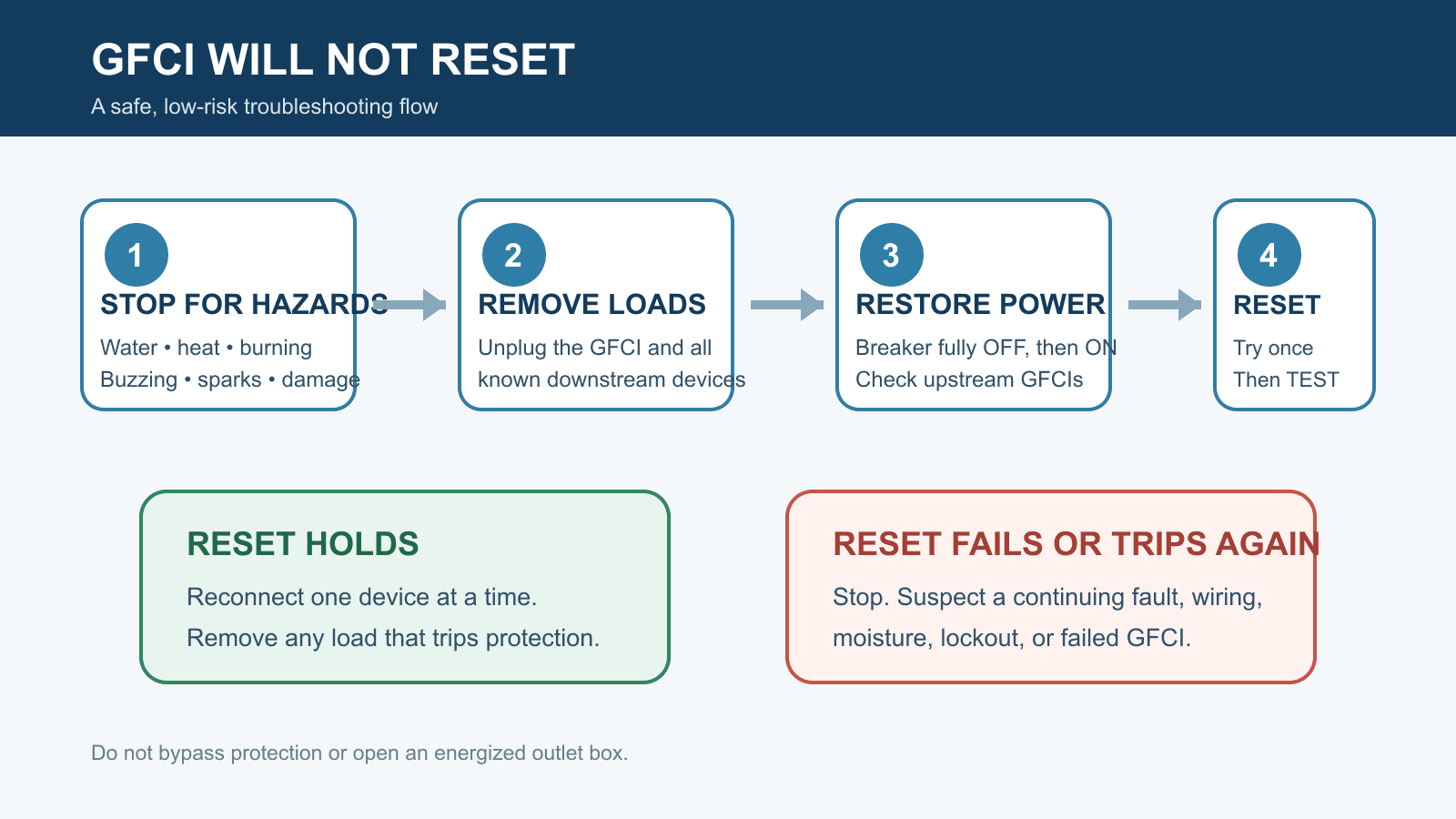
What does “won’t reset” actually mean?
People use the same phrase for several different symptoms. Separating them prevents wasted troubleshooting and unsafe assumptions.
| What you observe | Likely direction | First safe check |
|---|---|---|
| RESET button will not stay in | No line power, continuing fault, reset lockout, wiring error, or failed GFCI | Unplug loads and reset the breaker fully |
| RESET clicks, but the receptacle is still dead | Incorrect wiring, damaged contacts, upstream problem, or a protected downstream outlet issue | Test with a known-working lamp and check other GFCIs |
| RESET holds, then trips immediately | Active leakage, moisture, damaged equipment, or downstream fault | Unplug everything on the protected circuit |
| TEST button does nothing | Loss of power, incorrect installation, or failed protection function | Stop using the outlet until it is evaluated |
| Several outlets are dead | One upstream GFCI may protect multiple downstream receptacles | Locate and check every GFCI on the circuit |
The U.S. Consumer Product Safety Commission (CPSC) says a GFCI should be tested after installation, at least monthly, after a power failure, and according to the manufacturer’s instructions. In the CPSC test procedure, failure to restore power after RESET is a replacement signal. See the CPSC GFCI fact sheet.
Six common reasons a GFCI outlet will not reset
1. No power is reaching the LINE terminals
Many modern GFCIs need incoming power before the internal mechanism can latch. A breaker can be tripped even when its handle does not look fully OFF. Turn the correct breaker firmly to OFF and then back to ON. If it trips again, leave it off and call an electrician.
The loss of power may also be upstream from the visible GFCI. A loose connection, failed receptacle, service switch, or another tripped GFCI can interrupt the feed. Bathrooms, garages, basements, kitchens, laundry areas, and outdoor receptacles are sometimes linked in ways that are not obvious from room boundaries.
2. A connected appliance still has leakage current
A GFCI compares current leaving on the ungrounded conductor with current returning on the neutral. If some current takes an unintended path, the device opens the circuit. Motors, heaters, pumps, refrigerators, pressure washers, extension cords, and outdoor lighting can develop leakage because of moisture, insulation damage, or component wear.
Unplug everything from the GFCI face and from known downstream receptacles. If the GFCI resets with all loads removed, reconnect one item at a time. Stop using any device that repeatedly causes a trip. Do not move suspect equipment to an unprotected outlet as a workaround.
3. Moisture is inside a receptacle, box, plug, or connected device
Rain is not the only source. Condensation, a leaking hose bib, washdown, a wet extension-cord connection, damp landscape lighting, or a poorly sealed wall penetration can create a conductive path. A weather-resistant (WR) receptacle is designed for better resistance to environmental exposure, but it is not waterproof and cannot compensate for a bad box, cover, gasket, or drainage path.
If the outlet or enclosure is visibly wet, do not keep resetting it. Disconnect the circuit at the breaker and have the complete assembly inspected. Faith’s guide to WR versus TR GFCIs explains why environmental rating and tamper resistance solve different problems.
4. LINE and LOAD conductors are reversed or mixed
This is especially likely when a new GFCI has never worked correctly. LINE receives power from the panel. LOAD is optional and supplies GFCI protection to downstream outlets. The terminals are not interchangeable. Modern devices may refuse to reset when miswired.
If the problem began immediately after replacement, stop and compare the installation with the device instructions. Do not identify conductors by color alone or move wires while energized. See Faith’s LINE versus LOAD guide for the concept, then use a qualified electrician when circuit identification is uncertain.
5. Reset lockout or end-of-life logic is doing its job
Modern self-test GFCIs monitor their protection electronics. A reset-lockout feature can block power when the device is miswired, cannot provide ground-fault protection, or detects an unsafe condition. Leviton’s manufacturer guidance describes no incoming power, a continuing fault, incorrect wiring, and device damage as common reasons for lockout. See How to Reset a GFCI Outlet After Lockout.
Indicator colors and behavior vary by manufacturer and model. Do not assume that green, red, amber, dark, steady, or flashing means the same thing on every product. Read the markings and instructions for the exact model. Faith’s GFCI status indicator guide gives a practical framework.
6. The GFCI or its terminations have failed
Internal contacts, electronics, button mechanisms, and terminals can be damaged by surges, heat, corrosion, repeated use, or poor connections. Warning signs include discoloration, cracking, loose plug retention, intermittent power, heat, buzzing, arcing, or a burning odor. These symptoms require more than another press of RESET.
A failed GFCI may still pass power like an ordinary receptacle, which is why functional testing matters. If the TEST function does not cut power, remove the device from service and replace it after the circuit is checked.
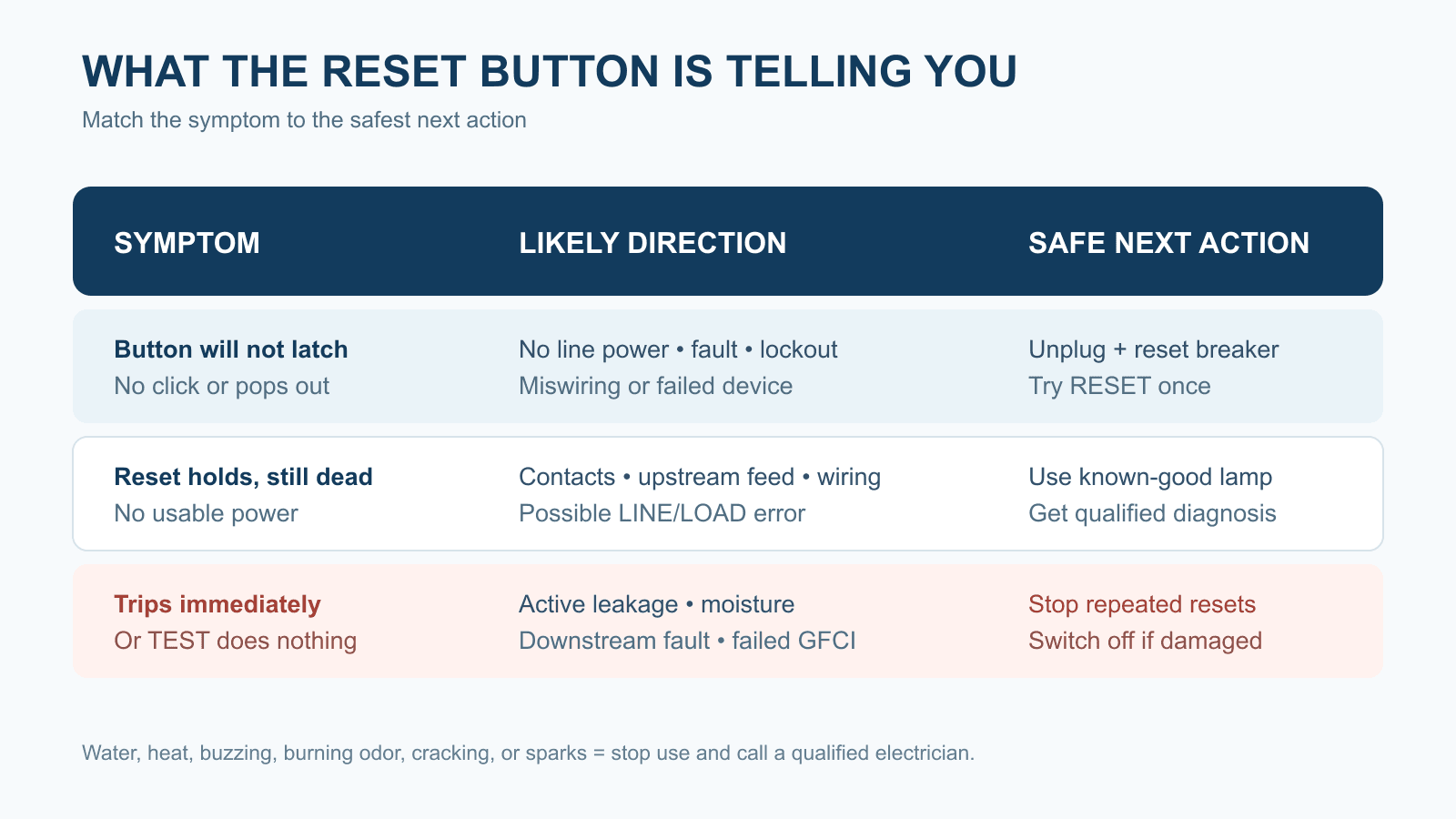
A safe troubleshooting sequence
The order matters. Start with observations that do not require removing the faceplate or touching conductors.
- Stop for danger signs. If you see water, scorching, melted plastic, sparks, smoke, heat, or hear buzzing or crackling, switch the circuit off and call a qualified electrician.
- Unplug all visible loads. Include equipment connected to known downstream outlets, not just the two receptacle openings on the GFCI face.
- Reset the breaker correctly. Move the suspected breaker fully to OFF, then back to ON. Do not repeatedly reset a breaker that trips again.
- Look for another GFCI. Check the garage, exterior, basement, bathrooms, laundry, and kitchen. One upstream device may control several ordinary-looking outlets.
- Inspect without opening the box. Look for moisture, damage, a loose face, or an indicator condition described in the manufacturer’s instructions.
- Press RESET once. Use firm pressure. If it does not latch, do not hold it in or repeat the attempt indefinitely.
- Verify power with a simple load. A known-working lamp is clearer than assuming a phone charger or appliance is good.
- Use the built-in TEST button. Power should turn off, and RESET should restore it. A plug-in tester does not replace the built-in test and may not behave as expected on an ungrounded circuit.
- Reconnect loads one at a time. A device that repeatedly trips GFCI protection needs repair or replacement.
- Escalate when the fault remains. Hidden downstream wiring, LINE/LOAD identification, insulation damage, and energized testing belong to a qualified person.
What not to do
- Do not replace a required GFCI with a standard receptacle.
- Do not tape or hold the RESET button in.
- Do not bypass the LOAD protection to conceal a downstream problem.
- Do not assume a breaker is good because the handle looks ON.
- Do not use a different unprotected outlet for equipment that is tripping GFCIs.
- Do not open a wet box or move conductors while the circuit is energized.
- Do not assume the absence of an equipment ground prevents a GFCI from operating. GFCI shock protection and equipment grounding perform different functions.
Does a GFCI need a ground wire to reset?
Not necessarily. A Class A GFCI detects imbalance between the current paths through hot and neutral; its protective function does not depend on an equipment grounding conductor. The NEC permits certain replacements of older nongrounding receptacles with GFCI protection when required labels are applied. However, a GFCI does not create an equipment ground, and some plug-in testers use the ground path to simulate a fault, so their test button may not trip an ungrounded installation.
If a GFCI on a two-wire circuit will not reset, do not add a neutral-to-ground jumper. A “bootleg ground” is unsafe. Have the circuit identified and labeled correctly.
When replacement is the right next step
Replacement is reasonable when the device fails its built-in test, cannot reset after power and external loads are checked, has physical damage, has been exposed to water, or has unreliable buttons or contacts. The circuit should still be evaluated when the cause is not clear. Installing a new device on a wet box, active downstream fault, or incorrect wiring will not solve the underlying problem.
Faith’s GFCI replacement guide covers the replacement workflow. Electrical work should follow the adopted code, manufacturer instructions, and local licensing rules.
How to choose the replacement GFCI
| Decision | What to verify | Why it matters |
|---|---|---|
| 15A or 20A configuration | Branch-circuit rating, receptacle configuration, wiring, and project specification | Prevents a mismatched device selection |
| Self-test and reset lockout | Model instructions and indicator behavior | Supports ongoing monitoring and fail-safe response |
| TR designation | Dwelling-unit and project requirements | Adds internal shutters for child-access protection |
| WR designation | Outdoor or damp/wet exposure and full enclosure system | Matches environmental conditions |
| Certification | Current listing for the exact model and rating from an OSHA-recognized NRTL | Supports inspection, acceptance, and traceability |
| Downstream protection plan | Which outlets are connected to LOAD and how they are labeled | Reduces troubleshooting confusion later |
For project and distributor orders, compare the device, carton, instructions, model number, and certification record as one controlled package. Faith Electric has supplied wiring devices since 1996 and supports GFCI outlet selection for North American applications.
FAQ
Why will my GFCI reset button not stay in?
The device may have no incoming power, may still detect leakage, may be miswired, or may have entered reset lockout or failed internally. Unplug loads, reset the breaker fully, and try once. If the button still will not latch, stop and have the circuit checked.
Why does the GFCI reset but still have no power?
Possible causes include failed contacts, wrong LINE/LOAD connections, loss of upstream power, or a wiring problem. Confirm with a known-working lamp and do not assume the connected appliance is good.
Can another GFCI cause this outlet to be dead?
Yes. An upstream GFCI can protect multiple downstream receptacles. Search nearby wet-area, garage, basement, and outdoor locations for another tripped device.
Should I keep pressing RESET?
No. One reset attempt after removing loads is reasonable. Repeated immediate tripping indicates a fault or a failed device that needs diagnosis.
Will a new GFCI fix the problem?
Only if the old device itself is the cause. A new GFCI will not correct water intrusion, an appliance fault, damaged downstream wiring, or incorrect installation.
When should I call an electrician?
Call when the outlet is wet, hot, damaged, buzzing, sparking, recently rewired, trips with no loads, will not reset after basic checks, or when identifying LINE and LOAD requires opening the box.
Sources and further reading
- U.S. Consumer Product Safety Commission – GFCI Fact Sheet
- Leviton – How to Reset a GFCI Outlet After Lockout
- Electrical Safety Foundation International – How to Use GFCIs
This article provides general safety and product-selection information. It is not a substitute for the adopted electrical code, the manufacturer’s instructions, or an inspection by a qualified electrician.