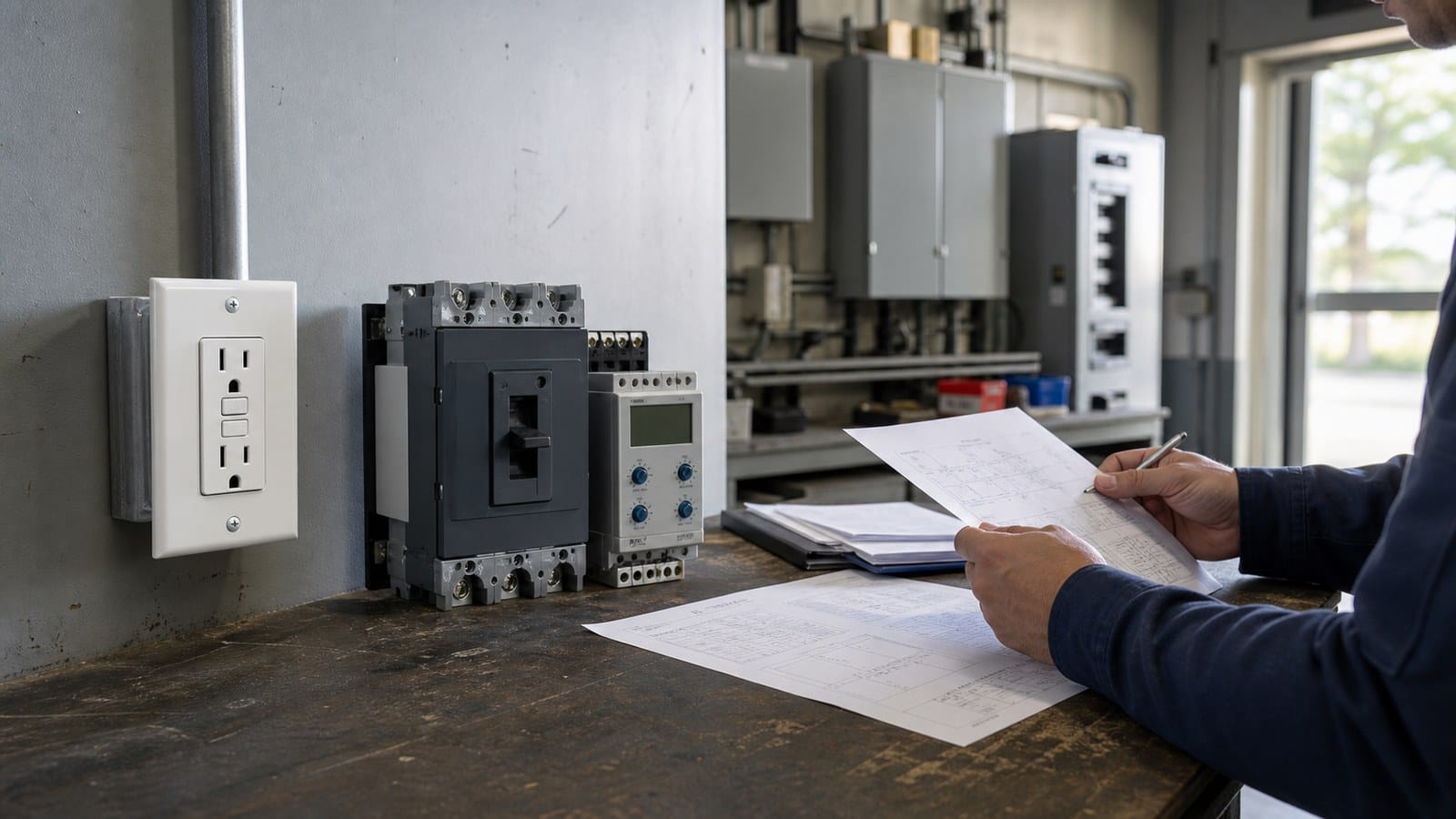
A GFCI, ALCI and LCDI are not interchangeable names for the same device. A GFCI protects people on a branch circuit or receptacle by detecting an imbalance between current leaving and returning. An ALCI is built into certain appliance cords—most visibly hair-care appliances—and responds to appliance leakage conditions. An LCDI monitors leakage associated with a power-supply cord and is commonly used with room air conditioners. The correct choice depends on what is being protected, where the protective function is located, the applicable product standard and the instructions for the complete product.
That distinction matters to importers and private-label buyers. A test/reset module on a cord may resemble a portable GFCI, yet its marking and certification category can be different. Specifying “a safety plug” without the device type, standard, rating and end-product application leaves too much room for error.
How this article was prepared: Faith Electric’s editorial team used AI-assisted drafting to organize the cited CPSC and UL Solutions materials, then checked each device description against those sources. No laboratory testing, product certification, manufacturer approval, licensed-electrician review, or AHJ approval is claimed.
Quick comparison
| Device | Primary location | Typical application | Core purchasing question |
|---|---|---|---|
| GFCI | Receptacle, circuit breaker or portable assembly | Building circuits, construction power and locations where installation rules require GFCI protection | Is the device listed and rated for the actual branch circuit and installation? |
| ALCI | Appliance attachment plug or cord set | Hair dryers and other defined personal-care appliance applications | Is the protective plug evaluated as part of the appliance system and identified for that use? |
| LCDI | Power-supply cord | Room air conditioners and similar cord-connected equipment | Does the complete cord set match the equipment load, plug pattern and end-product listing? |
The table is a routing tool, not permission to substitute one device for another. The product listing, markings and instructions control the final selection.
What a GFCI actually protects
A Class A GFCI compares current in the ungrounded and grounded circuit conductors. When enough current takes an unintended path—possibly through a person—the device opens the circuit. The U.S. Consumer Product Safety Commission describes receptacle, circuit-breaker and portable GFCI forms and recommends routine testing.
The important procurement point is that “GFCI” describes a protective function, not one physical package. A project can use:
- a GFCI receptacle at the point of use;
- a GFCI circuit breaker at the panel;
- an upstream GFCI device protecting downstream outlets; or
- a portable GFCI assembly where permanent protection is impractical.
The correct arrangement depends on the locally adopted electrical code, accessibility of the test/reset control, panel compatibility, environmental exposure and manufacturer instructions. For a broader location-based overview, see Faith Electric’s GFCI outlet requirements guide.
UL Solutions identifies UL 943 as the standard associated with GFCIs. Certification should be checked against the precise model—not merely a logo printed on a carton. UL Product iQ allows searches by company, model, file number and product category.
A GFCI is not a substitute for grounding
GFCI protection can reduce shock risk even on certain ungrounded replacement installations, but it does not create an equipment-grounding conductor. It also does not provide the same function as overcurrent protection, surge protection or arc-fault protection. A combined product may perform more than one function, but each function must be identified and evaluated.
What an ALCI does
An appliance leakage-current interrupter is associated with a cord-connected appliance rather than the building’s general branch-circuit protection. Hair dryers are the familiar example: the protective module is integrated into the attachment plug and includes test/reset controls.
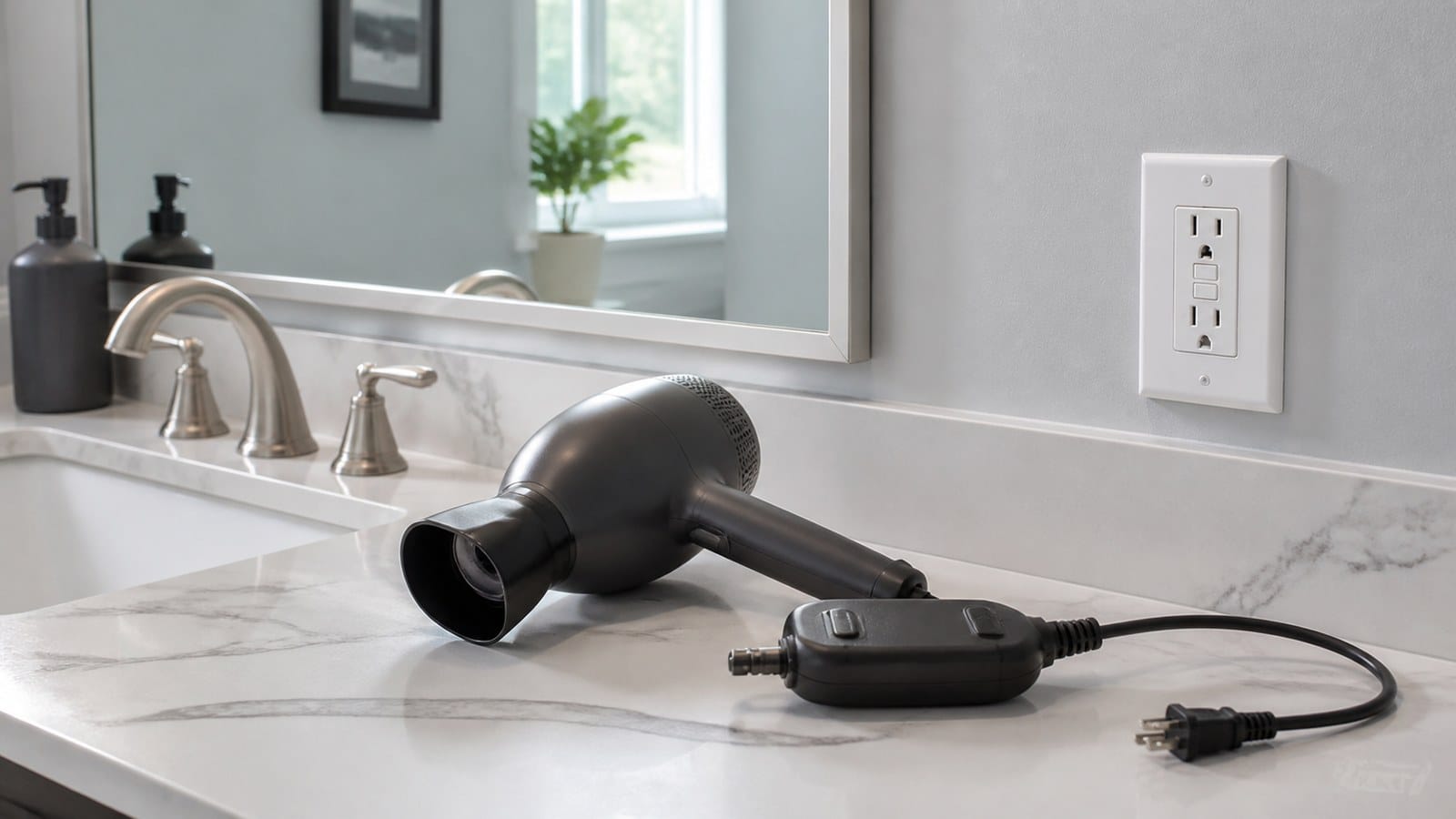
An ALCI is intended to respond to leakage conditions associated with the appliance and its cord. It is not a reason to omit GFCI protection where the adopted installation code requires GFCI protection for the receptacle or circuit. UL’s technical material explicitly cautions that an ALCI is not intended to replace a GFCI required by the NEC.
For a buyer, the mistake is treating the ALCI module as a stand-alone accessory. The plug, cord, appliance load, strain relief, enclosure, test/reset behavior and instructions form an approval set. A module that is acceptable for one hair appliance is not automatically acceptable for another wattage, cord construction or enclosure design.
ALCI procurement fields
Ask the supplier for the following information before approving a sample:
- End-product appliance category and intended use.
- Rated voltage, frequency and current of the complete appliance.
- Plug configuration and polarization.
- Cord type, conductor size, length and temperature rating.
- Protective-device marking and applicable standard.
- Certification file and exact model relationship.
- Test/reset operating instructions.
- Reset behavior after loss and restoration of supply power.
- Production traceability markings.
- Change-control procedure for the cord, plug and protective components.
Do not approve a drawing that lists only shell dimensions and color. The safety function depends on the complete electrical construction.
What an LCDI does
A leakage-current detection and interruption device is commonly incorporated into the supply cord of a room air conditioner. Its purpose is tied to leakage associated with the cord assembly. Damage from furniture, repeated bending, heat or installation stress can create a condition that is not addressed merely by placing a conventional fuse in the appliance.

UL Solutions includes LCDI devices among protective technologies used for air-conditioning equipment. Again, the end product is decisive. An LCDI cord for one air-conditioner family cannot be selected only because the plug fits and the current rating appears sufficient.
Why cord matching is critical
The buyer should match at least:
- equipment model and electrical rating;
- plug configuration;
- conductor gauge and cord length;
- LCDI trip and reset characteristics;
- ambient and temperature conditions;
- enclosure and strain-relief construction;
- certification relationship to the end product; and
- installation and replacement instructions.
A replacement cord should be the model specified by the equipment manufacturer or a formally evaluated alternative. Field-splicing a different protective plug onto a damaged air-conditioner cord is not a purchasing shortcut.
Why the devices are often confused
All three may use test/reset controls and may interrupt power after detecting an abnormal leakage condition. Product listings on marketplaces also use loose phrases such as “GFCI plug,” “leakage protector” or “safety breaker.” Those similarities are visual and marketing-level; they do not establish equivalence.
Three questions separate the categories quickly:
- What is the protected system? A building circuit, a specific appliance or a power-supply cord?
- Where is the protection located? Panel, receptacle, portable enclosure or attachment plug?
- Which certification record covers the exact construction? The device alone, the cord set or the complete end product?
If a supplier cannot answer all three with documents tied to the quoted model, the specification is not ready for approval.
Buyer decision process
Step 1: Define the product, not the nickname
Write the end use in plain language: “self-test 20 A, 125 V GFCI receptacle for a commercial kitchen,” “protective attachment plug for a 1,875 W hair dryer,” or “LCDI cord set for a specified room air-conditioner model.” This prevents the phrase “safety plug” from becoming the whole requirement.
Step 2: Identify the governing installation and product documents
For a wiring device, check the adopted electrical code, UL 943 scope, certification record and installation instructions. For an appliance protective plug or cord, check the appliance standard, end-product listing and model-specific bill of materials.
Step 3: Verify ratings as a set
Voltage, current, frequency, plug pattern, conductor size, load type and environmental conditions must agree. A current rating by itself does not establish suitability.
Step 4: Verify the certification trail
Search the certification database using the exact model and company. Compare the certified model description with the sample marking, technical drawing and packaging. If a private label is used, confirm the authorized listing or multiple-listing relationship rather than assuming the factory’s base file automatically covers the buyer’s brand.
Step 5: Lock change control
Define which changes require written approval: protective module, sensing components, relay, PCB, cord material, conductor size, plug blades, enclosure resin, labels and instructions. Safety-device sourcing fails when purchasing treats electrically significant parts as interchangeable commodities.
Specification table for RFQs
| Field | What to record |
|---|---|
| Product type | GFCI receptacle/breaker/portable unit, ALCI plug or LCDI cord set |
| End use | Building circuit, named appliance category or exact equipment model |
| Electrical rating | Voltage, current, frequency, phase where applicable |
| Connection | Receptacle configuration, plug pattern, cord and terminals |
| Protective behavior | Device category, test/reset operation and reset mode |
| Standard/listing | Applicable standard, certifier, file number and exact model |
| Environment | Indoor/outdoor, moisture, temperature and enclosure requirements |
| Markings | Rating, device type, certification mark, traceability and warnings |
| Instructions | Installation, testing, replacement and end-product limitations |
| Change control | Components and documents requiring buyer approval |
For purchasing, treat the protection module, cord or receptacle, ratings, certification record, markings and instructions as one approval set.
Common specification failures
Calling every test/reset plug a GFCI. The label can lead the engineering team toward the wrong standard and test program.
Checking only the certification logo. A genuine mark does not prove that the quoted model or private-label identity is covered.
Ignoring the end product. ALCI and LCDI constructions are closely tied to the appliance or equipment they serve.
Assuming upstream protection changes the appliance listing. Building-circuit GFCI protection and appliance-integrated protection address related but distinct requirements.
Approving substitutions by price and amperage. Protective electronics, cord construction and reset behavior can change while the headline rating remains the same.
Sources and references
- U.S. Consumer Product Safety Commission, GFCI Fact Sheet, accessed August 27, 2026.
- UL Solutions, Arc Fault Circuit Interrupter Device Testing and Certification, including LCDI application information, accessed August 27, 2026.
- UL Solutions, Understanding Ground Fault and Leakage Current Protection, accessed August 27, 2026.
- UL Solutions, Product Sourcing and Certifications Database, accessed August 27, 2026.
- NFPA, NFPA 70, National Electrical Code; use the edition adopted by the project jurisdiction.
*This article provides general product-selection information, not installation approval or legal advice. Follow the locally adopted code, the product listing and the manufacturer’s instructions. Electrical installation and diagnosis should be performed by qualified persons.*