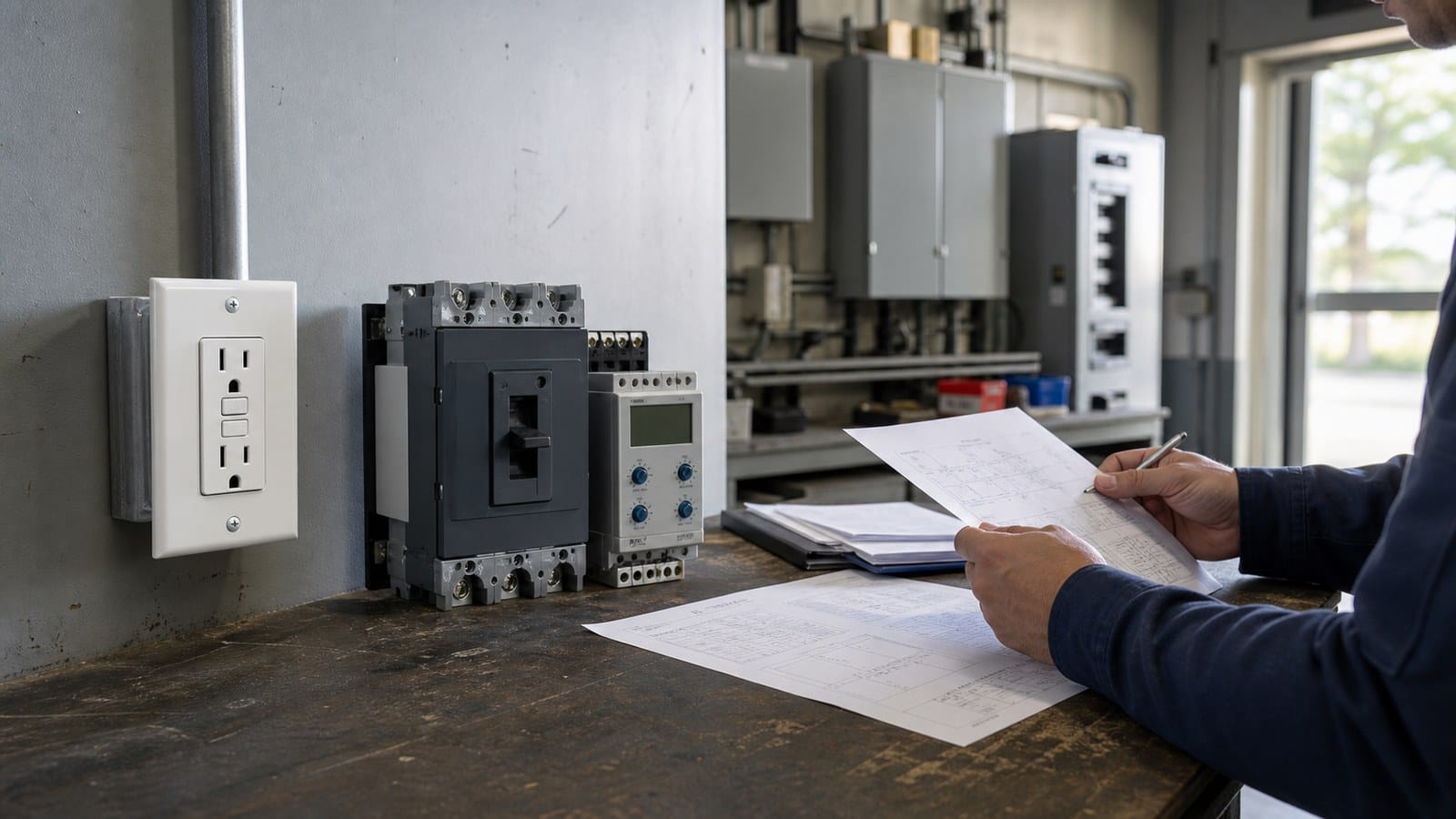
Whether a clothes dryer needs GFCI protection depends on the dryer, connection, circuit, location, and the code edition adopted where the project is located. The 2023 edition of NFPA 70 Section 210.8(D) includes clothes dryers among specific appliances requiring GFCI protection for the supplying branch circuit or outlet when the stated voltage and current limits apply. The 2020 dwelling laundry-area receptacle rule can also capture many common dryer receptacles. Older adopted editions and local amendments may differ.
For a typical 120/240-volt electric dryer on a 30-amp circuit, protection normally means a compatible two-pole GFCI circuit breaker, not a standard 15- or 20-amp receptacle-type GFCI. A gas dryer usually uses a 120-volt receptacle and still needs a location-and-edition review. In both cases, GFCI protection does not replace equipment grounding, correct conductor sizing, a four-wire connection where required, or the appliance instructions.
If a dryer trips a GFCI, do not remove the protection or substitute an ordinary breaker. Moisture, damaged cords, heating-element leakage, motor or filter leakage, neutral-to-ground contact downstream, wiring errors, or a mismatched breaker can all produce trips.
Code and product-document basis: Faith Editorial Team checked NFPA 70 (2023) Section 210.8(D) in NFPA LiNK, Leviton and Eaton’s 2023 appliance guidance, UL Solutions GFCI certification information, and GE Appliances’ current installation portal for electric dryer model GTD48EASWWB. The GE page is used only as a model-specific document example; it does not create a GFCI rule for every dryer. No licensed-electrician, appliance technician, manufacturer, or AHJ review is claimed.
Choose the circuit case before choosing the device
| Dryer installation | Protection question | Typical design response |
|---|---|---|
| 120/240V electric dryer, 30A | Is the circuit within the adopted specific-appliance or laundry-location rule? | Compatible two-pole GFCI breaker when required |
| 120V gas dryer | Does the laundry-area receptacle rule apply? | Listed 15/20A GFCI receptacle, upstream device, or breaker |
| Hardwired commercial dryer | Is the appliance covered by the adopted specific-appliance rule and ratings? | Branch-circuit GFCI equipment appropriate to voltage, phase, and current |
| Existing three-wire dryer connection | GFCI does not correct missing modern grounding provisions | Evaluate alteration and replacement requirements separately |
| New dryer trips immediately | Possible appliance, wiring, or breaker issue | Leave off and arrange coordinated diagnosis |
| Old installation unaffected by remodel | Existing-installation treatment is local | Confirm permit scope and AHJ requirements |
How recent NEC editions reach dryer circuits
NFPA LiNK provides access to the formal 2023 NFPA 70 text. Section 210.8(D) lists clothes dryers as a specific appliance within the section’s voltage and current limits. Leviton’s 2023 explanation emphasizes that the branch circuit or outlet is protected whether the appliance is cord-connected or hardwired. Eaton’s guide describes protection at the breaker, receptacle, or another appropriate upstream point.
The adopted edition matters. A project under the 2020 NEC may reach a dryer receptacle through the dwelling laundry-area provision. The 2023 specific-appliance language is broader because it directly names clothes dryers and addresses the supplying branch circuit or outlet. State or local amendments may delay, modify, or remove model-code provisions.
Write the adopted edition and amendment reference on the circuit schedule. Avoid a bare note that says “per latest NEC,” because the latest published edition may not be enforceable locally.
GE Appliances’ support page for current model GTD48EASWWB links the installation instructions for that exact dryer. That is the level of traceability a submittal should preserve: manufacturer, model, document title or number, revision where available, and the circuit data taken from that document.
Electric dryer versus gas dryer
Electric dryer
A conventional residential electric dryer commonly uses a 120/240-volt, 30-amp branch circuit and a four-wire receptacle/cord arrangement in modern installations. The breaker must protect both ungrounded conductors and provide GFCI functionality appropriate for the circuit.
A standard 125-volt receptacle-type GFCI is not a substitute for a two-pole dryer-circuit solution. Specify the panel manufacturer and series, system voltage, poles, amperage, interrupting rating, neutral connection, and listing compatibility.
Gas dryer
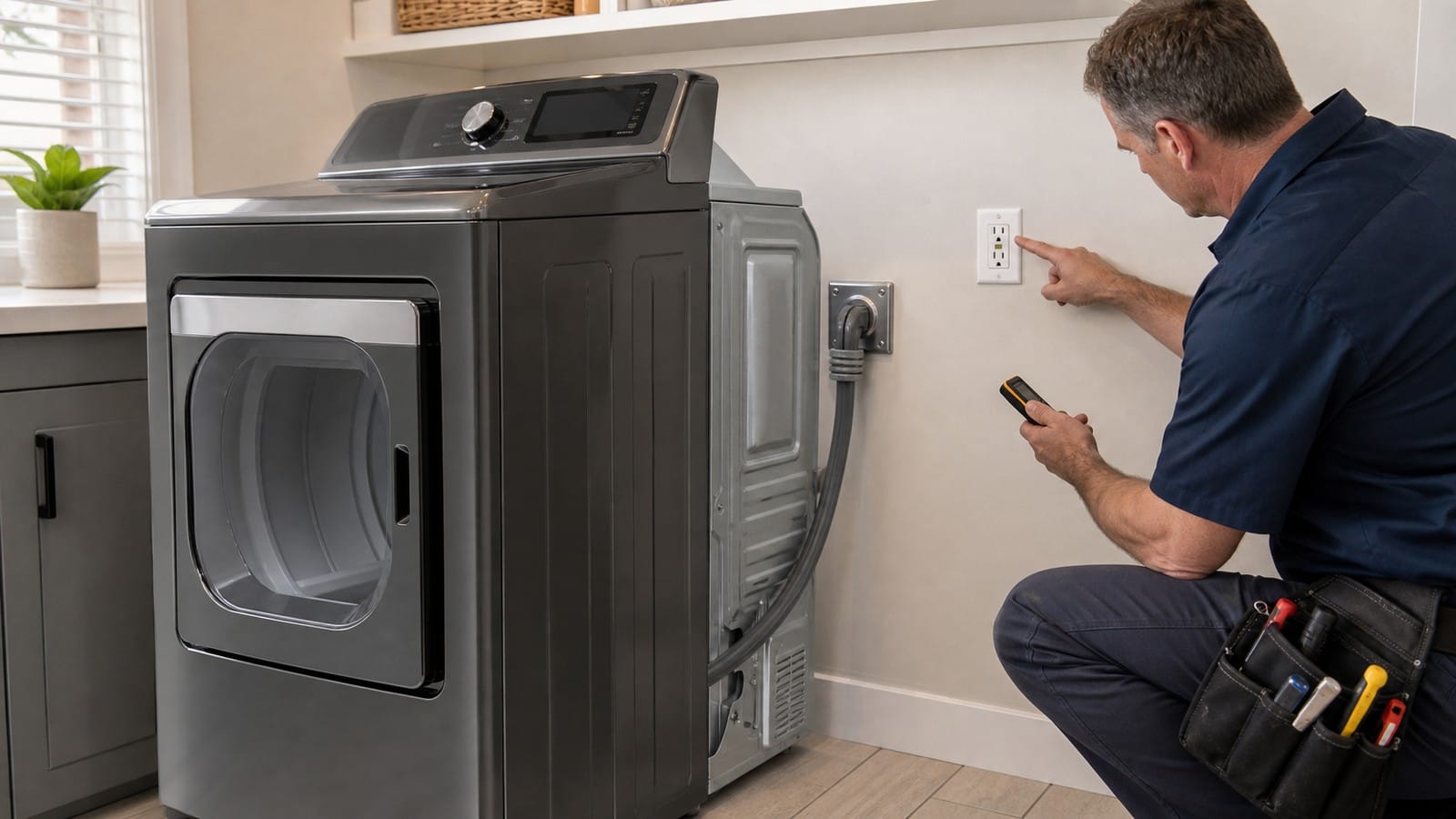
A gas dryer typically uses electricity for the motor, controls, and ignition while heat comes from gas. Its 120-volt receptacle is still in a laundry area and may require GFCI protection under the adopted code. The gas connection does not create an electrical exemption.
Because the electrical load differs from an electric dryer, do not copy circuit details between models. Confirm the nameplate and manual.
Commercial or multi-load laundry equipment
Commercial dryers can use different voltages, phases, current ratings, controls, and connection methods. Some equipment exceeds the common residential profile. The project team must compare the exact appliance ratings with the scope of the adopted rule and available listed protective equipment.
Why four-wire grounding still matters
GFCI protection detects an imbalance between the conductors passing through its sensing system. It does not create an equipment grounding conductor, correct an improper neutral-frame bond, or make a damaged cord acceptable.
When replacing a dryer or modifying a circuit, verify:
- four-wire versus legacy three-wire connection;
- separation of neutral and equipment ground as required;
- conductor material and size;
- receptacle and cord configuration;
- terminal torque and strain relief;
- circuit and breaker rating; and
- appliance bonding instructions.
Never cut off a grounding pin, install an adapter, or move the neutral/ground bond based on a generic diagram. Follow the exact dryer manual and adopted code.
Selecting a dryer GFCI breaker
The purchase description must identify more than “30A GFCI.” At minimum, include:
| Field | Why it matters |
|---|---|
| Panel manufacturer and series | Breakers are not universally interchangeable |
| Poles and ampere rating | Must match the branch circuit and appliance requirements |
| System voltage | Determines equipment suitability |
| Neutral arrangement | GFCI sensing and installation depend on correct neutral routing |
| Interrupting rating | Must be suitable for available fault current |
| Listing and compatibility | Needed for the complete panelboard installation |
| GFCI class/function | Must match the applicable personnel-protection requirement |
| Reset access | Panel must be accessible to occupants or facility staff |
If AFCI protection also applies under the adopted edition, the designer must determine whether an appropriate dual-function or coordinated solution is available for that circuit and panel. Do not stack devices or improvise a combination without listing and manufacturer support.
Why dryers trip GFCI protection
| When the trip occurs | Possible cause | Safe response |
|---|---|---|
| Immediately when breaker is energized | Wiring error, neutral-ground contact, cord fault, or appliance fault | Leave circuit off; qualified inspection |
| When drum starts | Motor, cord, filter, or wiring leakage | Stop use and isolate appliance/circuit diagnosis |
| When heat turns on | Heating-element leakage or insulation breakdown | Appliance service and circuit testing |
| During wet laundry or vent problems | Moisture or condensation where it should not be | Correct moisture/vent issue and inspect electrically |
| After breaker replacement | Incompatible breaker, incorrect neutral routing, or installation error | Verify exact panel compatibility and wiring |
| GFCI holds but overcurrent breaker trips | Overload or short-circuit issue | Identify load and fault; do not upsize breaker |
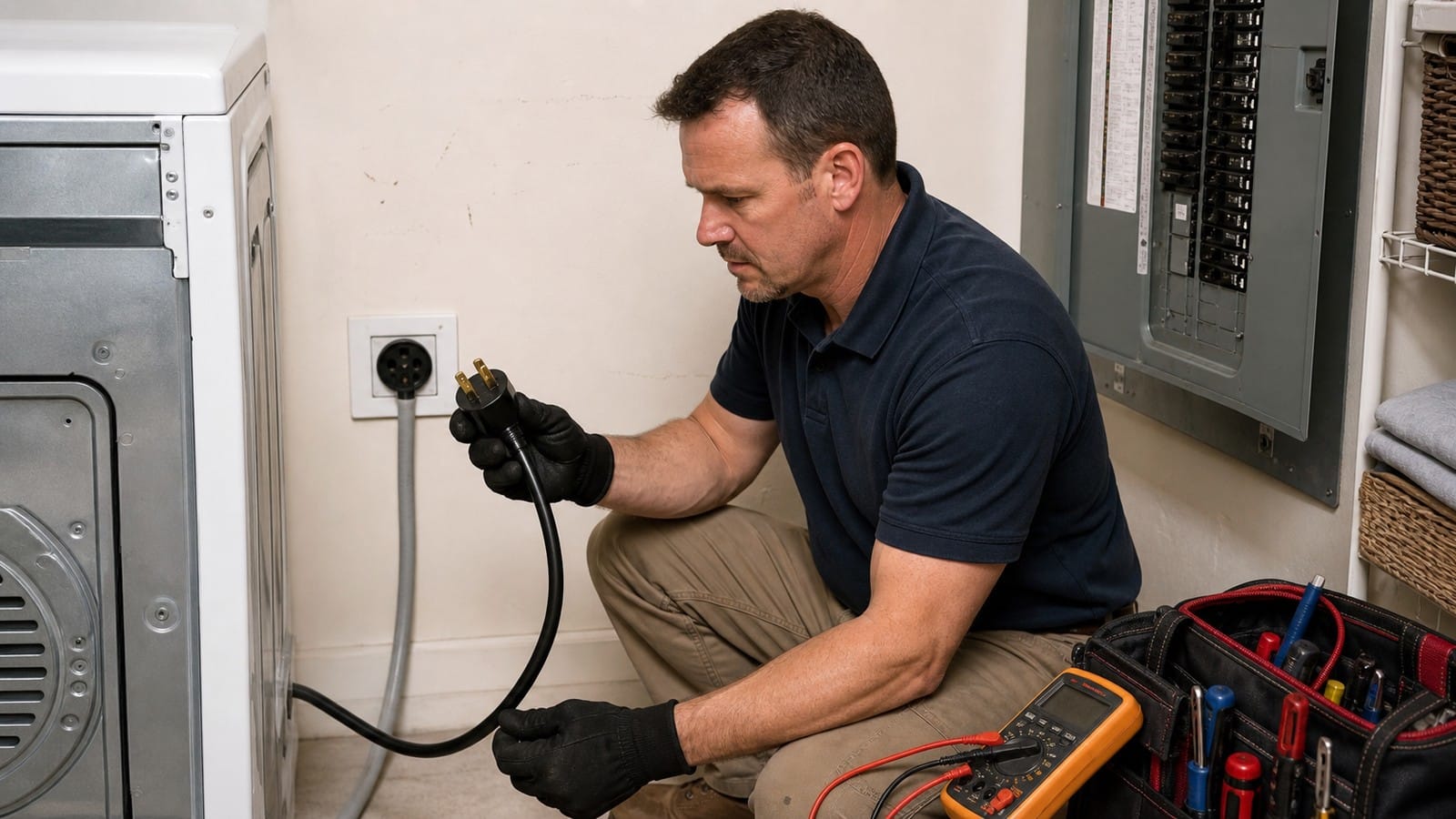
Do not use repeated resets as a test. Record whether the GFCI function or overcurrent function operated, what cycle was running, whether heat had started, and whether the dryer was empty or loaded. That information helps a qualified electrician and appliance technician divide the problem efficiently.
Project workflow for a new dryer circuit
- Identify jurisdiction, permit scope, adopted NEC edition, and amendments.
- Obtain the exact dryer installation manual and nameplate data.
- Confirm electric, gas, stacked, combination, or commercial configuration.
- Determine voltage, phase, current, branch-circuit, receptacle, and cord requirements.
- Verify the panel manufacturer, model, spaces, and compatible GFCI solution.
- Coordinate grounding, neutral, conductor, box, receptacle, and cord details.
- Keep the protective device readily accessible.
- Label the circuit and record the device catalog number.
- Test the completed installation according to the protective-device and appliance instructions.
- Provide facility staff with reset and escalation instructions.
Faith’s 15-amp versus 20-amp GFCI guide is useful for ordinary 125-volt receptacles, but it should not be used to specify a 30-amp dryer circuit. Different product categories and ratings apply.
Procurement checklist
- Exact dryer model and electrical data sheet obtained
- Locally adopted code edition recorded
- Circuit voltage, poles, amperage, and phase confirmed
- Cord-and-plug versus hardwired connection documented
- Correct receptacle and cord configuration specified
- Equipment grounding and neutral arrangement reviewed
- Panel-compatible listed GFCI device identified
- AFCI coordination checked where applicable
- Reset access and circuit labeling planned
- Replacement stock uses the exact approved catalog number
- Installation and operational tests included in closeout
Faith has produced electrical wiring devices since 1996. For any project, the purchaser should verify the exact product category, catalog number, certification record, electrical ratings, markings, and instructions rather than treating a family brochure as approval for every model.
FAQ
Does a 30-amp dryer outlet need a GFCI breaker?
It can under recent NEC editions, including the 2023 specific-appliance framework. The adopted edition and amendments control.
Can I use a GFCI receptacle for an electric dryer?
Common 15/20A, 125V receptacle-type GFCIs are not a substitute for a 120/240V, 30A dryer-circuit protective device. A compatible two-pole GFCI breaker is commonly used.
Does a gas dryer need GFCI protection?
Its 120V receptacle is usually in a laundry area and may require protection under location rules. Verify locally.
Will GFCI protection stop a dryer fire?
GFCI protection addresses ground-fault shock hazards. Overcurrent protection, correct wiring, clean venting, appliance condition, and maintenance address other hazards.
Can I replace a tripping GFCI breaker with a standard breaker?
Not as a troubleshooting shortcut. Identify whether the trip is caused by the appliance, wiring, moisture, neutral-ground contact, or an installation/compatibility problem.
Does GFCI protection make a three-prong dryer connection safe?
It does not replace equipment grounding or resolve legacy neutral/bonding issues. Have the circuit evaluated under applicable alteration rules.
Sources / References
Accessed August 17, 2026.
- NFPA 70, 2023 edition, Section 210.8(D), via NFPA LiNK
- NFPA 70 formal document page
- Leviton Captain Code 2023 – GFCI Protection for Specific Appliances
- Eaton – 2023 NEC Section 210.8(D) appliance GFCI requirements
- GE Appliances – model GTD48EASWWB installation and support page
- UL Solutions – GFCI personal protection devices testing and certification
This article is general U.S. code-planning, procurement, and troubleshooting information. It does not replace the locally adopted code, appliance instructions, panel documentation, listing conditions, permit requirements, or AHJ approval. Electrical and appliance diagnosis should be performed by qualified persons.