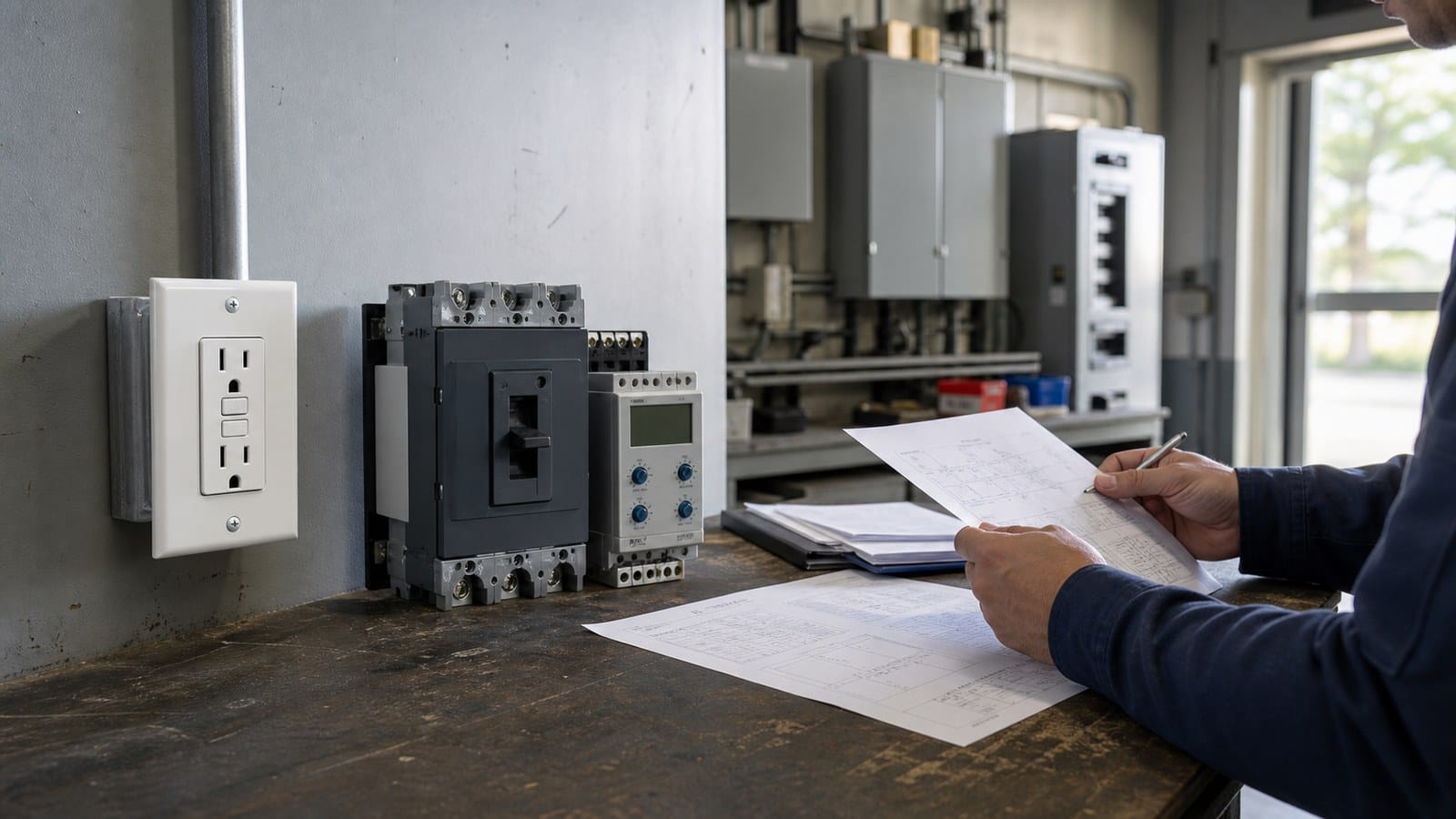
For EV charging, the connection method changes the GFCI question. A receptacle installed for EV charging is subject to NEC 625.54 in editions that contain that rule. A hardwired EVSE has no charging receptacle, so its branch-circuit protection must be resolved from the adopted code, local amendments, the equipment listing, and the exact installation manual. Built-in EVSE monitoring is not automatically a substitute for upstream GFCI protection.
Source note: This guide was organized with AI-assisted drafting and checked against the cited NEC summary, UL Solutions, and U.S. Department of Energy material. It does not evaluate a specific EVSE model or claim manufacturer, electrician, or AHJ approval.
Quick decision table
| Installation | Starting GFCI question | Buyer/installer check |
|---|---|---|
| Level 1 portable EVSE on a 120 V receptacle | Does the adopted NEC require the receptacle to have GFCI protection? | Receptacle rating, dedicated circuit, equipment ground, weather exposure and EVSE instructions |
| Plug-in Level 2 EVSE on a 240 V receptacle | NEC 625.54 applies to receptacles installed for EV charging in the relevant editions | GFCI breaker availability, panel compatibility, receptacle/listing, continuous load and enclosure |
| Hardwired Level 2 EVSE | Do the adopted code and local amendments require upstream GFCI for this outlet/equipment? | EVSE listing, manual, internal protective function, branch circuit and AHJ interpretation |
| Existing receptacle repurposed for charging | Was it installed and rated for continuous EV load, and does current work trigger an upgrade? | Condition, conductor size, torque, grounding, GFCI and permit requirements |
This table cannot replace a permit review. NEC adoption varies by state and locality, and amendments may change the baseline text.
Why NEC 625.54 matters
Leviton’s NEC 2020 code-change summary reproduces the 2020 requirement: in addition to Section 210.8, all receptacles installed for connection of EV charging must have GFCI protection for personnel. The important words are “all receptacles” and “for the connection of electric vehicle charging.” The rule is not limited to outdoor receptacles or to 120 V charging.
For a NEMA 14-50 charging outlet, this commonly means a two-pole Class A GFCI circuit breaker compatible with the installed panel. A standard 14-50 receptacle does not become GFCI-protected because the portable EVSE contains its own charge-circuit interrupting device.
Always verify the version adopted by the project jurisdiction. Proposed text, committee materials and future-edition discussions are not the governing code until adopted. The permit set should identify the adopted edition and any local amendment rather than using “latest NEC” as a placeholder.
Receptacle-connected charging: what the branch circuit must provide
Correct circuit rating
EV charging is commonly treated as a continuous load. The branch-circuit rating, conductors and overcurrent protection must be selected for the EVSE’s maximum continuous current in accordance with the applicable rules and instructions. A 40 A charging setting commonly corresponds to a 50 A circuit, but do not specify from that example alone; use the nameplate and permitted adjustable-current provisions.
GFCI protection for the receptacle
Where NEC 625.54 applies, the receptacle needs personnel GFCI protection. For 240 V receptacles, that protection is typically at the breaker because common wall GFCI receptacles are 125 V products. Confirm that the breaker is listed for the exact panel, voltage, poles and circuit. Faith’s GFCI receptacle versus GFCI circuit breaker guide explains the reset-location and compatibility tradeoffs.
Equipment grounding
EVSE generally checks the equipment-grounding path and may refuse to operate if it is missing or abnormal. A GFCI-protected but ungrounded replacement receptacle is not a sensible shortcut for EV charging. Provide the grounding and bonding arrangement required by the EVSE instructions and electrical code.
Receptacle durability and enclosure
Repeated high-current charging exposes poor terminations and worn receptacle contacts. Use a receptacle identified and rated for the application, install it with the specified conductor and torque, and select an enclosure suitable for the environment. Outdoor equipment needs weatherproofing appropriate while in use, not just a closed cover.
Hardwired EVSE is a separate decision
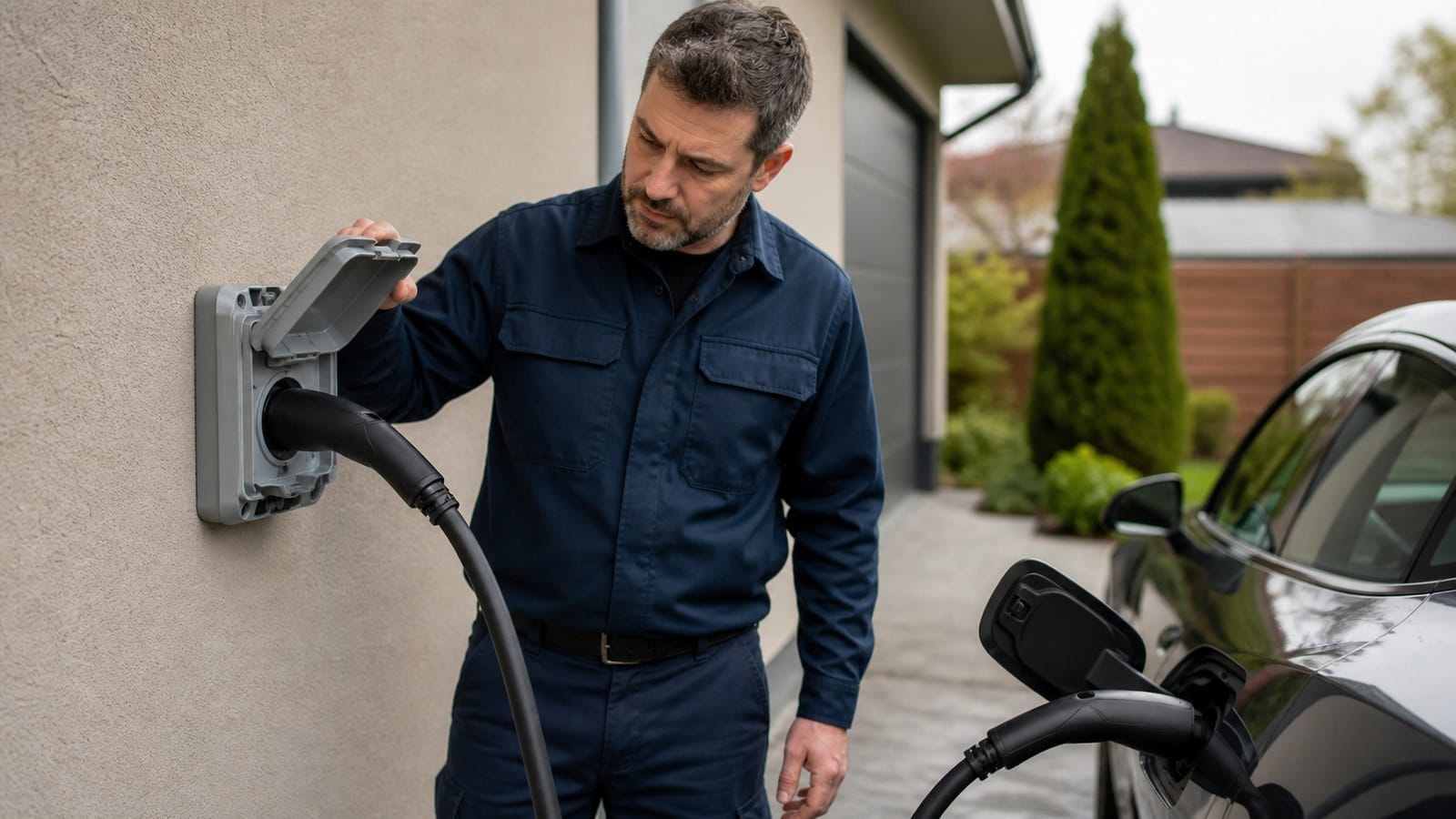
Hardwiring removes the receptacle and attachment plug from the installation. It can reduce contact points, eliminate receptacle wear and avoid the need to source a high-amperage GFCI breaker where the adopted rule applies only to receptacles. But hardwiring does not grant a blanket exemption from every ground-fault rule.
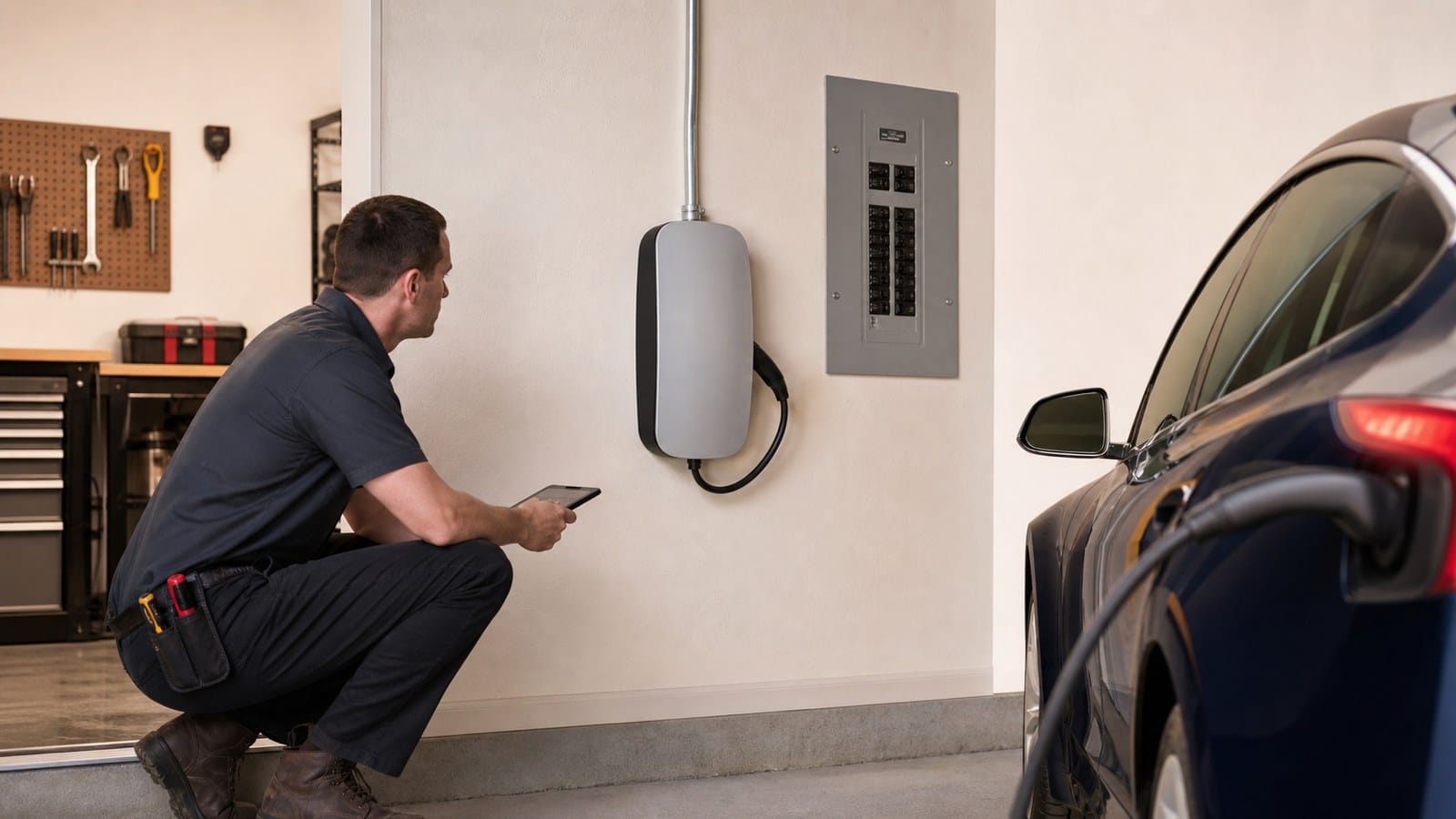
Check four documents together:
- the NEC edition and amendments adopted by the jurisdiction;
- the EVSE installation manual;
- the EVSE certification and nameplate;
- the permit drawings or AHJ direction.
If the exact EVSE installation manual restricts or cautions against an upstream GFCI device, compare that model-specific instruction with the adopted code and permit requirements. Do not generalize the instruction to other chargers. Send the exact model, manual revision, wiring method and code reference to the manufacturer and AHJ when the documents appear to conflict.
Built-in EVSE protection is not the same as branch-circuit GFCI
EVSE contains charge-circuit interrupting and ground-monitoring functions evaluated as part of the complete charging equipment. These functions help prevent energizing the vehicle connector under unsafe conditions. A Class A GFCI breaker monitors the branch circuit upstream of the EVSE.
The protected zones are different:
- The branch-circuit GFCI can detect qualifying imbalance in the wiring, receptacle, plug and connected equipment downstream of the breaker.
- The EVSE’s internal protection operates within the charging system defined by its listing and design.
- Overcurrent protection addresses overloads and short circuits; it is not a substitute for either ground-fault function.
The presence of one protective function does not prove that another required function can be omitted.
Why EV chargers sometimes trip GFCI breakers
Power-up self-test interaction
If the documented design of the specific EVSE performs a power-up self-test or leakage-monitoring check, that behavior may be relevant to an upstream trip. If tripping occurs at plug-in or startup, compare the exact charger manual with the breaker instructions and contact both manufacturers rather than assuming a generic EVSE behavior.
Normal filter leakage
Electronic equipment uses filters that may pass small current to ground. Multiple loads should not share an EV charging circuit, but conductor length, moisture and equipment condition can still affect leakage. A clamp leakage-current measurement by qualified personnel can help distinguish cumulative leakage from a hard fault.
Moisture or damaged cord equipment
Outdoor receptacles, in-use covers, plugs and portable EVSE cords experience weather and mechanical stress. Water intrusion, contamination, bent blades or cable damage can produce a genuine trip. Do not repeatedly reset the breaker until the cause is identified.
Incorrect neutral or shared conductors
A two-pole GFCI breaker must be wired exactly as its instructions require. Neutral conductors mixed between circuits, a misplaced load neutral or an improper panel connection can cause immediate tripping. A 240 V EVSE that does not use a neutral still requires the breaker and conductors to be connected according to the listed arrangement.
Incompatible or incorrect breaker
A breaker that physically fits is not necessarily approved for the panel. Use the exact panel labeling and manufacturer documentation. Adapters, cross-brand substitutions and used breakers with uncertain history create avoidable risk.
A safe troubleshooting sequence
- Stop charging and note when the trip occurs: immediately, during startup, after rain or after sustained load.
- Inspect the plug, receptacle, cord, enclosure and EV connector without opening energized equipment.
- Verify the EVSE model, current setting and installation method against its manual.
- Confirm the GFCI breaker model and panel compatibility.
- Have a qualified electrician test the branch circuit, grounding, insulation and leakage.
- Contact the EVSE and breaker manufacturers with the exact models and observed trip pattern.
- Obtain AHJ direction before changing the protection method when code interpretation is involved.
Do not replace a tripping GFCI breaker with a standard breaker simply to keep the charger running. A trip is evidence to investigate, not a nuisance to defeat.
Procurement checklist for EV charging circuits
EVSE data
- exact manufacturer and model;
- cord-and-plug or hardwired configuration;
- input voltage, phase and maximum continuous current;
- adjustable-current settings and access control;
- plug configuration, if present;
- indoor/outdoor and enclosure ratings;
- installation instructions and certification record.
Branch-circuit data
- panel manufacturer, series and available spaces;
- breaker type, poles, ampere rating and interrupting rating;
- Class A GFCI requirement and approved breaker model;
- conductor material, size, temperature rating and length;
- grounding and neutral arrangement;
- receptacle grade, box, cover and mounting location;
- disconnecting means and accessibility where required.
Approval data
- adopted NEC edition and local amendments;
- permit or plan-review comments;
- manufacturer clarification for any upstream-GFCI restriction;
- commissioning test and torque records;
- owner instructions for testing, resetting and reporting trips.
For purchasing, treat the EVSE model, wiring method, circuit rating, panel compatibility, GFCI requirement, certification record and installation instructions as one approval set.
Plug-in or hardwired: which is better?
Plug-in equipment can be removed without opening the wiring compartment and may suit portable charging. It adds a receptacle, plug and enclosure that must carry continuous current reliably, and the receptacle may trigger an explicit GFCI requirement.
Hardwired EVSE eliminates the receptacle connection and can simplify a dedicated installation. Service or replacement may require qualified electrical work, and the unit must still comply with its listing and locally adopted requirements. The better choice depends on portability, service strategy, panel availability, outdoor exposure and AHJ expectations—not on avoiding one protective device.
Two installation questions to resolve before ordering
Does a receptacle used for EV charging need GFCI protection?
Under NEC editions containing the Section 625.54 receptacle requirement, a receptacle installed for EV charging requires GFCI protection for personnel. Confirm the locally adopted edition, amendments, receptacle configuration and compatible breaker before ordering.
Does the same answer apply to a hardwired EVSE?
Not automatically. A hardwired EVSE has no charging receptacle, so review the adopted code text, local amendments, the exact EVSE listing and installation manual, and AHJ direction for that installation.
Sources and references
- Leviton Captain Code, 625.54 GFCI Protection for Receptacle Outlets Used for EV Charging, quoting the 2020 NEC with permission, accessed August 27, 2026.
- UL Solutions, Electric Vehicle Charging System Equipment, accessed August 27, 2026.
- UL Solutions, Product iQ, certification-record database overview, accessed August 27, 2026.
- U.S. Department of Energy, Alternative Fuels Data Center, Charging Electric Vehicles at Home, accessed August 27, 2026.
Safety and code disclaimer: EV charging is a continuous high-power application. This article is general information, not a wiring instruction or code ruling. Use the NEC edition and amendments adopted by the jurisdiction, the EVSE and panel instructions, and permit requirements. Qualified personnel should design, install and test the circuit.