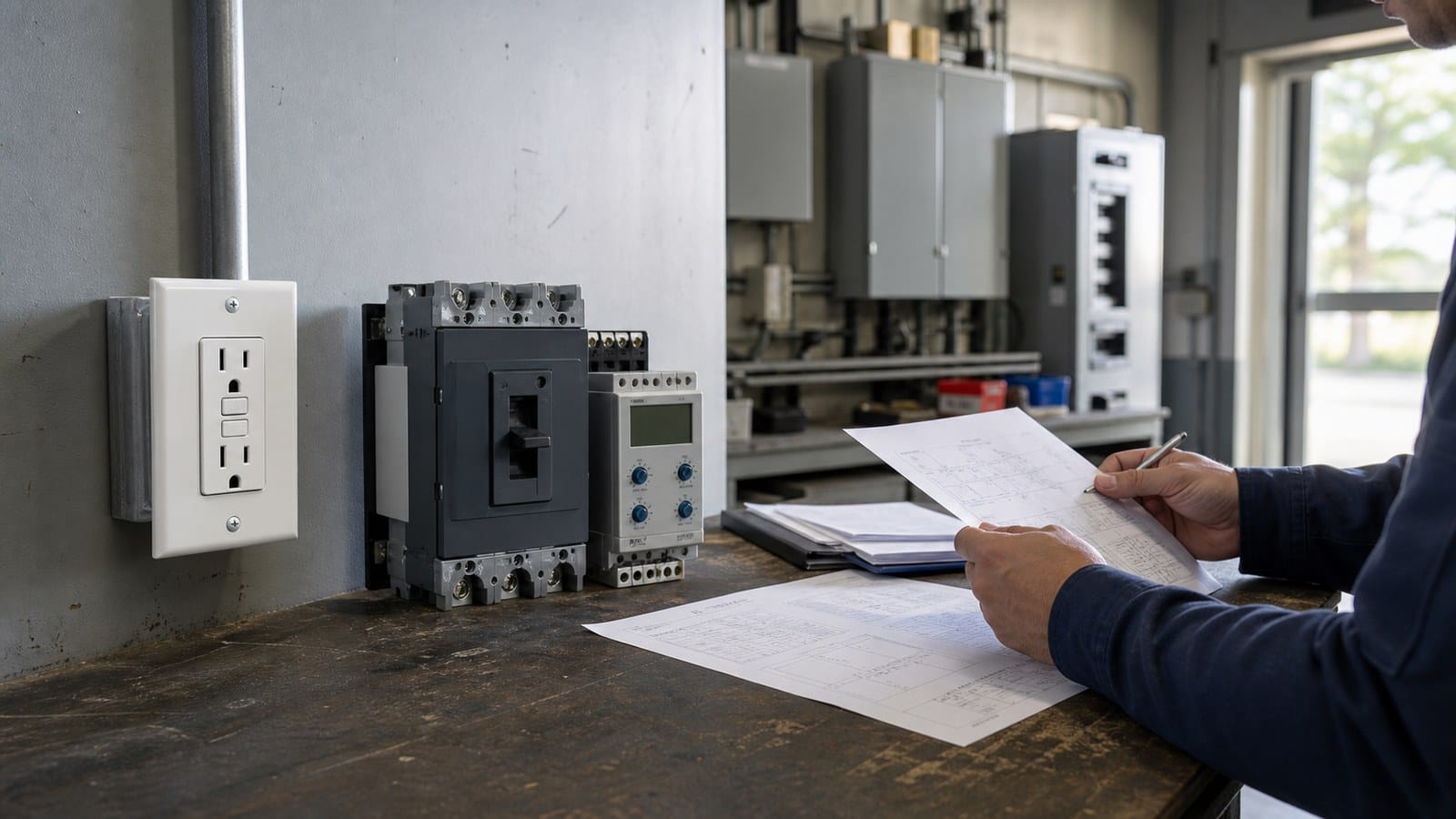
GFCI tripping is usually caused by issues such as a ground fault, leakage current, moisture, faulty equipment, wiring problems, or an aging GFCI device. When a GFCI outlet trips repeatedly, it should be taken seriously. However, this does not always mean the outlet itself is defective. This guide breaks down the most common reasons why a GFCI outlet keeps tripping and what each situation usually means.
How a GFCI Outlet Works and Why It Trips
A GFCI outlet, short for Ground Fault Circuit Interrupter, is a safety receptacle designed to reduce the risk of electric shock. It monitors the current flowing through the hot and neutral conductors. Under normal conditions, the current going out through the hot wire should return through the neutral wire.
When the GFCI detects a small imbalance, it cuts power quickly.
In many GFCI devices, the trip threshold is around 5 milliamps, or 0.005 amps. That is a very small amount of current, but it can matter when electricity is leaking through water, damaged insulation, grounded metal, equipment housing, or a person.
This is why GFCI outlets are common in areas where moisture and conductive contact are more likely, such as bathrooms, kitchens, garages, laundry rooms, basements, crawl spaces, outdoor receptacles, workshops, and maintenance areas.
A GFCI is different from a standard circuit breaker.
| Device | Main Function | Typical Problem It Responds To |
| GFCI outlet | Detects leakage current / ground fault | Shock hazard, moisture, damaged appliance |
| Circuit breaker | Protects wiring from overload and short circuit | Too much current, short circuit |
| AFCI device | Detects dangerous arcing conditions | Damaged cords, loose connections, arc faults |
This distinction matters. A GFCI is not primarily an overload protection device. If high-amperage equipment keeps causing power loss, the breaker, circuit size, load distribution, and wiring condition may also need to be checked.
A GFCI that trips is doing its job. A GFCI that trips repeatedly is telling you something in the circuit deserves attention.
Common Reasons a GFCI Outlet Keeps Tripping
There is no single answer that fits every jobsite or building. A GFCI outlet may trip because of the device plugged into it, the installation environment, the wiring behind it, the downstream outlets it protects, or the GFCI itself.
Ground Fault or Leakage Current
A ground fault happens when electrical current leaves its intended path and finds another path to ground. That path may be through water, a metal appliance frame, damaged insulation, a wet surface, or human contact.
This is the core condition a GFCI is built to detect.
For example, a commercial kitchen outlet may trip when a piece of food-prep equipment has moisture inside the motor housing. An outdoor receptacle may trip when a damaged extension cord lies on wet concrete. In a garage, a power washer or pump with deteriorated insulation may create enough leakage current to trigger the GFCI.
In these cases, the GFCI is not being “too sensitive.” It is reacting to a shock risk.
Do not bypass the GFCI to keep the equipment running. That turns a warning signal into a safety hazard.
Moisture Inside the Outlet or Electrical Box
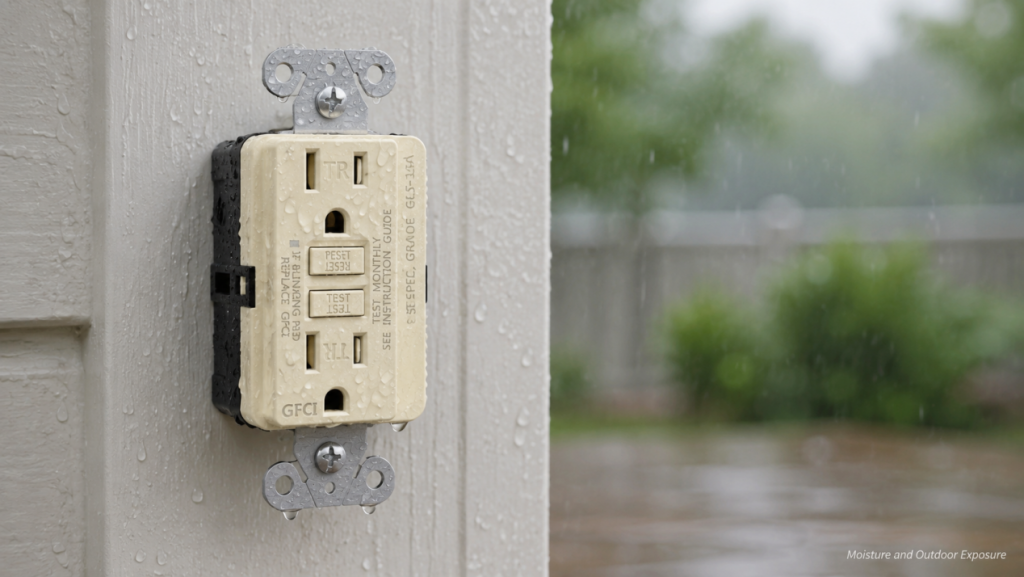
Moisture is one of the most common reasons an outdoor GFCI keeps tripping after rain. It can also affect indoor locations such as bathrooms, laundry rooms, basements, utility rooms, and commercial washdown areas.
The source may be obvious, such as rain entering an outdoor box. It may also be less visible:
- Condensation inside a metal box
- Water splashing near a kitchen or laundry receptacle
- Humidity in a basement or crawl space
- Poor sealing around an exterior wall box
- Washdown procedures in food processing, car wash, or maintenance areas
Even a small amount of water can create a conductive path. Once the GFCI detects leakage, it trips.
For outdoor or exposed installations, the solution is not just “install any GFCI.” The installation should match the environment. That usually means a weather-resistant GFCI outlet, a proper weatherproof box, an in-use cover, and correct sealing.
Do not describe this as a waterproof outlet. A weather-resistant GFCI still depends on the full installation system around it.
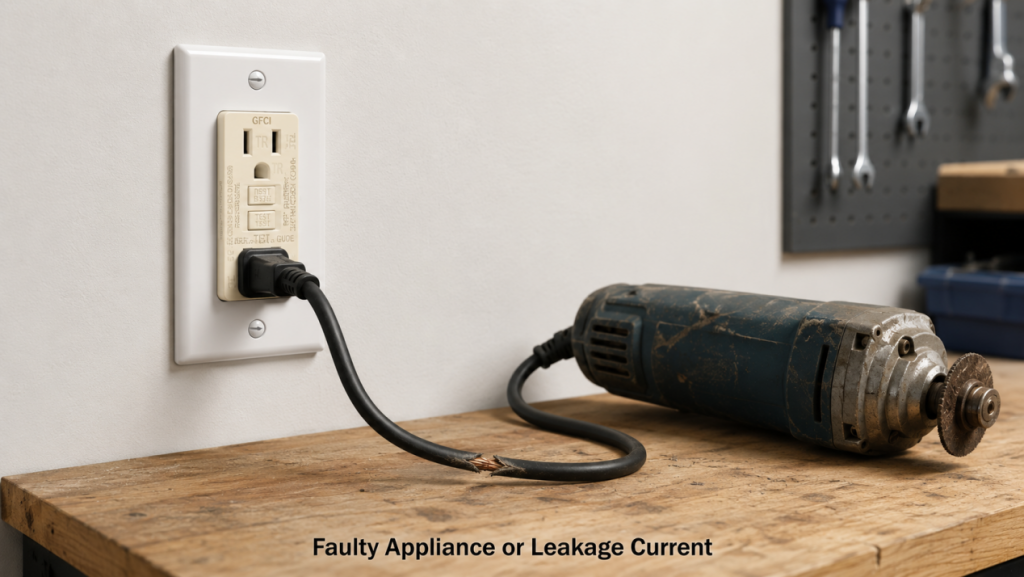
Faulty Appliance or Equipment
If a GFCI trips when something is plugged in, start with the connected device.
A faulty appliance or piece of equipment can leak current to ground because of damaged cords, cracked insulation, moisture inside the housing, worn motor windings, or failing heating elements. This is common with equipment that works near water, heat, vibration, or outdoor conditions.
Typical examples include:
- Hair dryers and bathroom appliances
- Washing machines and sump pumps
- Space heaters and toasters
- Outdoor power tools
- Pressure washers
- Commercial cleaning equipment
- Portable jobsite tools
- Extension cords exposed to weather
A practical test is simple: unplug everything, reset the GFCI, then plug devices back in one at a time. If one device trips the GFCI repeatedly, test that same device on another GFCI-protected outlet. If it trips more than one GFCI, the equipment is likely the problem.
That device should be repaired or replaced. Continuing to use it can damage the electrical system or create a shock risk.
Wiring Problems or Loose Connections
A GFCI may also trip because of wiring problems behind the wall, inside a junction box, or along the downstream circuit.
Loose terminals, damaged insulation, corroded conductors, frayed wiring, or poor splices can create intermittent ground faults. These issues are often harder to identify because the GFCI may trip randomly. It may work for hours and then shut off when vibration, humidity, or load changes disturb the connection.
One common warning sign is this: the GFCI trips even when nothing is plugged into the outlet.
That does not always mean “no load.” A GFCI outlet can protect other downstream receptacles through its LOAD terminals. A problem at another outlet, outdoor box, or connected device on the same protected circuit may cause the upstream GFCI to trip.
Wall wiring is not a guessing game. If the outlet trips with no visible device connected, the circuit should be checked by a qualified electrician.
Incorrect LINE and LOAD Wiring
Newly installed GFCI outlets that keep tripping often point to installation issues.
A GFCI outlet has LINE terminals for incoming power and LOAD terminals for protecting downstream outlets. If these are reversed, mixed, or connected incorrectly, the GFCI may fail to reset, trip immediately, or behave unpredictably.
This matters on multi-outlet circuits. In residential projects, one GFCI in a bathroom, garage, kitchen, or outdoor area may protect several receptacles. In commercial work, a GFCI may protect maintenance points, exterior workstations, or equipment service areas.
Incorrect wiring can also create confusion during troubleshooting. The visible GFCI may not be the only place to inspect.
For electricians and contractors, LINE/LOAD identification is basic but non-negotiable. For end users, this is not the place to experiment. If a new GFCI outlet keeps tripping after installation, the wiring should be verified by a qualified person.
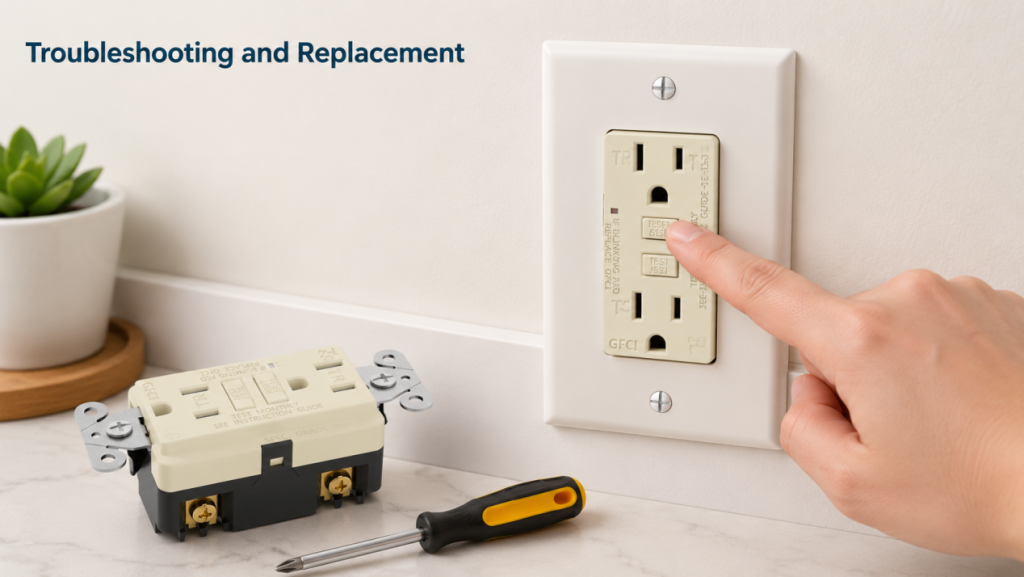
Aging or Defective GFCI Outlet
GFCI outlets do not last forever. Moisture, heat, frequent tripping, harsh environments, and years of use can wear down internal components.
A bad GFCI outlet may show symptoms such as:
- It will not reset
- TEST or RESET button feels loose, stuck, or unresponsive
- Power does not return after reset
- It trips without a clear external cause
- The face is cracked, discolored, or loose
- There is buzzing, heat, sparks, or a burning smell
Do not assume the GFCI is bad before checking connected equipment and moisture. But once those causes are ruled out, replacing the outlet is often the correct move.
For contractors and project buyers, outlet failure is not only a repair issue. In multi-unit housing, hospitality, retail, or commercial installations, repeated GFCI complaints can become warranty claims, return requests, and labor costs.
What Different GFCI Tripping Situations Usually Mean
Users rarely describe the problem by technical cause. They describe what they see: “It trips after rain,” “It trips when I plug in a device,” or “It trips with nothing plugged in.”
That is the right starting point.
| What You Notice | Possible Cause | What to Check First |
| GFCI trips immediately after reset | Ongoing ground fault, wiring issue, bad GFCI | Unplug all devices; stop resetting if it still trips |
| GFCI trips when one appliance is plugged in | Faulty appliance or leakage current | Test that appliance on another GFCI |
| GFCI trips with nothing plugged in | Downstream issue, moisture, wiring fault | Check whether other outlets are on the same protected circuit |
| Outdoor GFCI trips after rain | Moisture infiltration | Check cover, box sealing, WR outlet, outdoor devices |
| Newly installed GFCI keeps tripping | LINE/LOAD issue or downstream wiring problem | Have installation verified by a qualified electrician |
| Multiple outlets lose power | One GFCI may protect downstream receptacles | Locate the upstream GFCI and inspect the protected circuit |
GFCI Trips Immediately After Reset
If the GFCI trips immediately after reset, treat it as a warning. There may be active leakage current, a wiring fault, moisture inside the box, a downstream problem, or a failed GFCI device.
Do not keep pressing RESET.
A GFCI that cannot hold reset is not a nuisance. It is either detecting a condition that needs correction, or it has reached the end of its service life.
GFCI Trips When Something Is Plugged In
This is the most straightforward scenario. If the GFCI stays on with no devices connected but trips when a specific appliance is plugged in, the device is the first suspect.
This often happens with motor-driven or heat-producing equipment. Motors, pumps, heaters, compressors, and outdoor tools see vibration, heat, moisture, and insulation stress. Over time, they are more likely to leak current.
A good rule: if the same device trips multiple GFCI outlets in different locations, stop blaming the outlet.
GFCI Trips With Nothing Plugged In
This situation is more complex. The outlet face may be empty, but the GFCI may still be protecting downstream outlets.
For example, a garage GFCI may protect an exterior receptacle. A bathroom GFCI may protect another bathroom outlet. A kitchen GFCI may be part of a longer branch circuit. If one downstream box has moisture or damaged wiring, the upstream GFCI can trip even when nothing is plugged into the visible device.
This is where many users misdiagnose the problem. “Nothing is plugged in” does not always mean “nothing is connected.”
Outdoor GFCI Keeps Tripping After Rain
Rain-related tripping usually points to water intrusion, poor cover protection, damaged outdoor equipment, or an outlet not suited for the exposure.
The fix should look at the full assembly:
- Is the GFCI weather-resistant?
- Is the box rated and installed correctly?
- Does the cover protect the receptacle while a plug is inserted?
- Is water entering through the wall opening?
- Are outdoor tools, cords, or lighting fixtures wet or damaged?
Replacing only the outlet may not solve the problem if the box, cover, or sealing is wrong.
How to Troubleshoot a GFCI Outlet That Keeps Tripping Safely
Troubleshooting should start with low-risk checks. It should not start with opening the outlet box or moving wires around.
Step 1: Unplug All Devices on the Circuit
Start by unplugging everything connected to the GFCI and any downstream outlets you know are protected by it. Then press RESET.
If the GFCI stays on, the problem is likely one of the connected devices. If it trips again with all visible loads removed, the problem may be moisture, wiring, downstream outlets, or the GFCI itself.
This step separates device problems from circuit problems.
Step 2: Test Appliances One by One
Plug in one device at a time. Give the circuit a moment after each device is connected.
Pay special attention to devices used around water, heat, or outdoor conditions. A washing machine, pump, pressure washer, space heater, or jobsite tool may appear normal but still leak enough current to trip a GFCI.
If a device trips the outlet more than once, stop using it. Do not keep testing a suspect appliance just to “make sure.”
Step 3: Check for Moisture, Heat, or Visible Damage
Look for visible warning signs:
- Water inside or around the outlet
- Burn marks
- Heat on the faceplate
- Cracks or discoloration
- Buzzing sounds
- Sparks
- Burning or melting plastic smell
If any of these appear, stop resetting the device. Cut power from the breaker if needed and call a qualified electrician.
Moisture and heat are not cosmetic issues in electrical devices. They change the risk level immediately.
Step 4: Know When to Call an Electrician
Some GFCI problems need professional diagnosis. Call a qualified electrician when:
- The GFCI trips immediately after reset
- It trips with nothing plugged in
- Multiple outlets lose power at the same time
- There is heat, smoke, sparks, burn marks, or buzzing
- A new GFCI outlet will not work correctly
- You suspect LINE/LOAD wiring or downstream circuit problems
A GFCI is a safety device. If the troubleshooting requires opening boxes, testing conductors, or tracing hidden circuits, the work belongs to someone qualified.
When Should You Replace a GFCI Outlet?
A GFCI outlet should not be replaced just because it trips once. First, check for a faulty appliance, moisture, and obvious circuit issues.
Replacement becomes reasonable when the outlet itself shows signs of failure. A GFCI that cannot reset, fails the TEST function, trips with no clear cause after other problems are ruled out, or shows physical damage should be replaced.
Physical warning signs matter. Cracks, discoloration, loose mounting, heat, buzzing, sparks, and burning smells are not normal aging. They are reasons to remove the device from service and inspect the circuit.
In commercial and project installations, replacement decisions should also consider cost beyond the part itself. A low-cost GFCI that creates frequent callbacks can become expensive after labor, customer complaints, and repeated troubleshooting.
The outlet is a small component. The cost of failure is not always small.
How to Choose the Right Replacement GFCI Outlet
Choosing a replacement GFCI outlet should not be based only on price or appearance. The right product must match the installation environment, electrical requirements, code expectations, and long-term service conditions.
Choose UL or ETL Certified GFCI Outlets
For the U.S. market, GFCI products should be properly certified by recognized testing bodies such as UL or ETL. Standards such as UL 943 are commonly associated with GFCI safety performance, and code requirements such as NEC Article 210.8 are widely used to determine where GFCI protection is required. Always check the code version adopted by the local jurisdiction.
For contractors, distributors, and project buyers, certification is not a marketing detail. It affects acceptance, inspection, liability, and product confidence.
Match the GFCI Type to the Installation Environment
A replacement GFCI must fit the job.
| Installation Area | Recommended Consideration |
| Bathroom, kitchen, laundry | Self-test GFCI, code-compliant installation |
| Outdoor receptacle | Weather-resistant GFCI, weatherproof box, in-use cover |
| Garage or workshop | Proper amperage, durable device, correct circuit protection |
| Residential or multi-family housing | Tamper-resistant GFCI where required |
| Commercial maintenance area | Product consistency, durability, clear certification |
| Project installation | 15A or 20A selection based on circuit design and local code |
A weather-resistant GFCI is not a substitute for a poor enclosure. A 20A device is not an upgrade if the circuit is not designed for it. A certified product still needs correct installation.
Consider Self-Test Function and Supplier Reliability
Modern self-test GFCI outlets monitor their own protection function and help identify failure conditions. For residential, commercial, and project use, this adds a layer of long-term safety management.
For bulk buyers, the supplier matters as much as the single device. Look at certification completeness, batch consistency, production stability, packaging, documentation, and whether the manufacturer can support a full wiring device line.
A GFCI purchase is rarely isolated. It often sits inside a broader system that includes AFCI outlets, USB receptacles, standard receptacles, switches, wall plates, and project-specific requirements.
Is a Tripping GFCI Dangerous?
A GFCI that trips once is not automatically dangerous. A GFCI that keeps tripping should be treated as a safety signal.
The dangerous response is to ignore it.
Do not keep resetting a GFCI that trips immediately. Do not bypass it. Do not replace a required GFCI outlet with a standard receptacle just to stop the tripping. Do not open the outlet box or change wiring unless you are qualified to do that work.
Stop using the outlet if you notice heat, moisture, sparks, buzzing, discoloration, or a burning smell.
The GFCI is often the last visible part of a larger problem. Respect the warning before the problem moves behind the wall, inside equipment, or into a person’s hand.
FAQ About GFCI Outlet Tripping
Why does my GFCI outlet keep tripping with nothing plugged in?
The problem may be downstream. A GFCI outlet can protect other receptacles through its LOAD terminals, so another outlet, outdoor box, or connected circuit section may be causing the trip. Moisture, damaged wiring, or a failing GFCI can also be involved.
Can a bad GFCI outlet cause frequent tripping?
Yes. A defective or aging GFCI can trip without a clear external cause, fail to reset, or respond incorrectly to the TEST/RESET function. Still, check appliances, moisture, and wiring conditions before assuming the device itself is bad.
Why does my outdoor GFCI keep tripping after rain?
Rain-related tripping usually means moisture is entering the receptacle box, cover, connected plug, outdoor equipment, or wiring path. Outdoor installations should use weather-resistant GFCI devices with a proper box, cover, and sealing.
Is it safe to keep resetting a GFCI outlet?
No, not if it keeps tripping. Repeated tripping means the GFCI is detecting a problem or the device itself has failed. Reset once after removing loads. If it trips again, troubleshoot the cause or call an electrician.
Can one GFCI outlet control other outlets?
Yes. One GFCI outlet can protect downstream outlets when wired through the LOAD terminals. That is why several receptacles may lose power when one GFCI trips.
Conclusion: Treat Frequent GFCI Tripping as a Safety Signal
A GFCI outlet keeps tripping because something in the protected circuit is creating a condition the device is designed to detect. The cause may be leakage current, moisture, faulty equipment, wiring problems, incorrect LINE/LOAD installation, downstream circuit issues, or an aging GFCI outlet.
Do not treat repeated tripping as a small annoyance. Find the cause, fix the condition, and replace the device when the outlet itself is no longer reliable.
Faith Electric provides UL/ETL certified GFCI outlets and complete in-wall wiring device solutions for contractors, distributors, and project buyers serving the U.S. market. Contact us to discuss certified GFCI products for your next residential, commercial, or project installation.