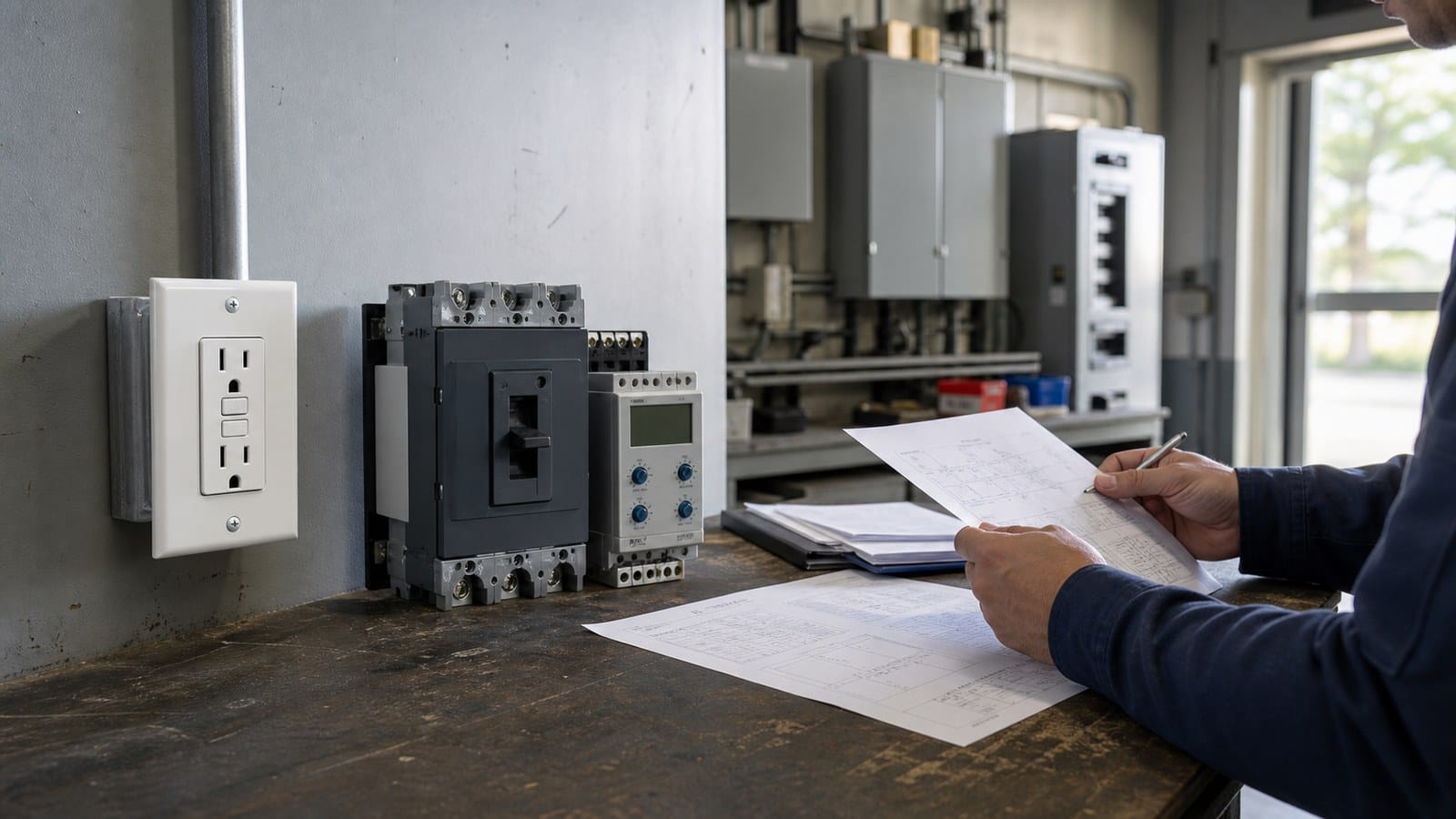
An AFCI outlet is more than a North American-style receptacle with a certification mark on the front. True compliance for the US market means the product has been properly tested, listed, documented, and is suitable for real-world installation under the National Electrical Code (NEC).
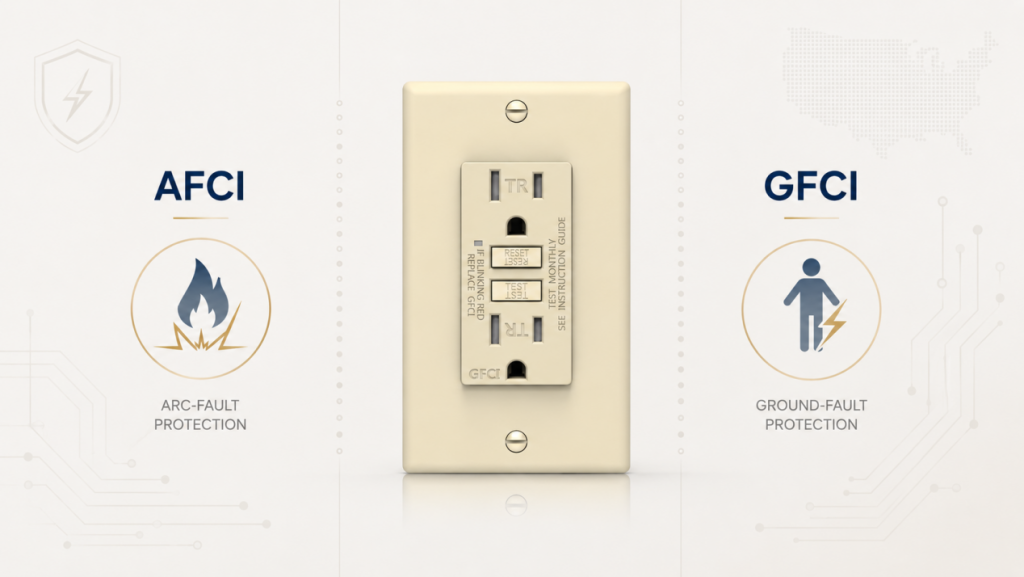
AFCI stands for Arc Fault Circuit Interrupter. It detects dangerous electrical arcs that can cause fires and shuts off the circuit before a hazard escalates. This makes AFCI outlets different from standard receptacles and from GFCI outlets (which protect against electric shock).
For buyers, distributors, and brands, the key question is not just “Does it work?” but:
Can this AFCI outlet pass certification review, meet the correct standards, support code-compliant installations, and remain consistent in mass production?
That is the standard that matters.
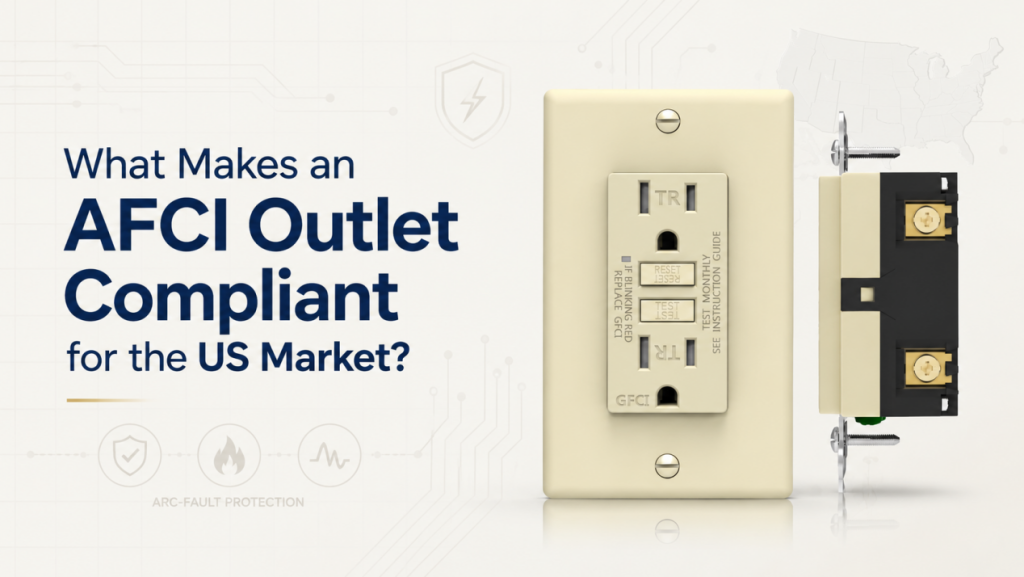
What Does “Compliant” Mean for an AFCI Outlet in the US Market?
For an AFCI outlet, “compliant” has several layers. A product can pass one layer and still fail another.
A receptacle may have the correct 15A or 20A configuration, but that does not prove it has arc-fault protection. A supplier may show a UL or ETL certificate, but that does not prove the exact model you are buying is covered by that listing. A device may be listed, but if the installation manual does not clearly explain Line / Load wiring or feed-through protection, it can still create field problems for electricians and inspectors.
A compliant AFCI outlet for the US market should be checked across these areas:
| Compliance Area | What Buyers Should Check | Why It Matters |
| Certification | UL, ETL, or another OSHA-recognized NRTL listing | Confirms recognized product safety evaluation |
| Product Category | AFCI receptacle or outlet branch-circuit AFCI listing | Avoids mixing up outlet and breaker requirements |
| Safety Standard | Applicable AFCI receptacle standard and related receptacle construction requirements | Confirms the product was tested under the right category |
| Ratings | 15A or 20A, 125V, correct NEMA configuration | Matches US residential and light commercial applications |
| Marking | Model number, certification mark, Test / Reset, Line / Load | Helps installers and inspectors verify the device |
| Documentation | Datasheet, installation manual, packaging, warning labels | Reduces installation errors and channel disputes |
| Production Consistency | Certified model matches samples and bulk shipments | Prevents compliance risk after the first order |
For B2B buyers, this is where many sourcing mistakes happen. They check the surface of the product, but not the chain behind it.
AFCI outlet compliance is a system, not a sticker.
AFCI Outlet Basics: What It Protects Against and How It Differs from GFCI
Before discussing UL, ETL, and NEC requirements, the product function has to be clear. AFCI and GFCI devices both interrupt power, but they are designed for different hazards.
AFCI Protection: Designed for Arc-Fault Fire Prevention
An AFCI outlet is designed to detect hazardous electrical arcing. Arc faults can occur when wiring is damaged, insulation breaks down, conductors become loose, or a connection point starts to degrade. These faults may happen behind walls, inside junction boxes, or at old terminal connections.
There are two common arc-fault patterns:
| Arc Fault Type | Typical Cause | Risk |
| Series arc fault | A loose or broken conductor within the same current path | Localized heating and possible ignition |
| Parallel arc fault | Current jumps between hot-neutral or hot-ground conductors | Higher fault energy and fire risk |
A properly designed AFCI outlet must do more than trip whenever it sees electrical noise. Normal switching, plugging, and unplugging can produce brief arcs. A compliant AFCI device needs to distinguish normal operating events from dangerous arc signatures.
That is why AFCI outlets require dedicated safety evaluation. They are not simply standard receptacles with extra buttons.
GFCI Protection: Designed for Ground-Fault Shock Protection
A GFCI outlet, or Ground Fault Circuit Interrupter, is designed to reduce electric shock risk. It monitors current imbalance between the hot and neutral conductors. If current is leaking through an unintended path, such as water or a person, the GFCI trips quickly.
That is why GFCI receptacles are common in bathrooms, kitchens, garages, laundry areas, outdoor locations, and other wet or damp environments.
The simple distinction is this:
| Device Type | Main Protection Purpose | Typical Hazard |
| AFCI outlet | Fire prevention | Dangerous arcing |
| GFCI outlet | Shock protection | Ground fault current leakage |
| Dual-function device | Fire + shock protection | Arc fault and ground fault |
AFCI and GFCI products are not interchangeable. A buyer who treats them as the same category is already starting from the wrong specification.
Dual-Function Devices Need Clearer Compliance Verification
Some products combine AFCI and GFCI functions. These may be useful in applications where both arc-fault and ground-fault protection are required, but they also increase the compliance burden.
For a dual-function receptacle, buyers should verify that both protection functions are covered in the certification scope. It is not enough for the supplier to say “AFCI + GFCI” in a brochure.
If the product includes smart monitoring, app connectivity, USB charging, or other added electronics, the listing scope becomes even more specific. Those features must match the certified configuration, not just the marketing name.
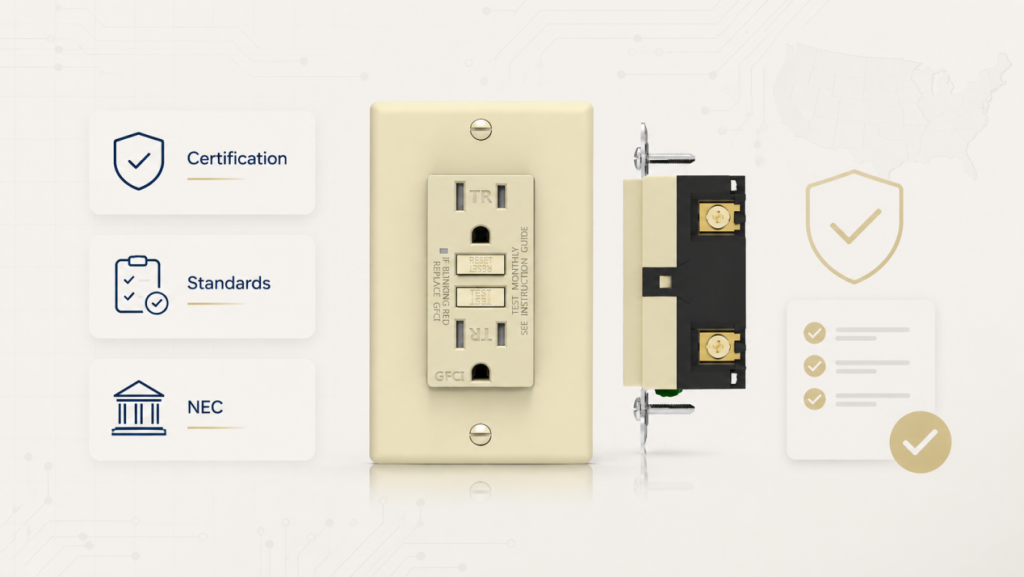
UL, ETL, and NRTL Listing: The First Gate for US Market Acceptance
For the US electrical market, certification is not optional for serious distribution. Retailers, project buyers, inspectors, and insurance-related reviews all expect electrical products to be listed by a recognized testing body.
Why NRTL Listing Matters
An NRTL, or Nationally Recognized Testing Laboratory, is a testing organization recognized by OSHA to evaluate products against applicable safety standards. UL and Intertek ETL are two well-known examples in the electrical product market.
A common mistake is assuming that “UL” is the only acceptable path. In many cases, ETL listing can also be accepted because ETL is issued by Intertek, an NRTL. The real question is not whether the mark looks familiar. The real question is whether the exact product is listed under the correct category and standard.
For AFCI outlets, buyers should confirm:
- The certification body is an OSHA-recognized NRTL.
- The exact model number is listed.
- The product category matches an AFCI receptacle or outlet branch-circuit AFCI device.
- The listing covers the actual configuration being purchased.
- The listing is active and searchable in the official directory.
A printed mark without a traceable listing is not enough.
UL vs ETL: What Buyers Should Understand
UL and ETL marks both indicate that a product has been evaluated by a recognized testing body, but they are not brand decorations. They must connect to a real listing file, product category, and standard.
For a US distributor, the safer process is straightforward: check the directory, match the model, and confirm the standard.
This matters in private-label and OEM projects. A supplier may have one listed AFCI outlet model, but the buyer requests a different face design, indicator light, terminal structure, packaging claim, or combined function. Those changes may move the product outside the original certification scope.
Do not assume one certificate covers every variation.
How to Verify an AFCI Outlet Certification
A serious supplier should be able to provide certification details without delay. For AFCI outlet sourcing, buyers should ask for:
- Certification file number
- Listed model number
- Product category
- Applicable standard
- Rated voltage and current
- Listing directory link or searchable record
- Installation instruction sheet
- Product photos showing markings
- Packaging artwork if private label is involved
Then compare the certificate, product label, sample, datasheet, and packaging. They should tell the same story.
If the certificate lists Model A, but the sample label shows Model B, pause the order. If the packaging claims dual-function protection but the listing only covers AFCI function, pause the order. These are not minor paperwork issues in the US market. They can affect channel approval, inspection acceptance, and product liability.
Which Safety Standards Should Buyers Check for AFCI Outlets?
AFCI products are not all evaluated under the same product category. This is where many buyer specifications become too loose.
AFCI Receptacle Standards Are Not the Same as AFCI Breaker Standards
An AFCI breaker and an AFCI receptacle serve related safety goals, but they are different products. A breaker is installed in the electrical panel. An AFCI outlet is installed at a receptacle location and may provide protection at the outlet and, depending on design and wiring, to downstream loads.
For buyers, the standard boundary matters.
AFCI breakers are commonly associated with UL 1699. AFCI receptacles or outlet branch-circuit AFCI devices are commonly associated with AFCI receptacle evaluation such as UL 1699A-related listing scope. The exact standard and category should always be verified through the certification record.
Do not buy an AFCI outlet based only on a breaker-related claim.
Receptacle Construction and Additional Functions Also Matter
An AFCI outlet is also a receptacle. That means the mechanical and electrical construction still matters: blade retention, terminal design, insulation material, temperature performance, face configuration, grounding path, and durability under repeated plug insertion.
Typical US-market configurations include:
| Specification | Common US Requirement |
| Voltage | 125V |
| Current | 15A or 20A |
| Receptacle style | NEMA 5-15R or NEMA 5-20R |
| Safety feature | Tamper-resistant design where required |
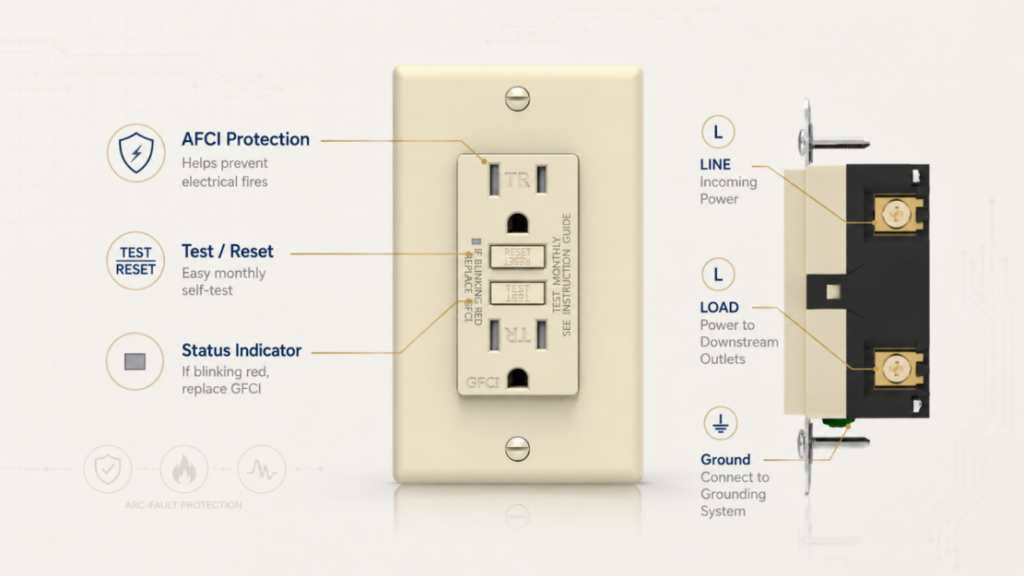
| User interface | Test / Reset buttons and status indication |
| Wiring | Clear Line / Load terminal identification |
If the device includes GFCI, USB, WR, TR, smart control, or other added functions, those configurations should be covered by the listing. A certified base model does not automatically certify every upgraded version.
For product managers and importers, this is one of the cleanest ways to avoid future claims: specify the exact configuration, then verify that the listing covers it.
NEC Requirements: Product Certification Does Not Automatically Mean Code-Compliant Installation
The NEC, or National Electrical Code, is an installation code widely adopted across the United States, often with local amendments. It does not replace product certification. It tells electricians, contractors, and inspectors how products should be applied in real electrical systems.
NEC Is an Installation Code, Not a Product Listing
UL or ETL listing answers one question: has the product been evaluated under the applicable safety standard?
NEC compliance answers a different question: can this product be used in this circuit, in this building, under the locally adopted code?
Both matter.
A listed AFCI outlet may still be the wrong solution for a specific branch circuit if the installation method, protection location, wiring type, or local inspection requirement does not match the intended application. Local AHJs, or Authorities Having Jurisdiction, often make the final call on project acceptance.
That is why a supplier should avoid absolute claims such as “This AFCI outlet can replace any AFCI breaker.” That statement is too broad.
Where AFCI Protection Is Commonly Required
AFCI protection is commonly required in many residential 15A and 20A branch circuits, especially in living areas. Over time, NEC editions have expanded AFCI protection requirements beyond the earliest bedroom-focused applications.
For buyers, the exact list of required areas is less useful than the principle: AFCI demand is tied to residential branch-circuit fire protection. It may apply differently depending on the NEC edition adopted in the target state, local amendments, and project type.
This affects product planning. A distributor serving renovation contractors may need a different AFCI product mix than a brand supplying new residential construction. A project supplier may also need both AFCI receptacle and breaker-based solutions, depending on the job.
Can an AFCI Outlet Replace an AFCI Breaker?
Sometimes an AFCI outlet can support a code-compliant solution, especially in replacement, retrofit, or renovation situations where panel changes are difficult. Outlet-level AFCI receptacles can be useful when installed at the right location and wired correctly.
But it is not an automatic replacement.
The decision depends on:
- Branch circuit design
- Whether the device is installed as the first outlet
- Line / Load wiring accuracy
- Whether feed-through protection is supported
- Conductor conditions and circuit length
- The NEC edition adopted locally
- AHJ acceptance
- Compatibility with upstream devices
In a real renovation project, this matters. For example, if a contractor is replacing receptacles in an older dwelling and the panel cannot easily accept AFCI breakers, a listed outlet branch-circuit AFCI receptacle may be considered. But the receptacle must be placed and wired according to its listing and the code path accepted by the local inspector.
AFCI outlets have value, but they need the right application context.
Product Marking, Wiring Instructions, and Documentation Buyers Should Review
Many compliance failures are visible before the product ever enters a jobsite. They appear on the product label, packaging, instruction sheet, or certification document.
Product Markings and Ratings
A US-market AFCI outlet should provide clear markings that help buyers, electricians, and inspectors identify the device. At minimum, buyers should review:
- 15A or 20A rating
- 125V rating
- Model number
- Certification mark
- Certification file number where applicable
- Manufacturer identification
- Test / Reset labeling
- Status indicator meaning
- TR marking if applicable
- Line / Load identification
- AFCI protection marking
If a sample has unclear markings, expect problems later. Field electricians do not have time to interpret vague labels. Inspectors do not approve products based on sales explanations.
Line / Load, Feed-Through Protection, and First-Outlet Clarity
Line / Load wiring is especially important for AFCI and GFCI receptacles. If the product is intended to protect downstream receptacles, the manual must clearly explain how feed-through protection works and under what conditions it applies.
This is not just a technical detail. It affects the protection zone.
A common problem in the field is installing a protective receptacle at the wrong point in the branch circuit. If the device is not at the first outlet, or if the Load terminals are not used correctly, downstream protection may not work as expected.
For B2B buyers, clear wiring instructions reduce installer confusion, product returns, and support calls. They also make the product easier for US channel partners to accept.
Test / Reset Instructions and User Maintenance
Test / Reset buttons are familiar on GFCI outlets, and AFCI outlets may also use a similar interface. The purpose is not cosmetic. The user needs a simple way to test the protection function and restore power after a trip.
A strong instruction sheet should explain:
- How to test the device
- What the indicator light means
- What to do after a trip
- When to contact a qualified electrician
- What not to connect if the device keeps tripping
For the US market, documentation is part of the product experience. Poor instructions turn a certified product into a support burden.
Compliance Checklist for Buying AFCI Outlets from Overseas Suppliers
When sourcing AFCI outlets from overseas suppliers, do not start with price. Start with compliance evidence.
Certification Checklist
Before placing an order, confirm:
- Is the product UL, ETL, or NRTL listed?
- Can the listing be found in the official directory?
- Does the model number match the sample?
- Does the product category match AFCI receptacle use?
- Does the listing cover the exact configuration?
- Is the certification active?
- Are private-label markings allowed under the supplier’s certification arrangement?
A PDF certificate can be useful, but it should never be the only proof.
Product and Packaging Checklist
Product and packaging claims must stay inside the certification scope. Buyers should compare:
| Item | What to Check |
| Product label | Model, rating, certification mark, Line / Load |
| Datasheet | Same model and electrical ratings as the listing |
| Manual | Correct wiring, testing, reset, warnings |
| Packaging | No unsupported claims such as unverified dual-function protection |
| Sample | Same configuration as the listed model |
| Private label artwork | Correct certification mark usage and required information |
This is especially important for OEM and ODM projects. A new logo is usually simple. A changed housing, added function, or revised terminal design may require additional review.
Supplier and Production Consistency Checklist
AFCI outlet sourcing is not only about passing the first test. Bulk production must remain consistent with the certified design.
A qualified supplier should be able to show:
- Experience with US-market receptacle products
- Stable production control for certified models
- Traceability for key components
- Routine electrical safety testing
- Clear packaging and manual control
- Support for certification document review
- Ability to supply related product lines such as GFCI outlets, USB receptacles, standard receptacles, switches, and wall plates
The cheapest AFCI outlet supplier is not always the lowest-risk supplier. In this category, inconsistent production can erase the value of the certificate.
Common AFCI Outlet Compliance Mistakes Buyers Should Avoid
Several mistakes appear again and again in overseas AFCI outlet sourcing.
The first is relying on the mark printed on the product without checking the listing directory. A certification mark is only meaningful when it connects to a valid listing record.
The second is confusing AFCI breakers with AFCI outlets. These products may be related, but they are not evaluated or applied in the same way.
The third is mixing AFCI, GFCI, and dual-function products in one loose specification. A buyer may request “AFCI GFCI outlet” when the project only needs one function, or the supplier may quote a product that does not match the requested protection.
The fourth is ignoring NEC and AHJ requirements. Product certification does not guarantee acceptance in every installation.
The fifth is accepting samples that differ from the certified production model. Small changes in terminals, face design, indicator lights, or internal components can matter.
The sixth is allowing packaging claims to go beyond the listing. In the US electrical market, overclaiming can create problems with distributors, inspectors, and liability reviews.
Compliance mistakes are not just paperwork errors. They affect whether a product can be sold, installed, inspected, and trusted.
How Faith Electric Supports AFCI and GFCI Solutions for the US Market
Faith Electric is a professional electrical manufacturer in China with 28 years of experience serving the North American market. Our product range covers UL / ETL certified wall-in electrical solutions, including GFCI outlets, AFCI outlets, USB receptacles, standard receptacles, switches, and wall plates.
For buyers, the value is not only the product itself. It is the ability to review specifications, certification information, packaging requirements, and market-fit details before bulk ordering.
If you are sourcing AFCI or GFCI receptacles for the US market, Faith Electric can support product selection, sample evaluation, certification document review, and stable production supply. Contact our team to discuss the right receptacle solution for your project or product line.