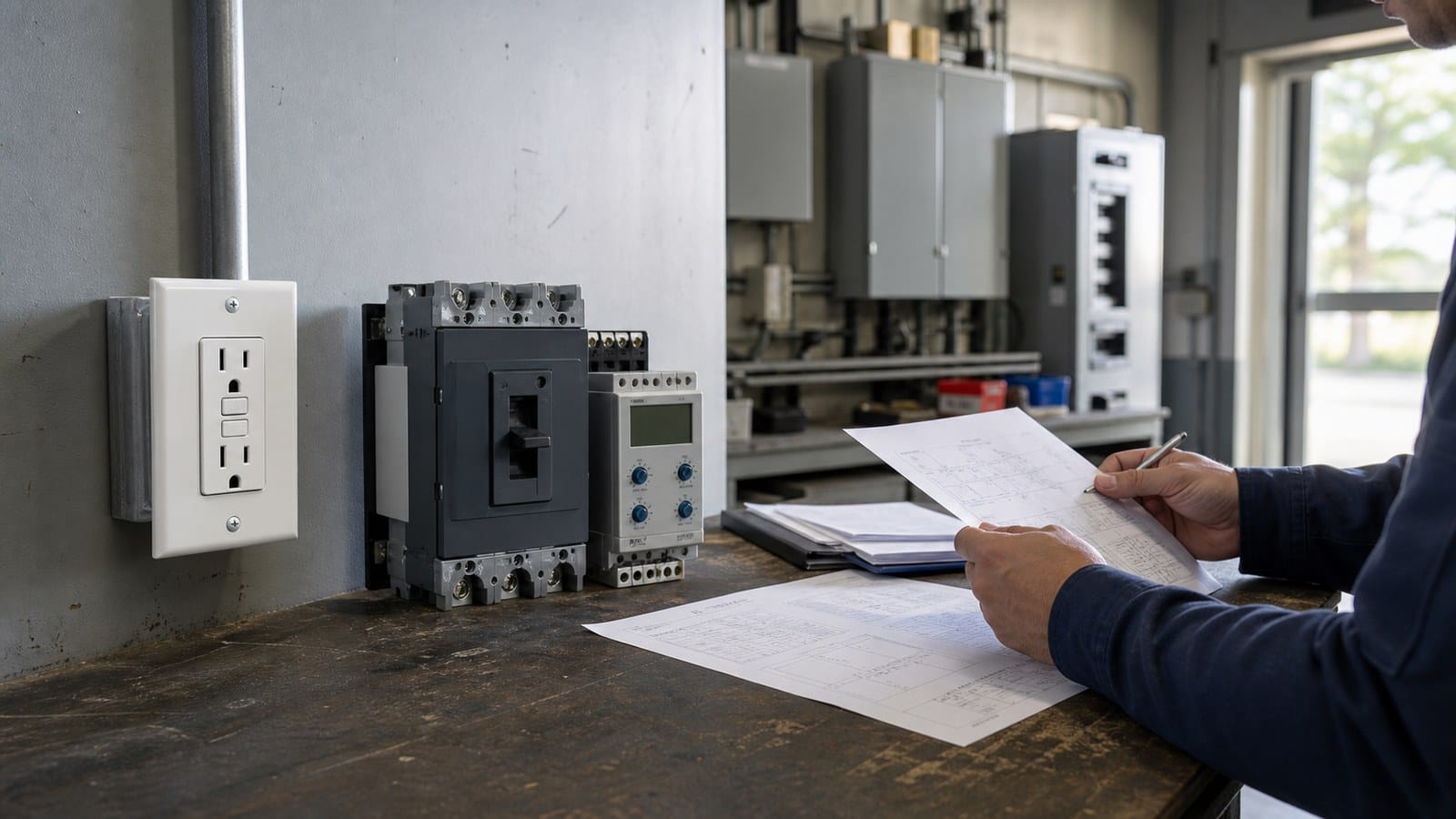
For most new residential construction, full home rewiring, or whole-branch-circuit protection, an AFCI breaker is usually the better choice.
For retrofit work, localized upgrades, or projects where the existing electrical panel cannot easily accept a compatible breaker, an AFCI outlet can be the more practical option.
That is the real answer behind AFCI outlet vs AFCI breaker. One is not automatically “better” in every case. The better choice depends on where protection needs to start, how the circuit is wired, what the local code requires, whether the panel is compatible, and how the project will be maintained after installation.
If you are a contractor, distributor, electrical wholesaler, or project buyer, the decision should not be based on device price alone. You are choosing a protection method for a circuit, a building type, and a long-term maintenance plan.
What AFCI Protection Does and Why It Matters
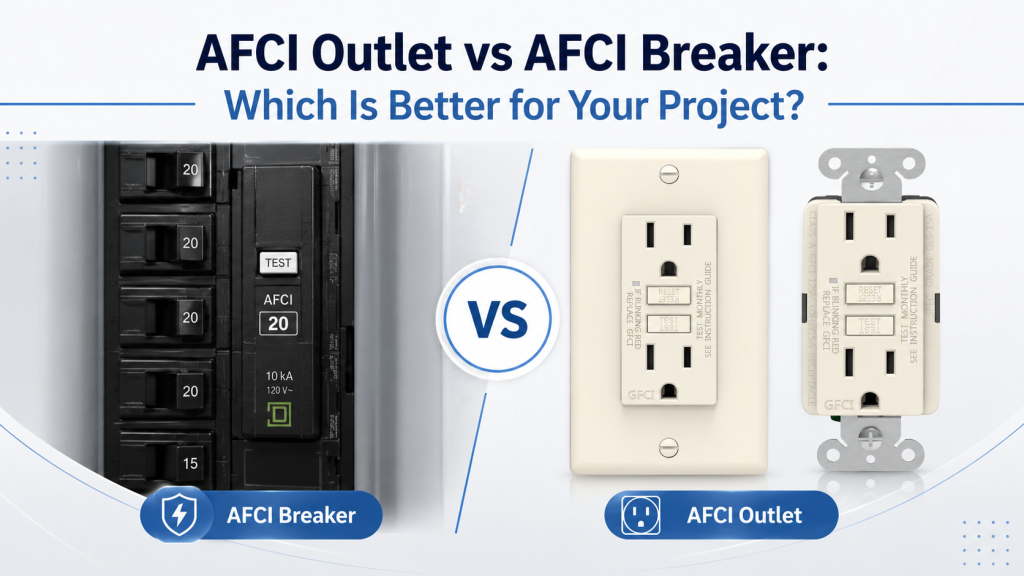
An AFCI, or Arc Fault Circuit Interrupter, is a protection device designed to detect dangerous electrical arcing and interrupt power before the condition develops into a fire risk.
An arc fault can happen when electricity jumps across a damaged, loose, or deteriorated connection. Common causes include frayed cords, cracked insulation, loose terminals, poor wiring work, corroded connections, pinched cables, or damaged conductors hidden inside walls.
A standard circuit breaker is mainly designed to respond to overloads and short circuits. That does not mean it will detect every dangerous arc pattern. Some arc faults do not draw enough current to trip a standard breaker, but they can still generate enough heat to ignite nearby insulation, wood framing, dust, or other combustible materials.
That is why AFCI protection exists.
AFCI protection should not be confused with GFCI protection. A GFCI, or Ground Fault Circuit Interrupter, is mainly designed to reduce shock risk from ground faults, especially in wet or damp areas. AFCI protection is mainly about electrical fire prevention. In some projects, both types of protection may be required, either through separate devices or dual-function protection.
For this article, the focus is narrower: AFCI receptacle vs breaker and which one makes more sense for a real project.
AFCI Outlet vs AFCI Breaker: Key Differences
An AFCI breaker is installed in the electrical panel. An AFCI outlet, also called an AFCI receptacle, is installed at the wall outlet location.
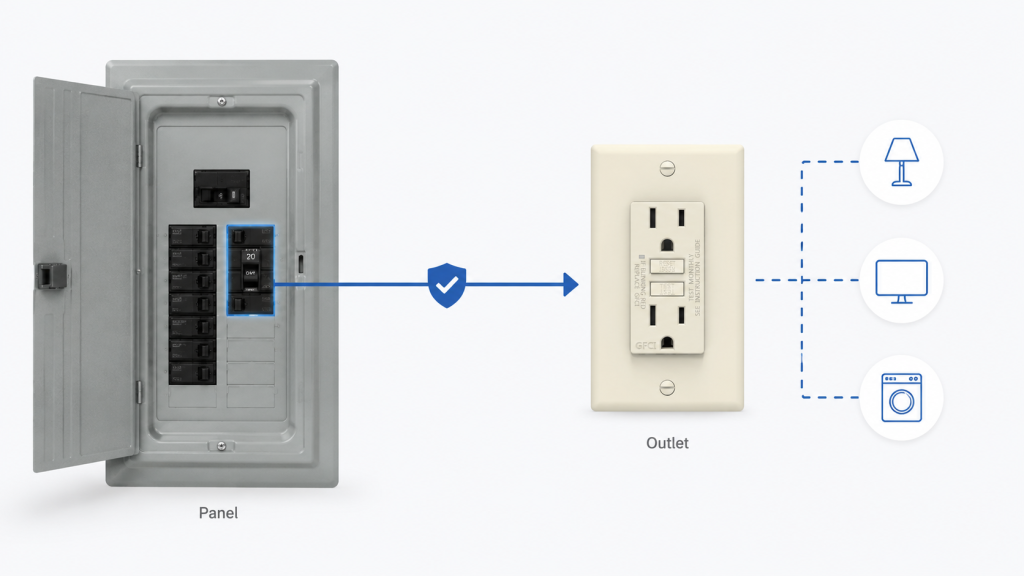
That physical difference changes almost everything: protection range, installation method, cost structure, troubleshooting, and code strategy.
| Comparison Point | AFCI Breaker | AFCI Outlet / AFCI Receptacle |
| Installation location | Electrical panel | Wall receptacle box |
| Typical protection logic | Branch-circuit level protection | Protection depends on placement and wiring |
| Best use case | New construction, full circuit upgrade, standardized projects | Retrofit, localized upgrade, panel-limited projects |
| Panel compatibility | Required | Less dependent on breaker panel compatibility |
| Upstream wire protection | Usually stronger from panel side | Does not automatically protect upstream wiring |
| Testing / reset location | At panel | At receptacle location |
| Cost logic | Better for standardized or whole-circuit work | Better for selected outlet or limited retrofit work |
| Main risk if misapplied | Wrong breaker/panel match | Incorrect placement may leave protection gaps |
Installation Location
AFCI breakers are installed at the distribution panel. This makes them a natural choice when the project is already touching the panel, such as new construction, whole-house rewiring, or a major renovation.
AFCI outlets are installed in the wall box, similar to a GFCI receptacle. This makes them easier to apply in certain retrofit situations where panel work is limited, expensive, or impractical.
For example, in a 20-year-old residential remodel where the panel has limited space or uses an older breaker series, replacing multiple breakers may not be straightforward. An AFCI outlet may provide a practical path for selected circuit protection, but only when the wiring layout and local code allow it.
Protection Coverage
This is the most misunderstood part of the AFCI outlet vs AFCI breaker discussion.
An AFCI breaker is installed at the panel and is commonly used for branch-circuit protection. Since it sits at the supply side of the circuit, it can protect the circuit from the panel outward, based on the device type and installation method.
An AFCI outlet protects according to where it is installed and how line/load wiring is connected. It may protect downstream wiring and devices, but it does not automatically protect upstream wiring between the panel and the receptacle.
So the location matters.
If an AFCI outlet is installed too far downstream, part of the circuit may remain outside its protection range. That is why an AFCI outlet should not be treated as a simple plug-and-play replacement for an AFCI breaker in every project.
Panel Compatibility
AFCI breakers must match the panel system. The brand, breaker type, panel listing, available space, amperage, and circuit design all matter.
In new construction, this is easy to plan. A contractor can specify compatible 15-amp or 20-amp AFCI breakers for 120-volt branch circuits during the design stage.
In retrofit work, the panel may be the problem. Older panels may lack space, accept fewer modern breaker options, or require a panel upgrade before AFCI breakers can be installed properly. That is where an AFCI outlet can become a practical alternative for certain circuits.
This does not make the outlet “better” in a technical sense. It makes it more workable under certain site conditions.
Cost and Labor
AFCI outlets are often attractive in small retrofit jobs because the device can be installed at the receptacle location without replacing a breaker at the panel.
But total project cost is not the same as device price.
A contractor comparing an AFCI outlet cost against an AFCI breaker cost should look at:
- device price
- electrician labor
- panel access
- breaker compatibility
- possible panel upgrade
- number of circuits involved
- inspection and rework risk
- future maintenance time
For one bedroom outlet upgrade, an AFCI outlet may be economical. For a new 2,000-square-foot home with multiple 15A and 20A branch circuits, breaker-based AFCI protection may be easier to standardize and manage. For a 25-circuit older home, the cost picture can change quickly if the panel needs replacement or rewiring before AFCI breakers can be used.
The right question is not “Which device is cheaper?”
The right question is: Which method gives the required protection with the lowest total installed risk?
Testing and Maintenance
AFCI breakers are tested and reset at the panel. AFCI outlets are tested and reset at the wall device.
That difference matters in multifamily housing, rental units, hotels, dormitories, and managed residential properties.
If tenants can access an AFCI outlet reset button, minor nuisance trips may be easier to handle without opening an electrical room. If the project is managed by facility staff and all reset points are preferred at the panel, breakers may be more controlled.
Neither approach is universally better. Maintenance access should match how the property is operated.
When an AFCI Breaker Is the Better Choice
An AFCI breaker is usually the stronger choice when the project needs broad, clean, branch-circuit-level protection.
New Residential Construction
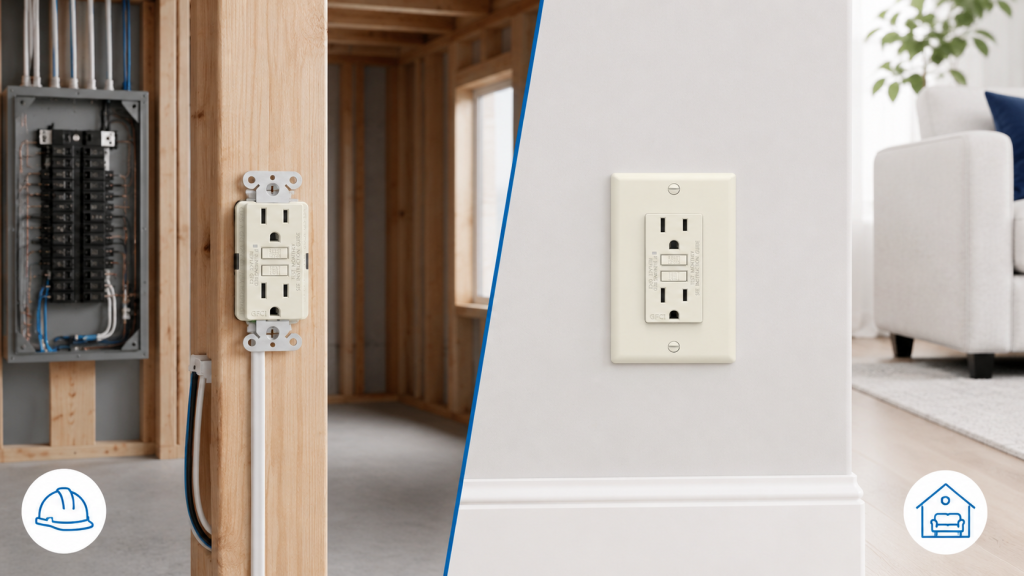
For new homes, AFCI breakers are often the cleaner solution. The electrical plan can specify compatible breakers, circuit ratings, panel capacity, and protection requirements before installation begins.
This reduces guesswork.
A new residential project may include multiple 120V, 15A and 20A circuits for bedrooms, living rooms, kitchens, laundry areas, hallways, and other areas depending on the adopted code. When the panel and branch circuits are designed together, AFCI breakers fit naturally into the system.
They also simplify inspection logic. The inspector can see AFCI protection at the panel and verify breaker types more directly.
Full Home Renovation or Whole-Circuit Upgrade
If the project is already replacing wiring, upgrading the panel, or rebuilding branch circuits, an AFCI breaker is usually the more direct option.
A full renovation is not the same as swapping one receptacle. When walls are open and circuits are being reworked, protecting the branch circuit from the panel side is often the better engineering decision.
This is especially true when the project scope includes multiple rooms, multiple outlets, lighting circuits, and long cable runs behind walls.
Projects with Standardized Electrical Panels
For builders, contractors, and distributors working with repeated project models, standardization matters.
If the panel system is known and the breaker compatibility is clear, AFCI breakers are easier to specify in batches. This is common in tract housing, multifamily developments, and large renovation programs where repeatability reduces installation errors.
The more standardized the panel design, the stronger the case for AFCI breakers.
When an AFCI Outlet Makes More Sense
An AFCI outlet is not a weak product. It is a different protection method for a different set of constraints.
It makes the most sense when the project is localized, the panel is difficult to modify, or the protection target is downstream from a clear receptacle location.
Retrofit and Old House Upgrades
Older homes create practical problems. The panel may be crowded. Compatible AFCI breakers may be hard to source. The owner may not want a full panel replacement. The project may only involve one room, one circuit segment, or one outlet location.
In these cases, an AFCI outlet for retrofit work may reduce the amount of panel-side labor.
For example, a contractor upgrading outlets in a bedroom of an older property may consider an AFCI receptacle if the circuit layout allows the device to protect the intended downstream section and the local authority accepts that method.
The key phrase is “if the circuit layout allows it.”
Localized Protection Needs
Some projects are not whole-home upgrades. A remodel may involve one finished room, a small apartment unit, or a selected area where wiring changes are limited.
If protection is needed for a known downstream load or a defined section of a circuit, an AFCI outlet can be a practical choice. It also keeps test and reset access at the point of use, which can be useful in tenant-facing environments.
But the installer must understand line and load connections. Incorrect wiring can leave the expected downstream outlets unprotected or create confusion during troubleshooting.
Projects Where Panel Work Is Limited
Sometimes the issue is not technical preference. It is site reality.
A project may have limited access to the electrical room. The panel may be shared. The breaker series may be discontinued. The owner may not approve panel replacement. Work hours may be restricted in an occupied building.
In those cases, an AFCI outlet may keep the project moving without turning a small upgrade into a large electrical renovation.
That does not remove the need for code review. It simply gives the contractor another path to evaluate.
Can an AFCI Outlet Replace an AFCI Breaker?
Sometimes, but not automatically.
An AFCI outlet may be acceptable in certain retrofit or localized protection applications. It can provide AFCI protection when installed correctly, located properly, and accepted by the applicable code and the authority having jurisdiction.
But an AFCI outlet is not always equal to an AFCI breaker.
The main limitation is upstream protection. Since the outlet is installed at the receptacle location, wiring between the panel and that receptacle may not receive the same protection as it would with an AFCI breaker at the panel.
Before using an AFCI outlet instead of an AFCI breaker, confirm three things:
- Is the AFCI outlet installed at the correct point in the circuit?
- Does the wiring method allow the intended downstream protection?
- Does the adopted NEC edition, local code, and AHJ accept this method for the project?
For a new construction branch circuit, the AFCI breaker is usually easier to justify. For a retrofit where the panel is difficult to modify, an AFCI receptacle may be a reasonable solution when installed under the right conditions.
This is where experienced electricians and code review matter. The product choice should follow the circuit design, not the other way around.
Code, Certification, and Product Selection Considerations
AFCI selection is not only a product question. It is also a compliance and procurement question.
NEC, Local Code, and AHJ Requirements
In the U.S. market, AFCI requirements are tied to the National Electrical Code, especially branch-circuit protection rules such as NEC 210.12. But projects do not follow the NEC in a vacuum.
Different states and cities may adopt different NEC editions. Local amendments may apply. The authority having jurisdiction, or AHJ, makes the final call during inspection.
That means a blog article should not be treated as a project approval document. The safe approach is to confirm the local requirement before deciding whether an AFCI breaker, AFCI outlet, or another approved configuration is acceptable.
AFCI breaker is commonly used for branch-circuit protection because the protection point is clear. AFCI outlet can be valid in certain applications, but the installation method must be defensible.
UL / ETL Certification
For the North American market, certification is not a marketing detail. It is part of the product’s ability to enter real projects and distribution channels.
AFCI devices should be selected based on the applicable UL or ETL listing, electrical rating, product category, and installation instructions. For buyers, that means checking more than the front label.
A distributor or contractor should review:
- listed certification mark
- voltage and amperage rating
- device type and intended application
- wiring instructions
- packaging and labeling for the U.S. market
- consistency across bulk orders
A low-cost device without the right certification can create delays, failed inspections, warranty exposure, and channel risk.
Match the Product to the Project
A good AFCI product selection process should start with the project, not the catalog.
For a contractor, that means checking the circuit design, panel compatibility, device location, and local code path.
For a distributor, that means stocking products that match real customer scenarios: new construction, retrofit, replacement, multifamily maintenance, and retail electrical upgrades.
For an OEM or private-label buyer, that means asking whether the manufacturer can support certification, packaging, stable production, documentation, and long-term supply.
The device must fit the project. The supplier must fit the market.
Project-Based Selection Guide
The fastest way to compare AFCI outlet vs AFCI breaker is to look at project type.
| Project Type | Better Starting Point | Why |
| New home construction | AFCI breaker | Easier branch-circuit planning and panel-level protection |
| Full home renovation | AFCI breaker | Works well when wiring and panel work are already included |
| Old house retrofit | Depends on panel condition | AFCI outlet may help when breaker compatibility is limited |
| Single-room upgrade | AFCI outlet may be practical | Lower disruption when downstream protection is acceptable |
| Multifamily housing | Depends on maintenance plan | Reset location, tenant access, and standardization matter |
| Hotel or rental renovation | Depends on downtime and access | Outlet may reduce panel work; breaker may centralize control |
| Distributor inventory | Both | Different customers need different installation solutions |
New Home Construction
Start with AFCI breakers. They are easier to integrate during panel planning and branch circuit design.
Old House Retrofit
Check the panel first. If compatible AFCI breakers are available and panel work is reasonable, breaker protection may still be preferred. If not, evaluate AFCI outlets for selected circuits or downstream protection zones.
Multifamily or Rental Projects
Look beyond initial installation. Maintenance access matters. If every reset requires maintenance staff to access an electrical room, that affects operations. If tenants reset devices themselves, the property manager must be comfortable with that setup.
Electrical Distributors and OEM Buyers
For distributors, the right answer is often not choosing only one device type. The market needs both.
A contractor doing new builds may need AFCI breakers. A remodeler working in older homes may ask for AFCI receptacles. A wholesaler serving both groups should understand the difference and avoid treating all AFCI products as interchangeable.
For OEM buyers, product stability, certification, packaging, and documentation matter as much as the device itself.
Final Recommendation
If your project needs full branch-circuit protection, new construction planning, or standardized electrical installation, an AFCI breaker is usually the better choice.
If your project is a retrofit, a localized upgrade, or a situation where panel compatibility limits breaker installation, an AFCI outlet may be the better practical solution.
But an AFCI outlet should not be treated as an automatic replacement for an AFCI breaker. Its protection range depends on placement and wiring. Code acceptance depends on the adopted NEC edition, local rules, and AHJ interpretation. Cost should be judged by total installed cost, not only the device price.
Faith Electric is a China-based electrical manufacturer with 28 years of experience serving the North American market. We provide UL/ETL certified in-wall electrical solutions, including AFCI/GFCI safety outlets, USB outlets, standard receptacles, switches, and wall plates for distributors, contractors, electrical wholesalers, and OEM/ODM buyers.
Contact Faith Electric to discuss certified AFCI outlet solutions and complete wiring device supply for your next U.S. market project.