
I’ve been in the wiring devices business since the mid-90s. Seen too many bulk orders go wrong—contractors stuck with non-compliant stock, inspectors rejecting installations, callbacks eating margins. GFCI receptacles protect against ground faults by tripping at 4–6 mA leakage, usually within 25–30 ms. But cheap or outdated units compromise that protection fast.
For bulk buys—whether you’re a contractor loading up for a multifamily project, a distributor stocking shelves, or an OEM integrating into assemblies—five checks separate good decisions from expensive mistakes. Miss one, and you risk safety, code violations, or rework.
At Faith Electric, we participate in the UL Standards Committee for UL 943 (GFCI), UL 943B, and UL 1699 (AFCI). That gives us early visibility into spec changes. Here’s what matters most right now.
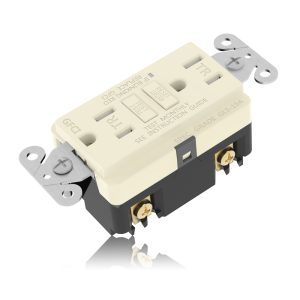
1. Certification, Compliance, and Self-Testing Capability
Start here. Every GFCI receptacle sold today in North America must carry UL 943 listing (or ETL equivalent). Since the 2015 update to UL 943, all new-manufactured receptacles require auto-monitoring/self-testing. The device runs internal diagnostics—typically every few seconds to every 30 seconds depending on design—and if critical components fail (sensing circuit, SCR, solenoid), it must deny power or lock out reset. End-of-life indication (flashing LED or no reset) prevents false security.
NEC (2023 edition, with ongoing adoptions) references these UL requirements and mandates GFCI in more locations: bathrooms, kitchens (all receptacles now, not just countertops), garages, outdoors, basements, laundry areas, and certain food-prep zones in non-dwelling units.
What to verify in bulk:
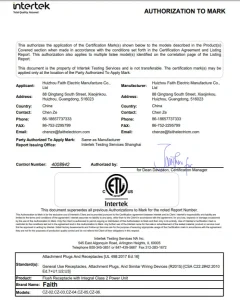
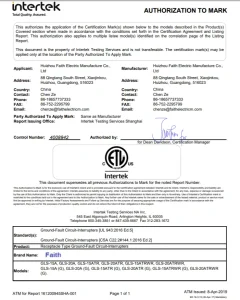
- Look for “UL Listed” or “ETL Listed” mark + file number on the device and box.
- Confirm self-test/auto-monitor compliance (post-2015 production).
- Ask for batch-specific COA or third-party test reports showing trip time <30 ms at 4–6 mA.
- Check database yourself on UL.com or ETL site—don’t trust seller claims.
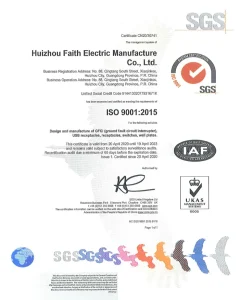
Manufacturers active on the UL 943 committee (like us at Faith Electric, the only one in Greater China region) track revisions closely. We build to the latest before enforcement dates hit. Skip this check, and you might receive old non-self-test inventory that fails inspection or creates liability.
2. Build Quality and Internal Materials
Durability shows in the internals. Cheap GFCIs use inferior contacts that corrode or overheat under repeated cycles or humidity.
Key elements:
- Contacts: Phosphor bronze or tin-plated copper resist corrosion and maintain low resistance. Brass or copper-clad steel degrades faster, risks arcing or failure.
- Housing: Flame-retardant polycarbonate (PC) rated 750°C+ glow-wire. ABS plastic melts or warps under heat stress.
- Assembly: Tight tolerances, no flash on plastic, consistent soldering.
Quick field checks on samples:
- Weight: Quality units feel heavier (better metals).
- Disassemble one: Contacts should look shiny, no oxidation; internals clean.
- LED indicator: Reliable units have clear status LEDs (green power, red tripped, flashing end-of-life).
In bulk, inconsistent batches kill reliability. We use patented contact designs for better corrosion resistance without jacking price—important when you’re buying hundreds or thousands.
Cut corners on materials, and field failure rates climb. We’ve seen contractors replace entire floors because contacts oxidized in humid climates.
3. Product Type, Features, and Application Match
Match the GFCI to the job. NEC dictates features by location.
Common types:
- Standard self-test GFCI: Basic protection, LED status.
- Tamper-Resistant (TR): Internal shutters block foreign objects—required in dwellings since NEC 2008.
- Weather-Resistant (WR): Extra seals, corrosion-resistant internals—for outdoors, bathrooms, kitchens, garages.
- Amp rating: 15A or 20A. 20A handles higher loads (e.g., appliances); mismatch causes nuisance trips or overheating.
- Feed-through (downstream protection): LOAD terminals protect additional outlets on the circuit.
Matching guide (quick table):
| Location | Required Features | Recommended Spec |
| Indoor dry (general) | Self-test, basic TR | 15A/20A TR self-test |
| Bathrooms / Kitchens | Self-test, TR, WR if near sink | 15A/20A TR WR self-test |
| Outdoors / Garages | Self-test, WR, extra corrosion | 20A WR TR self-test |
| Commercial / Multi-family | Self-test, TR, high-cycle durability | 20A TR self-test, heavy-duty |
Buy uniform type across project. Mixing creates confusion during install and inspection. Prioritize self-test + TR/WR combos now—NEC keeps expanding coverage.
4. Electrical Specifications and Real-World Performance
Specs must align with circuit and load.
Core checks:
- Voltage: 125V standard for North America.
- Amp rating: Match breaker and wire (15A on 14 AWG, 20A on 12 AWG).
- Trip sensitivity: 4–6 mA Class A, trip <25–30 ms.
- Downstream protection: Confirm LOAD side works—test with GFCI tester on samples.
- Reverse wiring: Modern units won’t reset if LINE/LOAD swapped.
Use a plug-in GFCI tester on samples. Press TEST—should trip instantly. Simulate faults at different points. Inconsistent trip or no downstream protection means reject the lot.
We’ve tested thousands of units. Good ones hold tight tolerances across batches. Poor ones vary 10–20 ms or fail downstream.
5. Brand, Supplier Reliability, and Total Cost of Ownership
Brand matters. Established names (Leviton, Eaton, Pass & Seymour) deliver consistent quality and support. But for bulk, look beyond name—check supply chain stability, MOQ flexibility, lead times.
Red flags:
- No traceable batch numbers (recall nightmare).
- Too-cheap pricing (usually cuts corners on materials or skips full testing).
- Short/no warranty (1 year vs 5–10 years).
- Poor support (no tech docs, slow samples).
Faith Electric focuses on North American market: UL/ETL certified, 28+ years manufacturing, committee participation for standards insight. We offer competitive bulk pricing without sacrificing self-test reliability or materials. Many contractors and distributors use us for high-volume runs—stable supply, customization options, and direct factory support cut total cost.
Final Thoughts
Bulk purchasing GFCI outlets is not about finding the lowest unit cost.
It is about reducing hidden risk.
Before placing a large order:
- Verify compliance beyond labels
- Test self-test reliability at scale
- Scrutinize build quality, not descriptions
- Match specifications to real environments
- Choose suppliers who understand standards, not just certifications
If you are sourcing GFCI outlets for North America and want to review specifications, certifications, or request production samples, it is worth having that conversation early—before volume locks in decisions that are expensive to reverse.
About the Author
Faith Electric is a professional electrical manufacturer with 28+ years of experience, specializing in UL/ETL-certified wiring devices for the North American market, serving contractors, distributors, and OEM partners worldwide. Contact us today to request a free sample.
References / Data Sources:
https://www.nfpa.org
https://www.ul.com


.jpg)