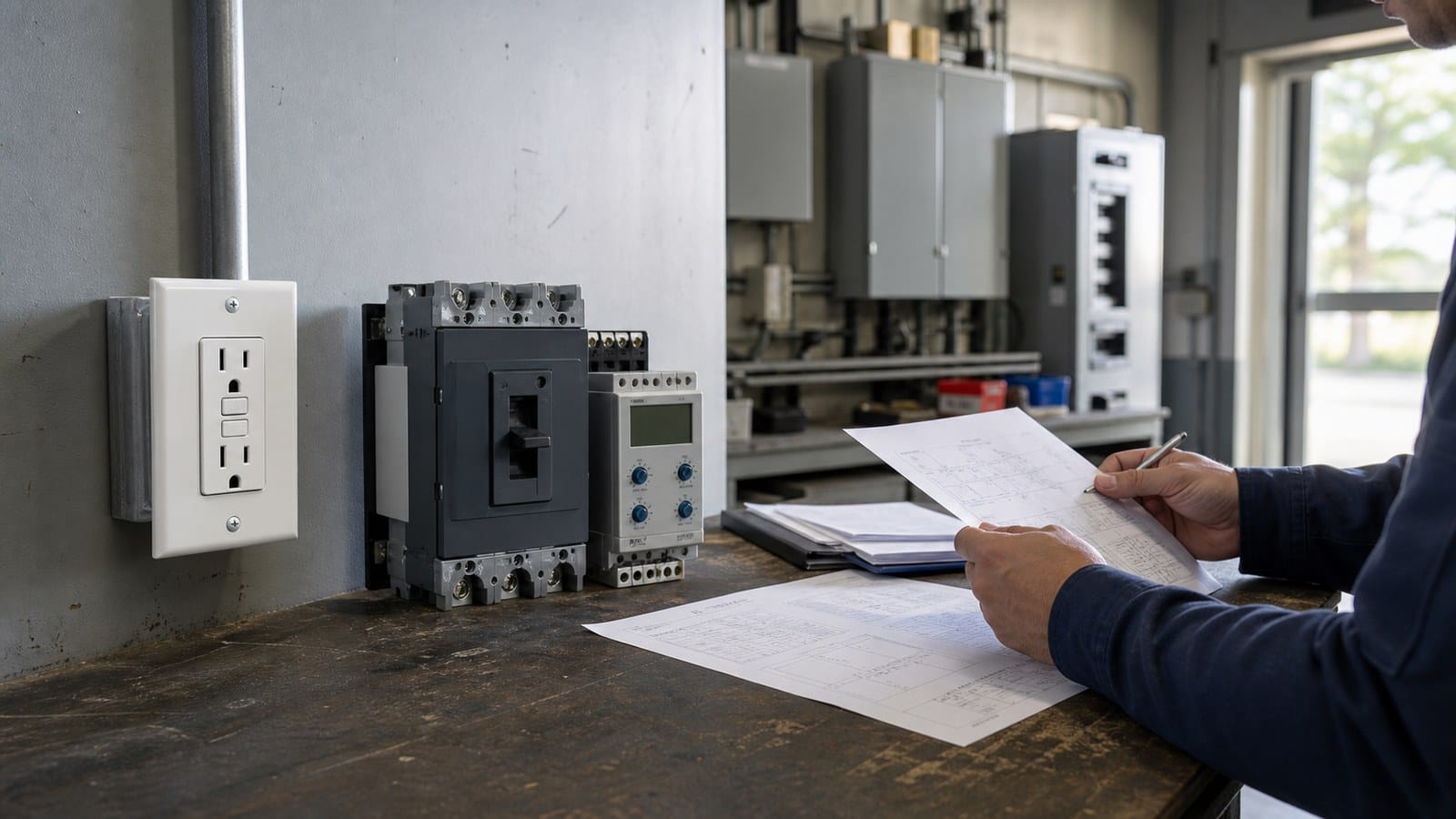
A bathroom receptacle in a 1960s home is different from a bedroom wall outlet. A kitchen countertop outlet being replaced during a remodel is different from an untouched outlet that has been in place for decades. A garage circuit serving power tools or a freezer is different from a living room receptacle behind a sofa.
From a code standpoint, some older installations may be treated as existing conditions.
From a safety standpoint, GFCI protection should be one of the first upgrades considered in wet, damp, unfinished, and outdoor areas.

Why Many Older Homes Were Built Without GFCI Protection
A GFCI, or Ground Fault Circuit Interrupter, is a safety device designed to reduce electric shock risk. It monitors the current leaving through the hot conductor and returning through the neutral conductor. If the device detects a small imbalance, often around 5 milliamps, it trips quickly and cuts power.
That matters because a normal circuit breaker is not designed mainly to protect people from shock. A breaker protects the circuit from overload or short circuit conditions. A GFCI reacts to leakage current that may be passing through water, a damp surface, a tool, or a person.
Many older homes were built before GFCI protection became common in residential wiring. Earlier electrical codes required GFCI protection in fewer locations. Over later code cycles, the requirements expanded into more areas such as bathrooms, garages, kitchen countertop receptacles, unfinished basements, crawl spaces, laundry areas, outdoor outlets, and receptacles near sinks.
That is why an older home may have ordinary receptacles in places where a new installation would now require GFCI protection.
This does not always mean the original installation was wrong. It often means the house was built under an earlier code standard.
The practical problem appears when the home is repaired, remodeled, sold, inspected, or upgraded. At that point, the old system may need to meet newer safety expectations in the areas being touched.
When an Older Home May Need GFCI Upgrades
The word “required” becomes clearer when you look at trigger events. In older homes, GFCI upgrades are often required when new electrical work is performed, when existing receptacles are replaced, or when a local inspector requires correction.
Replacing an Existing Outlet
Replacing a receptacle may look like a small job, but the location matters.
If an old standard outlet in a bathroom, garage, laundry area, outdoor wall, basement, or kitchen countertop area is replaced, current GFCI protection rules may apply. The same is often true when a damaged or worn receptacle is swapped out in an area that is now covered by modern code.
For example, a 1970s kitchen may still have standard duplex receptacles above the countertop. If those receptacles are replaced during a cabinet, countertop, or appliance upgrade, the project may need GFCI protection for the countertop outlets.
The key point is simple: replacing old outlets with GFCI protection is not only a safety decision. In many renovation or repair situations, it becomes a code compliance issue.
Remodeling, Adding Circuits, or Expanding Electrical Work
Remodeling usually changes the answer.
A bathroom remodel, kitchen upgrade, garage conversion, basement finishing project, or new laundry area can trigger current code requirements for the work being performed. New receptacles and modified circuits are usually not judged by the code from 40 years ago. They are judged by the current local rules adopted for that project.
Common trigger situations include:
- Adding receptacles near a sink
- Replacing kitchen countertop outlets
- Installing new outdoor receptacles
- Extending a garage or basement circuit
- Reworking laundry room wiring
- Adding a receptacle for a dishwasher, appliance, or utility equipment
- Upgrading wiring in a bathroom or wet area
A homeowner may think, “I am only replacing a few outlets.” An electrician or inspector may see something different: a modified branch circuit in a location where GFCI protection is expected.
That difference is where many old-home GFCI questions begin.
Home Inspection, Selling, or Insurance Requirements
Missing GFCI protection is common in older-home inspection reports. It is especially common in bathrooms, kitchens, garages, basements, and outdoor receptacles.
Usually, this is not a deal killer.
For a buyer, missing GFCI protection is often a correctable safety upgrade rather than proof that the entire electrical system is defective. For a seller, adding GFCI protection in key areas before listing a home may reduce negotiation problems after inspection.
Insurance requirements, rental property rules, and local housing standards can also affect whether an older installation needs correction. These requirements are not always the same as NEC language, but they matter in real projects.
For older homes, the safest question is not only “Was this legal when the house was built?” It is also “Will this pass the local inspection, sale, rental, or remodeling requirement now?”
Where GFCI Protection Is Commonly Required in Older Homes
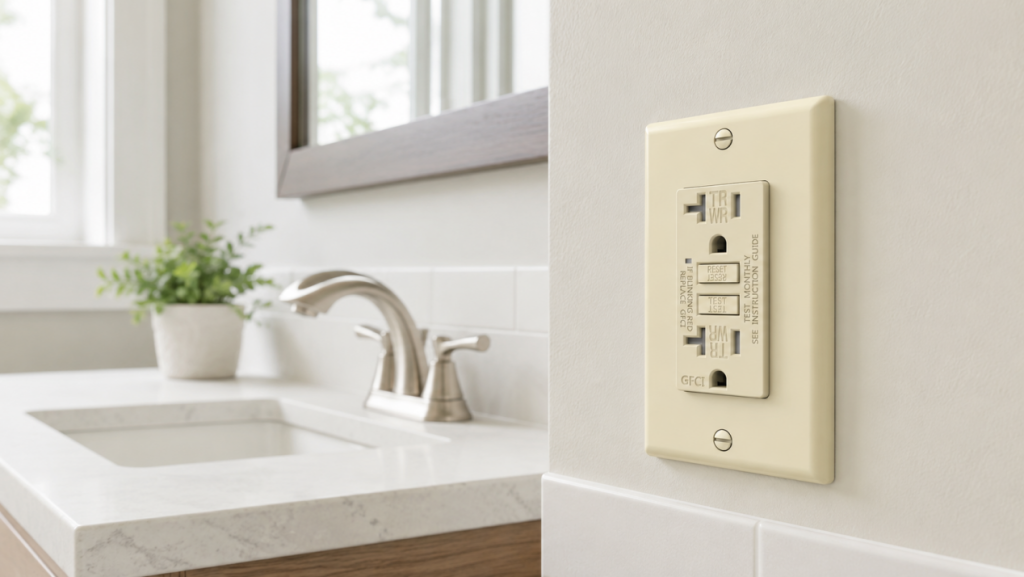
GFCI protection is mainly associated with areas where people, water, grounded surfaces, tools, or outdoor conditions create higher shock risk. The exact rule depends on the code version and local adoption, but the following areas are the first places to check.
| Area in an Older Home | Why GFCI Protection Matters | Practical Note |
| Bathrooms | Water, bare feet, metal plumbing, personal grooming devices | Usually one of the highest-priority upgrade areas |
| Kitchen countertops | Small appliances used near sinks and grounded surfaces | Often checked during kitchen remodels |
| Garages | Damp floors, power tools, freezers, extension cords | Common issue in old-home inspections |
| Unfinished basements | Moisture, concrete floors, utility equipment | Often overlooked in older homes |
| Outdoor receptacles | Rain, irrigation, yard tools, holiday lights | Use weather-resistant devices and proper covers |
| Laundry areas | Water supply, appliances, grounded equipment | Frequently included in modern GFCI requirements |
| Crawl spaces and utility rooms | Damp conditions and service equipment | Should be checked during maintenance or upgrades |
| Receptacles near sinks | Water contact risk | Often judged by distance and room type |
Bathrooms and Sink Areas
Bathrooms are the easiest case to understand. Water and electricity are used close together. Hair dryers, shavers, chargers, heated devices, and damp hands create a direct shock hazard.
In older homes, bathroom receptacles may still be ordinary two-slot or three-slot outlets with no visible GFCI device. These should be treated as priority upgrade points.
Receptacles near sinks in other rooms can also fall under GFCI protection rules. The exact distance and location requirements depend on code version and local interpretation, but sink proximity is one of the most common reasons a receptacle needs protection.
Kitchens and Countertop Receptacles
Kitchen countertop receptacles are high-use outlets. Coffee makers, blenders, toasters, rice cookers, mixers, and other small appliances are often used near sinks or wet surfaces.
That makes kitchen countertop areas one of the most common old-home GFCI upgrade points.
A typical older kitchen may have several standard outlets along the counter. During a remodel, these may need to be protected by GFCI receptacles, an upstream GFCI device, or a GFCI breaker. The best method depends on the circuit layout and the panel condition.
Garages, Basements, and Crawl Spaces
Garages and unfinished basements are not always wet, but they are often damp, grounded, and rough-use spaces. Concrete floors, metal tools, portable equipment, battery chargers, freezers, and extension cords all increase risk.
A garage outlet feeding a workbench is a different risk category from a bedroom outlet feeding a lamp.
Crawl spaces and utility areas also deserve attention. These areas may contain service equipment, damp surfaces, limited working clearance, and older wiring that has not been inspected for years. GFCI protection in these spaces is not just a code topic. It is a practical service safety issue.
Outdoor, Laundry, and Utility Areas
Outdoor receptacles are exposed to weather, irrigation water, snow, soil moisture, and temporary loads. Even when the receptacle is covered, the environment is not controlled like an interior room.
For outdoor upgrades, GFCI protection should be paired with the right device type. A weather-resistant GFCI outlet and a proper in-use cover are usually part of a better installation.
Laundry rooms and utility spaces are also common problem areas in old houses. Washers, utility sinks, sump pumps, and service equipment bring water and electrical loads into the same zone. These areas should not be treated as ordinary dry-room receptacle locations.
GFCI Protection Does Not Always Mean Every Outlet Must Be a GFCI Outlet
This is one of the most common misunderstandings.
Electrical code often requires GFCI protection. That does not always mean every receptacle must physically be a GFCI outlet with “Test” and “Reset” buttons on the face.
GFCI protection can be provided in several ways.
Upstream GFCI Outlets Can Protect Downstream Receptacles
A properly wired GFCI receptacle can protect standard receptacles downstream on the same circuit. The protected downstream receptacles may look like normal outlets, but they are protected through the load side of the upstream GFCI device.
This matters in old homes because a homeowner may look at an outlet and assume there is no GFCI protection simply because there are no buttons on the face.
That may or may not be true.
For example, one GFCI outlet installed as the first receptacle in a garage circuit may protect several downstream garage outlets. The same approach can apply in some kitchen, basement, or outdoor circuits, depending on the wiring layout.
The catch is that it must be wired correctly. Line and load terminals cannot be guessed. Downstream protected outlets should also be labeled properly.
GFCI Breakers Can Protect the Whole Circuit
A GFCI breaker is installed in the electrical panel and protects the entire branch circuit. This can be a good solution when multiple receptacles need protection or when individual GFCI outlets would be hard to access.
For example, if several basement receptacles are on one circuit, a GFCI breaker may provide clean protection from the panel. In some projects, this is easier to manage than installing multiple GFCI receptacles around the space.
But GFCI breakers are not always the simplest choice. Panel compatibility, breaker type, circuit wiring, shared neutrals, and available space all matter. Older homes can have panel conditions that require careful checking before a breaker is replaced.
Why Proper Testing and Labeling Matter
You cannot confirm GFCI protection by appearance alone.
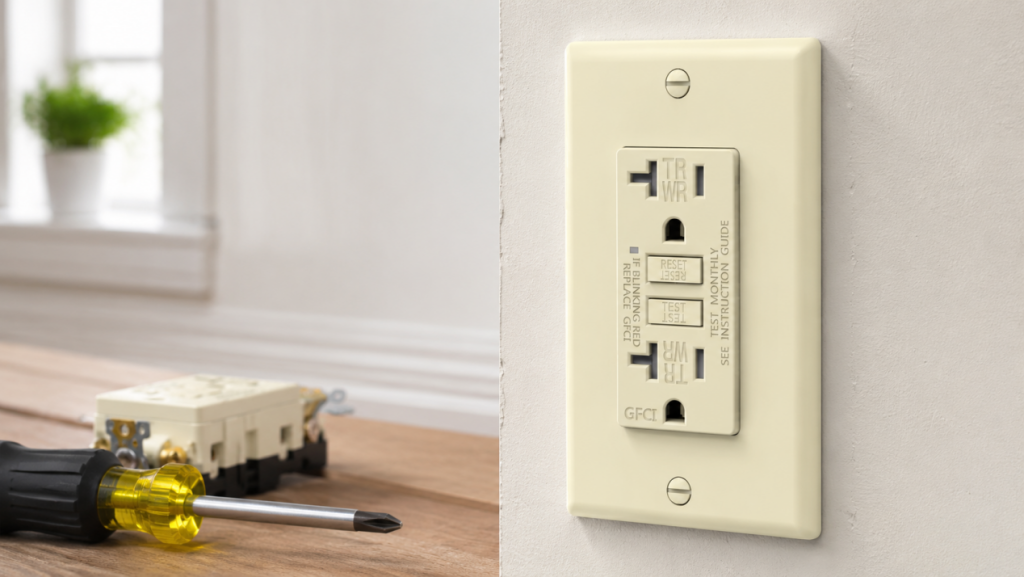
After installation, the protection should be tested. The Test and Reset buttons on the device should function correctly. A receptacle tester can help verify downstream protection, but older wiring can still require professional judgment.
Labeling also matters. Downstream outlets protected by an upstream GFCI should be marked as GFCI protected. If a GFCI is installed on an ungrounded circuit, it should also carry the proper “No Equipment Ground” marking.
Without testing and labeling, future homeowners, inspectors, and service electricians may not know what is actually protected.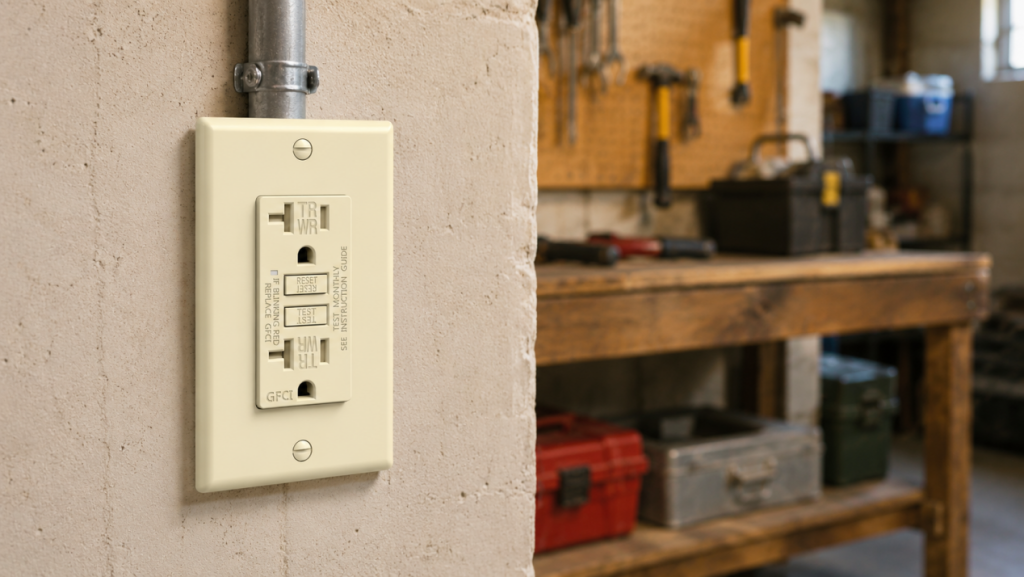
Can You Install GFCI Outlets in an Older Home Without a Ground Wire?
Yes, GFCI protection can often be used in older homes that do not have an equipment grounding conductor. This is one reason GFCI outlets are so common in old-home upgrades.
But the wording matters.
A GFCI outlet can improve shock protection on an ungrounded circuit. It does not create a real equipment ground.
How GFCI Works Without a Ground Wire
A GFCI does not need a ground wire to detect a ground fault. It compares the current leaving on the hot conductor with the current returning on the neutral conductor.
If some of that current is leaking through another path, the device trips.
That is why a GFCI receptacle may be used in some old two-wire circuits as a safety upgrade. This is common in older homes with two-prong receptacles or old wiring systems that lack a grounding conductor.
For human shock protection, this can be a meaningful improvement.
Why GFCI Is Not the Same as Grounding
GFCI protected is not the same as grounded.
A grounded receptacle has an equipment grounding path. That path helps clear faults and supports proper operation of certain equipment. A GFCI protects people by detecting current imbalance. These are different functions.
On an ungrounded circuit, a GFCI-protected three-slot receptacle should not mislead users into thinking a true ground exists. That is why proper labeling is required:
- “No Equipment Ground”
- “GFCI Protected”
This matters for sensitive electronics, surge protection devices, grounded appliances, and commercial-grade equipment. Some devices expect a true equipment ground. A GFCI does not provide that path.
Old wiring also brings other concerns. Brittle insulation, reversed polarity, shared neutrals, damaged boxes, and overloaded circuits cannot be fixed by installing a GFCI device. A licensed electrician should check the circuit when the wiring condition is uncertain.
How to Choose the Right GFCI Upgrade for an Older Home
The right upgrade depends on the location, circuit layout, panel condition, and long-term maintenance needs. For contractors and project buyers, product selection also matters. A low-cost device that fails testing, does not match the application, or lacks proper certification can create callbacks and inspection problems.
GFCI Outlet vs GFCI Breaker
| Option | Best Used For | Advantages | Limitations |
| GFCI outlet | Local protection in bathrooms, kitchens, garages, outdoor points | Easy to test and reset at the outlet; direct replacement in many locations | May not protect the whole circuit unless wired correctly |
| Upstream GFCI outlet | Protecting downstream receptacles on the same circuit | Can reduce the number of GFCI devices needed | Requires correct line/load wiring and labeling |
| GFCI breaker | Whole-circuit protection from the panel | Good for multiple outlets or hard-to-access receptacles | Higher device cost; panel compatibility and electrician installation required |
| Rewiring with grounding | Older circuits with broader wiring issues | Provides a true grounding path and modernizes the circuit | More labor-intensive and project-dependent |
For many older-home upgrades, GFCI receptacles are the most direct solution. They are easy to identify, test, and reset. For broader circuit protection, a GFCI breaker may be better.
The correct choice depends on how the home is wired, not only on the room name.
Product Features to Check Before Replacement
For the U.S. market, GFCI device selection should not be based only on face color and amperage. Certification, function, and installation environment matter.
Key features to check include:
- UL listed or ETL listed GFCI receptacles for U.S. market acceptance
- Self-test GFCI function for automatic internal monitoring
- Tamper-resistant design for residential applications
- Weather-resistant GFCI outlets for outdoor or damp locations
- 15A or 20A rating matched to the circuit and installation
- Correct faceplate and box compatibility
- Clear labeling for GFCI-protected and no-equipment-ground conditions
A bathroom replacement, an outdoor receptacle, and a garage workbench outlet may all require GFCI protection, but they are not the same installation environment. Outdoor applications should not be treated like interior dry-wall applications. A 20A circuit should not be fitted casually with the wrong device rating.
Faith Electric provides UL/ETL certified in-wall electrical solutions for the U.S. market, including GFCI and AFCI safety receptacles, USB outlets, standard receptacles, switches, and wall plates. For contractors, distributors, and project buyers, choosing the right certified device reduces installation risk and helps keep residential upgrade projects consistent.
Local Code, NEC, and Licensed Electricians: What Still Needs to Be Verified
The NEC is the main reference point for residential electrical safety in the United States, but it is not applied everywhere in the same way at the same time.
States and cities may adopt different NEC editions. Local amendments may change how requirements are enforced. The authority having jurisdiction, often called the AHJ, has the final say for inspection and approval.
That is why older-home GFCI questions need careful wording.
A national article can explain the common rule pattern. It cannot replace local code interpretation for a specific property.
This is especially true in older homes, where wiring may not match modern assumptions. Before installing or replacing GFCI devices, the following should be verified:
- Whether the circuit has a grounding conductor
- Whether the receptacle is on a multi-wire branch circuit
- Whether line and load conductors are correctly identified
- Whether downstream outlets are intended to be protected
- Whether the box and wiring condition are safe for replacement
- Whether outdoor boxes, covers, and device ratings match the location
- Whether local code requires a specific protection method
A GFCI upgrade is usually straightforward when the wiring is clean and predictable. Older homes are not always predictable.
That is why the best answer is not only “What does the NEC say?” The better question is: “What does the local code require for this actual circuit and this actual project?”
Final Advice: Prioritize GFCI Protection Where Risk Is Highest
Older homes do not automatically need every existing outlet replaced with a GFCI outlet. That is too broad and not how real electrical work is judged.
But older homes should not ignore GFCI protection either.
The first areas to check are bathrooms, kitchen countertops, garages, unfinished basements, laundry rooms, utility areas, crawl spaces, outdoor receptacles, and outlets near sinks. These are the places where water, grounded surfaces, tools, appliances, and people often come together.
Code may not require every old receptacle to be replaced immediately. Practical safety says high-risk areas should be upgraded first.
For contractors, distributors, and project buyers working in the U.S. residential market, Faith Electric can support GFCI upgrade needs with UL/ETL certified wiring devices and complete in-wall electrical solutions. Contact us to discuss GFCI receptacles, AFCI safety outlets, USB outlets, switches, and wall plates for your next residential or renovation project.