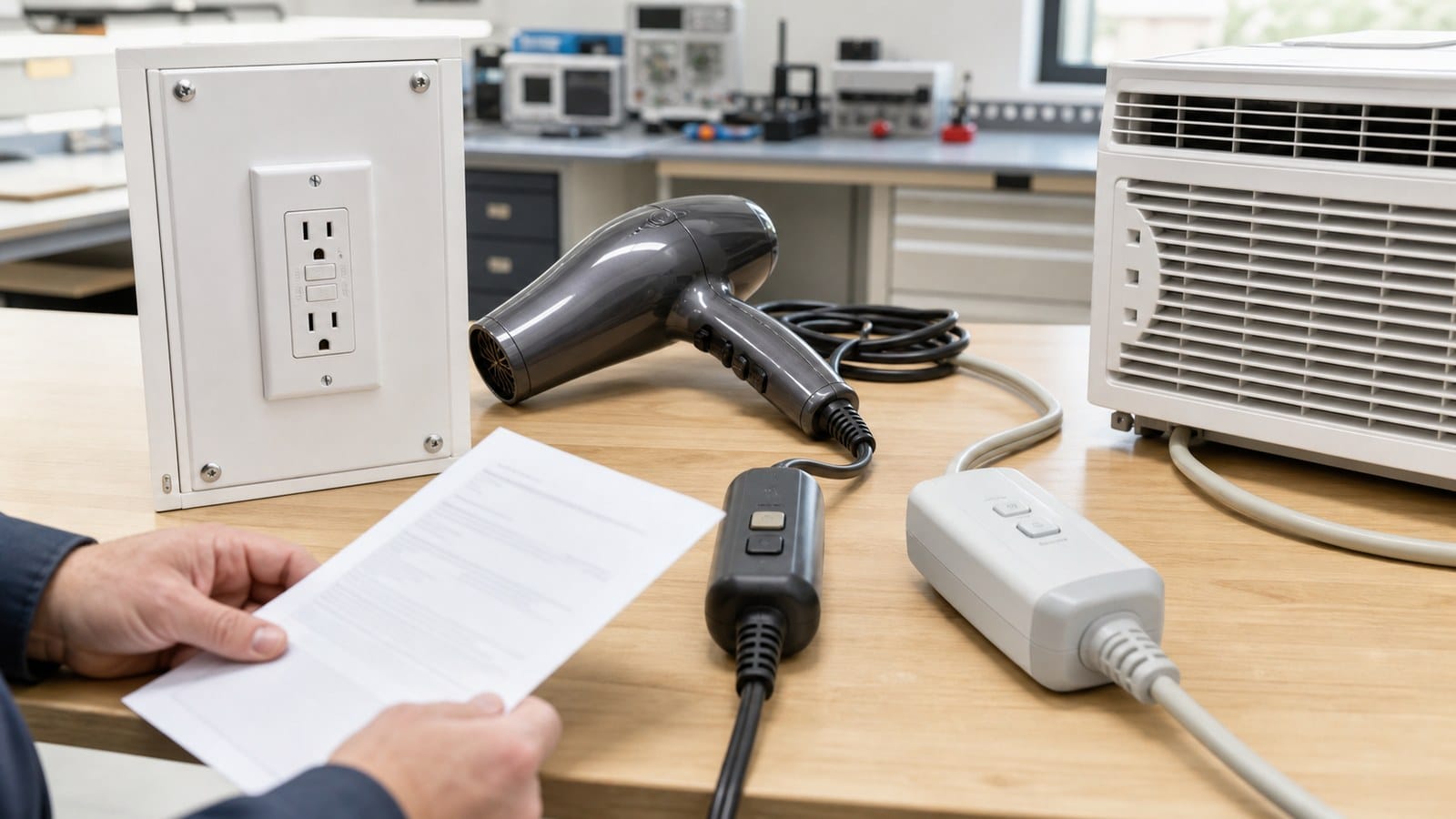
A GFCI receptacle—Ground Fault Circuit Interrupter—is not optional in wet or damp locations anymore. It monitors current imbalance between hot and neutral. Detects 4-6 mA leakage and trips in milliseconds. Prevents shocks that kill or injure. In kitchens, bathrooms, garages, outdoors—NEC 2023 made it broader. All 125-250V kitchen receptacles now require GFCI protection, not just countertops. Outdoor, garage, accessory buildings too, with limited exceptions for listed HVAC until September.
We build and test these devices daily. Miss one step and the protection fails. Or worse, leaves downstream outlets blind. Here’s how to do it right the first time.
-300x300.jpg)
Understanding GFCI Outlets
GFCI differs from standard receptacles. It actively watches for ground faults. Trips when current leaks to ground—through a person, water, damaged cord.
Key parts matter:
- Line terminals: Incoming power from panel. Always connect here first.
- Load terminals: Downstream outlets on same circuit. Connect only if you want them protected. Ignore if protecting only this location.
- Test and Reset buttons: Manual simulation of fault. Press Test—power cuts. Reset restores.
- Green grounding screw: Bare copper or green wire.
- Some models have LED indicators: Green = good, red/flashing = end of life or miswire.
Line and Load reversal compromises everything. Downstream stays unprotected. Or unit won’t reset. Common rookie mistake.
GFCI breaker alternative exists for whole-circuit protection—especially kitchens now fully covered. But most replacements use receptacle type.
Safety First & Tools You Actually Need
Turn off power at breaker. No exceptions. Plug lamp in target receptacle. Kill breaker. Lamp off. Test both slots. Still off? Proceed.
Use non-contact voltage tester on terminals after removal. Double-check.
Turn off power at breaker. No exceptions. Plug lamp in target receptacle. Kill breaker. Lamp off. Test both slots. Still off? Proceed.
Use non-contact voltage tester on terminals after removal. Double-check.
Tools list—no shortcuts:
- Flathead and Phillips screwdrivers
- Non-contact voltage tester
- Wire strippers
- Needle-nose pliers
- Electrical tape
- Wire nuts (for pigtails or caps)
- Receptacle tester (cheap, catches miswires fast)
Materials:
- UL-listed GFCI receptacle, 15A or 20A match circuit
- Weather-resistant (WR) for outdoors, damp locations
- In-use cover for wet/exposed installs
Aluminum wire? Stop. Call electrician. Copper or copper-clad only.
If box has >4 wires (excluding ground) or multiple cables with confusion—stop. Get licensed help.
Preparation Steps
Kill power. Confirmed.
Remove cover plate. Unscrew receptacle. Pull out gently.
Photograph everything. Wiring before you touch it. Saves grief later.
Inspect wires:
- Frayed insulation? Damaged? Overheated signs? Replace or call pro.
- Enough slack? GFCI thicker than standard. Box cramped? Issues.
Identify Line vs Load—critical.
One cable (2-3 wires)? All Line. Simple.
Two cables (4-6 wires)? Identify:
- Cap one cable’s hot and neutral.
- Temporarily restore power.
- Tester on remaining—live = Line incoming.
- Dead = Load downstream.
- Label clearly. Kill power again.
Miss this and protection fails downstream. Or unit locks out.
Step-by-Step: How To Install a GFCI Outlet
Step 1: Turn Off Power at the Breaker
Identify the correct circuit breaker and switch it off.
Verify at the outlet with a voltage tester. Test all conductors, not just the receptacle face.
No voltage means confirmed, not assumed.
Step 2: Remove the Existing Outlet
- Remove the faceplate
- Unscrew the receptacle from the box
- Gently pull it forward
Before disconnecting anything, look closely:
- Wire colors
- Number of cables
- Signs of overheating or damaged insulation
A quick photo helps preserve orientation if you need to reference it later.
Step 3: Identify Line vs. Load Wires (This Step Matters Most)
This is where most GFCI installations fail.
- Line wires bring power from the panel.
- Load wires feed downstream outlets that you want protected.
If there is only one cable in the box:
- All conductors are line
- The load terminals are not used
If there are two cables:
- One is line
- One is load
To identify them correctly:
- Separate the conductors safely
- Briefly restore power
- Use a tester to find the energized pair
- Mark them clearly
- Turn power off again before proceeding
Reversing line and load does not “sort of work.”
It renders the GFCI ineffective or prevents resetting entirely.
Step 4: Connect the Wires Correctly
Follow terminal markings. Do not improvise.
Standard connection order:
- Ground → green screw
- Neutral (white) → silver terminal
- Hot (black) → brass terminal
Use the LINE terminals for incoming power.
Use the LOAD terminals only if you intend to protect downstream outlets.
If load protection is not required:
- Leave load terminals unused
- Keep factory tape in place
Tighten connections firmly. Loose terminations generate heat and failure points over time.
Step 5: Secure the Outlet and Restore Power
- Fold wires carefully into the box
- Avoid sharp bends or forced compression
- Mount the receptacle squarely
- Install the faceplate
Restore power at the breaker only after everything is secured.
Power On and Testing
Restore breaker.
Press Reset. Click. Should power up.
Plug lamp or tester. Works.
Press Test. Immediate trip. No power.
Reset. Back on.
Use receptacle tester. Checks for open ground, hot/neutral reverse, etc. Green lights only.
LED models: Green good. Red/flashing? Replace unit.
No trip on Test? Miswired. Line/Load swap most likely. Redo.
Fails reset? Internal fault. New unit.
Maintenance & Troubleshooting
Test monthly. Plug device. Test—off. Reset—on.
Fails? Replace immediately. GFCI has finite life—internal components wear.
Common failures:
- No power: Miswired Line/Load or no incoming.
- Trips instantly: Reversed hot/neutral, loose neutral.
- Downstream unprotected: Load not connected.
- Frequent nuisance trips: Defective appliance or actual fault—
Cannot reset after trip? End-of-life or miswire. Swap.
Special Considerations & Current NEC Requirements
The 2023 NEC expanded GFCI rules significantly (Section 210.8). Key points contractors and buyers need to know:
- Kitchens (210.8(A)(6)): All 125–250V receptacles now require GFCI protection—no more “countertop only” Covers wall outlets, islands, peninsulas, and appliance circuits.
- Bathrooms (210.8(A)(1)): All receptacles must be GFCI-protected, no exceptions—every outlet in the bathroom space, regardless of distance from water sources.
- Outdoors, Garages, Accessory Buildings (210.8(F)): GFCI required for circuits ≤150V to ground and ≤50A (expanding to 60A in future codes). Use WR-rated GFCI receptacles + in-use covers for exposed locations.
- Specific Appliances (210.8(D)): GFCI now mandatory for supply circuits (≤150V to ground, ≤60A) to dishwashers, ranges, wall ovens, cooktops, dryers, microwaves, etc.—cord-and-plug or hardwired.
- HVAC Exception: Listed outdoor HVAC equipment exempt until September 1, 2026. After that, full GFCI required (Class C SPGFCI may help reduce nuisance trips on inverters).
- 2-Prong Upgrades: Replace directly with GFCI. No ground wire needed. Label “GFCI Protected / No Equipment Ground.”
- Multi-GFCI Circuits: One trip can kill downstream outlets. Trace to the upstream GFCI for reset.
- Stop and Call Electrician: If >4–5 wires in box (excluding grounds), aluminum present, or post-install issues (no reset, constant tripping)—do not proceed. Risk outweighs DIY savings.
Final Thoughts
Proper GFCI install saves lives in wet zones. But only if Line feeds correctly, Load protects if intended, and monthly tests happen. Cut corners and it becomes liability. Done right, it works for decades. Done wrong, it gives false security. Unsure on any step? Stop. Bring in licensed pro. Better safe than sorry.
Discover Faith Electric – We are a professional Chinese electrical manufacturer with 28 years of experience, specializing in the production of UL/ETL certified GFCI, AFCI, USB charging receptacles, standard receptacles, switches, and wall plates, along with other safe wiring devices. We serve the North American residential and commercial markets with patented durable technology and high cost-performance solutions. Contact us now for more GFCI information and a free quote.

References / Data Sources:
https://www.ul.com
https://www.nfpa.org