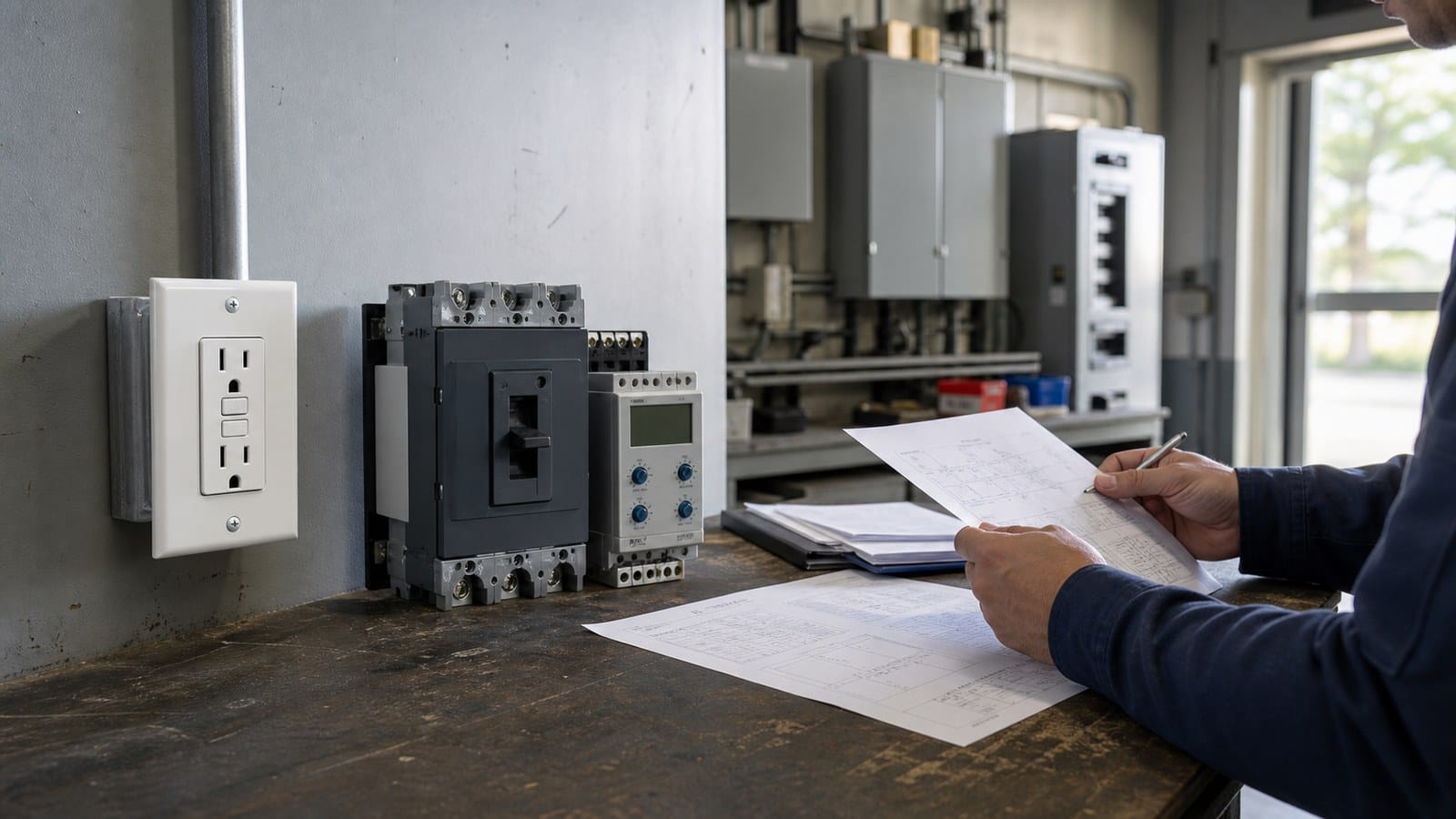
Yes, you can have multiple GFCI outlets on the same circuit.
But that does not mean every outlet on that circuit should be a GFCI outlet.
In most installations, one properly wired upstream GFCI receptacle can protect multiple downstream standard outlets. Adding more GFCI devices after that point often adds cost, makes troubleshooting harder, and does not always add more safety.
The real question is not whether multiple GFCI outlets are allowed on one circuit. The better question is:
How should they be wired, and does each GFCI device have a clear purpose?
A “same circuit” in this context usually means the outlets are supplied by the same branch circuit breaker in the electrical panel. For example, several bathroom receptacles, garage outlets, or kitchen countertop outlets may be fed from one breaker, depending on the installation design and local code requirements.
To make the right decision, you need to understand three things: GFCI protection, LINE and LOAD wiring, and the difference between redundant protection and independent protection.
How One GFCI Outlet Can Protect Downstream Outlets
A GFCI outlet, or ground-fault circuit interrupter receptacle, is designed to reduce shock risk by monitoring the current flowing through the hot and neutral conductors. If the device detects an imbalance, usually caused by leakage current to ground, it trips and cuts power quickly.
This is why GFCI protection is commonly required in areas where moisture, grounded surfaces, or human contact increase shock risk. Typical locations include bathrooms, kitchens, garages, basements, laundry areas, outdoor outlets, and similar wet or damp environments.
A single GFCI outlet can protect more than just itself.
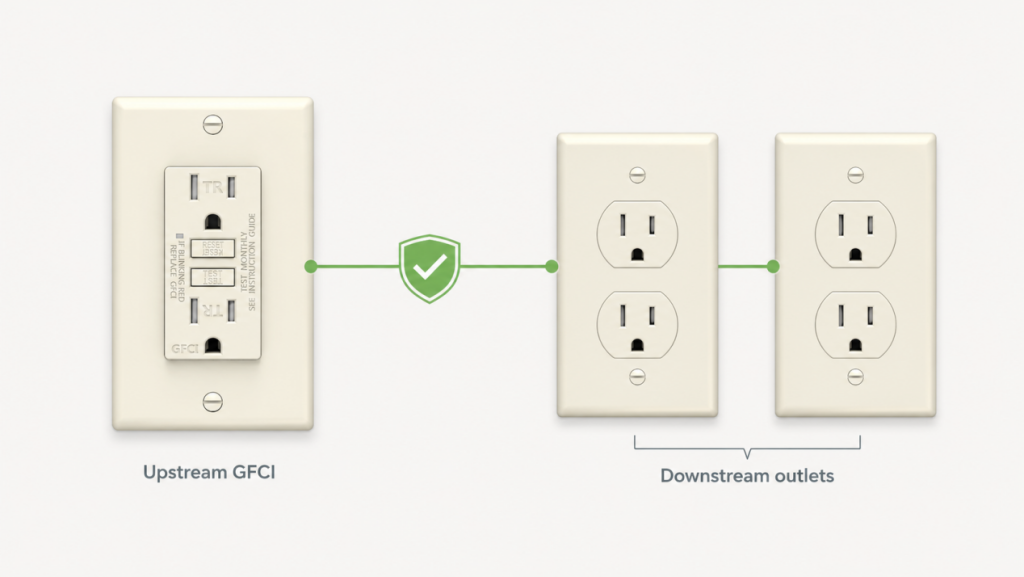
If downstream standard receptacles are connected to the GFCI outlet’s LOAD terminals, those downstream outlets receive GFCI protection from the upstream device. That is why you may see ordinary-looking receptacles in a bathroom or garage with a small label that says “GFCI Protected.”
That label matters. The outlet may not have TEST and RESET buttons, but it can still be protected by an upstream GFCI.
This is a common residential layout:
| Circuit Layout | What Happens |
| Breaker → GFCI outlet → standard outlet → standard outlet | The GFCI outlet protects itself and the downstream standard outlets |
| Breaker → standard outlets only | No GFCI protection unless the circuit is protected by a GFCI breaker |
| Breaker → GFCI breaker → standard outlets | The whole branch circuit is protected from the panel |
For many residential circuits, one GFCI outlet at the correct upstream position is enough. It lowers device cost, keeps the wiring logic simple, and gives clear control over the protected section of the circuit.
The trade-off is also clear: if the upstream GFCI trips, every downstream outlet connected to its LOAD side loses power.
That is not a defect. That is how the protection is designed to work.
LINE vs LOAD: The Wiring Detail That Matters Most
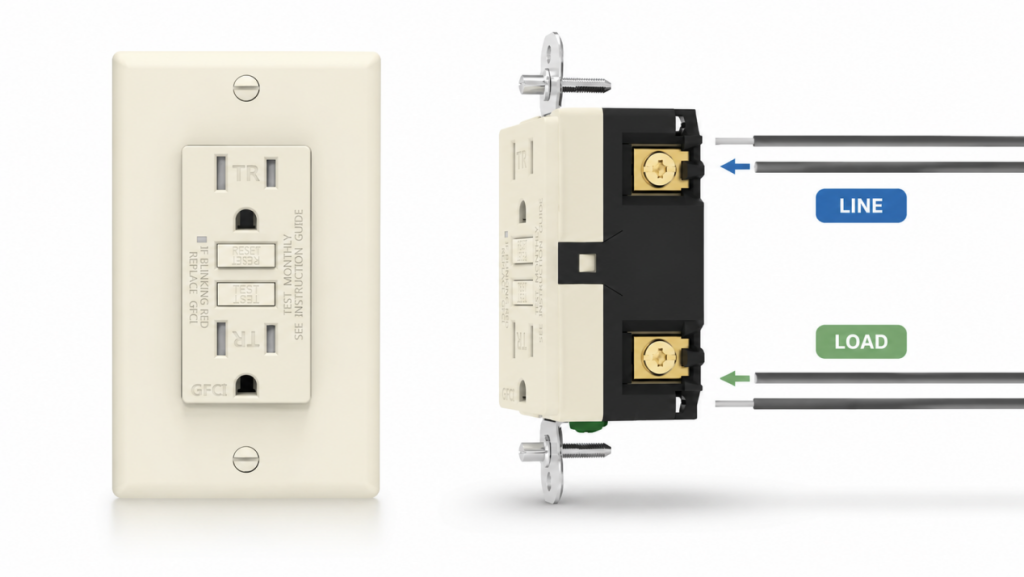
The most important detail in GFCI outlet wiring is the difference between LINE and LOAD.
These two terms appear on the back of most GFCI receptacles. They are not decorative markings. They decide how protection is applied.
What LINE Means on a GFCI Outlet
LINE refers to the incoming power connection.
The hot and neutral wires that bring power from the breaker, or from the previous point in the circuit, connect to the LINE terminals of the GFCI outlet.
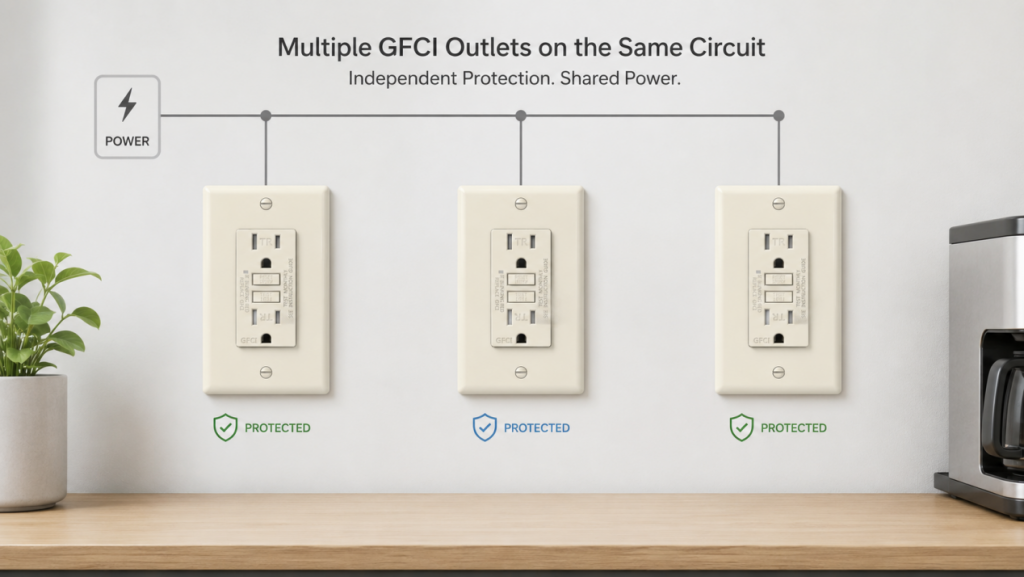
When a GFCI outlet is wired only on the LINE side, it protects that GFCI receptacle location. If several GFCI outlets on the same circuit are each wired independently to their LINE terminals, each device works as its own local protection point.
This setup can make sense when local reset access matters.
For example, in a commercial kitchen with several countertop work zones, each GFCI receptacle may be wired independently so that a small appliance fault at one station does not shut down every other protected outlet downstream. The maintenance team can see the tripped device immediately and reset it at the same location after the fault is cleared.
That is a practical reason to use multiple GFCI outlets.
What LOAD Means on a GFCI Outlet
LOAD refers to the outgoing protected connection.
When downstream outlets are connected to the LOAD terminals of an upstream GFCI outlet, those downstream outlets are protected by that GFCI device. They do not need to be GFCI receptacles themselves to receive GFCI protection.
This is the wiring method often used when one GFCI protects several outlets in the same branch circuit.
But LOAD wiring has to be intentional. If LINE and LOAD are reversed, or if the installer connects downstream devices without confirming the feed direction, the result may be confusing: the GFCI may not reset, downstream outlets may have no power, or the TEST / RESET function may not behave as expected.
Do not guess based on outlet position alone. In older buildings, remodeled kitchens, garages, or multi-bathroom circuits, the first physical outlet on the wall is not always the first electrical point in the circuit.
Correct LINE and LOAD identification is the difference between clean protection and a circuit that creates service calls later.
Three Common Wiring Setups for GFCI Outlets on One Circuit
Multiple GFCI outlets on one circuit can be wired in different ways. Some designs are useful. Some are mostly redundant.
The difference is not about whether the outlets can physically work. The difference is whether the design makes maintenance and protection clearer.
Setup 1: One Upstream GFCI Protects Downstream Standard Outlets
This is usually the simplest and most cost-effective setup.
The circuit feeds one GFCI outlet first. The downstream standard receptacles are connected to the LOAD terminals of that GFCI. Once installed correctly, the GFCI protects both itself and the downstream receptacles.
This setup is common in residential bathrooms, garages, laundry areas, and some kitchen circuits.
The advantages are straightforward:
- Lower device cost because only one GFCI receptacle is needed
- Clear protection path when the circuit is documented well
- Fewer TEST / RESET points for the user to understand
- Easy product standardization for many residential installations
The main drawback is that a trip at the upstream GFCI shuts off the downstream protected outlets. If the GFCI is hidden behind storage in a garage or placed in another room, the user may not immediately know where to reset power.
That is why labeling and outlet placement matter.
For a typical residential branch circuit, this setup is often the cleanest answer. One GFCI device does the protection work, and the downstream receptacles do not need to duplicate it.
Setup 2: Multiple GFCI Outlets Wired Independently on LINE
In this setup, several GFCI receptacles share the same circuit, but each one is wired to the LINE side rather than being protected through another GFCI’s LOAD side.
Each GFCI outlet operates independently.
If one device trips, only that receptacle location is affected. The other GFCI outlets on the circuit remain powered, assuming there is no broader circuit issue.
This design costs more because every protected location uses a GFCI receptacle. But it can be a better choice in projects where downtime and fault location matter more than device cost.
Common examples include:
| Application | Why Independent GFCIs May Make Sense |
| Commercial kitchen prep areas | Local reset and faster fault isolation |
| Rental properties or hospitality units | Easier maintenance for each room or zone |
| Garage workstations | One tool fault does not shut down every protected outlet |
| Multi-zone wet areas | Each area can be serviced separately |
| Light commercial spaces | Maintenance staff can identify the tripped point quickly |
This approach is not mainly about making the circuit “more protected.” It is about making the protection more localized.
That is a different goal.
Setup 3: A GFCI Outlet Downstream from Another GFCI
This is the setup that causes the most confusion.
A GFCI receptacle may be installed downstream from another GFCI receptacle, especially if the downstream GFCI is connected to the upstream device’s LOAD side. In many cases, this is not the cleanest design.
The issue is redundant protection.
If a ground fault occurs, the user may not know whether the upstream GFCI tripped, the downstream GFCI tripped, or both were affected. The downstream device may also appear dead if the upstream GFCI has already cut power. Someone may press RESET on the downstream device repeatedly without realizing the real reset point is upstream.
This does not always mean the circuit is unsafe. But it does mean the circuit is harder to understand.
For most residential and standard commercial installations, avoid stacking GFCI protection without a reason. Either use one GFCI to protect downstream standard outlets, or wire multiple GFCIs independently on LINE when local reset and fault isolation are needed.
Random GFCI-after-GFCI wiring is rarely a good design choice.
Is It Bad to Have Multiple GFCI Outlets on One Circuit?
No, it is not automatically bad.
Multiple GFCI outlets on one circuit can be perfectly reasonable if each device is wired with a clear purpose. The problem starts when additional GFCI receptacles are installed because someone assumes “more GFCI means more safety.”
That assumption is not always true.
If one upstream GFCI already protects the downstream outlets, replacing those downstream outlets with additional GFCI receptacles usually does not add meaningful safety. What it may add is cost, extra reset points, and more confusion during troubleshooting.
Correctly wired multiple GFCIs should not trip simply because there are several of them on the same circuit. GFCI devices trip because they detect a ground fault condition, wiring issue, moisture problem, faulty appliance, or device failure.
Still, redundant GFCI protection can make nuisance-tripping complaints harder to diagnose. A user may say, “The circuit keeps tripping,” when the real issue is a wet outdoor box, a damaged extension cord, or a downstream appliance leaking current.
The extra GFCI devices do not always cause the problem. They often make the problem harder to locate.
A clear wiring strategy is better than more devices.
When Should You Use One GFCI, Multiple GFCIs, or a GFCI Breaker?
There is no single best setup for every project. The right choice depends on the circuit layout, reset access, code requirements, maintenance needs, and cost target.
Here is a practical way to think about it.
| Scenario | Better Option | Main Reason |
| Standard bathroom or kitchen circuit | One upstream GFCI + downstream standard receptacles | Lower cost and clear protection |
| Garage with several work zones | Multiple independent GFCI outlets | Easier local reset and fault isolation |
| Outdoor outlets on different sides of a property | Independent GFCIs or GFCI breaker | Better access and zone control |
| Commercial kitchen | Multiple independent GFCIs | Reduces downtime from one tripped point |
| Whole branch circuit protection from panel | GFCI breaker | Centralized circuit-level protection |
| Circuit already protected by a GFCI breaker | Standard receptacles may be enough | GFCI protection is already provided |
Typical Residential Circuits
For many homes, one upstream GFCI outlet protecting downstream standard receptacles is the practical choice.
Take a garage branch circuit as an example. If the first receptacle near the panel is a GFCI and the rest of the garage receptacles are connected to its LOAD side, all downstream outlets can receive GFCI protection. This avoids installing GFCI devices at every outlet box.
The design is simple, but placement matters. If that first GFCI is hidden behind a freezer, shelving, or stored equipment, resetting it becomes annoying. In that case, a more accessible GFCI location may be worth the extra planning.
A low-cost design is only good if the user can operate it.
Commercial or Maintenance-Sensitive Areas
Commercial and property maintenance environments often have different priorities.
In a commercial kitchen, for example, several countertop receptacles may serve mixers, warmers, coffee equipment, prep tools, or cleaning equipment. If one appliance has a leakage fault, shutting down a long downstream chain may interrupt more of the kitchen than necessary.
Independent GFCI receptacles can make the system easier to service. The tripped device is visible at the affected location. The maintenance staff does not need to search across the room or inside another area to find the reset point.
This same logic can apply to rental units, hospitality properties, workshops, and shared service areas.
The cost per device is higher. But the maintenance logic is cleaner.
When a GFCI Breaker May Be Better
A GFCI breaker protects the branch circuit from the panel. Instead of placing GFCI protection at the receptacle, the breaker provides protection for the circuit it supplies.
This can be a good option when the entire branch circuit needs GFCI protection, especially in new construction or panel-based upgrades. It also keeps the receptacle locations visually simple because standard receptacles may be used downstream, assuming the circuit is properly protected and labeled as required.
But GFCI breakers have one practical drawback: the reset point is at the electrical panel.
For a homeowner, that may be fine. For a restaurant employee, hotel guest, or tenant, it may be less convenient than a local GFCI outlet with a visible RESET button.
If a circuit is already protected by a GFCI breaker, installing GFCI outlets at every receptacle is usually not needed unless there is a specific reason, such as local reset preference or project specification.
The best choice is not the most expensive one. It is the one that makes the protection clear, accessible, and serviceable.
Why Multiple GFCI Outlets Trip or Fail to Reset
When multiple GFCI outlets are installed on one circuit, troubleshooting complaints often sound similar:
“The GFCI keeps tripping.”
“The downstream GFCI will not reset.”
“One outlet works, but the next one is dead.”
“After rain, the outdoor outlet trips again.”
These problems do not always mean the circuit has too many GFCI devices. Usually, the cause is more specific.
LINE and LOAD Are Reversed or Miswired
LINE / LOAD mistakes are common, especially during replacement work.
If someone removes an old receptacle and installs a GFCI without identifying the feed and load conductors, the device may not work as expected. In some cases, the GFCI will not reset. In others, the downstream outlets may remain dead.
This is why the installer should identify the incoming power conductors before connecting the GFCI. The instruction sheet that comes with the device is not optional reading. It tells you how that specific model handles LINE and LOAD connections.
With self-test GFCI receptacles now common in the U.S. market, incorrect wiring can also create confusion because the device may appear to reject normal operation when the real issue is the connection.
One Upstream GFCI Has Already Tripped
If a downstream GFCI is fed from the LOAD side of an upstream GFCI, the downstream device depends on the upstream device for power.
When the upstream GFCI trips, the downstream GFCI may be dead. Pressing RESET on the downstream device will not solve the issue because power has already been cut before it reaches that point.
This is one of the main reasons redundant GFCI wiring creates service problems. The user sees TEST and RESET buttons on the downstream device and assumes that is the only reset point.
It may not be.
For this reason, long chains of GFCI devices should be avoided unless the installer has a clear reason and the circuit is documented well.
Moisture, Faulty Loads, or Aging Devices
GFCI trips are often caused by the environment or the connected equipment.
Outdoor receptacles are a common example. A weather-resistant GFCI receptacle still needs the right box, cover, gasket, and installation method. If water enters the enclosure, the GFCI may trip after rain or during humid conditions.
Other common causes include:
- Damaged extension cords
- Outdoor power tools
- Pumps or wet-location equipment
- Appliances with insulation leakage
- Old or damaged receptacles
- Loose wiring connections
- Contaminated or corroded outlet boxes
For outdoor and damp locations, the device selection also matters. Weather resistant GFCI outlets, tamper resistant designs where required, proper covers, and corrosion-resistant installation practices all reduce field problems.
A GFCI trip is a message. The device is telling you something about the circuit, the environment, or the load. Treat it as a fault signal, not just an inconvenience.
Best Practices for Safe and Clear GFCI Outlet Installation
A good GFCI design is not complicated, but it should be deliberate.
Before choosing one GFCI, multiple GFCIs, or a GFCI breaker, define the protection goal first. Are you trying to protect a short line of bathroom outlets? A garage with multiple workstations? A commercial kitchen? An outdoor service area? A whole branch circuit?
The answer changes the design.
For most projects, these practices keep the installation clearer:
- Use one upstream GFCI to protect downstream standard outlets when the circuit is simple and reset access is clear.
- Use multiple independent GFCI outlets when local reset and fault isolation matter.
- Avoid placing GFCI after GFCI through LOAD wiring unless there is a specific design reason.
- Use “GFCI Protected” labels on downstream standard receptacles.
- Choose WR-rated devices and proper covers for outdoor or damp locations.
- Match the receptacle rating, circuit rating, and application requirements.
- Follow the device instructions, adopted electrical code, and local inspection requirements.
- Use UL/ETL certified devices for U.S. market projects.
For contractors, distributors, and project buyers, product consistency matters. Clear LINE / LOAD markings, reliable TEST / RESET operation, self-test performance, stable supply, and proper certification all affect installation efficiency and long-term service experience.
A clean circuit design can still perform poorly if the device quality is inconsistent.
Conclusion: Multiple GFCI Outlets Are Allowed, but the Design Should Be Intentional
You can have multiple GFCI outlets on the same circuit. That part is not the real problem.
The better design question is whether those GFCI outlets are needed. In many residential circuits, one correctly installed upstream GFCI can protect the downstream outlets through the LOAD terminals. In commercial, rental, workshop, or maintenance-sensitive projects, multiple GFCI outlets wired independently on LINE may be worth the higher cost because they provide local reset access and clearer fault isolation.
What should be avoided is random redundant protection. A GFCI outlet downstream from another GFCI may work, but it often makes troubleshooting harder without adding much practical value.
Faith Electric provides UL/ETL certified GFCI receptacles and complete in-wall electrical device solutions for the U.S. market, including GFCI outlets, AFCI devices, USB receptacles, standard receptacles, switches, and wall plates. If you are sourcing GFCI outlets for distribution, contractor supply, or project use, contact us to discuss product options and certification requirements.