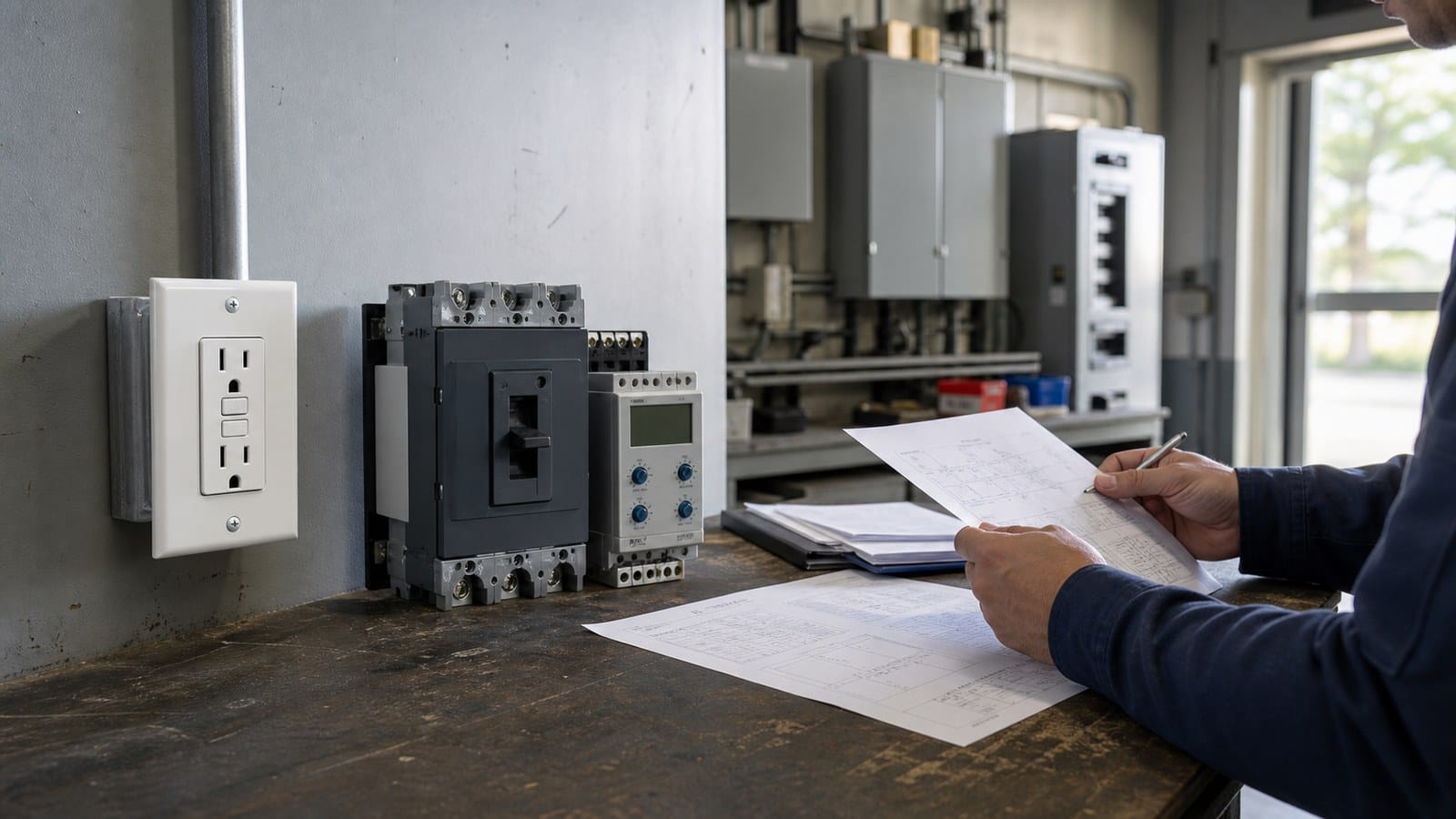
When buying GFCI outlets for North American projects, the certification mark is not a small detail. It can affect product acceptance, inspection results, procurement documents, and liability.
The question buyers often ask is simple:
Is an ETL Listed GFCI outlet as acceptable as a UL Listed GFCI outlet?
The direct answer: yes, it can be — if the ETL listing is valid, traceable, and based on the applicable safety standards.
UL and ETL are different certification marks. They are issued by different organizations. But both can indicate that a GFCI outlet has been tested by a recognized third-party laboratory for safety compliance.
For contractors, distributors, and project buyers, the better question is not “Which logo looks more familiar?”
The better question is:
Is this exact GFCI outlet properly listed, verifiable, and acceptable for my project?
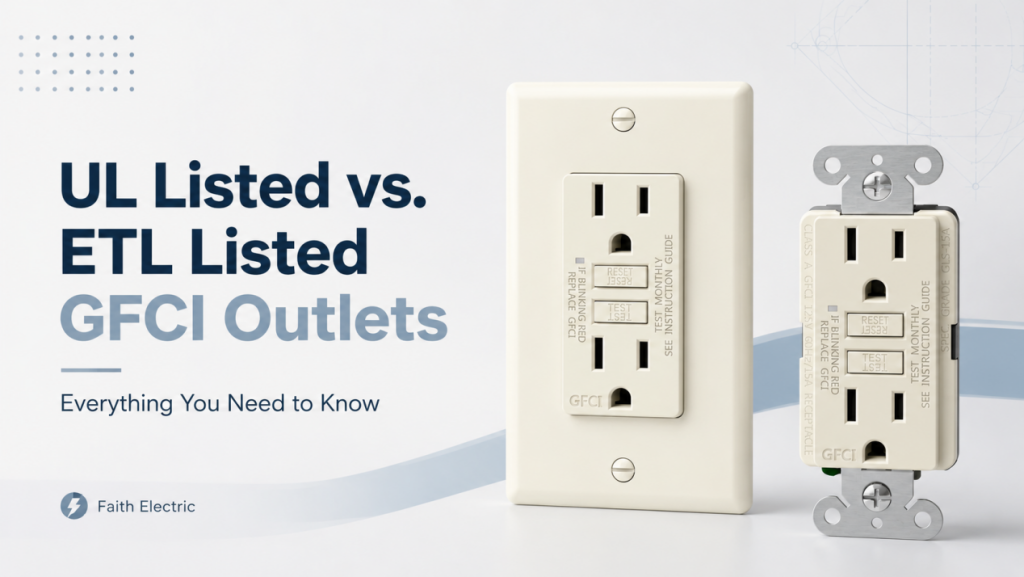
Quick Answer: Are ETL Listed GFCI Outlets as Acceptable as UL Listed Ones?
An ETL Listed GFCI outlet can be acceptable in many North American applications when it is certified by Intertek, tested to the applicable standards, and covered under a valid listing.
A UL Listed GFCI outlet is certified through UL Solutions and is often more familiar to inspectors, contractors, retailers, and specification writers.
The safety question is not decided by the logo alone.
A listed product must match the tested design, use approved materials and components, and remain under the certification body’s follow-up program. A GFCI outlet with a logo that cannot be verified is not the same as a properly listed product.
For a buyer, the working rule is clear:
UL Listed and ETL Listed GFCI outlets can both be valid choices, but the listing must be real, current, and applicable to the exact model being purchased.
What Does “Listed” Mean for a GFCI Outlet?
A listed GFCI outlet is a device that has been evaluated by a recognized testing and certification organization and found to comply with applicable safety standards.
GFCI stands for Ground-Fault Circuit Interrupter. A GFCI outlet monitors the current flowing through the hot and neutral conductors. If it detects an imbalance that may indicate current leakage through a person or another unintended path, it trips and cuts power.
In many North American applications, Class A GFCI protection is associated with a trip threshold around the 5 mA range. That level is designed for personnel protection, not just equipment protection.
For a GFCI receptacle, listing matters because the device is not just a plastic outlet body. It includes sensing electronics, contacts, terminals, trip mechanisms, reset functions, line/load wiring, face markings, and housing materials. A failure in any of these areas can create a real safety issue.
A listed mark tells the buyer that the product has gone through a structured safety evaluation.
It does not tell the buyer everything.
The buyer still needs to verify the product model, certification scope, applicable standard, and project acceptance.
Why NRTL Matters More Than the Logo Alone
NRTL means Nationally Recognized Testing Laboratory. In the U.S. electrical safety system, an NRTL is a testing and certification organization recognized by OSHA to evaluate certain products against specific safety standards.
UL and Intertek are both widely known in this space.
This is where many buyers misunderstand UL vs. ETL. UL and ETL are not two different “grades” of electrical safety. They are different marks issued by different certification organizations.
The real questions are:
- Is the certification body recognized for the applicable standard?
- Is the product listed under the correct category?
- Does the listing cover the exact GFCI model?
- Is the listing still active?
- Will the AHJ or project specification accept it?
AHJ means Authority Having Jurisdiction. In electrical work, this is the local authority, inspector, agency, or project authority responsible for interpreting and accepting code compliance.
For a contractor installing 20A GFCI receptacles in a commercial kitchen, the AHJ’s view matters more than a supplier’s sales claim. For a distributor supplying thousands of devices into a retail channel, the certification file and product markings matter as much as the unit price.
The logo starts the conversation. Verification finishes it.
What Does “UL Listed” Mean for GFCI Outlets?
A UL Listed GFCI outlet has been evaluated through UL’s certification process and listed under the applicable product category and standard.
UL has long recognition in the North American electrical market. Many contractors, inspectors, retailers, and engineers are familiar with the UL mark. In some project specifications, the words “UL Listed” may appear directly.
This is why UL Listed products are often preferred in certain procurement environments:
- Large commercial projects with strict written specifications
- Retail programs where UL is specifically named
- Industrial facilities with internal safety policies
- Projects where the owner or engineer is less familiar with ETL
- Public-sector or institutional work with conservative approval processes
That does not mean UL is the only valid path.
It means UL has strong market familiarity. When a document says “UL Listed only,” the buyer should follow that requirement or get written approval before substituting another NRTL mark.
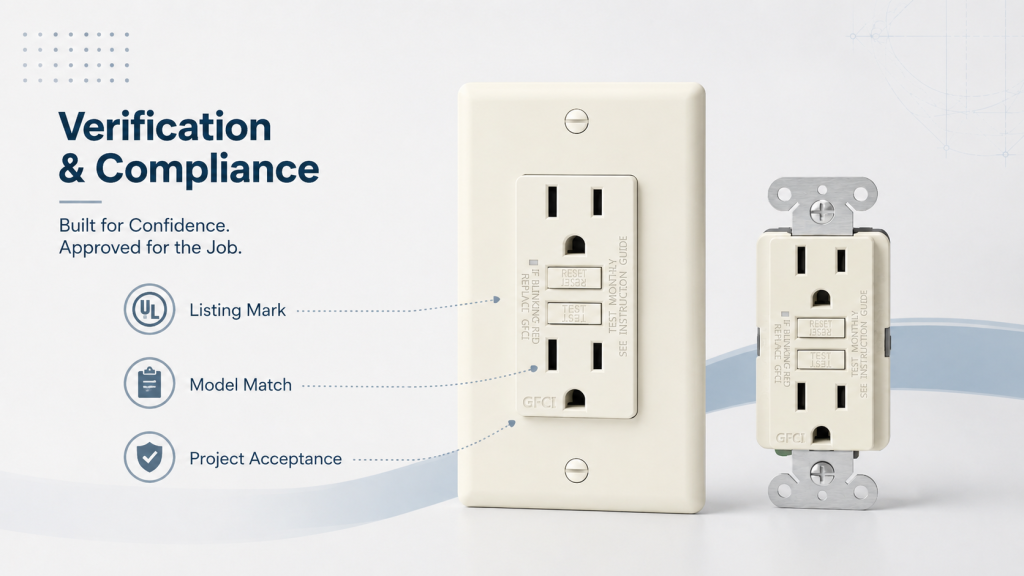
What Does “ETL Listed” Mean for GFCI Outlets?
An ETL Listed GFCI outlet is certified through Intertek’s ETL listing program. ETL is a recognized certification mark used across many electrical and electronic product categories.
A common misunderstanding is that ETL means the product is “less certified” than UL. That is not the right way to look at it.
ETL Listed products may be tested to the same applicable UL, CSA, ANSI, or other safety standards used for the product category. The mark is different because the certification organization is different.
For GFCI outlets, the relevant question is whether the product is listed to the proper GFCI safety requirements and whether the certification can be verified.
ETL can be a practical certification route for many electrical manufacturers and buyers. It may offer flexibility in testing process, timeline, or certification management, depending on product type and program scope. But that should not be confused with lower safety expectations.
A properly listed ETL GFCI outlet should be treated as a serious certified product, not as an unofficial alternative.
UL Listed vs. ETL Listed GFCI Outlets: Key Differences
The difference between UL Listed and ETL Listed GFCI outlets is mostly about the certification body, mark, market familiarity, and verification path.
The buyer should focus on the standard and listing scope, not only the logo.
| Category | UL Listed GFCI Outlet | ETL Listed GFCI Outlet | Buyer Takeaway |
| Certification body | UL Solutions | Intertek | Different certification organizations |
| Certification mark | UL Listed mark | ETL Listed mark | Both marks should be verifiable |
| Market recognition | Very widely recognized in North America | Also widely used and recognized | UL may be more familiar in some channels |
| Standards basis | Applicable UL/CSA/ANSI standards | Applicable UL/CSA/ANSI standards | Check the exact standard and product category |
| Product verification | UL Product iQ | Intertek Listed Product Directory | Always verify before bulk purchase |
| Factory follow-up | Yes, under certification program | Yes, under certification program | Listing is tied to ongoing compliance |
| Best fit | Projects or channels that specifically prefer or require UL | Projects accepting valid NRTL-listed products | Follow the project specification and AHJ direction |
For GFCI outlets, UL 943 is commonly associated with ground-fault circuit interrupter safety requirements. Receptacle construction may also involve related receptacle requirements, depending on the product and certification scope.
A buyer does not need to become a standards engineer. But a buyer should know enough to ask the right question:
Which standard was this exact GFCI outlet evaluated to?
Do GFCI Outlets Need to Be UL Listed or ETL Listed?
Many North American electrical projects require electrical products to be listed and labeled by a recognized testing organization. The exact requirement depends on the code edition, local interpretation, project documents, and AHJ.
That does not always mean the product must carry the UL mark specifically.
In many cases, a valid NRTL listing may satisfy the requirement. ETL can fall into that category when the product is properly certified and accepted by the project authority.
But there is one exception that buyers should never ignore:
If the project specification says “UL Listed only,” do not assume ETL will be accepted.
Ask before buying. Get written confirmation if the project is large enough to carry material risk.
For example, if a contractor is buying 3,000 self-test GFCI outlets for a multi-family housing project and the electrical schedule names UL Listed receptacles, a late-stage substitution can create inspection delays, change-order disputes, or product returns. The cost of confirmation is small compared with the cost of rework.
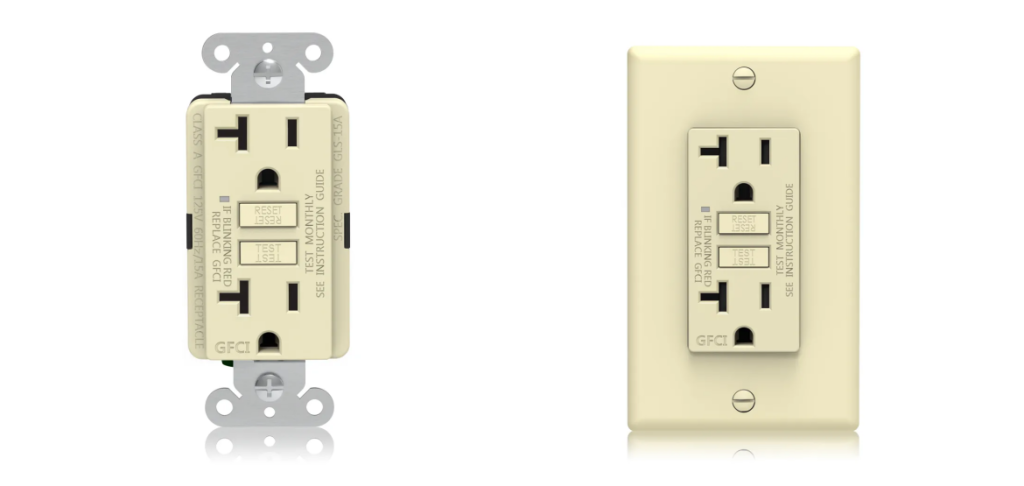
Will Inspectors or AHJs Accept ETL Listed GFCI Outlets?
Many inspectors are familiar with ETL Listed products. Many AHJs accept properly listed ETL products when the certification is valid and the product fits the installation.
But field acceptance is not a promise made by the manufacturer.
It depends on the AHJ, the project documents, and the product markings.
Residential Projects
Residential GFCI outlets are commonly used in bathrooms, kitchens, garages, laundry areas, unfinished basements, outdoor locations, and other areas where ground-fault protection is required.
For a residential installation, the inspector usually looks for a properly listed device, correct wiring, accessible testing, and suitable use for the location.
A typical residential GFCI selection may include:
| Application | Common Buyer Concern | Product Feature to Check |
| Bathroom | Moisture exposure, daily use | Self-test GFCI, clear TEST/RESET function |
| Kitchen countertop | Frequent appliance use | 15A or 20A rating based on circuit design |
| Garage | Tools, chargers, damp conditions | Durable construction, WR where needed |
| Outdoor receptacle | Weather exposure | WR GFCI plus proper weatherproof cover |
| Laundry area | Moisture and appliance load | Correct rating and listed device |
For residential jobs, the difference between UL and ETL is usually less important than the validity of the listing and the suitability of the device.
Commercial Projects
Commercial projects are less forgiving.
A restaurant kitchen, retail store, school, office build-out, warehouse, or hospitality project may have tighter documentation requirements. The general contractor, electrical engineer, owner, or facility manager may request submittals before installation.
For commercial GFCI outlets, buyers should check:
- Product listing mark
- Model number
- Amp rating, such as 15A or 20A
- Voltage rating, commonly 125V for standard North American receptacle applications
- TR or WR marking where required
- Installation instructions
- Datasheet and certification documentation
- Packaging and product body markings
Commercial work is where “the outlet looks the same” becomes a weak argument. Documentation carries weight.
Project Procurement and Bid Requirements
Project procurement adds another layer.
Bid documents may include language such as “UL Listed,” “NRTL Listed,” “Listed and labeled,” or a named approved manufacturer list. These phrases are not always interchangeable.
If the project says NRTL Listed, then ETL may be acceptable if the product is properly listed.
If the project says UL Listed, the buyer should confirm before using ETL.
If the project includes a named brand or approved equal process, certification is only one part of acceptance. The buyer may still need to submit product data, installation instructions, and certification evidence.
For bulk procurement, never rely on a catalog image alone.
Why UL or ETL Listing Matters When Buying GFCI Outlets
A GFCI outlet is a safety device. Listing is not decoration.
For professional buyers, UL or ETL listing affects five areas.
First, it supports safer installations. A GFCI outlet must trip under the right fault conditions, reset correctly, and maintain proper contact performance over time.
Second, it supports inspection. A listed mark gives the inspector a recognized basis for acceptance.
Third, it supports procurement records. Distributors and project buyers often need datasheets, certification documents, product images, and packaging files.
Fourth, it reduces liability exposure. If a non-listed device fails in a rental property, hotel, school, or workplace, the installer and buyer may face questions that go beyond product cost.
Fifth, it protects project schedules. Failed inspections, product substitutions, and missing documentation can delay completion.
A cheap GFCI outlet becomes expensive when it causes a failed inspection.
When Should You Choose UL Listed vs. ETL Listed GFCI Outlets?
The right choice depends on the project, not on a blanket ranking of UL and ETL.
When UL Listed May Be Preferred
Choose or specify UL Listed GFCI outlets when the project clearly asks for UL, or when the channel strongly prefers UL.
This may apply to:
- Projects with “UL Listed” written into the specification
- Retail programs where UL is requested by the buyer
- Institutional projects with conservative compliance review
- Owners or engineers who are not comfortable with substitution
- Markets where UL brand recognition reduces approval friction
If the project requires UL, treat that as a purchasing requirement.
Do not try to solve a specification issue after the product has already arrived on site.
When ETL Listed May Be a Practical Choice
ETL Listed GFCI outlets can be a practical choice when the project accepts NRTL-listed products and the listing is valid.
This can work well for:
- Residential and light commercial projects
- Distributor programs where ETL is already accepted
- OEM or private-label programs with verified certification
- Cost-sensitive projects that still require listed products
- Buyers who can verify the model, standard, and listing status
The right ETL product is not a shortcut around safety. It is another certified route to market.
When You Should Confirm Before Buying
Confirm before buying when:
- The specification says “UL only”
- The buyer requests a specific certification mark
- The AHJ has a history of strict interpretation
- The project is large enough that replacement cost is high
- The product will be used in a special environment
- The certification document does not clearly match the model
For a small repair job, the risk may be limited. For a 500-room hotel, a student housing project, or a national retail rollout, the risk is not small.
Ask early.
How to Verify a UL or ETL Listed GFCI Outlet Before Buying
Verification is simple, but many buyers skip it until there is a problem.
Do it before purchase, especially for bulk orders.
Check the Listing Mark on the Product Body
A listed GFCI outlet should carry clear markings. The listing mark may appear on the device body, packaging, installation sheet, or product label depending on the certification and marking rules.
For professional procurement, do not rely only on a website image.
Ask for clear product photos showing:
- Front face
- Back body markings
- Rating information
- Certification mark
- Wiring labels
- Packaging label
- Installation sheet
If the supplier cannot provide clear marking images, slow down.
Look for the Certification Number or Control Number
A certification number, file number, control number, or report reference helps connect the product to the certification record.
This is where many low-quality suppliers fail. They show a logo but cannot provide traceable information.
A real buyer should ask:
- What is the file number or control number?
- Which company holds the listing?
- Which model numbers are covered?
- Which standard applies?
- Is the factory covered under the certification?
A logo without traceability is weak evidence.
Use UL Product iQ or Intertek Listed Product Directory
UL Listed products can be checked through UL Product iQ.
ETL Listed products can be checked through the Intertek Listed Product Directory.
When checking, match the product carefully. Look at the company name, product category, model number, certification reference, and standard.
Do not assume that one certified model covers every similar-looking model in the same catalog.
Confirm the Exact Model and Certified Scope
This is one of the most common procurement mistakes.
A supplier may have one listed GFCI outlet, while the buyer is purchasing another version with a different face style, rating, feature set, or private-label marking.
Model mismatch can create trouble.
For example:
| Item to Check | Why It Matters |
| Exact model number | Listing may not cover all models in a series |
| Amp rating | 15A and 20A versions may be treated separately |
| TR/WR marking | Required in many applications |
| Self-test function | May be part of the evaluated design |
| Brand or private label | Must match certification rules |
| Factory location | May affect certification coverage |
| Packaging and instructions | Often reviewed as part of compliance |
The safest purchasing path is to match the product, certification, label, and project requirement before shipment.
Request Documents from the Manufacturer
For contractors, distributors, and project buyers, proper documentation is part of the product.
Ask for:
- Datasheet
- Certification document or listing reference
- Installation instructions
- Product marking photos
- Packaging label artwork
- Product series information
- Rated voltage and amperage
- TR, WR, or self-test details
- Available colors and face styles
- Wall plate compatibility
A serious GFCI manufacturer should be able to support these requests.
Why Ongoing Certification Surveillance Matters
Listing is not only a one-time lab test.
Certification programs often include ongoing follow-up, factory inspections, product consistency checks, and component traceability requirements. The goal is to confirm that the product being manufactured still matches the product that was evaluated.
This matters for GFCI outlets because small changes can affect safety.
A change in relay design, contact material, terminal structure, plastic resin, PCB layout, or production site may require review. A manufacturer cannot freely change the internal construction of a listed GFCI and assume the certification still applies.
This is why buyers should avoid suppliers that treat certification as a marketing file rather than a controlled production system.
For a distributor buying 50,000 units per year, ongoing consistency is not a detail. It is the difference between a stable product line and a future recall, delisting, or customer complaint.
A listed product must stay listed.
Key GFCI Features to Check Besides UL or ETL Listing
Certification is the first filter. It is not the whole selection process.
A GFCI outlet still needs to fit the job.
TEST and RESET Function
A GFCI outlet should be tested after installation according to the manufacturer’s instructions.
When the TEST button is pressed, the device should trip and cut power. When the device is functioning correctly and wired properly, the RESET button restores power.
This is basic, but it catches problems in the field.
Incorrect line/load wiring, damaged devices, or failed mechanisms can show up during testing. Contractors should not skip this step just because the outlet is listed.
Self-Test Function
A self-test GFCI outlet automatically monitors its ground-fault protection function. Many modern GFCI receptacles include self-test features because users often forget to manually test devices.
For rental housing, hospitality, assisted living, schools, and commercial spaces, self-test GFCIs reduce dependence on user behavior.
The product still needs proper installation and periodic checking, but self-test adds another layer of protection.
Tamper-Resistant Design
A tamper-resistant GFCI outlet, often marked TR, includes internal shutters that help prevent foreign objects from being inserted into one slot.
TR receptacles are widely used in residential and many commercial applications in North America.
For distributors and retailers, TR is often not optional from a market standpoint. A non-TR device may be harder to sell into common residential channels.
Weather-Resistant Options
A weather-resistant GFCI outlet, often marked WR, is designed with materials suitable for outdoor, damp, or weather-exposed locations when installed with the correct cover and enclosure.
Outdoor applications may include:
- Patios
- Garages
- Balconies
- Pool equipment areas
- Exterior walls
- Service areas
- Outdoor commercial spaces
A WR GFCI is not a substitute for proper weatherproof installation. The cover, box, seal, and installation method still matter.
15A, 20A, and Application Fit
Most North American GFCI receptacle selections involve 15A or 20A, commonly at 125V for standard receptacle applications.
| Rating / Feature | Typical Use | Buyer Check |
| 15A GFCI | General residential branch circuits | Match circuit and code requirements |
| 20A GFCI | Kitchens, commercial areas, higher-load circuits | Confirm receptacle configuration and circuit rating |
| TR GFCI | Residential and public-access spaces | Check tamper-resistant marking |
| WR GFCI | Outdoor or damp locations | Use with proper cover and enclosure |
| Self-test GFCI | Modern residential and commercial projects | Confirm indicator behavior and instructions |
The correct product is not only listed. It is rated, marked, and built for the location where it will be installed.
Commercial Grade and Batch Consistency
For contractors and project buyers, installation feel matters.
A commercial-grade GFCI outlet should offer stable terminal strength, clear wiring layout, consistent screw quality, reliable reset feel, and packaging that supports jobsite handling.
When a project uses hundreds or thousands of outlets, small issues become large ones:
- Screws stripping during installation
- Inconsistent face color across batches
- Weak terminal grip
- Poor back-body markings
- Missing installation sheets
- Packaging damage during transport
- Model numbers not matching submittals
Batch consistency is part of professional product quality.
The Risks of Using Non-Listed or Unverified GFCI Outlets
Non-listed or unverifiable GFCI outlets are not worth the risk in professional work.
The risk is not only electrical shock. It also includes failed inspections, project delays, product returns, liability claims, and damage to contractor reputation.
Common warning signs include:
- Certification logo shown only on website images
- No file number or control number
- Listing cannot be found in official databases
- Product body has no clear marking
- Supplier refuses to provide documents
- Model number on certificate does not match purchased product
- Packaging claims do not match device markings
- Price is far below normal market range without explanation
A GFCI outlet is installed inside a wall system and often used near water, appliances, tools, or outdoor equipment. If it fails, the cost of replacement is not just the device price. Labor, inspection, delay, and responsibility all come into play.
Cheap becomes expensive quickly.
Common Mistakes When Comparing UL and ETL Listed GFCI Outlets
Assuming ETL Means Lower Quality
ETL does not automatically mean lower quality.
A properly listed ETL GFCI outlet can be tested to applicable safety standards and accepted in many professional applications. Product quality depends on design, materials, manufacturing control, certification scope, and supplier discipline.
A weak product with a familiar logo is still a weak product.
Assuming UL Is Always Required
UL is highly recognized, but it is not always the only acceptable certification mark.
If the project accepts NRTL-listed products, ETL may be acceptable. If the project says UL only, that is different.
Read the specification. Then verify.
Checking the Logo but Not the Listing Status
A certification logo is not enough.
The buyer needs to confirm the listing status, model number, manufacturer, product category, and applicable standard. Old certificates, copied logos, and incomplete documents create real procurement risk.
Ignoring Project Specifications and AHJ Requirements
The AHJ has the final say in many field situations. Project specifications may also be stricter than baseline code requirements.
If the product is going into a school, hotel, hospital-adjacent facility, public project, commercial kitchen, or large housing development, check the requirement before buying.
Choosing Based Only on Certification Cost
Manufacturers may experience different certification costs and timelines with UL and ETL. Those numbers vary by product category, test scope, documentation, corrective actions, and factory setup.
Buyers should not reduce the decision to certification cost.
For buyers, the better filters are:
- Is the listing valid?
- Does it cover the exact model?
- Does the project accept it?
- Is the product built consistently?
- Can the supplier provide documentation?
- Will the device perform reliably in the intended installation?
That is the decision path that protects the project.
FAQ
Is ETL Listed the Same as UL Listed?
No. ETL Listed and UL Listed are different certification marks issued by different organizations.
But both can indicate third-party safety certification when the product is properly listed to the applicable standard and the listing is valid.
Are ETL Listed GFCI Outlets Safe?
ETL Listed GFCI outlets can be safe when they are properly certified, traceable, and manufactured under the certified design and quality controls.
The buyer should verify the listing, model number, and applicable standard before purchasing.
Do Electrical Inspectors Accept ETL Listed Outlets?
Many inspectors and AHJs accept ETL Listed outlets when the listing is valid and the product meets project requirements.
Final acceptance depends on the AHJ and project documents. If the specification says UL only, confirm before using ETL as a substitute.
How Can I Verify If a GFCI Outlet Is Really Listed?
Check the product marking, certification number, model number, and manufacturer documentation.
UL Listed products can be checked through UL Product iQ. ETL Listed products can be checked through Intertek’s Listed Product Directory.
Match the exact model, not just the product family.
Should Contractors Choose UL or ETL Listed GFCI Outlets?
Contractors should choose GFCI outlets that are properly listed, accepted by the project, clearly marked, supported with documentation, and suitable for the installation environment.
If the project requires UL, choose UL or get approval. If the project accepts NRTL-listed products, ETL can be a valid option.
What Happens If a GFCI Outlet Is Not Listed?
A non-listed or unverifiable GFCI outlet can create safety risk, inspection problems, project delays, product returns, and liability exposure.
For professional electrical work, unverified GFCI outlets should be avoided.
Final Thoughts: The Right GFCI Choice Is About Compliance, Traceability, and Trust
UL Listed and ETL Listed GFCI outlets are not separated by a simple “good vs. bad” line.
UL is more familiar in many North American channels. ETL is also a recognized certification mark when properly issued and verified. The right choice depends on the project specification, AHJ acceptance, certification scope, product quality, and supplier support.
For contractors and project buyers, the safest decision is to choose GFCI outlets that are listed, traceable, properly documented, and built by a manufacturer that understands North American electrical requirements.
Looking for UL/ETL certified GFCI outlets for the American market?
Contact Faith Electric for GFCI, AFCI, USB receptacles, standard receptacles, switches, and wall plates designed for contractors, distributors, and project buyers.