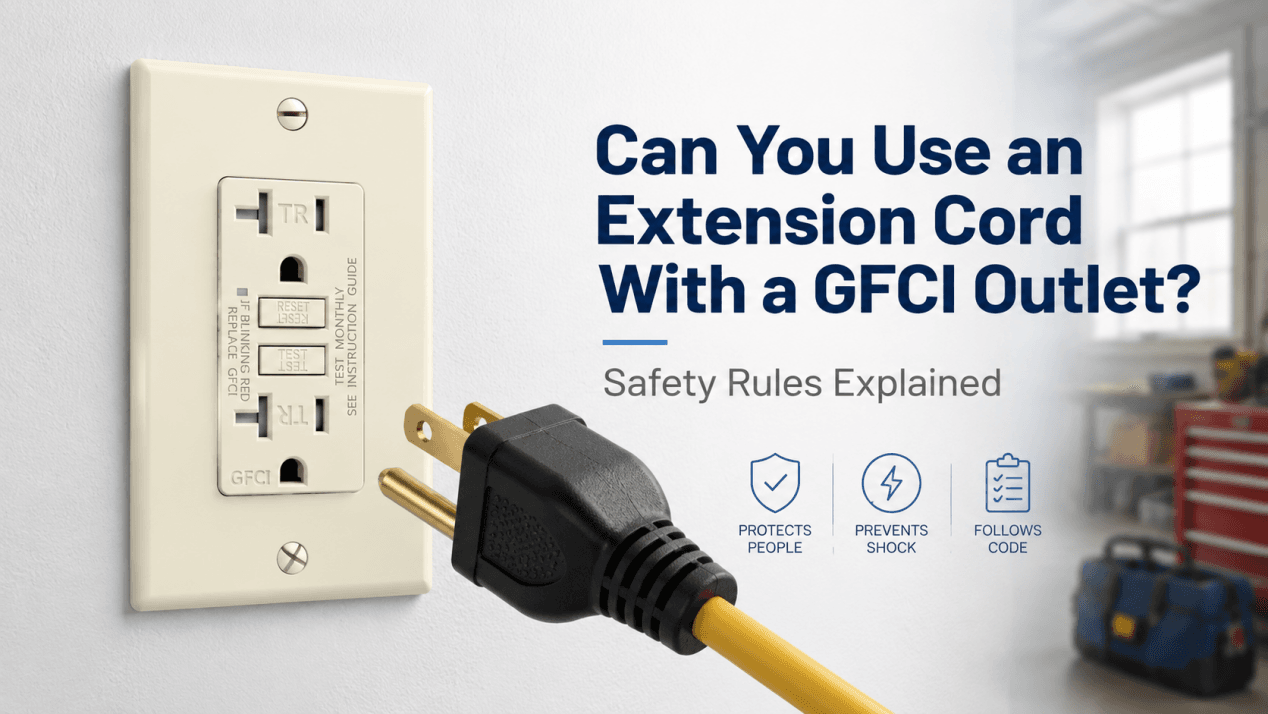
Bathroom outlets handle wet environments and high-draw appliances like hair dryers. People often ask: do I need a 15-amp or 20-amp GFCI?
The short answer: Most bathrooms use 15-amp GFCI outlets, even on a 20-amp circuit. This is code-compliant and practical for typical loads. Use a 20-amp GFCI only when you have high-power needs or want the T-slot for future-proofing. Always match the outlet to the circuit breaker rating—never install a 20-amp GFCI on a 15-amp circuit.
NEC Requirements for Bathroom Circuits and GFCI
NEC 210.11(C)(3) requires at least one (or more) 120-volt, 20-amp branch circuit to supply bathroom receptacle outlets required by 210.52(D)—mainly countertop and work surface outlets. This circuit uses #12 AWG wire and a 20-amp breaker. It supplies countertop receptacles in one or multiple bathrooms, but no other outlets or loads (with a limited exception for a single-bathroom setup that allows lighting/fan if loads stay within rules).
NEC 210.8(A)(1) mandates GFCI protection for all 125-volt, 15-amp or 20-amp receptacles in bathrooms. This covers every outlet, near sinks, tubs, or showers. Bathroom exhaust fan internal receptacles are exempt unless the manufacturer requires it (2023 update).
Placement rule: At least one receptacle within 36 inches of each sink basin edge. All receptacles must be tamper-resistant (TR). Weather-resistant (WR) models are recommended for humidity.
The 20-amp circuit rule exists because hair dryers and similar tools pull 12–15 amps. A 15-amp circuit would overload easily. But the code does not force 20-amp rated outlets—only the circuit.
Most bathrooms run fine with 15-amp GFCIs on that 20-amp circuit.
15A vs 20A GFCI Outlets: Key Differences
Here is the direct comparison.
| Feature | 15-Amp GFCI Outlet | 20-Amp GFCI Outlet |
| Slot Configuration | Two parallel vertical slots + round ground | One vertical + one T-shaped horizontal slot + round ground |
| Circuit Compatibility | Works on 15A or 20A circuits (feed-through rated 20A) | Must be on 20A circuit only (#12 wire, 20A breaker) |
| Max Continuous Load (approx.) | 12 amps / ~1440 watts at 120V | 16 amps / ~1920 watts at 120V |
| Typical Bathroom Use | Standard homes, single hair dryer or shaver | Master baths with multiple high-draw tools running at once |
| NEC Allowance on 20A Circuit | Yes – permitted for multi-receptacle setups (Table 210.21(B)(3)) | Yes – required if you install a 20A outlet |
| Common Choice | Used in most residential bathrooms | Less common unless specific high-load plan |
A 15-amp GFCI on a 20-amp circuit is safe and allowed. The outlet’s feed-through supports the full 20 amps downstream. A duplex counts as multiple receptacles, so no issue. But a 20-amp GFCI on a 15-amp circuit violates code—wiring (#14 AWG) can’t handle sustained 16–20 amps without risk.
In practice, few bathroom appliances need the T-slot. Standard hair dryers top out at 1875 watts (about 15.6 amps), and continuous load rules keep things under 12 amps per outlet most times.
How to Choose the Right Amp Rating for Your Bathroom
Follow these steps.
- Open the panel and find the breaker for the bathroom outlets. Note if it’s labeled 15A or 20A.
- Check wire gauge if possible—#14 AWG = 15A circuit; #12 AWG = 20A.
- Look at existing outlets. T-slot means 20A rating.
- Think about your appliances. One 1500W hair dryer? 15A is plenty. Multiple tools plus heater? Consider 20A for headroom.
Recommendation: Go with a 15-amp GFCI for replacement or standard installs. It meets code on a 20-amp circuit, handles typical bathroom loads, costs less, and avoids unnecessary tripping from minor overloads. Choose 20-amp GFCI only if the circuit is 20A and you plan heavy simultaneous use or want T-slot compatibility.
Always use UL or ETL listed products. Faith Electric’s UL/ETL certified GFCI line covers both ratings with solid feed-through performance.
Installation and Safety Tips
Install GFCI at the first outlet in the chain or use a GFCI breaker for whole-circuit protection. GFCI receptacle is usually simpler and cheaper for bathrooms.
Basic steps (power off first, verify with tester):
- Remove old outlet.
- Connect LINE terminals (incoming power: black to brass, white to silver).
- Connect LOAD if protecting downstream outlets.
- Ground to green screw.
- Mount and test—press TEST (should trip), then RESET.
Test monthly. If it won’t reset or trips often, check for moisture, bad appliance, or wiring fault. Call a licensed electrician for persistent issues or if you’re unsure about the circuit.
Common mistakes: Mixing LINE/LOAD wires (downstream loses protection), installing 20A on 15A circuit (fire risk), skipping monthly tests, placing too close to water spray.
Final Thoughts
For most bathrooms, a 15-amp GFCI outlet on the required 20-amp circuit gives reliable protection without complications. It follows NEC 2023, handles everyday grooming loads, and keeps things simple.
If your setup has high demands, step up to 20-amp. Either way, match the circuit, use certified products, and test regularly.
Faith Electric builds UL/ETL listed GFCI outlets for North American contractors and builders—15A and 20A options, WR versions, plus full wall solutions like USB combos, switches, and plates. Contact us for bulk specs or samples. Drop a comment if your bathroom circuit is 15A or 20A—we can help confirm the right fit.



![GFCI Outlet Requirements for U.S. Construction Projects [2026 Guide]](https://www.faithelectricm.com/wp-content/uploads/2026/06/图片10-1.png)