
Quick Takeaways:
- The Core Function: Monitors electrical current balance to prevent electrocution.
- The Requirement: Mandatory in all “wet locations” (NEC Code 210.8).
- The Faith Advantage: We are one of only two U.S. companies with GFCI patents and an active seat on the UL Committee, ensuring our devices reduce false tripping and exceed safety standards.
(Introduction)
Electricity powers our world, but it demands respect. For electrical distributors, contractors, and OEMs, a GFCI (Ground Fault Circuit Interrupter) is not just a commodity item on a shelf—it is a critical life-saving device that protects you from liability.
While many brands produce GFCIs, few understand the engineering behind them. At Faith Electric, we don’t just follow the safety codes; as members of the UL Standards Committee, we help write them.
Here is everything you need to know about GFCI technology, optimized for professional safety and reliability.
1. The Anatomy of Safety: Understanding Your GFCI Interface
Most people interact with GFCI outlets daily in kitchens and bathrooms, but few understand the interface. A GFCI is more than a receptacle; it is a mini-computer monitoring your safety.
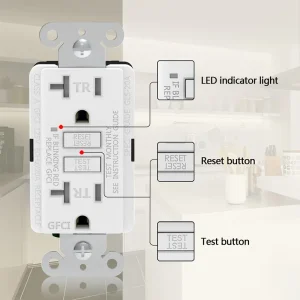
- Caption: Figure 1: The user interface of a patented Faith Electric self-testing GFCI.
The Interface Decoded:
- TEST Button: The only way to verify protection. Pressing this simulates a ground fault. If the button doesn’t pop out, the device is defective.
- RESET Button: Restores power after a test or a trip.
- LED Indicator: This is your “health check.”
- Solid Green: Power is on, device is safe.
- Solid Red / No Light: The device has reached its end-of-life or is miswired.
2. The Science of Survival: How GFCI Technology Works
In a standard electrical circuit, the current flowing out to an appliance (via the hot wire) should exactly match the current coming back (via the neutral wire).
If the current leaks—even by a tiny amount (4 to 6 milliamps)—it means electricity is escaping, potentially through water or a human body. This is a Ground Fault.
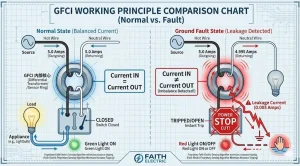
Caption: Figure 2: Faith Electric GFCIs react within milliseconds to cut power when leakage is detected.
The “Faith” Patent Advantage: Solving Nuisance Tripping
One of the biggest complaints from electricians is **”Nuisance Tripping”**—when a GFCI cuts power unnecessarily due to electrical noise from treadmills, fluorescent lights, or refrigerators.
Most generic GFCIs cannot tell the difference between “noise” and “danger.” Faith Electric holds specific US patents on detection algorithms that filter out this harmless noise. This means our GFCIs stay on when they should, and trip only when they must.
3. Installation Logic: Line vs. Load
A critical mistake in installation can render a GFCI useless. For B2B buyers stocking these items, educating your customers on proper installation reduces returns and complaints.
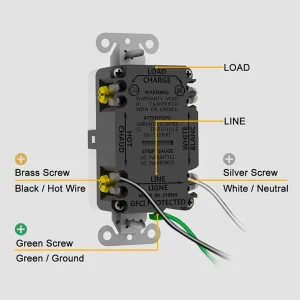
- Image Alt Text: Correct GFCI wiring diagram showing Line vs Load connections to ensure safety.
- Caption: Figure 3: Never reverse the Line and Load connections.
- LINE (Power In): Connected to the main service panel.
- LOAD (Power Out): Feeds protection to other standard outlets downstream.
- Safety Feature: Faith Electric GFCIs feature a Miswire Lockout. If the line/load is reversed during installation, the device will simply refuse to reset, forcing the installer to fix it immediately.
4. Generic vs. Patented: Why Specification Matters
Why should a wholesaler or OEM choose Faith Electric over a generic “white label” brand? The difference lies in the Self-Test capabilities mandated by the latest UL 943 standard.
| Feature | Generic / Standard GFCI | Faith Electric (Patented) | |||
|---|---|---|---|---|---|
| Self-Testing Frequency | Minimal Requirement | Optimized Periodic Testing(Patented) | |||
| False Tripping | Common with motors/appliances | Minimizedvia noise-filtering technology | |||
| Authority | Follows the rules | UL Committee Member(Helps write the rules) | |||
| Design Profile | Bulky, hard to fit in box | Slim Designfor easy installation |
5. Where is GFCI Mandatory? (NEC Code Reference)
According to the **National Electrical Code (NEC)**, GFCIs are non-negotiable in areas where electricity and water might meet. Compliance is key for all construction projects.
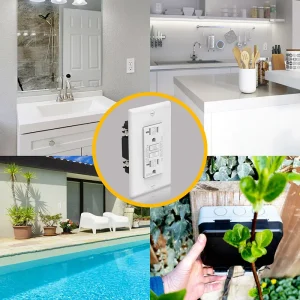
- Caption: Figure 4: Essential GFCI locations mandated by NEC Article 210.8.
Key Mandated Areas:
- Residential: Kitchen countertops, bathrooms, laundry areas, garages, basements, and outdoors.
- Commercial: Hotel bathrooms, rooftop maintenance outlets, and commercial kitchens.
- Industrial: High-current GFCIs are required for specific machinery to protect workers.
Frequently Asked Questions (FAQ)
Q: What is the difference between GFCI and GFI?
A: There is no technical difference. GFI (Ground Fault Interrupter) is simply an older or shorthand term for GFCI (Ground Fault Circuit Interrupter). Both refer to the same life-saving device.
Q: Why is my GFCI blinking red?
A: A blinking red light typically indicates the device has failed its internal Self-Test and is no longer providing protection. It must be replaced immediately. Faith Electric GFCIs automatically alert you to this end-of-life status.
Q: Can I use a GFCI outlet without a ground wire?
A: Yes. The NEC allows a GFCI to be installed in an ungrounded outlet box (common in older homes) to provide shock protection. However, the package must be labeled “No Equipment Ground.”
(Call to Action)
Ready to Upgrade Your Inventory?
Safety is not a place for compromise. Partner with a manufacturer that owns the technology.
Explore Faith Electric’s GFCI Catalog or Contact Our US Sales Team:[email protected] for wholesale pricing and OEM opportunities.


![GFCI Outlet Requirements for U.S. Construction Projects [2026 Guide]](https://www.faithelectricm.com/wp-content/uploads/2026/06/图片10-1.png)

.jpg)